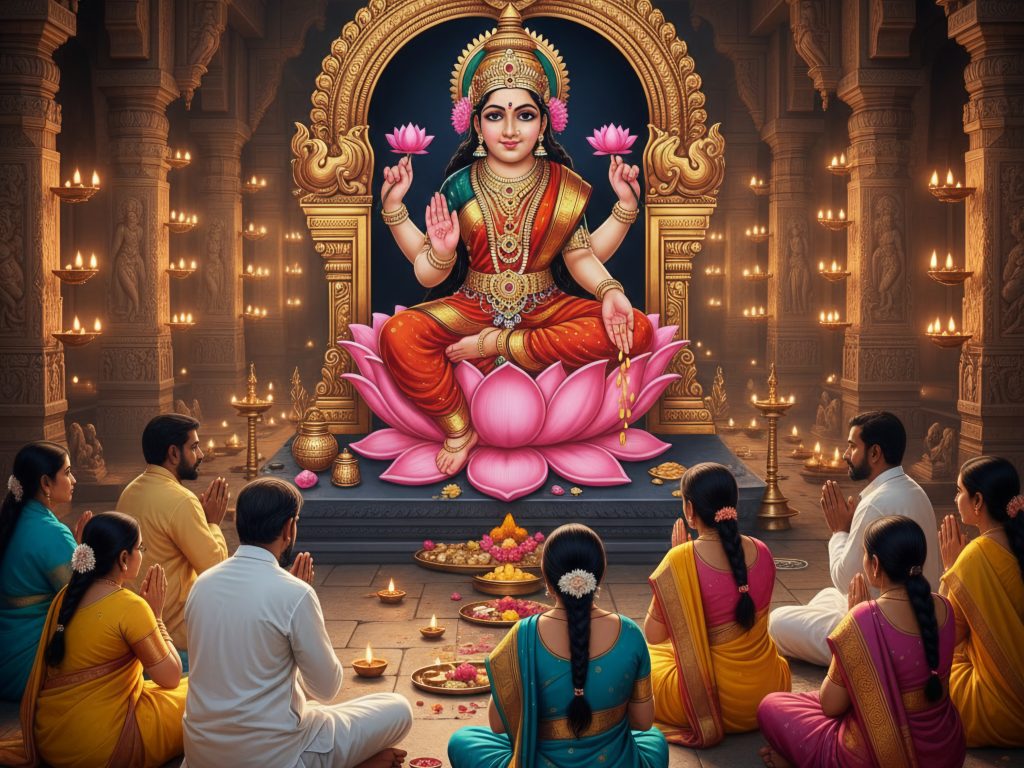
Day 3: Unlocking the Divine Key – The Kilakam Stotram
Namaste, and welcome to the third day of our Navaratri blog series. As we stand on the threshold of the nine nights of devotion, commencing tomorrow, we prepare to unlock the immense power of the divine feminine. Following our previous posts on the Devi Kavacham and Argala Stotram, today we delve into the Kilakam Stotram, the divine “key” that unlocks the full spiritual potential of the Devi Mahatmyam.
This stotram, or hymn, is not just a prayer; it is a profound guide given by Lord Shiva himself to ensure that the recitation of the sacred Devi Mahatmyam yields its complete and intended fruit. Without this key, the immense energy of the mantras remains “pinned” or “locked.” The Kilakam Stotram is the final piece of the preparatory trilogy, ensuring that our devotion is not only protected and fortified but also fully activated.
The Kilakam Stotram
Part 1: The Divine Key (Verses 1-7)
The first seven verses of the Kilakam Stotram set the stage for our spiritual journey. They begin by invoking the pure, knowledge-filled form of Devi, and then directly address the central purpose of the hymn: to unpin the mantras of the Devi Mahatmyam.
Verse 1: We begin with a salutation to the one whose form is pure knowledge, the essence of the three Vedas, and the one who bestows the ultimate good. This verse establishes the divine nature of the force we are seeking to connect with.
Verse 2-4: These verses reveal the core secret of the Kilakam. Lord Shiva explains that without unpinning the mantras, no ritual or spell can be perfected. He asserts that a devotee who understands and performs this “unpinning” will attain well-being and success. It is a direct statement that mere recitation is not enough; one must engage with the text with the right intent and the proper method, which this stotram provides.
Verse 5-7: Here, the mystery deepens. It is revealed that Lord Shiva himself “locked” the Chandika Stotram (another name for Devi Mahatmyam) to prevent its misuse by the unworthy. The key, the Kilakam, was bestowed only upon the most deserving devotees, ensuring that the immense power of the text is accessed with pure intention and true devotion. This speaks to the principle that divine power is a privilege, not a right, and requires genuine effort and reverence to access.
Part 2: The Fruits of Devotion (Verses 8-15)
The final section of the Kilakam Stotram is the Phala Sruti, the part that details the auspicious benefits of reciting the text with the divine key. It is a powerful affirmation of the transformative potential of this practice.
Verse 8-11: These verses promise extraordinary results to the devotee who correctly performs the Kilakam. They state that such a person will attain perfection (siddha), become an attendant of the goddess, and even a divine musician (gandharva). The devotee is promised freedom from fear, immunity to untimely death, and the ultimate liberation (moksha) after death. This is a direct promise of spiritual ascension and complete freedom from worldly bondage.
Verse 12-14: The benefits extend to all aspects of life. The stotram declares that all good fortune and prosperity, particularly that seen in women, is a result of the goddess’s grace. It promises that the continuous chanting of this stotram leads to immense wealth and prosperity, along with health, the destruction of enemies, and the supreme liberation. It asks, “Why would anyone not praise her?”—a powerful rhetorical question that encourages deep contemplation.
Verse 15: This concluding verse summarizes the entire essence of the practice. It promises that whoever remembers Chandika Devi in their heart will have their heartfelt desires fulfilled, for the goddess will forever reside in their heart.
Reflection & Practical Application
The Kilakam Stotram teaches us a crucial lesson: the power of a spiritual practice is not in its mechanics, but in its profound meaning and sincere application. The goddess’s power is “locked” for those who approach it with a superficial or selfish mindset. This hymn is a metaphor for our own inner work.
Reflection: Think of the Kilakam as your sincere intention. What are you seeking from this journey? Is it just for a list of benefits, or is it for a genuine, transformative connection with the divine? The true power of any spiritual practice is unlocked when we approach it with a pure heart, a focused mind, and a sense of reverence.
Practical Application: As you begin your Navaratri journey from tomorrow and recite the first chapter of Devi Mahatmyam, remember the lesson of the Kilakam. Cultivate a mindset of profound respect and genuine devotion. Before you begin your recitation, take a moment to set a clear intention. This is your personal “unpinning” of the divine energy. Let your recitation be a key that unlocks your own inner potential, not just a series of words.
Closing Thoughts
With the commencement of Devi Navaratri tomorrow, we have now laid the foundation for a truly powerful and transformative nine nights. We have wrapped ourselves in the divine shield of the Kavacham, prepared our path with the Argala, and now, with the Kilakam, we hold the key to unlock the ultimate potential of our devotion.
May the divine grace of Saraswati, Lakshmi, and Durga be with you. Get ready for our next post, which will be a deep dive into the first chapter of Devi Mahatmyam and the worship of Devi as Shailaputri.
References
Vaidika Vignanam. (n.d.). Devi Mahatmyam Keelaka Stotram. This online resource provides the full Sanskrit text of the Kilakam Stotram with transliteration, which is essential for accurate recitation and understanding.
Devi’s Grace – Day 2: The Empowering Link – The Argala Stotram
If the Devi Kavacham is the shield that protects you from the world, the Argala Stotram is the cosmic key that unlocks the doors to your divine destiny. Within the powerful sequence of the Devi Mahatmyam, the Argala Stotram is a vibrant, direct, and purposeful hymn. It is not a passive prayer but a dynamic call to the universe, asking for every form of victory and blessing.
In a world that often teaches us to strive and struggle for what we want, the Argala Stotram offers an ancient and graceful alternative: a sacred method to petition the Divine Mother for the blessings we seek. It reminds us that true abundance is a state of being we can cultivate, not just an external reward we must earn.
Join us as we explore how this timeless hymn can become your personal key to unlocking not only fame, fortune, and prosperity, but also the inner confidence and clarity needed to fulfill your life’s highest purpose.
The Argala Stotram
The Argala Stotram, a key component of the Devi Mahatmyam recitation, is a powerful hymn of prayer and surrender. Unlike the Devi Kavacham, which is a conversation between Brahma and Markandeya, the Argala Stotram is a direct instruction from Rishi Markandeya to his disciples, explaining the powerful prayer to the Divine Mother. Its name, “Argala,” means a bolt or a latch, symbolizing how the stotram serves as the key to unlock the blessings of the Goddess.
The hymn is a direct and forceful appeal that invokes various forms of the Devi for specific blessings, and it can be grouped into three parts:
Praise and Invocation (Verses 1-5): The stotram begins with a glorious eulogy to the Goddess. It establishes the prayer’s purpose by invoking the divine grace of Ambika, Mahalakshmi, Mahakali, and Mahasaraswati. It is a recognition that all victory, fame, and auspiciousness stem from these supreme forms of the Divine Mother.
The Prayer for Victory and Blessings (Verses 6-18): This is the heart of the stotram, with each verse beginning or ending with the powerful plea, “Jayam dehi,” which means “Grant me victory.” The prayers are directed to various forms of the Devi for specific blessings. The devotee calls upon Gauri for a good partner, and seeks the removal of all forms of suffering and evil. The stotram repeatedly invokes Narayani as the source of all desires and prosperity. The prayers for the destruction of enemies are aimed at inner flaws, such as the ego, anger, and greed, which are represented as demons.
Concluding Salutations (Verses 19-26): The final verses offer salutations to the Goddess in her numerous forms and reaffirm the immense benefits of reciting this hymn. The devotee offers praise to Chamunda, Indrani, Sarvamangala, and Shiva, acknowledging their power and grace. The stotram concludes by promising that those who chant it with devotion will attain not just material wealth and happiness, but also ultimate liberation and spiritual enlightenment.
Application to Modern Life
The Argala Stotram is a timeless guide for navigating the complexities of modern life. In a world of endless pursuits and distractions, the stotram’s central message—**”Jayam dehi”—**serves as a powerful mantra for our daily struggles.
Think of the stotram as a key to unlocking your own potential. The “enemies” you are praying to conquer are not external forces, but the inner demons that plague us all: self-doubt, anxiety, procrastination, and comparison. Each time you ask the Goddess to “grant me victory,” you are setting a powerful intention to overcome these modern-day tyrants. The prayer for a good partner is a call for a meaningful, supportive relationship; the request for fame is a desire for positive recognition for your authentic work; and the plea for prosperity is a wish for abundance that allows you to live a life of purpose.
Chanting the Argala Stotram is a practice in intentional living. It shifts your focus from what you lack to a profound sense of trust in a higher power. By using this sacred hymn, you are not just asking for a better life; you are actively aligning your energy with the divine, transforming your inner landscape so that you can become a channel for grace and victory in all that you do.
Closing Thoughts: You Hold the Cosmic Key
As we conclude our journey through the Argala Stotram, remember its most profound lesson: the power to unlock your divine destiny lies within your hands. This stotram is more than a prayer; it is a sacred technology for intentional living. It shifts your focus from passive wishing to active, conscious alignment with the universe.
By chanting its powerful verses, you are not simply asking for things—you are embodying the very energy of victory, prosperity, and courage. You are turning the key in the cosmic lock, releasing your life’s fullest potential.
This understanding aligns beautifully with the teachings of Bhagawan Baba, who explains the mind’s function as a key to either liberation or bondage. As He states, “If you turn the key to the right, it unlocks,” leading to freedom by turning towards God and righteousness. The Argala Stotram is that very act of turning the key inward, providing a sacred framework to shift our focus from external desires to an inner quest for divine grace, transforming our state of mind from one of bondage to one of profound liberation.
References
Here are the verified online links that serve as a reference for the Argala Stotram and the teachings of Bhagawan Baba referenced in this post.
Devi’s Grace – Day 1: Building Your Inner Sanctuary (Devi Kavacham)
Introduction to the Series
As the sacred tide of Navaratri rises, we begin a 12-day journey through the Devi Mahatmyam—not merely as scripture, but as a mirror to our inner landscape. Each day, we’ll walk with a form of the Goddess, reflect on Her stories, and uncover the demons within that She helps us conquer. This series is designed to be immersive, symbolic, and spiritually nourishing—blending tradition with modern clarity.
Why Navaratri and Devi Mahatmyam Matter
Navaratri is not just a festival—it’s a spiritual reset. The Devi Mahatmyam (Durga Saptashati) is its heart: a cosmic drama of divine intervention, where the Goddess slays the forces of ego, desire, and delusion. These aren’t just mythic demons—they’re the subtle tyrants within us. Through Her stories, we learn to invoke courage, clarity, and compassion.
Roadmap for the Navaratri BlogSeries
Each day will begin with a short meditation on the Devi of the Day, followed by chapter summaries, highlighted verses, and practical insights. Here’s a detailed look:
The Devi Kavacham, a powerful hymn from the Markandeya Purana, serves as a divine protective shield (kavacham) that invokes the various forms of the Divine Mother, Devi. This comprehensive spiritual armor is designed to safeguard the devotee’s body, mind, and spirit from all forms of adversity. The spiritual essence of the hymn is the profound realization that this protection is not merely physical, but a metaphysical process of aligning one’s consciousness with divine energy, thereby becoming invincible to negative influences. Chanting this hymn is believed to purify the mind, dispel fear, and awaken one’s inner divine potential.
The first twelve verses of the Devi Kavacham lay the foundation for this spiritual armor. They begin with a conversation between Markandeya and Brahma, followed by an invocation of the Nava Durgas, namely Shailaputri, Brahmacharini, Chandraghanta, Kushmanda, Skandamata, Katyayani, Kalaratri, Mahagauri, and Siddhidatri. Other powerful forms of the Goddess like Chamunda, Varahi, Aindri, Vaishnavi, Narasimhi, Shivaduti, Maheshvari, Kaumari, Lakshmi, Ishvari, and Brahmi are also invoked. These verses establish a protective perimeter, invoking the divine energies to guard the devotee from all external threats and dangers, whether from enemies, fire, or calamities. The spiritual meaning of this section is a call to establish unwavering faith and surrender to the Divine Mother, recognizing her omnipresence and omnipotence as the ultimate source of protection.
The next twelve verses (13-24) continue the detailed assignment of divine guardians to specific body parts. These verses invoke forms of the Goddess to protect the different directions and then various parts of the body, including Jaya and Vijaya for the front and back, Ajita and Aparajita for the sides, and Dyotini for the topknot. The goddesses Uma, Maladhani, Yasasvini, Citranetra, Yamaghanta, Trinetra, Candika, Sankhini, Dvaravasini, Kalika, Sankari, and Sugandha are called upon to protect the head, face, and senses. This meticulous assignment underscores the all-encompassing nature of the divine shield. Spiritually, this section teaches the devotee to honor and sanctify their own body as a sacred vessel. By inviting the divine to reside within and protect each part, the practice fosters a deep sense of self-respect and awareness, transforming the body into a living temple.
Verses 25 to 36 extend the protective shield to the inner faculties and subtle body. Goddesses are invoked to guard the tongue, mind, heart, and internal organs. Specific forms mentioned include Caracika, Amritabala, Sarasvati, Kaumari, Candika, Citraghanta, Mahamaya, Karnaksi, Sarvamangala, Bhadrakali, Dhanurdhari, Nilagriva, Nalakubari, Khadgini, Vajradharini, Dandini, Ambika, Sulesvari, Kulesvari, Mahadevi, Manahshokavinashini, Lalita, Suladharini, Kamini, Guhyesvari, Putana, Kamika, Mahishavahini, and Bhagavati. This part of the hymn focuses on protecting our perceptions, thoughts, and emotions. The spiritual lesson here is the importance of cultivating a purified inner world. It’s a plea to the Divine Mother to guard our senses from seeing and hearing negativity and to protect our mind from destructive thoughts. This practice encourages a form of conscious living where our internal state is as protected and cared for as our external environment.
The final verses (37-60) provide an exhaustive list of protections for the entire being, including the life force (prana), dharma, fame, and even future progeny. The hymn concludes with powerful affirmations, stating that a devotee who chants the Kavacham becomes untouched by disease, fear, and sorrow. Devis mentioned include Vajrahasta, Yogini, Narayani, Varahi, Vaishnavi, Cakrini, Indrani, Candika, Jayanti, Papanaasini, and Mahadevi. The ultimate spiritual meaning is the realization that the Kavacham is a holistic path to liberation. It is not just a shield against external threats but a means to dissolve internal obstacles and karma, leading the devotee to an eternal state of peace and union with the divine, a state that is difficult for even the gods to attain.
Application to Modern Life
The Devi Kavacham, when viewed through the lens of ‘Transcendental Blogging’ or ‘Inspirational Blogging with a Purpose,’ offers timeless wisdom for modern challenges.
In an age of constant connectivity and information overload, the Devi Kavacham serves as a powerful metaphor for creating psychological and emotional boundaries. The hymn’s structure of assigning a specific goddess to protect a particular part of the body can be seen as a framework for a mindful self-care routine. Just as the verses invoke divine protection for the eyes and ears, we can consciously guard our minds from the negativity of social media, news, and toxic relationships. This isn’t about isolation but about intentional living—choosing what we consume mentally and emotionally to build a resilient and positive inner world. This practice helps to reduce stress and anxiety, creating a personal ‘force field’ against the pressures of modern life.
The Kavacham’s emphasis on protecting not just the body but also one’s karma, dharma, and life’s journey provides a blueprint for a purposeful life. In a society that often prioritizes material success over spiritual well-being, this ancient wisdom reminds us that true protection and success come from living in alignment with our values. Protecting our “dharma” (purpose) means making choices that are morally and ethically sound, while protecting our “kirti” (fame) and “lakshmi” (prosperity) signifies the cultivation of a good reputation and authentic wealth that are rooted in integrity. By applying these principles, we can navigate the complexities of modern life with a strong sense of purpose, integrity, and inner peace, transforming our existence from a mere struggle for survival to an intentional and spiritually rich journey.
Closing Thoughts: Donning Your Spiritual Armor
The Devi Kavacham is far more than an ancient prayer; it is a timeless manual for conscious living. In a world that often feels chaotic and overwhelming, this hymn offers us a profound truth: our greatest protection lies not in external circumstances, but in the unwavering strength of our inner world.
By embracing the practice of the Devi Kavacham, we are not simply reciting verses—we are actively building our spiritual armor, piece by piece. We are sealing our hearts against fear, guarding our minds from doubt, and shielding our souls from the relentless pressures of modern life. It is an act of proactive self-care, a daily ritual that reminds us that we are empowered, protected, and guided by a force far greater than ourselves.
Let this Kavacham be your daily reminder that the universe has your back. Don your divine armor, step out with confidence, and move through the world not with fear, but with the radiant grace and courage of Devi herself.
In our continuing journey through the Sri Rudram Namakam, we now enter deeper into the first Anuvaka with two mantras that beautifully expand the vision of Rudra. If last week’s verses reminded us of Rudra’s cosmic majesty and nearness, these two mantras reveal him in more vivid, personal, and inclusive terms.
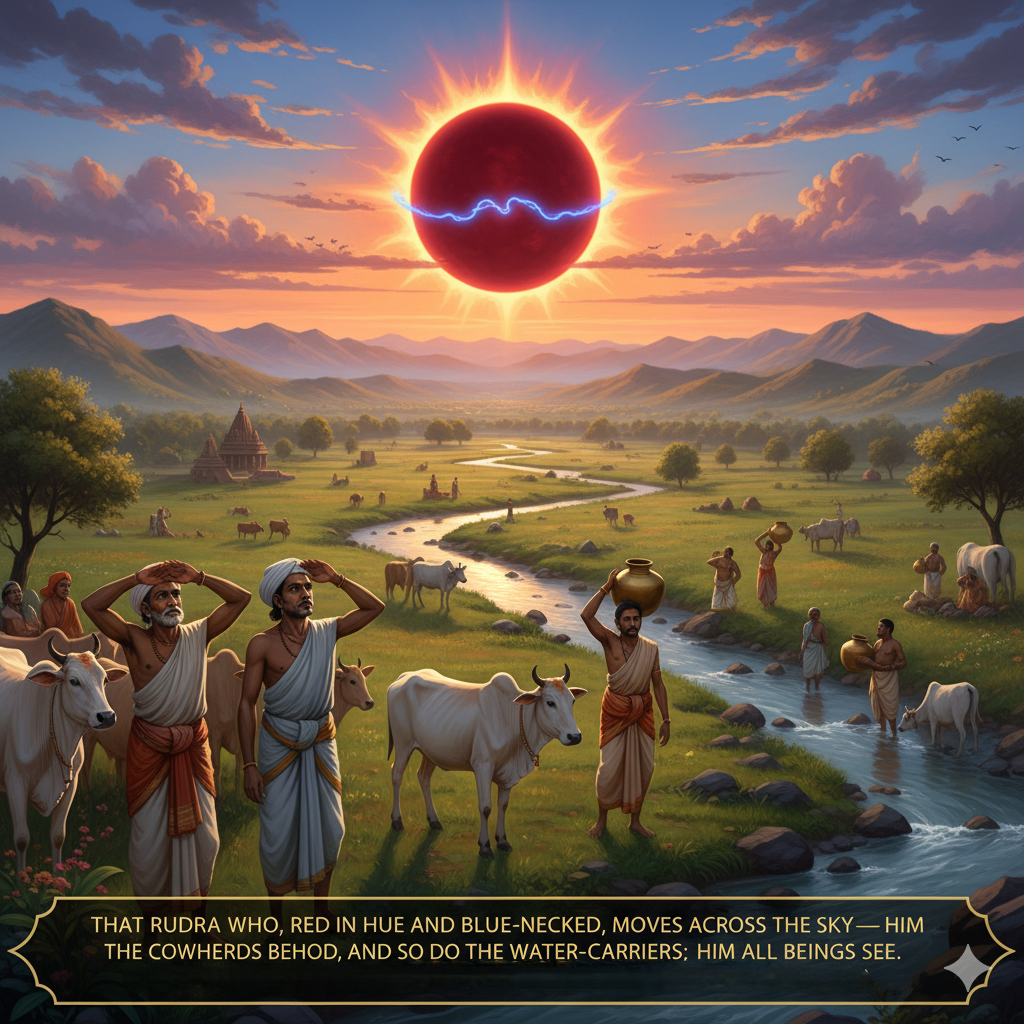
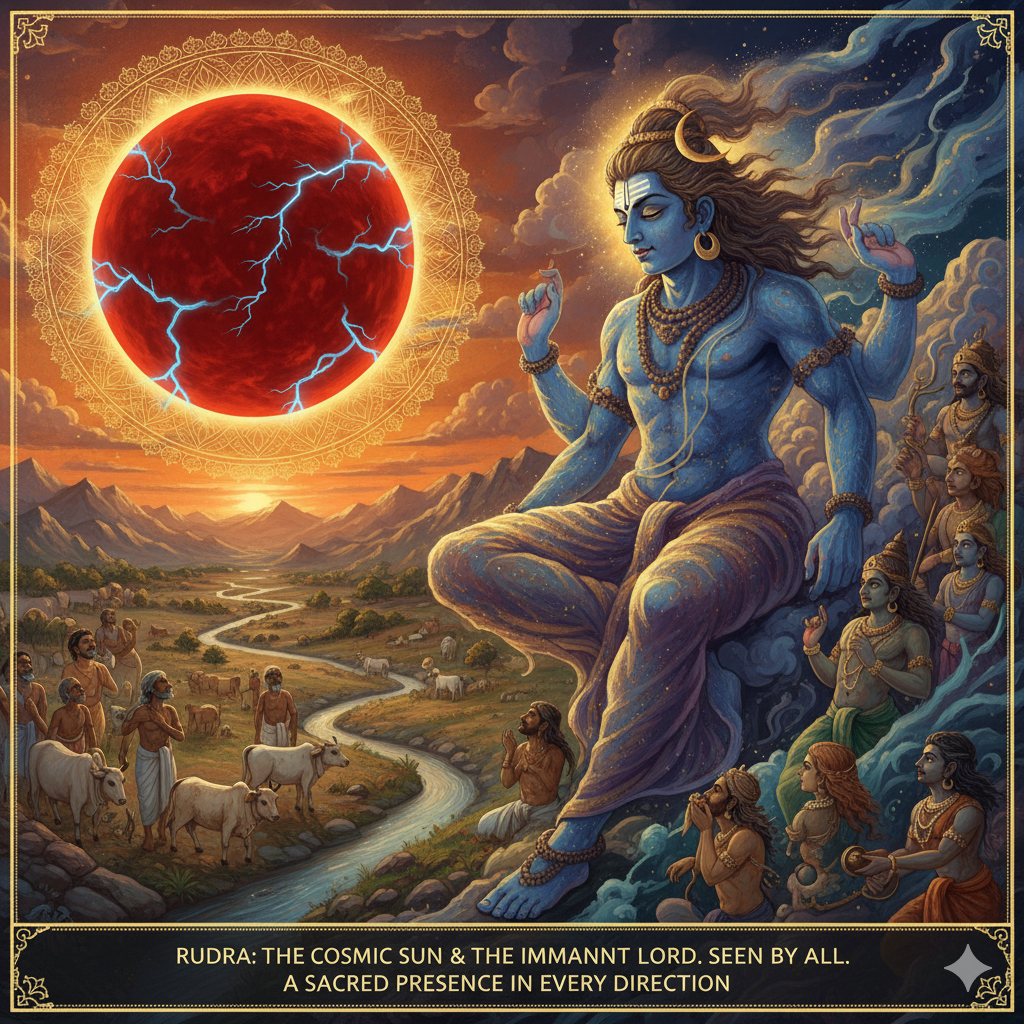
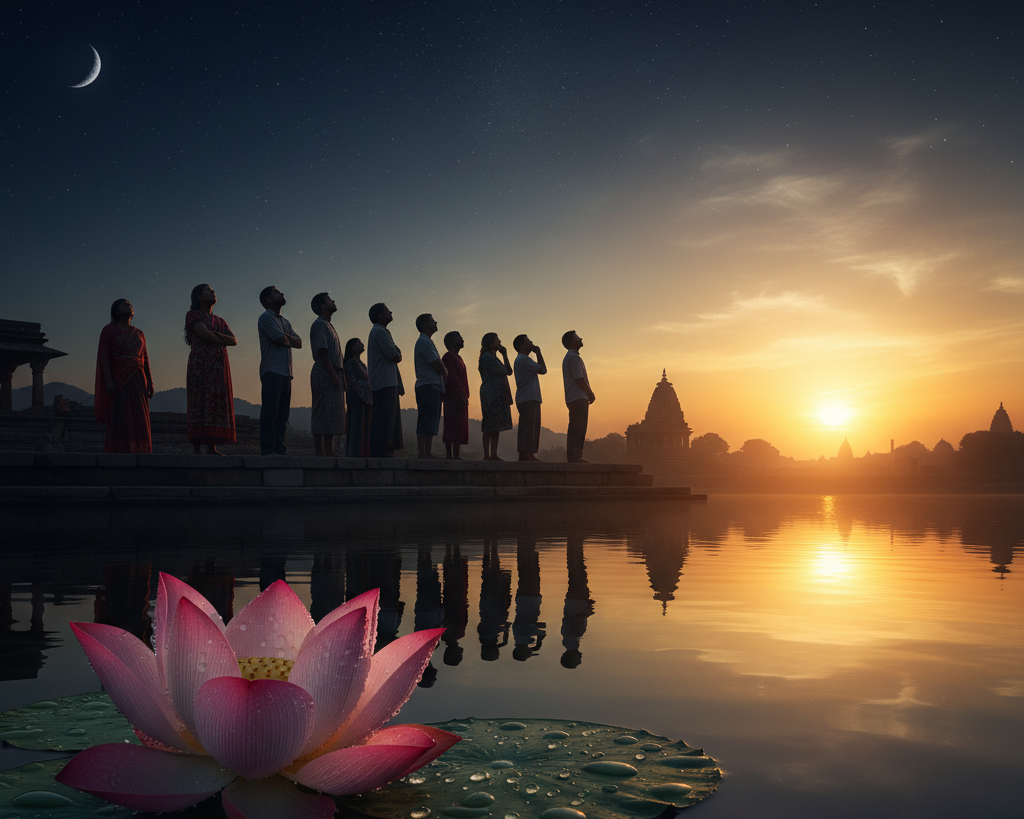
The first mantra (verse 8) presents Rudra as the blazing Sun — seen by cowherds, water-carriers, and indeed all beings. Here the sacred is not hidden away in esoteric rituals; it is woven into the fabric of daily life, shining above us every day.
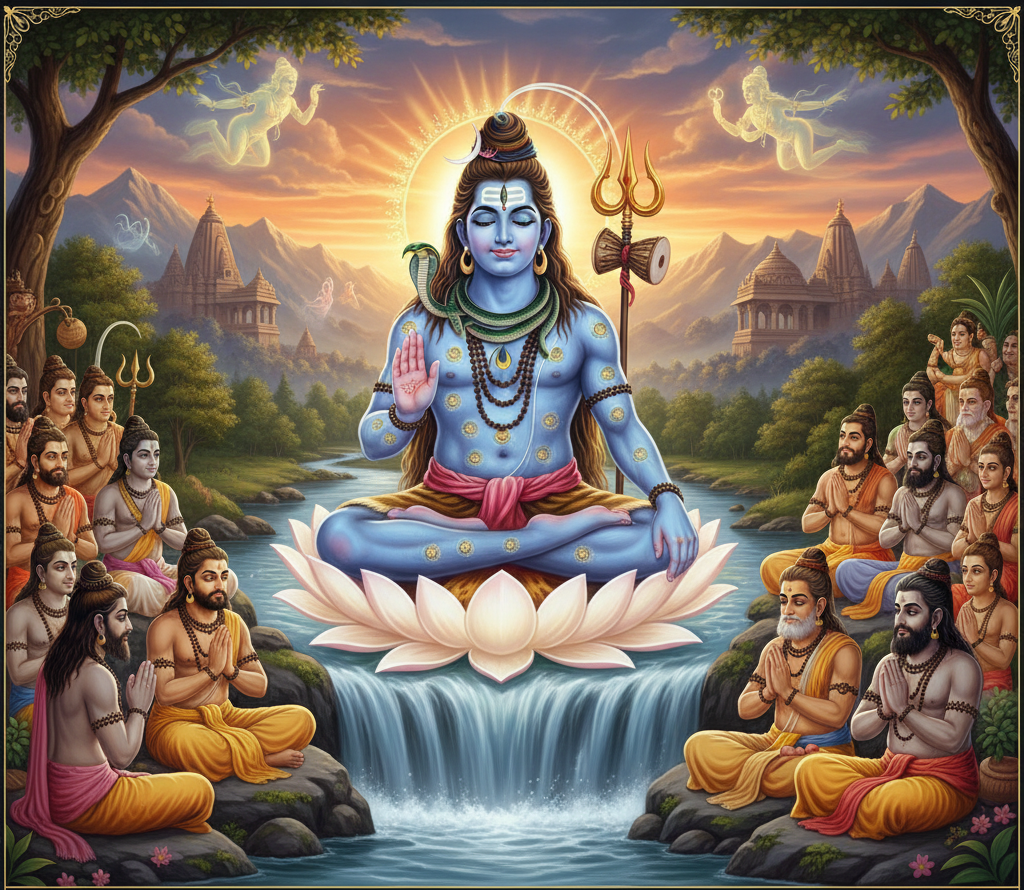
The second mantra (verse 9) broadens this vision even further. Rudra is praised as the blue-necked lord surrounded by his countless hosts, forces, and manifestations. This hymn acknowledges the fierce, the manifold, and the awe-inspiring dimensions of the divine, teaching us to bow not only to the serene but also to the wild and untamed.
Together, these verses invite us into a richer awareness of divinity: one that is cosmic yet intimate, universal yet deeply present in every aspect of creation.
Verse 1: Asau yo vasarpati (Namakam, 1st Anuvakam, verse 8)
Translation “That Rudra who, red in hue and blue-necked, moves across the sky— Him the cowherds behold, and so do the water-carriers; Him all beings see. May that vision of him be auspicious to us.” (Translation source: Vignanam.org)
Commentary
This mantra paints a striking image of Rudra as the fiery Sun traversing the heavens—nīlagrīvaḥ (blue-necked) and vilohitaḥ (red-hued). His presence is not distant or abstract: utainaṃ gopā adṛśan — even the humble cowherds see him daily in the open fields. Adṛśannudahāryaḥ — so too the water-carriers, those engaged in life’s simplest labors, lift their gaze to him.
The hymn here emphasizes an important Vedic truth: the divine is not reserved for sages or priests alone. Rudra, blazing in the sky, is visible to all — to villagers, laborers, and indeed to all beings (viśvā bhūtāni). The democratization of the sacred is clear: the same Sun that sustains life is the radiant Rudra, and his vision (sa dṛṣṭaḥ) is a blessing that grants auspiciousness (mṛḍayāti naḥ).
Philosophically, the verse bridges the transcendent and the immanent. Rudra is the cosmic force moving across the heavens, yet he is also the accessible deity encountered in the most ordinary rhythms of human life. In this way, the verse invites us to recognize divinity not only in rare moments of mystical insight but also in the everyday experience of seeing the Sun.
Verse 2: Namo astu nīligrīvāya (Namakam, 1st Anuvakam, verse 9)
Transliteration namo astu nīligrīvāya sahasrākṣāya mīḍhuṣe । atho ye asya sattvāno’ham tebhyo’karaṃ namaḥ ॥
Translation “Salutations be to the blue-necked, thousand-eyed, ever-bountiful Rudra. And to his myriad attendants, his forces and beings — to them too I offer my reverent salutations.” (Translation source: Vignanam.org)
Commentary
This mantra shifts the focus from Rudra as the cosmic Sun to Rudra as the mighty Lord surrounded by his hosts. He is nīligrīva — the blue-necked one, recalling the mythic image of Rudra consuming the poison during the cosmic churning. He is sahasrākṣa — thousand-eyed, the all-seeing, who beholds all directions and realms. He is mīḍhuṣe — ever-generous, showering blessings.
Yet the mantra does not stop with Rudra alone. It explicitly includes his sattvānāḥ — the beings, powers, attendants, and forces that move with him. This reflects a profound Vedic insight: the divine is not isolated, but ever-manifesting through innumerable forms. To honor Rudra is also to honor his hosts — the seen and unseen energies that sustain and govern creation.
Spiritually, this verse expands our understanding of worship. To salute Rudra is to salute the totality of life’s forces, acknowledging that every aspect of the world — from the protective to the fearsome — is suffused with divinity. It is an invitation to humility and inclusiveness, recognizing that the sacred expresses itself in countless ways beyond our limited perception.
Reflection
Together, these two mantras expand our vision of Rudra in complementary ways:
In the cosmos, he is the blazing Sun (asau yo vasarpati), rising and setting before the eyes of all beings. The mantra is careful to emphasize that not only sages but even cowherds in the fields and water-carriers at the well see him. In other words, divine vision is not a privilege — it is woven into daily life, accessible to anyone who looks up and recognizes the sacred in the ordinary.
In the world around us, he appears as the blue-necked, thousand-eyed lord surrounded by countless forces (namo astu nīligrīvāya). Here Rudra is not just a distant cosmic principle but a living presence moving among his hosts — the powers of nature, the energies of creation and destruction, the guardians and wild forces alike. By acknowledging them, the hymn teaches that nothing in creation is outside the sphere of the divine.
Together, these verses cultivate a spiritual attitude of both reverence and inclusiveness. They remind us that Rudra is to be found not only in the highest heavens but also in the humblest circumstances, not only in his serene blessings but also in his fierce and untamed forms. To walk with such awareness is to live with a sense of sacred presence in every direction we turn.
Closing Thought
With these verses, Sri Rudram deepens our understanding of Rudra as both immanent and transcendent. The seeker learns to see divinity in the blazing Sun above, in the labors of everyday people, and in the multitude of forces that animate the world. It is a vision that does not shy away from the fierce and awesome but instead embraces it as part of the whole.
This inclusiveness is the hallmark of Vedic spirituality: the divine is not confined to temples or rituals but permeates the entire universe, from the shining heavens to the bustle of earthly life. By saluting Rudra in both his cosmic radiance and his manifold forms, the hymn prepares us to enter the next verses, where the presence of Rudra will be invoked in every direction and every element of existence.
Last week we began exploring the Sūryamaṇḍala Aṣṭakam, a hymn of eight verses that venerates the Sun (Sūrya) as the cosmic principle, the illuminator, and remover of darkness and ignorance. Verses 1 & 2 set up themes of praise, light, and benefaction: the Sun’s brilliance, purity, majesty, and the power to dispel suffering.
Context
This week we move on to verses 3 & 4, which deepen the depiction: invoking the Sun as worshipped by the gods and sages, imbued with wisdom, present in all cosmos, and embodying creation, sustenance, dissolution (the three guṇas), among other qualities. We’ll see more about its universality, its salvific power, and how it is perceived by those who seek liberation (mokṣa).
Translation: May that Sun, whose orb (maṇḍala) is worshipped by the hosts of gods (devagaṇas), praised by Brahmins (viprāḥ), the Knower of devotion and liberation (bhāvanamukti-kovida), be the Supreme among gods (devadeva). I bow to that Sun; may that Sun protect me — that tatsavitur vareṇyam (that Savitṛ who is worthy of adoration).
Translation: May that Sun, whose orb is full of wisdom (jñānaghanaṃ), approachable (tvagamyaṃ), worshipped in the three worlds (trailōkya pūjyaṃ), of the form embodying the three guṇas (triguṇātma-rūpam), whose entire being is radiant and divine (samasta-tejomaya divya-rūpam), protect me; may that Sun — Savitṛ, worthy of adoration (tatsavitur vareṇyam) — cleanse me.
Reflections
Wisdom & Illumination: The Sun embodies not just physical brilliance but also spiritual insight — the light of knowledge.
Universality: Gods, sages, and all beings across the three worlds worship the Sun, symbolizing a principle beyond sectarian boundaries.
Accessibility: The Sun’s wisdom is approachable (tvagamyaṃ), reminding us that inner light is within reach.
Purification: The refrain punātu māṃ emphasizes the Sun as purifier of ignorance and sin.
Cosmic Principle: By encompassing the three guṇas and sustaining the three worlds, the Sun represents the very balance of creation.
Closing Thoughts
These verses invite us to see the Sun not just as the source of physical life but as the symbol of inner awakening. They call us to humility, reminding us that even the gods bow before this cosmic principle, and to hope — for the Sun’s radiance is accessible to us all as light, wisdom, and spiritual cleansing.
As we chant or contemplate these verses, we are invited to open our hearts to renewal and clarity. The light that rises each day in the sky can also rise within us, dissolving darkness and illuminating the path of liberation.
Next week, we’ll continue with verses 5 & 6, which highlight the Sun’s healing and life-sustaining powers.
In Vedic times, the heavens were not merely studied for practical reasons of navigation or calendrical keeping; they were revered as a living presence, an eternal expression of the divine. The ṛṣis looked to the night sky not with curiosity alone but with awe, reverence, and devotion. The stars, planets, and constellations were woven into the fabric of yajña and dharma. To them, the cosmos was not an inert expanse but a sacred order — Ṛta — that bound together gods, nature, and mankind.
The Vedas reveal astronomy as a part of the spiritual experience of existence. The same fire that blazes in the yajña-kund glows in the stars above; the same hymns that invoke Agni and Indra also call upon the Nakṣatras. Thus, when the seers gazed upon the heavens, they did not see distant, cold bodies of light, but radiant deities, showering grace upon humankind.
Nāsadīya Sūkta – Hymn of Creation (Ṛg Veda 10.129)
This Rg Veda hymn(10.129), also known as the “Hymn of Creation” or “Hymn of Non-existence,” stands out in the Vedic tradition for its radical philosophical inquiry. Composed in the late Vedic period, it moves beyond mythological narratives to ask fundamental questions about the ultimate reality. It posits a time before existence and non-existence, before the gods, and before any discernible form. The hymn’s power lies in its deep humility, acknowledging that the mystery of creation may be unknowable, even to the gods themselves. It is a contemplative, rather than declarative, text, marking a powerful shift towards philosophical speculation.
Here are the first four verses in transliteration and translation:
Transliteration: nāsad āsīn no sad āsīt tadānīṃ nāsīd rajo no vyomā paro yat kim āvarīvaḥ kuha kasya śarman ambhaḥ kim āsīd gahanaṃ gabhīram
Translation: Then, there was neither non-existence nor existence. There was no realm of air, no sky beyond it. What covered it? Where was it? In whose protection? Was there water, deep and unfathomable?
Commentary: This verse dissolves all dualities—being and non-being, space and sky. It evokes a primordial stillness, where even the concept of “covering” or “protection” is questioned. The mention of water hints at the Vedic motif of undifferentiated waters, yet even that is uncertain. A cosmic koan in poetic form.
Verse 2
न मृत्युरासीदमृतं न तर्हि न रात्र्या अह्न आसीत्प्रकेतः | आनीदवातं स्वधया तदेकं तस्माद्धान्यन्न परः किञ्चनास ॥२॥
Transliteration: na mṛtyur āsīd amṛtaṃ na tarhi na rātryā ahna āsīt praketaḥ ānīd avātaṃ svadhayā tad ekaṃ tasmād dhānyan na paraḥ kiñcanāsa
Translation: There was no death then, nor immortality. No sign of night or day. That One breathed, windless, by its own impulse. Apart from That, nothing else existed.
Commentary: Time and polarity vanish—no death, no immortality, no day or night. “It breathed without air” is a stunning image of self-sustained consciousness. “Svadhayā” suggests divine autonomy. This is not creation from emptiness, but emergence from fullness.
Transliteration: tama āsīt tamasā gūḷham agre apraketaṃ salilaṃ sarvam ā idam tucchyena ābhv api hitaṃ yad āsīt tapasas tan mahinā jāyataikam
Translation: Darkness was hidden in darkness at first. All this was undifferentiated water. That which was void and formless was covered by the void. Through the power of tapas, That One came into being.
Commentary: A paradox of concealment: darkness wrapped in darkness. The world is fluid, unformed, veiled by voidness. But then comes the turning point—through tapas (creative heat, austerity), the One emerges. This is the Vedic Big Bang of consciousness.
Transliteration: kāmas tad agre samavartatādhi manaso retaḥ prathamaṃ yad āsīt sato bandhumasati niravindan hṛdi pratīṣyā kavayo manīṣā
Translation: Desire arose in the beginning—that was the first seed of mind. Sages, searching in their hearts with wisdom, Found the bond of the existent in the non-existent.
Commentary: “Kāma” is not lust, but the primal will to manifest. It’s the first stir of mind, the seed of creation. The “kavayo manīṣā”—wise seers—intuit the link between sat and asat, form and formlessness. This is the birth of cosmic yearning.
From Kāma to “Eko’ham Bahu Syām” The fourth verse is remarkable. It speaks of kāma—desire—as the first stirring within the One, the subtle impulse toward manifestation. This is not passion in a human sense, but the cosmic will that bridges asat (non-being) and sat (being).
While the Ṛg Veda itself remains open and exploratory, later seers of the Upaniṣadic age drew upon this vision to articulate a profound truth: that the One wished to become many.
This is seen clearly in the Chāndogya Upaniṣad, where the primordial Being (Sat) thinks to itself, “bahu syām prajāyeya” (“May I become many, may I grow forth”) (6.2.3) [1].
Similarly, the Taittirīya Upaniṣad echoes this idea in the Brahmānandavallī, verse 6, stating that the Brahman, the Absolute, desired to become manifold [2].
From Creation to Cosmos: The Stars as Divine Beings
If the Nāsadīya Sūkta reveals the mystery of existence, the night sky reveals its sacred order. To the Vedic seers, the heavens were not an accidental scattering of lights. They were a yajña-vedi, a cosmic altar, where every star had its place and its purpose.
The sky was filled with deities: Agni blazed as the sun, Soma shone as the moon, and the Nakṣatras (lunar mansions) were honored as celestial presences. Each Nakṣatra was invoked in yajñas, each associated with a deity—from Agni to Indra, from Varuṇa to the Ādityas. To name a star was not to catalog it but to honor it, to recognize the deity whose energy flowed through its light.
Thus, the ancients did not merely “map” the sky; they sanctified it. The night was not empty darkness but a sacred tapestry of gods. Just as the five elements—Agni, Vāyu, Varuṇa, Pṛthvī, and Ākāśa—were revered as divine, so too were the stars. The heavens themselves were alive, a realm of deities showering their grace upon mankind.
Mapping the Celestial Deities: From Vedic to Western Names
While the Vedic seers saw the stars as living deities, modern astronomy has cataloged them with a different purpose—to create a universal map of the cosmos. This does not diminish the ancient wisdom; rather, it provides a bridge to connect their sacred vision with our modern understanding. The Nakṣatras, or lunar mansions, are the cornerstone of Vedic astronomy. There are 27 (or sometimes 28) of these, and each is a specific sector of the sky with a prominent star at its heart.
Below, we map some of the major Nakṣatras to their well-known Western astronomical names. This is not a one-to-one translation but a correspondence, linking the celestial deity to its physical location in the night sky.
Vedic Nakṣatra
Western Star/Constellation
Ashwini
The star cluster Beta and Gamma Arietis in the constellation Aries.
Krittika
The Pleiades star cluster in the constellation Taurus.
Rohini
Aldebaran, the brightest star in the constellation Taurus.
Mrigashira
Lambda Orionis, the head of the constellation Orion.
Punarvasu
Castor and Pollux, the two brightest stars in the constellation Gemini.
Pushya
Delta Cancri in the constellation Cancer.
Ashlesha
Epsilon Hydrae in the constellation Hydra.
Magha
Regulus, the brightest star in the constellation Leo.
This mapping reveals that the same luminous points in the sky that the Rig Veda referred to as divine beings are the very same celestial bodies we observe today. The difference lies not in the stars themselves, but in the lens through which we view them—as a cosmic dance of deities rather than just a collection of gas and dust.
Prominent Individual Stars: Vedic and Western Equivalents
Beyond the Nakshatras, several prominent stars also held significant importance in both Vedic and Western traditions. Here is a mapping of some well-known Western stars to their commonly associated Vedic names:
Western Star Name
Constellation
Vedic Name / Association
Sirius
Canis Major
Mrigavyadha or Lubdhaka
Canopus
Carina
Agastya
Vega
Lyra
Abhijit (part of a Nakshatra)
Capella
Auriga
Brahma Hridaya
Castor & Pollux
Gemini
Aditi and Diti
Elnath
Taurus
Agni
This simple mapping reveals a shared human connection to the heavens that transcends cultural and temporal boundaries.
The Sapta Rishi Mandala: The Seven Sages and Dhruva
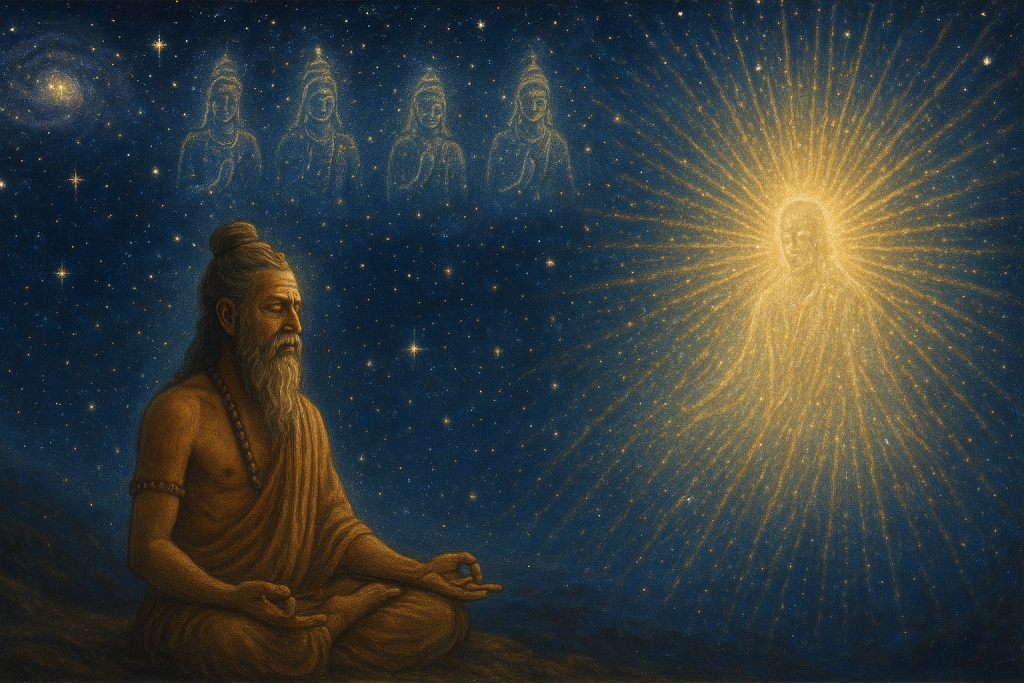
One of the most revered and easily recognizable constellations in the Northern Hemisphere is the Big Dipper, which holds a special and sacred place in Vedic astronomy. It is known as the Sapta Rishi Mandala, or “The Circle of the Seven Sages.” These seven stars are believed to be the cosmic forms of the seven great sages (Maharishis) who received and transmitted the sacred knowledge of the Vedas.
Each star in this constellation is a divine presence, honored for its wisdom and spiritual power. Here is the mapping of the seven stars and their corresponding rishis:
Dubhe (Alpha Ursae Majoris) – Marichi
Merak (Beta Ursae Majoris) – Vashistha (often accompanied by the faint star Alcor, known as Arundhati, Vashistha’s wife, a binary companion visible to the naked eye)
Phecda (Gamma Ursae Majoris) – Angiras
Megrez (Delta Ursae Majoris) – Atri
Alioth (Epsilon Ursae Majoris) – Pulastya
Mizar (Zeta Ursae Majoris) – Pulaha
Alkaid (Eta Ursae Majoris) – Kratu
This constellation served as a vital directional guide for ancient seers, with the two stars at the bowl’s outer edge (Dubhe and Merak) always pointing towards Dhruva (Polaris), the North Star. Dhruva is a symbol of steadfastness, eternal truth, and unwavering resolve in Vedic tradition, representing a fixed point around which the cosmos revolves.
Here is an image depicting the Sapta Rishi Mandala (Big Dipper) and Dhruva highlighting the connection between these celestial guides.
Reflections and Closing Thoughts
The journey from the Nāsadīya Sūkta’s questions on cosmic origins to the systematic mapping of stars reveals a timeless human quest for meaning. The Vedic seers didn’t simply observe the heavens; they engaged in a sacred relationship with them. They saw the night sky not as a distant, indifferent void, but as a direct expression of the divine, a celestial blueprint for life on Earth.
In our modern world, filled with scientific explanations and light pollution that obscures the stars, we can still learn from this ancient wisdom. The stars remind us that we are part of a grander, sacred order. They invite us to find our own “Dhruva,” a fixed point of purpose and truth that can guide us through life’s uncertainties. They encourage us to seek wisdom, just as the Sapta Rishis are said to embody.
By looking up at the night sky with a renewed sense of wonder and reverence, we can reconnect with a profound tradition that binds us to our past, to the universe, and to a higher purpose. The cosmos is not just a subject for study; it is a canvas for contemplation, inviting us to reflect on our place within its infinite, sacred tapestry.
Welcome to another edition of “Friday’s Fountain of Wisdom,” where we delve into timeless spiritual texts to find inspiration and guidance for our modern lives. This week, we are exceptionally delighted to explore the profound beauty and philosophical depth of Sri Stuti, a magnificent hymn composed by the illustrious philosopher-saint, Vedanta Desika.
Vedanta Desika was a remarkable 13th-century spiritual master in the Sri Vaishnava tradition. Known by the title “Kavi-Tarkika-Simha,” or “Lion among poets and logicians,” he was a brilliant polymath—a master of many different fields of study—who authored over a hundred works in Sanskrit, Tamil, and other languages. His most significant contribution was his ability to systematize and popularize the Vishishtadvaita philosophy of Ramanuja. He masterfully blended rigorous logic and profound devotion, creating works that not only clarified complex spiritual truths but also inspired sincere devotion, securing his place as a pivotal figure in Indian philosophy and spiritual thought.
Join us as we uncover the wisdom embedded in selected verses from this sacred text, perfect for reflection and transformation this weekend.
The Composition of Śrī Stuti
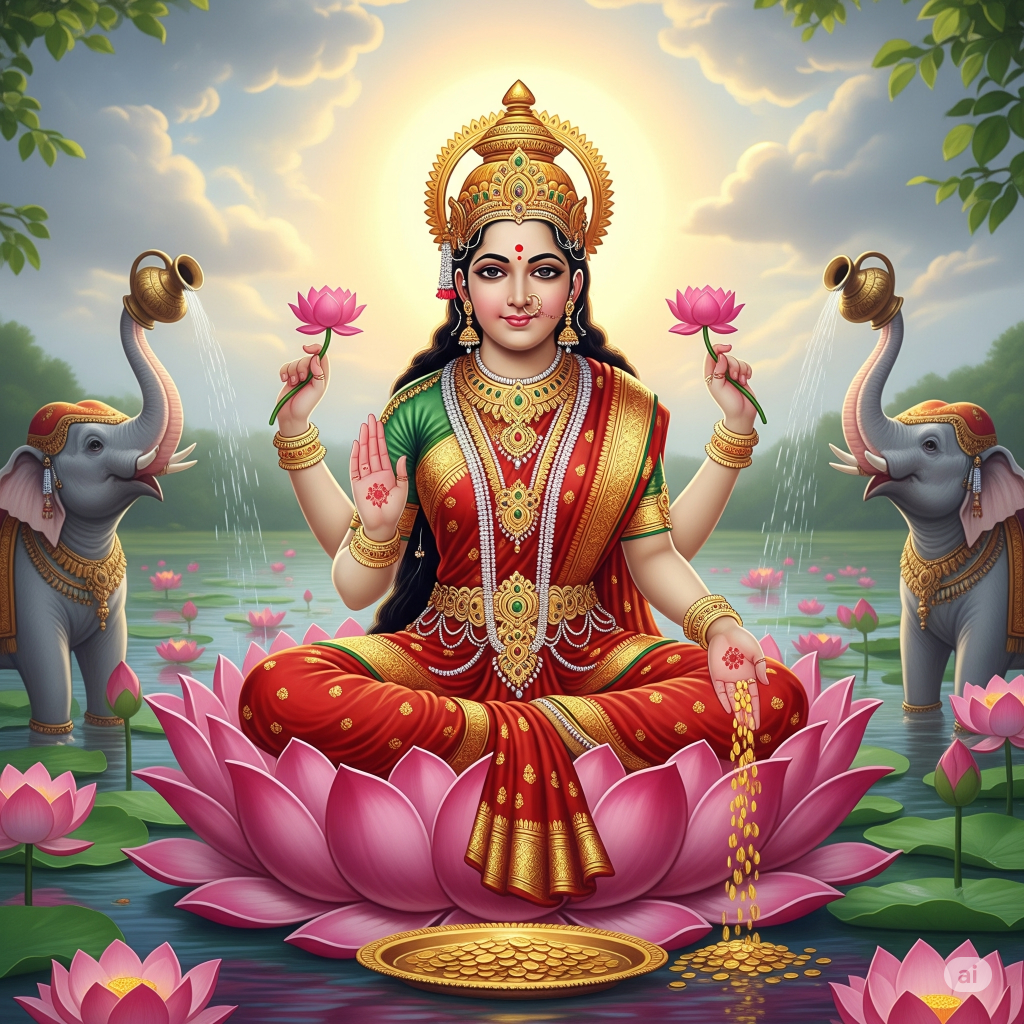
The Śrī Stuti is a concise yet profound hymn composed of 25 verses, crafted to serve as a complete prayer to Goddess Śrī (Lakṣmī). It guides the devotee through a spiritual journey, beginning with verses that praise her general auspiciousness and divine attributes, moving through her compassionate nature and her role as the bestower of all prosperity, and concluding with heartfelt pleas for grace and a reflection on her ultimate power. The hymn beautifully balances cosmic grandeur, devotional intimacy, and practical guidance for a life of auspiciousness, making it relevant for both spiritual practice and daily reflection.
For this post, we have selected four verses that exemplify this spiritual flow and convey a focused message: they illuminate Śrī’s ability to grant both ultimate spiritual and material blessings, her role as the universal mother and protector, and the way she bestows contentment—the highest form of spiritual wealth—to her devotees. These verses beautifully capture Vedānta Deśika’s intent, connecting the pursuit of divine grace to a life of holistic fulfillment. They highlight the inseparable link between devotion, grace, and the cultivation of inner and outer prosperity, showing how the pursuit of Śrī’s blessings naturally leads to a balanced and auspicious life.
Thematic Summary of Śrī Stutiḥ (25 Verses)
The Śrī Stutiḥ hymn beautifully glorifies Goddess Lakshmi in 25 verses. For ease of understanding, the hymn can be grouped thematically:
1. Invocation and Surrender (Verses 1–2)
The devotee begins by invoking the divine presence of Goddess Lakshmi, acknowledging her supreme qualities and expressing a heartfelt surrender to her will. Key Themes: Invocation, Surrender, Divine Presence
2. Divine Attributes and Cosmic Role (Verses 3–5)
These verses describe the goddess’s transcendental nature, her omnipresence in the cosmos, and her role in creation, sustenance, and dissolution of the universe. Key Themes: Omnipresence, Cosmic Role, Divine Attributes
3. The Goddess as the Ultimate Refuge (Verses 6–10)
The hymn emphasizes that Goddess Lakshmi is the ultimate refuge for all beings. Worshiping her surpasses all other forms of devotion. Key Themes: Refuge, Supreme Deity, Devotion
4. Manifestation and Grace (Verses 11–15)
These verses highlight her multiple manifestations and boundless grace, which bestows auspiciousness and fulfills the desires of devotees. Key Themes: Manifestation, Grace, Fulfillment of Desires
5. Conclusion and Benediction (Verses 16–25)
The hymn concludes with a benediction, invoking her blessings of prosperity, wisdom, and spiritual liberation for all beings, reaffirming her as the ultimate source of auspiciousness. Key Themes: Benediction, Prosperity, Spiritual Liberation
Śrī Stutiḥ – Selected Verses
The verses selected for this post offer a profound journey into the spiritual and philosophical core of the Sri Stuti. The hymn begins with a foundational invocatory verse, a heartfelt salutation to the master, Vedānta Deśika, seeking his guidance to unlock the hymn’s wisdom.
The subsequent verses unfold to guide us on a path of understanding and devotion. They first establish Goddess Lakshmi as the ultimate refuge and the embodiment of all auspiciousness. They then expand our perspective, illustrating her vast, all-encompassing nature that resides in the cosmos and beyond, a greatness that surpasses human comprehension. Finally, the verses culminate in a powerful message: the purest and most fulfilling spiritual path is one of surrender and devotion to her divine feet. They show us that serving her is the highest pursuit, a path where every noble desire is fulfilled and the ultimate object of meditation is revealed.
Invocatory Verse
Sanskrit: श्रीमाण्वेङ्कटनाथार्यः कवितार्किककेसरी। वेदान्ताचार्यवर्यो मे सन्निधत्तां सदा हृदि॥
Translation: “You are beyond all honor, the most renowned, the embodiment of all auspiciousness, and the source of all wealth. You adorn the chest of Lord Madhusudana, the beloved consort of the Goddess. I surrender to You, the refuge of all beings and the ultimate source of all that is auspicious.”
Commentary: This verse highlights Goddess Lakshmi’s divine grace, her presence with Lord Vishnu, and her role as the ultimate refuge and source of all auspiciousness.
Verse 2 Sanskrit: आविर्भावः कलशजलधौ अध्वरे वा अपि यस्याः। स्थानं यस्याः सरसिजवनं विष्णुवक्षःस्थलं वा। भूमा यस्याः भुवनमखिलं देवी दिव्यं पदं वा। स्तोकप्रज्ञैरनवधिगुणा स्तूयसे सा कथं त्वम्॥ २॥
Translation: “She who manifests in the sacrificial waters, who resides in the lotus forest or on the chest of Lord Vishnu, who encompasses the entire universe and resides in the divine abode — how can She be praised by those of limited intellect?”
Commentary: This verse emphasizes the vastness and grandeur of Goddess Lakshmi. Her presence is beyond comprehension, manifesting in sacred rituals, divine realms, and the cosmos.
Translation: “Your very form inspires praise by embodied beings. Those eager to worship You, even from the beginning of their spiritual endeavors and throughout all the worlds, cannot find anything better than service at Your feet.” Commentary: This verse portrays the supreme importance of devotion to Goddess Lakshmi. Worshiping her feet surpasses all other pursuits, highlighting her as the ultimate focus of reverence for all beings.
Transliteration: Yat saṅkalpād bhavati kamale yatra dehinyam īṣām janmasthema pralaya-racanā jaṅgama-ajaṅgamānām | Tat-kalyāṇaṁ kimapi yamina-meka-lakṣyaṁ samādhau pūrṇaṁ tejaḥ sphurati bhavatī-pāda-lākṣāra-sāṅkam || 4 || Translation: “From whatever desire arises in the heart of a devotee, in that lotus where beings take birth, dwell, and dissolve, all auspiciousness manifests. The brilliance of the Goddess’s lotus feet shines fully as the ultimate goal of meditation.”
Commentary: This verse highlights the all-gracious nature of Goddess Lakshmi. Every noble desire of a devotee is fulfilled through her divine presence. She illuminates the spiritual path and embodies the ultimate object of meditation.
Closing Thoughts: Bringing Ancient Wisdom to Modern Life
The Śrī Stuti is far more than a hymn; it is a profound spiritual guide wrapped in poetic devotion. Through its verses, Vedānta Deśika teaches us that true prosperity (Iśwarya) is not merely material accumulation but a holistic state of being, encompassing spiritual, mental, and emotional well-being. The hymn emphasizes that devotion, surrender, and service to Goddess Śrī cultivate both inner fulfillment and auspiciousness in life.
The core message for our modern lives is this: the greatest wealth we can seek is inner contentment (Tuṣṭi), a mind free from fear (Abhaya), and a heart aligned with divine grace. By cultivating a mindset of gratitude and reverence for the divine (as seen in verses 1–2), recognizing the goddess’s cosmic presence and her power to protect all beings (verses 2–3), surrendering to her guidance (verse 3), and focusing on spiritual fulfillment over mere material desire (verse 4), we invite the all-encompassing blessings of the divine into our lives.
This ancient wisdom reminds us that the path to a truly prosperous life lies not in endless acquisition, but in devotion, surrender, and alignment with the ultimate source of grace. By internalizing these teachings, we can cultivate peace, fulfillment, and holistic prosperity, integrating the timeless guidance of Vedānta Deśika into the rhythms of modern living.
Introduction: Veda and Dharma — The Eternal Foundations
In the vast spiritual landscape of Bharat, the Vedas stand as the primal sound of cosmic order. They are not merely scriptures but the very breath of Sanatana Dharma—timeless, authorless, and all-encompassing. Dharma, often translated as righteousness or duty, is the principle that sustains the universe, society, and the individual. It is the bridge between cosmic law and human conduct.
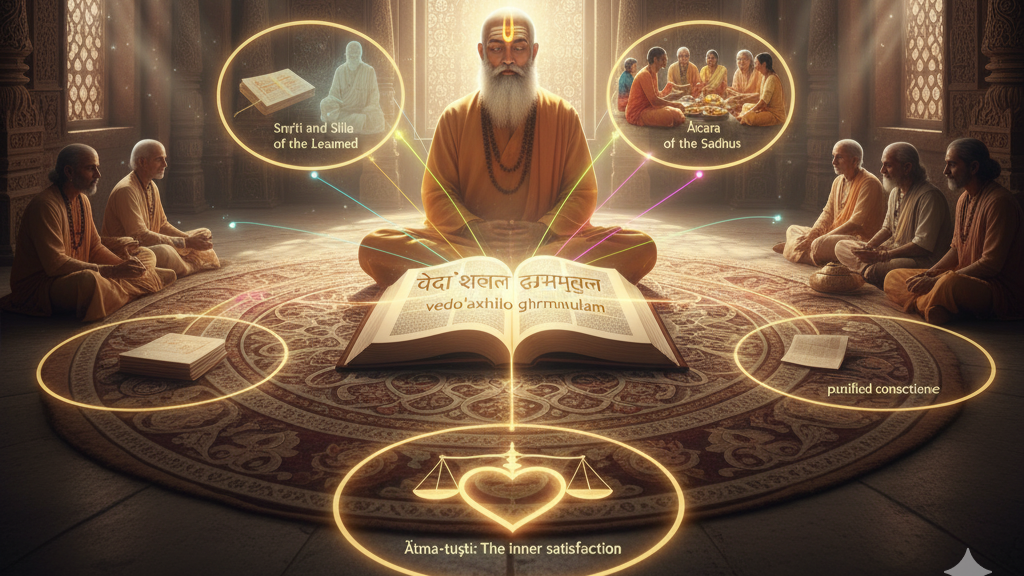
The phrase Vedokhilo Dharma Moolam—“The Vedas are the root of all Dharma”—encapsulates this sacred relationship. It affirms that all codes of righteous living, all moral frameworks, and all spiritual disciplines must ultimately trace their lineage to the Vedas.
Scriptural Origin and Dharma’s Dimensions
The phrase Vedokhilo Dharma Moolam originates from the Manusmriti 2.6: The full verse from reads:
Sanskrit: वेदोऽखिलो धर्ममूलं स्मृतिशीले च तद्विदाम् । आचारश्चैव साधूनामात्मनस्तुष्टिरेव च ॥
Transliteration: vedo’khilo dharmamūlaṃ smṛtiśīle ca tadvidām | ācāraścaiva sādhūnām ātmanas tuṣṭir eva ca ||
Translation: “The entire Veda is the root-source of Dharma; also the Smṛti and the conduct of those who know the Veda. The practice of good and learned men, and the satisfaction of one’s own conscience, are also sources of Dharma.”
Word-by-Word Breakdown
Here’s our signature table to unpack each word with clarity and reverence:
Sanskrit Word
Transliteration
Meaning
वेदः
vedaḥ
The Veda (sacred revealed scripture)
अखिलः
akhilaḥ
Entire, complete
धर्ममूलम्
dharmamūlam
Root-source of Dharma
स्मृतिशीले
smṛtiśīle
Smṛti (recollections) and Śīla (conduct)
च
ca
And
तद्विदाम्
tadvidām
Of those who know that (i.e., the Veda)
आचारः
ācāraḥ
Practice, conduct
च एव
ca eva
And indeed
साधूनाम्
sādhūnām
Of the virtuous, noble, learned
आत्मनः
ātmanah
Of the self
तुष्टिः
tuṣṭiḥ
Satisfaction, contentment
एव च
eva ca
Indeed also
Expanded Commentary: The Four Pillars of Dharma
This verse outlines a quadruple foundation for Dharma, each with its own nuance:
Veda (Vedokhilo Dharma Moolam)
The Veda is the supreme, eternal authority—apauruṣeya and free from human error.
It contains injunctions (vidhi) and prohibitions (niṣedha) that guide all aspects of life: ritual, ethics, cosmology, and liberation.
Smṛti and Śīla of the Learned
Smṛti texts (like Manusmriti itself) are codified recollections of Vedic wisdom.
Śīla refers to the conduct of those who have internalized the Vedas—not just scholars, but sages whose lives reflect scriptural truth.
Ācāra of the Sādhus
Ācāra is living tradition—the customs and practices of noble souls.
It reflects Dharma in action, contextualized for time and place. Baba often emphasized this as “practical spirituality.”
Ātma-tuṣṭi
The inner satisfaction of the self-realized.
This is not mere personal preference—it is the intuitive Dharma of one whose conscience is purified by sādhanā and wisdom.
Why This Matters
This verse is not just a list—it’s a hierarchy of discernment. When faced with moral dilemmas or spiritual choices, one must:
First consult the Veda.
If unclear, refer to Smṛti and the conduct of Vedic scholars.
If still uncertain, observe the practice of noble souls.
And finally, rely on one’s purified conscience.
This layered approach ensures that Dharma is both universal and adaptable, revealed and lived, scriptural and intuitive.
From Śāstra to Śakti: Linking Manusmriti to the Avatar’s Voice
Having explored the layered scriptural foundation of Vedokhilo Dharma Moolam—rooted in the Vedas and elaborated in the Manusmriti—we now turn to the one who came to reawaken these truths in the modern age.
Bhagawan Sri Sathya Sai Baba did not merely echo the wisdom of the ancients—He embodied it. His repeated invocation of this phrase was not a scholarly gesture, but a divine affirmation. He revealed that Dharma is not a human construct, but a cosmic principle, and that the Vedas are its eternal source.
“Vedokhilo Dharma Moolam. The Veda is verily the basis of Dharma. And I have come to restore it.”
More profoundly, Baba declared that his mission was not to interpret Dharma—it was to restore it, protect it, and plant it anew in the hearts of mankind.
In the following section, we explore how Bhagawan Baba unfolded this truth through His many discourses—calling for Veda revival, redefining Dharma for the modern age, and guiding humanity back to its sacred roots.
In the following section, we explore how Bhagawan Baba unfolded this truth through His discourses—calling for Veda revival, redefining Dharma for the modern age, and guiding humanity back to its sacred roots.
The Divine Foundation: Baba’s Explanation of Dharma
In the realm of spiritual wisdom, Bhagawan Baba’s teachings illuminate the profound meaning of the phrase “Vedhokhilo dharma moolam,” or “The Veda is the root of all Dharma.” This is not a static concept but a living principle that connects the divine with our daily lives.
He explains that true Dharma is born from the practice of Truth (Sathya). While many believe truth is simply speaking facts, Baba gives a deeper, more sublime definition. He says, “The creation emerges from truth and merges into truth, Is there a place where truth does not exist? Visualise such pure and unsullied truth.” This truth is not a fleeting concept but the eternal, unchanging essence of Brahman itself. It is the power that sustains the entire world. When our thoughts, words, and actions are in perfect alignment with this divine truth, we are living in Dharma.
Baba simplifies the path to Dharma with the core Vedic teaching: “Sathyam vada, dharmam chara” (Speak the truth, practice righteousness). He explains that when words are in harmony with our thoughts, they become truth; when these words are translated into action, that action becomes Dharma. In this way, every act, every word, and every thought becomes a reflection of divine consciousness. He declares, “Each act of Mine reflects a certain facet of dharma.”
For Baba, Dharma is the very moral fabric of a society. He states that morality, or Dharma, is not something to be forced upon oneself but is our very nature. He asserts, “No society can exist without morality” and reminds us that even birds and animals adhere to a code of conduct. It is only when man abandons this natural code that he suffers.
Ultimately, the source of all Dharma is the Atma, the divine self within each of us. By cultivating unwavering faith and turning our senses inward, we can connect to this Atmic principle. He teaches, “Truth and Righteousness are the two main pillars on which the entire world rests.” When we protect them, they in turn protect us, bringing an eternal state of peace and happiness. This is the ultimate promise of a life lived in accordance with Bhagawan’s vision of Dharma.
The above image shows a visual metaphor: the Veda is the root (the tree), Dharma is the principle (the flow), and Sathya is the foundation (the pool of water), all illuminated by the divine wisdom of Bhagawan Baba.
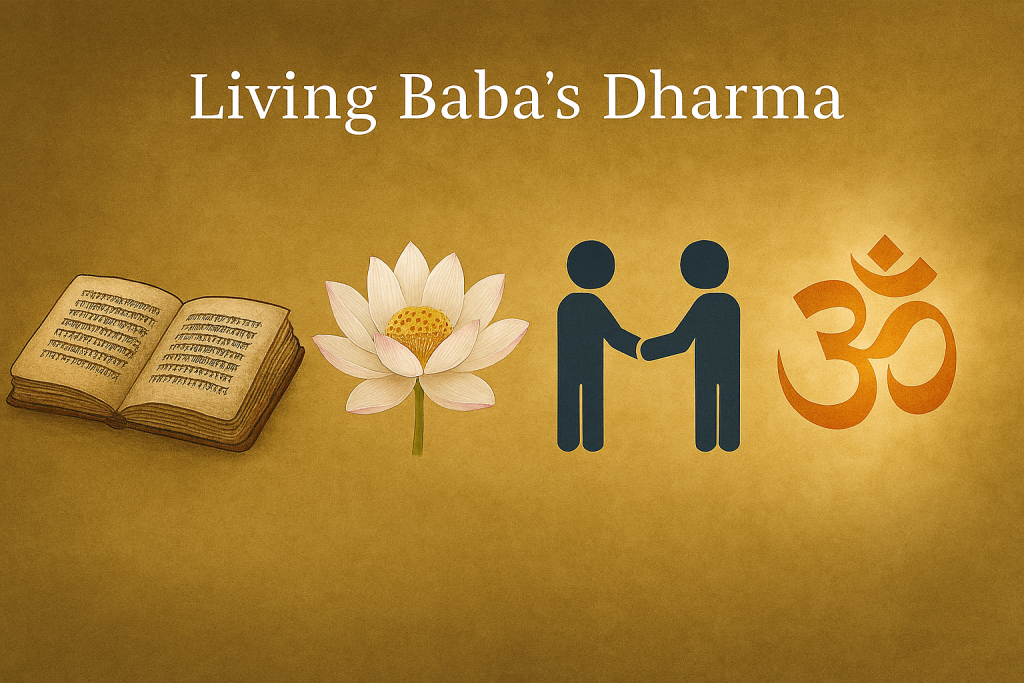
Living Baba’s Dharma — A Fourfold Path of Embodiment
1. Study the Vedas — Not as Texts, but as Living Guidance
Bhagawan Baba emphasized that the Vedas are not meant to be locked away in libraries or recited mechanically. They are living vibrations of cosmic truth, meant to be understood, internalized, and lived.
“The Vedas are the very breath of God. They are not man-made. They are eternal.” — Sathya Sai Speaks
To study the Vedas in Baba’s spirit means:
Listening with reverence, not just intellect
Seeking the essence behind the mantras—truth, compassion, unity
Using Vedic wisdom to guide daily decisions, not just ritual practice
Baba established Veda Pathashalas and encouraged even young children to chant and understand the Vedas, showing that this knowledge is for all—not just scholars.
2. Practice Dharma — Not as Duty Alone, but as Divine Alignment
For Baba, Dharma was not a burden—it was bliss. He taught that Dharma is the natural expression of one’s divine nature. It is not imposed from outside, but arises from within when the heart is pure.
“Dharma is not a set of rules. It is the path laid down by the Lord for the good of all.” — Truth Emerges from Wisdom
To practice Dharma in Baba’s way means:
Acting with integrity even when no one is watching
Choosing truth over convenience
Serving others without expectation
Aligning one’s life with cosmic order, not personal gain
Baba often said, “Follow the Master, Face the Devil, Fight to the End, Finish the Game.” Dharma is that fight—it is the soul’s commitment to righteousness.
3. Serve Humanity — As an Expression of Vedic Compassion
Service (seva) is the highest form of Dharma in Kali Yuga, according to Baba. He taught that the Vedas culminate in compassion, and that true spirituality is measured by how much one uplifts others.
“Hands that help are holier than lips that pray.” — Sathya Sai Speaks
To serve in Baba’s spirit means:
Seeing God in every being
Offering time, energy, and love without ego
Making one’s life a yajna—a sacred offering to the world
Uplifting the downtrodden, educating the ignorant, and healing the suffering
Whether through hospitals, schools, or water projects, Baba showed that Vedic Dharma must flow into society as tangible love.
4. Surrender to God — For He Alone Knows Dharma’s Depth
Baba often reminded devotees that only the Divine knows the full scope of Dharma. Human intellect is limited; divine wisdom is infinite.
“Whatever God says is Sathya, and whatever He does is Dharma.” — Truth Emerges from Wisdom
To surrender to Baba means:
Trusting His guidance even when it challenges our logic
Accepting His timing, His corrections, and His silence
Living with humility, knowing that He is the doer
Letting go of control and allowing Dharma to unfold through His will
This surrender is not passive—it is the most active form of spiritual engagement. It is saying, “Let Thy will be done,” and then living accordingly.
Closing Thoughts
In the end, ‘Vedokhilo dharma moolam’ is more than a phrase—it is a divine blueprint for human transformation. As Bhagawan Baba showed us, its wisdom is not meant to be confined to ancient texts but is to be embodied in every moment of our lives. The fourfold path of study, practice, service, and surrender is not a mere set of instructions, but the very process of rooting our consciousness in the eternal wisdom of the Vedas and blossoming into our divine potential.
By aligning our lives with this timeless Dharma, we not only uplift ourselves but become a force for righteousness in a world in need. This is the ultimate purpose of this ancient truth: to turn every human life into a sacred offering, a living testament to the harmony of cosmic law and divine love.
Sathya Sai Speaks, “All Mankind” This discourse provides Bhagawan’s definition of Dharma as right action stemming from truth, and the interconnectedness of Truth and Righteousness.
Sathya Sai Speaks, “Truth Emerges from Wisdom” The discourse highlights the profound link between Sathya (Truth) and Dharma, affirming that Dharma is a direct reflection of Truth. URL:
Sathya Sai Speaks, Vol. 42 (2009) This volume contains discourses that touch upon the importance of morality and a code of conduct in society, which are central to Bhagawan’s teachings on Dharma.
Samastah Lokah Sukhino Bhavanthu May all the beings in all the worlds be happy!
Jai Sai Ram!
Please note all images and content created using AI Tools
In our journey to discover purpose and peace, ancient wisdom often illuminates the most profound truths. Last week, we explored the Mudgala Purana as a guide to understanding Ganesha as the Supreme Brahman, the ultimate reality that helps us transcend inner obstacles. This week, we delve into the first and arguably most foundational of Ganesha’s eight incarnations: Vakratunda.
The name Vakratunda itself holds deep meaning, translating to “twisted trunk.” This seemingly unusual form is not a flaw but a symbol of the divine’s ability to navigate and straighten the complexities of the material world. Vakratunda embodies the absolute, the very aggregate of all bodies, and represents the form of Brahman from which all creation originates. He descends to conquer the demon Matsaryāsura, a powerful personification of envy and jealousy.
The Birth of Envy: Matsaryāsura and His Sons
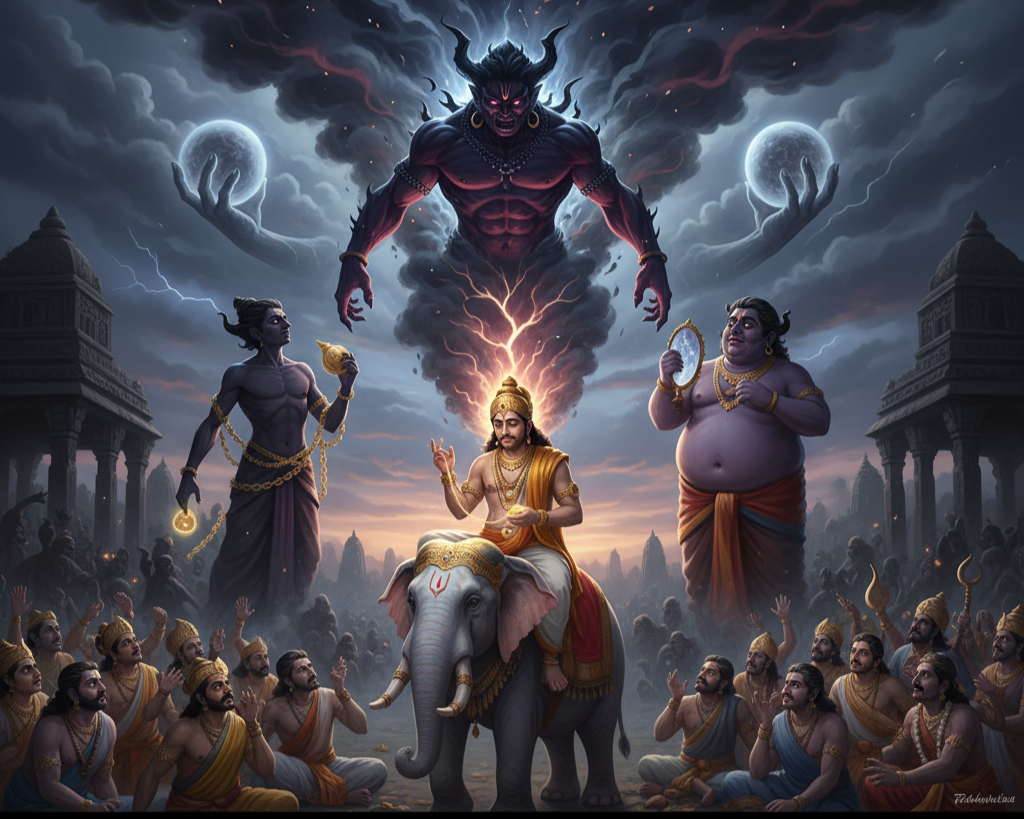
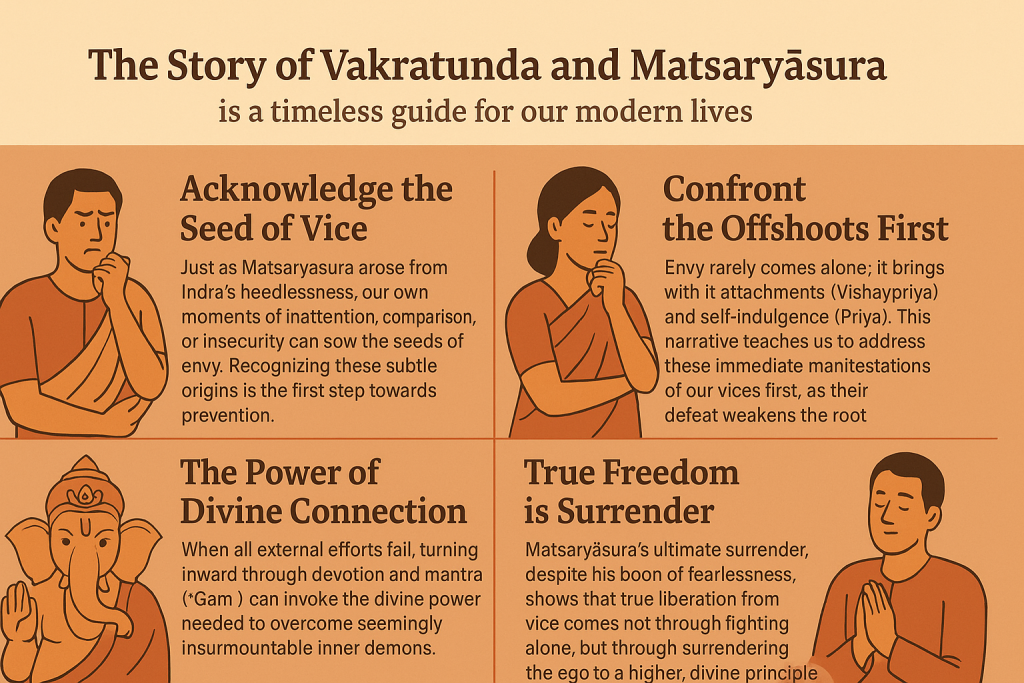
The story of Matsaryāsura begins with the heedlessness (pramada) of Indra, the king of the gods. From this single act of inattention, a formidable demon was born – Matsaryāsura, the embodiment of envy. This origin story is a profound lesson in itself: even minor slips in our mindfulness can give rise to powerful inner vices.
Matsaryāsura, driven by his inherent nature, sought power. He performed severe austerities and gained a powerful boon from Shiva – the gift of fearlessness. With this impenetrable shield, he, along with his two formidable sons, Vishaypriya (representing attachment to worldly pleasures) and Priya (representing self-indulgence or extreme fondness for oneself), conquered all three worlds. Gods, sages, and mortals alike found themselves under the dominion of envy, attachment, and self-serving desires.
Dattatreya’s Guidance and the Advent of Vakratunda
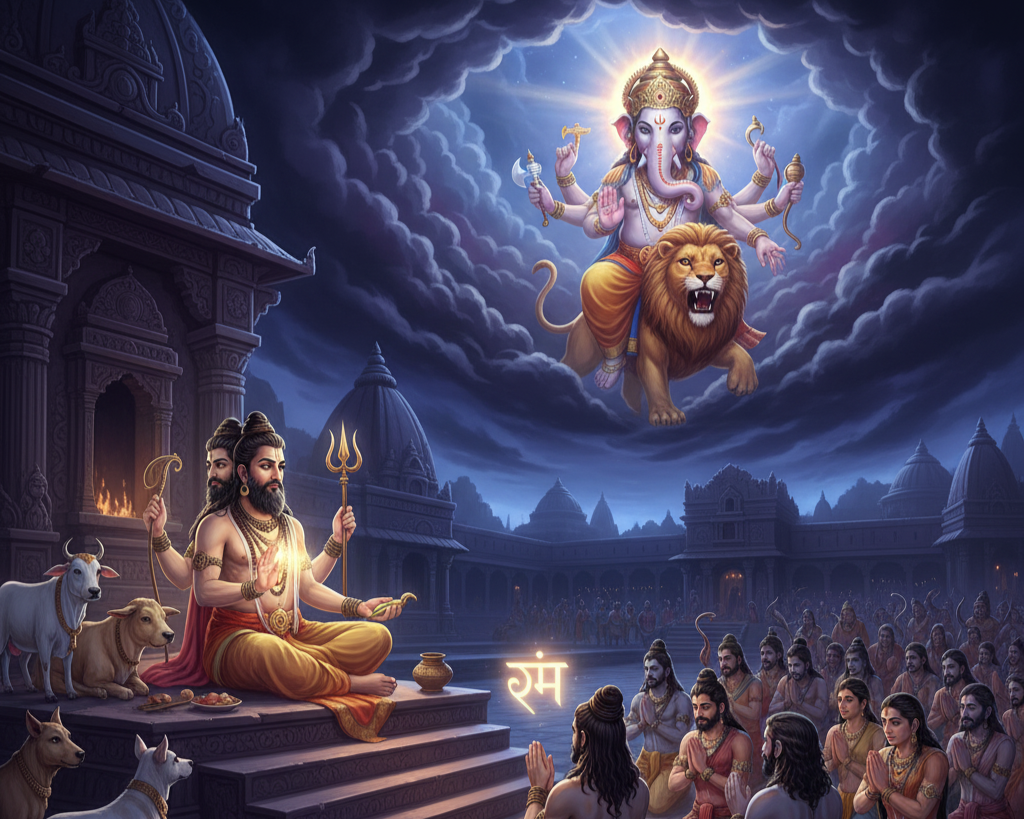
Defeated and desperate, the gods sought counsel from the great sage Dattatreya, the divine incarnation of the Trinity (Brahma, Vishnu, and Shiva). Dattatreya, with his profound spiritual insight, recognized the true nature of their predicament. He advised them that their deliverance lay in appealing to the ultimate source of all power – Ganesha. He imparted the powerful monosyllabic mantra “Gam” and instructed them to pray with unwavering devotion.
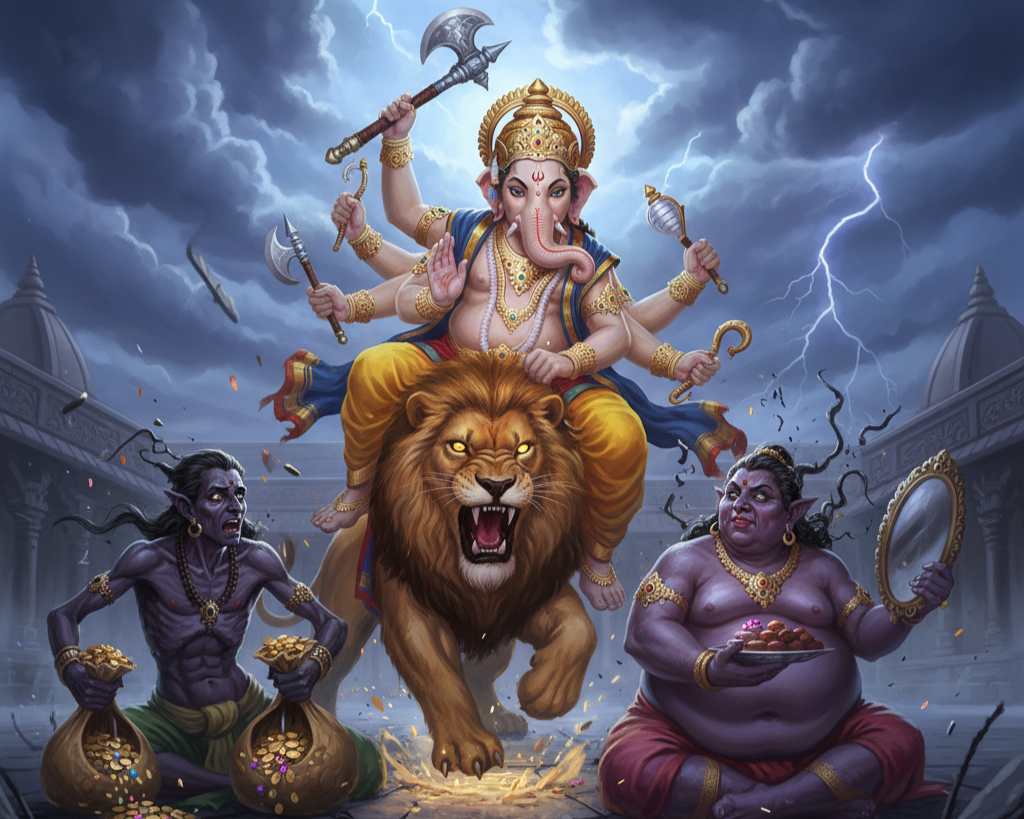
As the gods chanted, Ganesha manifested in his majestic form as Vakratunda, radiant and riding upon his mighty lion. The battlefield was set for a confrontation not just between divine and demonic forces, but between self-mastery and inner chaos.
Vakratunda first engaged Matsaryāsura’s sons, Vishaypriya and Priya. These two, representing the insidious offshoots of envy – attachment to fleeting pleasures and excessive self-love – were decisively defeated and slain. Their demise signifies the initial, crucial step in our own spiritual battles: confronting and overcoming the immediate, often tempting, manifestations of our core vices.
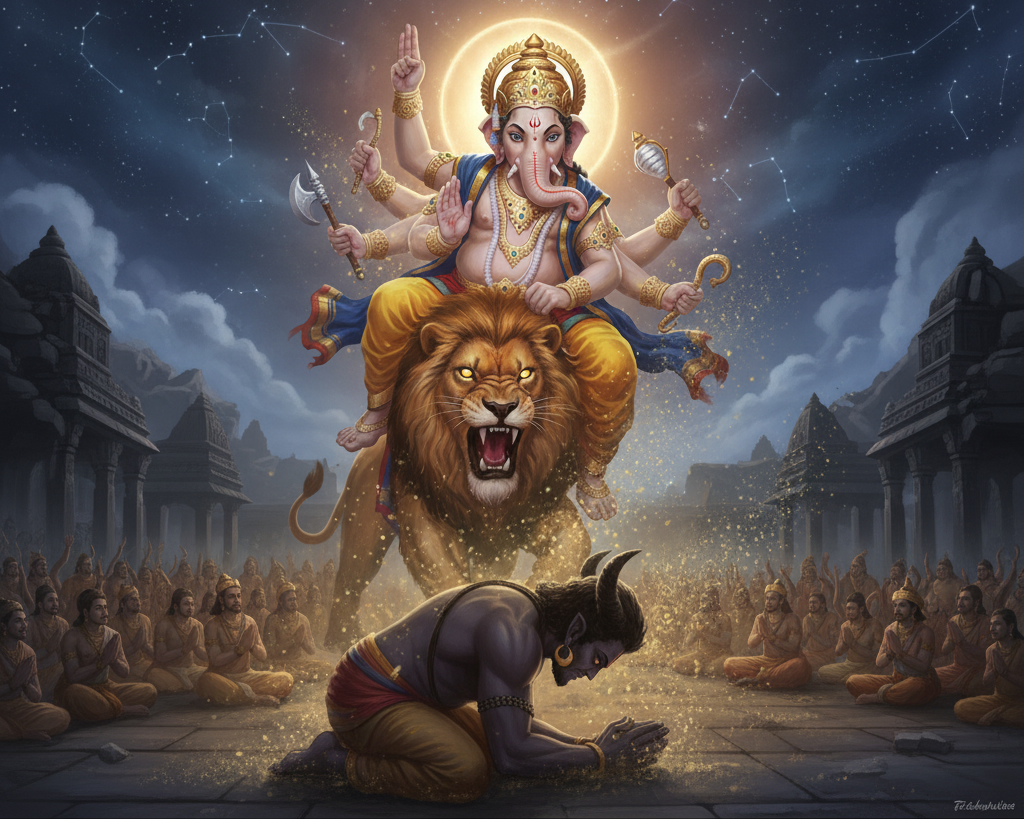
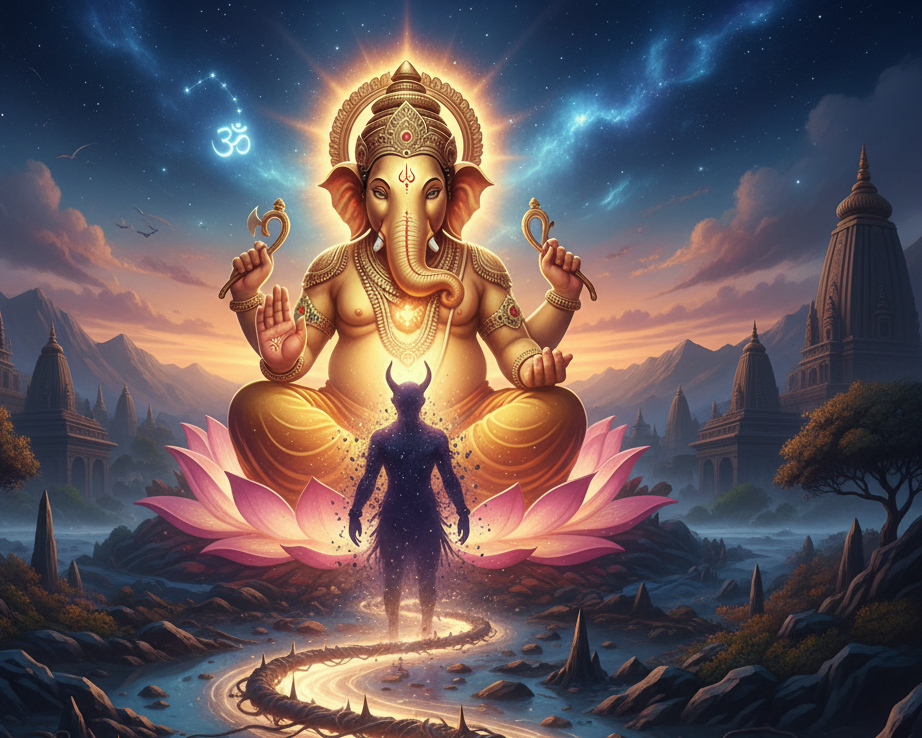
Witnessing the destruction of his sons, Matsaryāsura was overcome not by rage, but by sheer terror. His fearlessness, granted by Shiva, proved useless against the cosmic power of Vakratunda. Realizing the futility of resistance, the demon of envy surrendered completely to Lord Ganesha. Vakratunda, ever compassionate, accepted his surrender, restoring order to the cosmos.
Lessons for Modern Life: Conquering Our Inner Matsaryāsura
By meditating on Vakratunda’s triumph, we are inspired to identify the envy and jealousy within ourselves. We learn that true strength lies not in suppressing these emotions, but in confronting them with the wisdom and grace symbolized by Ganesha. Embracing the spirit of Vakratunda means straightening the “twisted” paths of our minds and aligning ourselves with our higher purpose, free from the chains of envy.
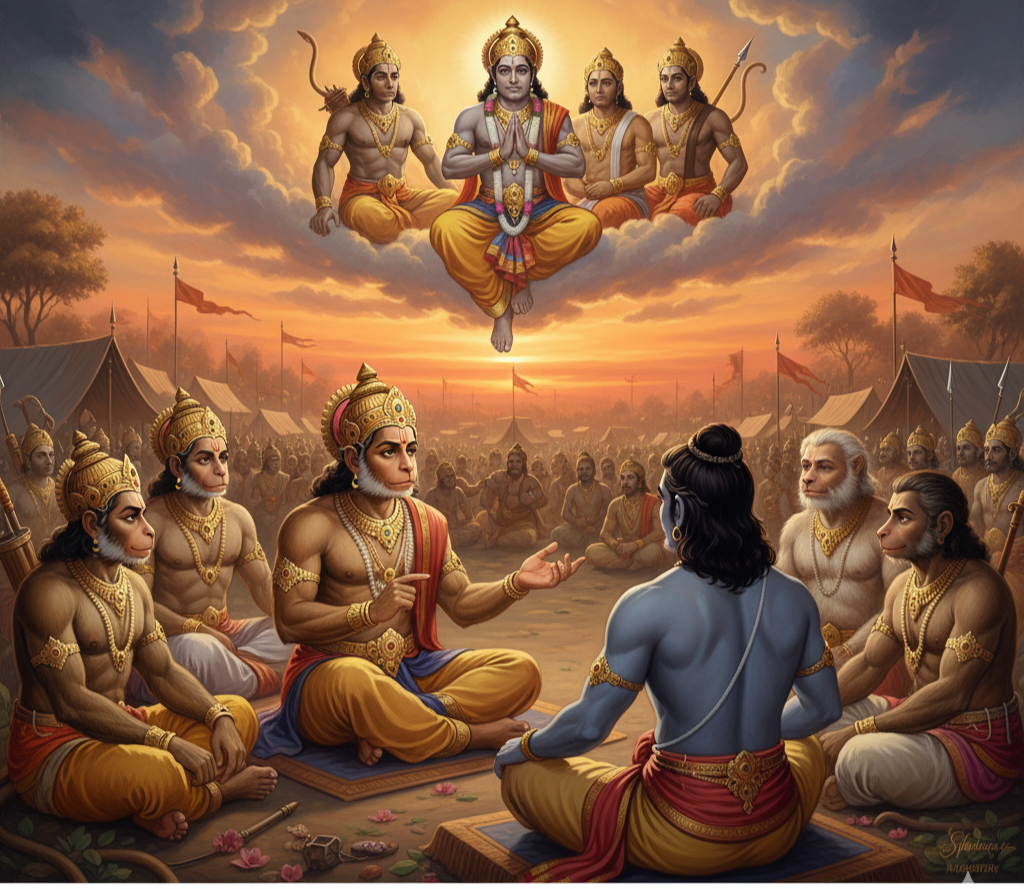
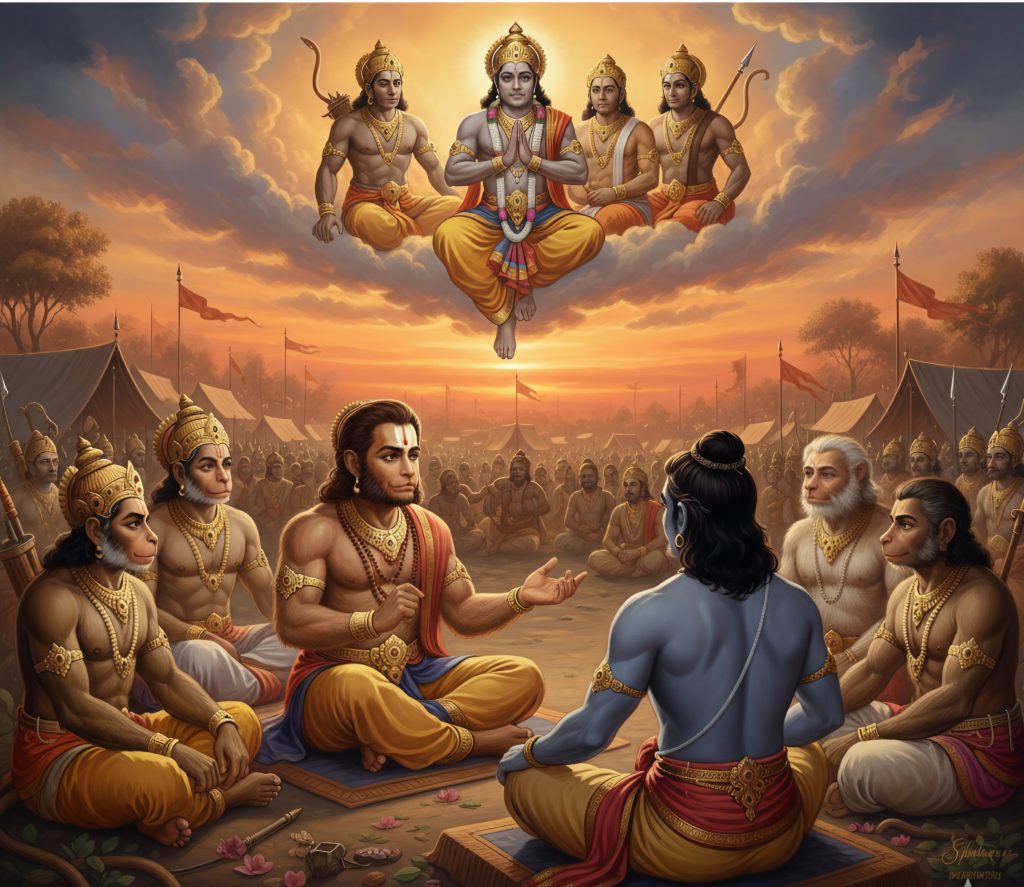
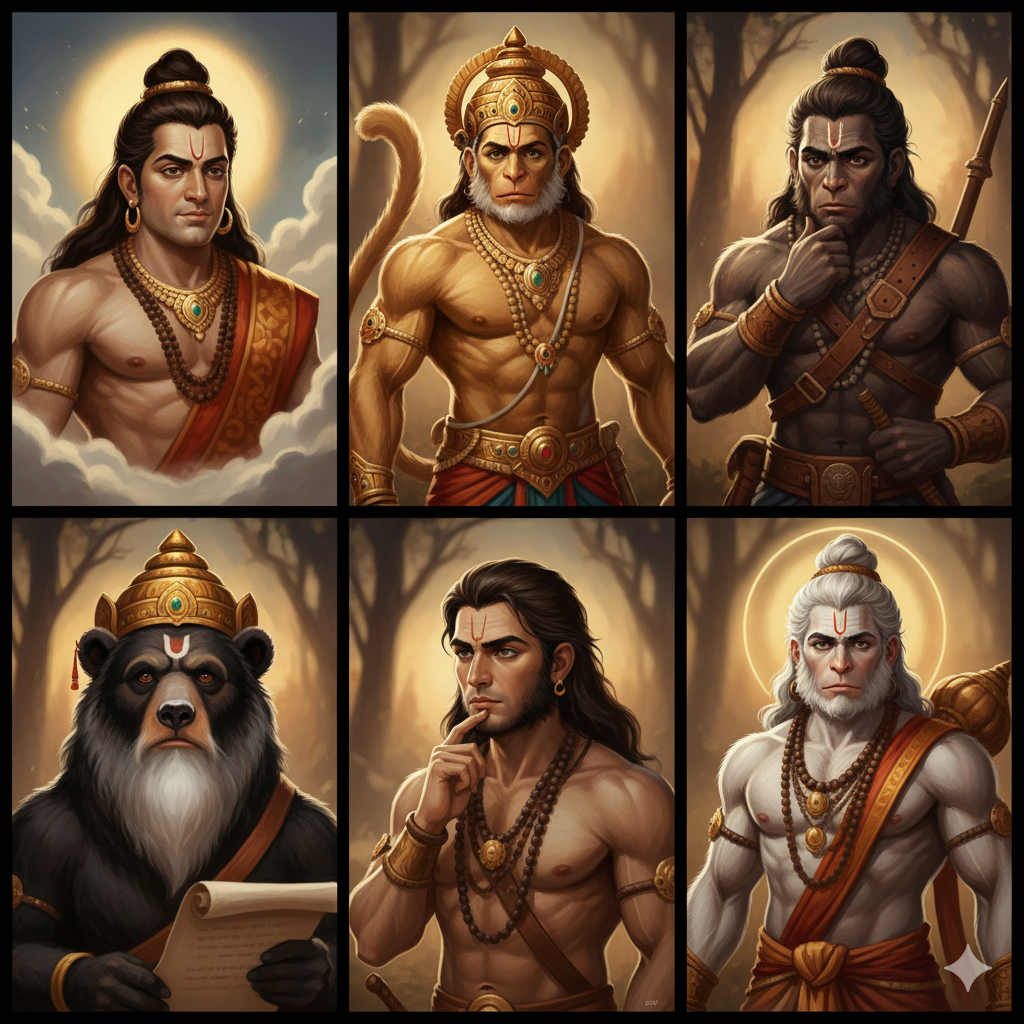
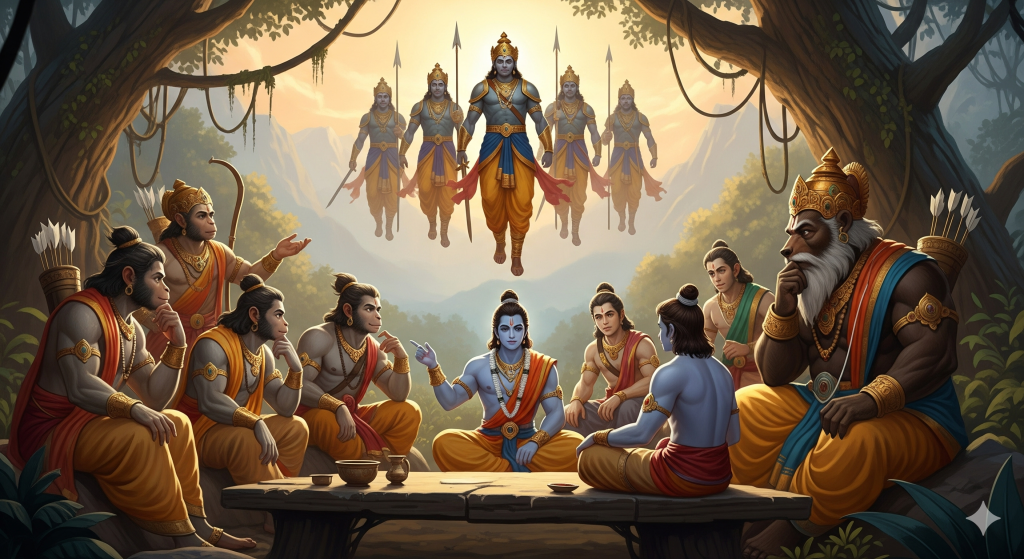
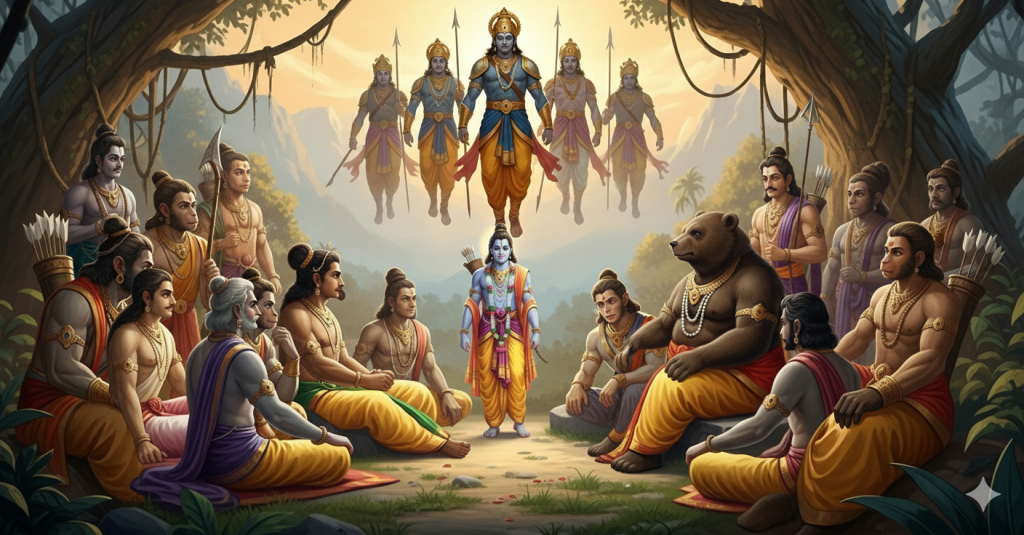
The arrival of Vibhīṣhaṇa at Rāma’s camp was no small event. Here stood the brother of mighty Rāvaṇa, hovering in the sky, declaring his intent to abandon Laṅkā and seek refuge with Rāma. Such a moment could not be taken lightly. For the vānaras, loyal to Rāma and vigilant against every stratagem of the rakṣasas, the question was pressing: Should this unexpected defector be trusted?
Context
Last week, we traced Vibhīṣhaṇa’s dramatic entrance, ending with his heartfelt appeal for shelter at Rāma’s feet. Yet, his words alone were not enough to settle the matter. Before Rāma himself would speak, the vānaras gathered to deliberate. Sugrīva, as king, raised the first doubts; others like Śarabha, Jāmbavān, and Mainda offered their cautionary views. Finally, it was Hanumān who provided a balanced voice — weighing risk and trust with insight.
This week, we turn to their speeches — words that reveal not just their loyalty, but also their distinct temperaments and wisdom as ministers in Rāma’s service.
6-17-18 — (introductory frame) Sugrīva hears Vibhīṣhaṇa’s proclamation and immediately speaks to Rāma — hurried, emphatic, and protective. This verse simply sets the scene: Sugrīva (the army-chief and king) leaps forward to give counsel without delay.
6-17-19 — (the owl metaphor; danger of surprise attack) Sugrīva warns that this guest “belongs to the enemy force” and may have come unawares to slay them at the first opportunity — like an owl preying on crows. The image stresses suddenness and predation: an enemy’s defector could be a trojan horse arriving under cover of friendliness.
6-17-20 — (be alert about organization, plans, and secret service) Sugrīva implores Rāma to be attentive to the mantra (plans), vyūha (battle formations), naya (leadership/strategy) and cāra (espionage/secret service). In short: secure the strategy, deployments and intelligence before accepting anyone new.
6-17-21 — (on rakṣasa nature: shape-shifting and deceit) He reminds the assembly that rakṣasas can change forms at will, disappear, and are both brave and expert in trickery — hence they are not to be trusted. This is an appeal to a generalization based on past experience with the demon-class.
6-17-22 — (the possibility of a planted agent from Ravana) Sugrīva suggests the possibility that Vibhīṣaṇa was sent by Ravana (the rakṣasa-lord) with a covert purpose: once accepted, he could work divisively among them. The verse raises the “planted agent” hypothesis — accept at your peril.
6-17-23 — (how an intelligent infiltrator can find and exploit weakness) He elaborates: a cunning man who enters their camp and gains trust can discover a chink in the armour and, later, strike at the heart of the force. This is a classic warning about insiders: confidence may be weaponized.
6-17-24 — (who to accept and who to reject) Sugrīva distinguishes troop-sources: contingents supplied by friends, locals, hereditary retainers or paid men are acceptable; contingents furnished by an enemy are not. Practically: source matters — provenance of allies/units should be trusted before incorporation.
6-17-25 — (on rakṣasa disposition and caution) He continues the line of argument by invoking rakṣasa disposition (their natural temperament) — the emphasis is that one must neither ignore the nature of the guest nor the fact of his lineage; such considerations weigh heavily in high-stakes decisions.
6-17-26 — (the fact of Vibhīṣaṇa’s identity and companions) Sugrīva points out plainly: this guest is Vibhīṣaṇa, the younger brother of Ravana, and he has come with four rakṣasas. The simple factual statement tightens the earlier suspicion: this is not a lone, neutral seeker but a kinsman of the foe arriving with armed companions.
6-17-27 — (conclusion: treat him as suspect, fit for arrest) Based on the evidence and the line of reasoning, Sugrīva counsels that Vibhīṣaṇa is fit to be arrested — that Ravana may be sending him — so detain him rather than accept him at once. This is a protective, preventative recommendation.
6-17-28 — (warning about hidden intent and witchcraft of deceit) He warns that the rakṣasa may be sent “with crooked intent” and remain hidden by magical arts; faith reposed in him could be used against Rāma. The verse underscores the fear of concealed motive and subterfuge.
6-17-29 — (use force: detain swiftly and decisively) Sugrīva urges decisive, forceful action — bind or detain him speedily with strong measures (daṇḍena), together with the counsellors. The recommendation moves from cautious observation to immediate arrest and restraint.
6-17-30 — (silence after the counsel) After delivering his rapid, security-first argument, Sugrīva falls silent — the speech has been made; now the king must decide and the council will speak in turn. The silence marks deference and the end of his urgent counsel.
Brief synthesis (how Sugrīva’s advice fits the council)
Sugrīva’s whole speech is a tightly argued case for security first: verify or restrain before you trust. His logic proceeds from:
The observed nature and capabilities of rakṣasas (shape-changing, deceit),
The political possibility of a sent agent,
The strategic need to protect formations and intelligence, to
The practical recommendation of immediate detention if doubt remains.
In leadership terms he is the risk-manager: prioritize continuity, secrecy and contingency protection over immediate magnanimity.
Sharabha
Śarabha is one of Sugrīva’s councillors; practical and decisive in counsel.
Śarabha’s Counsel
6-17-43 — (suspicion about timing and motive) Śarabha begins by pointing out the timing of Vibhīṣhaṇa’s arrival: “At the time when a great battle is about to take place, this rakṣasa approaches you.” His implication is clear — the suddenness is suspicious. If Vibhīṣhaṇa were truly loyal to Rāma, why wait until the eve of war? The doubt is not about his words, but about his motives and timing.
6-17-44 — (warns of espionage; suggests probing) Śarabha goes further, suggesting that Vibhīṣhaṇa may have been deliberately sent as a spy by Rāvaṇa, to infiltrate Rāma’s camp. He advises a practical measure: do not accept him at face value, but rather send out skilled spies to test the truth of his intentions before taking any decision.
In short: Śarabha’s counsel is one of suspicion and verification. He does not outright reject Vibhīṣhaṇa but urges caution through counter-intelligence.
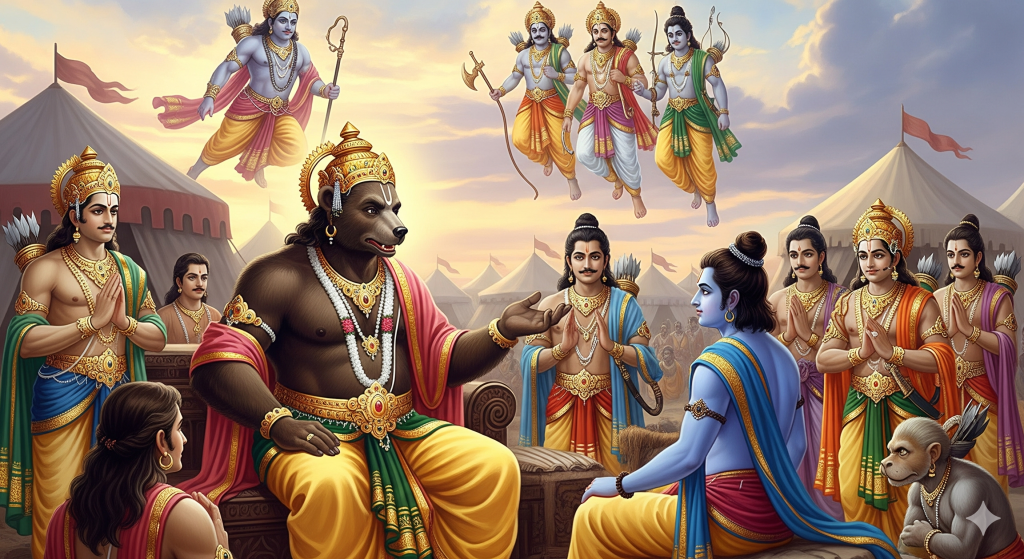
Jāmbavān
Jāmbavān is the venerable, scripture-learned elder (the wise bear); his voice grounds the council in tradition and prudence.
Jambavan’s counsel
6-17-45 — (deep distrust due to rakṣasa nature) Jāmbavān, the aged and wise bear-elder, speaks with calm gravity. He declares that Vibhīṣhaṇa should not be trusted simply because he comes seeking refuge. “A rakṣasa is by nature deceitful.” His counsel is to guard against misplaced compassion, for an enemy’s essence may not change overnight.
6-17-46 — (suspicion of calculated timing) He sharpens his doubt by focusing on circumstance: Vibhīṣhaṇa arrives precisely when the war is imminent. To Jāmbavān, this is not a coincidence but a tactic. He concludes that it is prudent to assume danger and not give him shelter.
In short: Jāmbavān’s counsel stresses essential mistrust — both because of Vibhīṣhaṇa’s rakṣasa identity and the timing of his appearance. Unlike Śarabha, who suggested probing, Jāmbavān recommends outright rejection as the safer course.
Mainda
Mainda is one of the Vānarā commanders known for discernment and reasoned speech.
Mainda’s Counsel
6-17-47 — (doubtful of intention, reminds of rakṣasa guile) Mainda, son of the Aśvinī gods and a sharp-minded warrior, begins with caution. He stresses that rakṣasas excel in cunning and in disguising their true intent. Accepting one of them blindly would be perilous.
6-17-48 — (question and test rather than accept outright) Instead of rejecting Vibhīṣhaṇa outright, Mainda suggests a middle path: he should be questioned carefully. By probing his words, testing his consistency, and watching his reactions, one can discern his real purpose. This blends skepticism with investigative pragmatism.
6-17-49 — (reading sincerity from words and demeanor) Mainda adds that when words and inner intent align, sincerity reveals itself. If Vibhīṣhaṇa’s responses withstand scrutiny and his behavior shows no duplicity, then his refuge might be genuine. Until then, caution is necessary.
In short: Mainda suggests a policy of testing and discernment — neither immediate trust (too risky) nor absolute rejection (possibly wasteful), but a process of probing speech and intent to uncover truth.
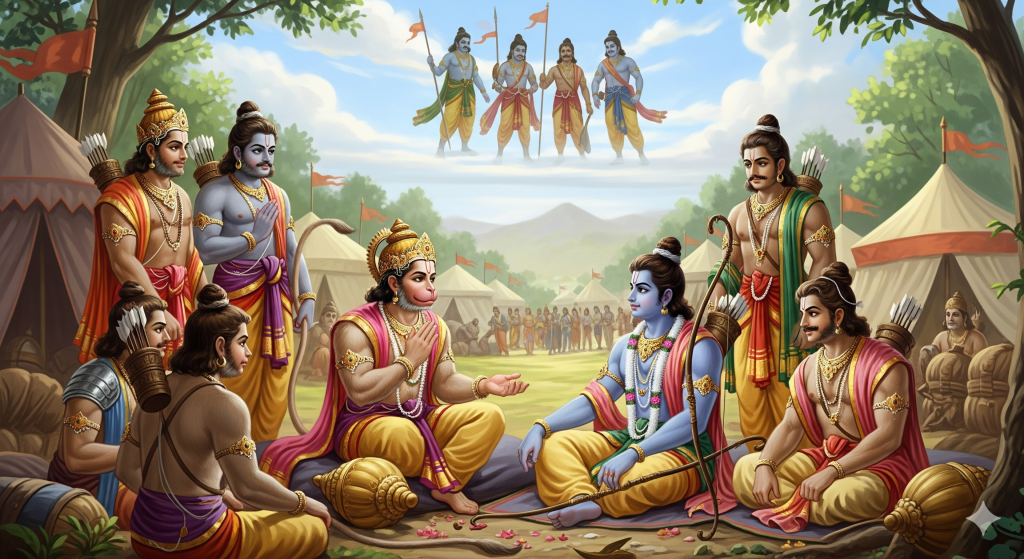
Hanumān
Hanumān is Rāma’s chief minister and envoy — learned, devoted, psychologically acute; his counsel blends compassion and practical insight.
Below is Hanumān’s counsel given in verses 6-17-50 → 6-17-68. Below is a table that highlights Hanuman’s advice that’s categorized into intent
Verse #:
Intent
Verses 6-17-50 → 6-17-54
Opening lines
Verses 6-17-55 → 6-17-59
Wise discernment of character
Verses 6-17-60 → 6-17-64
On questioning and signs
Verses 6-17-65 → 6-17-68
Motives & final appeal
Hanuman’s counsel
6-17-50
Introductory verse — it frames Hanumān as learned, eloquent and concise. Expect measured, wise counsel rather than heat or haste.
6-17-51
Hanumān opens by honoring Rāma (and the council) — not flattery but establishing respect. This calibrates his forthcoming counsel as sincere, humble, and addressed to a leader of high discernment.
6-17-52
Hanumān explicitly disavows debate-for-debate’s-sake — he positions his speech as practical and duty-driven, signalling that what follows is intended to help decision-making, not to score points.
6-17-53
Hanumān questions the feasibility of the proposed probes (spying/tests). He’s not dismissing caution, but noting a practical limit to the inspectors’ recommendations.
6-17-54
Balanced view: Hanumān acknowledges both sides — you must give tasks to know someone’s capacity, yet it is risky to entrust a newcomer immediately. He is weighing practical trade-offs.
6-17-55
A direct response to the “send a spy” suggestion: Hanumān says that while theoretically sound, it’s impractical here — either because of timing, detection risk, or circumstances.
6-17-56
Hanumān signals he will present his own reasoning about why Vibhīṣhaṇa has come now — preparing the council for an alternative reading of motive and timing.
6-17-57
Hanumān suggests interior motive: Vibhīṣhaṇa recognized Rāma’s superiority and Ravana’s faults — therefore the timing makes sense if the refugee is sincere.
6-17-58
This expands the previous verse: Hanumān reads Vibhīṣhaṇa’s decision as sensible judgment rather than trickery — arriving when hope of just rule exists and when Ravana’s cruelty is clear.
6-17-59
Hanumān now addresses the “question by spies” proposal directly, preparing to explain why that method may fail or backfire.
6-17-60
Hanumān warns that surprise-testing destroys trust. If you trick someone to prove loyalty, you may instead make a genuine friend suspicious and push them away.
6-17-61
Hanumān points out practical limits: only a master judge can read subtle cues quickly; ordinary spy-tests may misread honest hesitation as deceit.
6-17-62
Hanumān reports his own observation: Vibhīṣhaṇa’s words and countenance show no malice — important because he’s present, perceptive, and trustworthy to the council.
6-17-63
Hanumān reasons from behavior: someone plotting betrayal wouldn’t come openly and calmly. Openness and composure argue for sincerity.
6-17-64
Hanumān says inner intent leaks out in demeanor; even if words are practiced, true feelings show. This is an argument for relying on human observation and character-reading.
6-17-65
Hanumān notes that action timed and executed well succeeds — implying that decisive, well-judged acceptance can be effective; dithering or deceptive tests may waste the moment.
6-17-66
Hanumān gives the political reading: Vibhīṣhaṇa has practical motives — he sees Rāma’s advantage and Ravana’s weakness and therefore seeks a rightful position. This reframes the motive from treachery to ambition tied to dharma.
6-17-67
Crucial verdict: Hanumān argues that this motive (seeking legitimate kingship after seeing Ravana’s evil and Rāma’s strength) is sufficient reason to accept Vibhīṣhaṇa — a pragmatic, moral acceptance.
6-17-68
Verse 68 closes Hanumān’s argument: combine observation of intent, the situation (power + wrongdoing), and the candidate’s frankness — the wise should recognize sincerity and act. It’s the culmination of his balanced, experience-based counsel.
Hanumān’s Conclusion
Hanumān combines political realism (Vibhīṣhaṇa has a clear motive: his brother’s wrongdoing and the opportunity to claim the kingdom with Rāma’s support) and psychological insight (his demeanor and words bear the marks of sincerity). Importantly, Hanumān does not presume to decide for Rāma. Instead, he urges that the final judgment rests with the prince, after hearing all counsel. This measured, respectful close is what tips the debate toward dharma rather than suspicion, preparing the stage for Rāma’s decisive words.
In this way, Hanumān skillfully balances caution with compassion, transforming doubt into discernment and guiding the council toward trust — while leaving the ultimate decision to Rāma.
Short summary of the verses from this section : 6-17-11 → 6-17-68
Vibhīṣaṇa (6-17-11 → 6-17-17): Proclaims his identity, condemns Rāvaṇa’s arrogance, and seeks refuge with Rāma.
Sugrīva (6-17-18 → 6-17-30): Strongly warns against immediate trust; stresses caution and vigilance, noting it could be a ploy from Rāvaṇa to cause harm.
Śarabha (6-17-43 → 6-17-44): Suggests sending a spy first to quietly observe.
Jāmbavān (6-17-45 -> 6-17-46): Distrusts due to Vibhīṣaṇa’s sudden appearance and suspicious timing.
Mainda (6-17-47 → 6-17-48): Recommends gentle questioning to gauge sincerity.
Hanumān (6-17-50 → 6-17-68): Advises against trap-thinking, highlights openness in Vibhīṣaṇa’s demeanor, recognizes his valid motive to defect, and concludes by leaving the final decision to Rāma.
Leadership Insights from Vibhīṣaṇa’s Arrival
The debate in this Sarga is not only a spiritual and epic moment but also a masterclass in leadership and decision-making. Each speaker brings a unique perspective that can be applied to modern management and team dynamics.
1. Sugrīva – Caution & Risk Awareness
Context: As king of the vānaras, Sugrīva immediately suspects deception. He warns Rāma that the rākṣasas are masters of disguise and trickery (verse 6.17.21).
Lesson: A good leader should never overlook risks. Healthy suspicion protects an organization from threats. However, caution must be balanced with openness, else opportunities may be lost.
2. Śarabha – Balanced Prudence
Context: Śarabha, one of Sugrīva’s ministers, advises that it is not wise to reject Vibhīṣaṇa outright but equally unwise to accept him blindly (verse 6.17.43).
Lesson: Prudence is about balance—neither total mistrust nor naïve acceptance. Leaders must weigh pros and cons, gather information, and avoid hasty decisions.
3. Jāmbavān – Wisdom from Experience
Context: The wise elder Jāmbavān reminds the assembly that decisions should be guided by experience and precedent, not just emotion.
Lesson: In organizations, senior advisors bring the weight of past experience. Respecting their insights ensures decisions are grounded and less impulsive.
4. Mainda and Dvivida – Analytical Thinking
Context: The twin vānaras analyze the situation logically, pointing out practical aspects of accepting or rejecting Vibhīṣaṇa.
Lesson: Analytical leaders break down complex problems, remove emotional bias, and present facts clearly. Teams need such rational voices to balance passion with reason.
5. Hanumān – Strategic Vision & Fair Judgment
Context: Hanumān provides the most balanced counsel. He assesses Vibhīṣaṇa’s words, demeanor, and situation objectively, concluding that he seems trustworthy (verse 6.17.52).
Lesson: Great leaders are fair judges of character. They combine empathy with strategy, ensuring that decisions are both compassionate and aligned with long-term goals.
Management Insights from the Vanara Council
A management team that brings together these diverse perspectives—caution (Sugrīva), alert skepticism (Śarabha), balanced pragmatism (Jāmbavān), positive trust in ability (Mainda), and Hanumān’s discerning compassion—forms a strong collective. Each voice highlights a crucial aspect of leadership: risk-awareness, critical scrutiny, experience-based judgment, constructive optimism, and fair strategic insight. When such complementary qualities come together, decisions become not only well-rounded but also resilient and humane in the face of uncertainty.
Closing Thoughts
The arrival of Vibhīṣaṇa and the subsequent debate among the vānaras show how collective wisdom emerges from diversity of thought. Each minister voiced a unique perspective, yet together they shaped a decision that was both cautious and courageous.
For us today, this reminds us that effective leadership is not about unanimity, but about listening, discerning, and integrating different viewpoints. When a team can balance caution with trust, skepticism with pragmatism, it creates a foundation for decisions that stand the test of time.