Righteous Refuge
Introduction
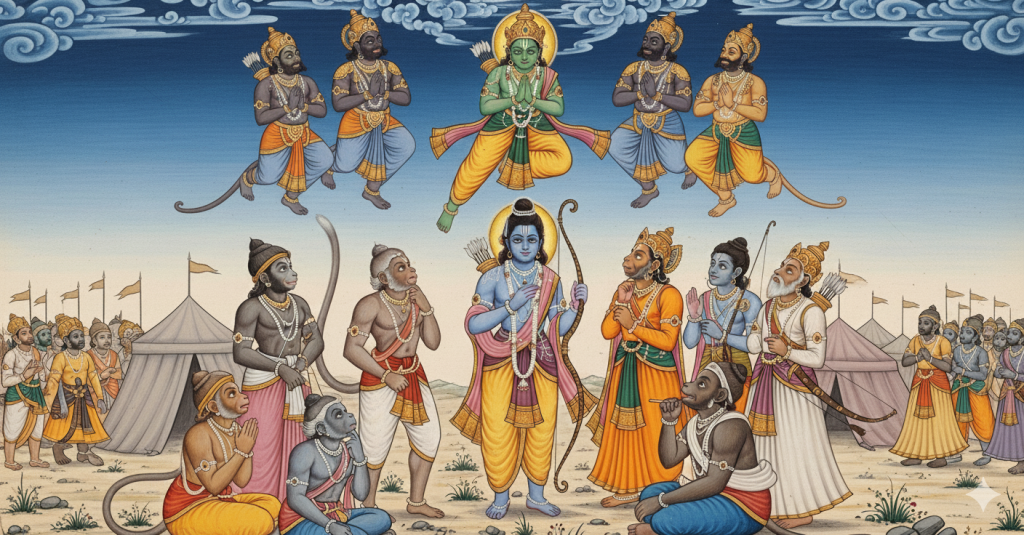
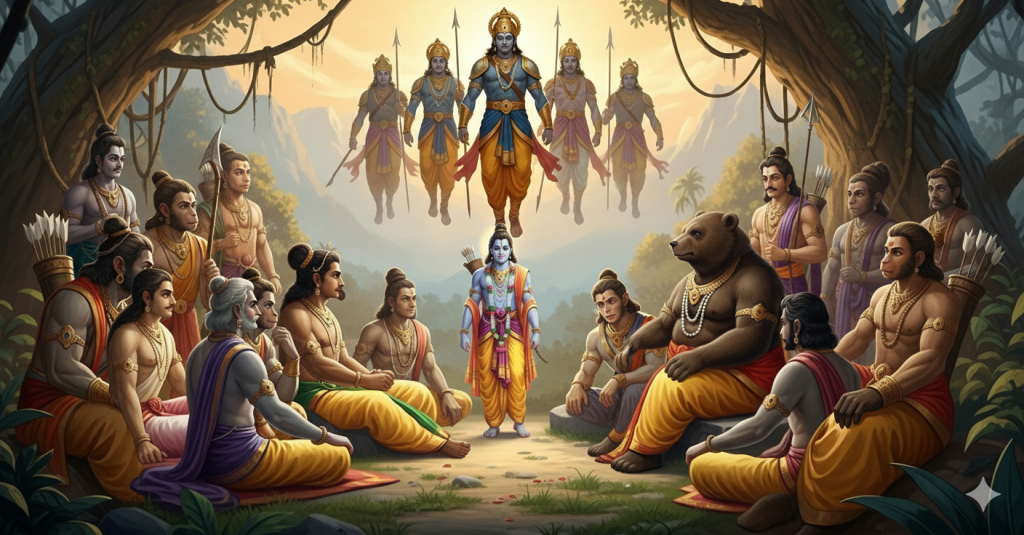
In Yuddha Kāṇḍa Sarga 17 of the Valmiki Rāmāyaṇa, we witness a turning point in the great battle against Rāvaṇa. Vibhīṣaṇa, the younger brother of the demon king, leaves the kingdom of Laṅkā, declaring his loyalty to Rāma. His arrival in the sky above Rāma’s camp immediately sparks a debate among the vānaras — leaders and ministers of Rāma’s army — each bringing a distinct perspective on whether this new ally can be trusted.
This Sarga provides not only a thrilling narrative but also timeless lessons in leadership, discernment, and group decision-making.
The discussion over Vibhīṣaṇa’s arrival is not just a tale from the Rāmāyaṇa, but a masterclass in leadership and decision-making.
Context
Vibhīṣaṇa, accompanied by four companions, arrived above Rāma’s camp and sought refuge at His feet. Suspended in the sky, he declared his intention to join Rāma’s side. Sugrīva, however, warned that a demon could never be trusted.
To resolve the dilemma, Rāma turned to His council of leaders for their counsel. Angada, Śarabha, Jāmbavān, and Mainda voiced their doubts, questioning the sincerity of Vibhīṣaṇa’s request.
Hanumān alone spoke differently: he argued that Vibhīṣaṇa had recognized both the virtues of Rāma and the flaws of Rāvaṇa, and that his desire to defect was also tied to his hope of rightfully ruling Laṅkā. With this balanced perspective, Hanumān urged Rāma to render the final decision.
In this post we present the heroic arrival of Vibhishana as described in the Valmiki Ramayana.
Heroic Arrival of Vibhīṣhaṇa

(Yuddha Kāṇḍa, Sarga 17: Verses 1–5)
Verse 6-17-1
Sanskrit (transliteration):
iti uktvā paruṣam vākyaṃ rāvaṇaṃ rāvaṇānujaḥ |
ājagāma muhūrteṇa yatra rāmaḥ salakṣmaṇaḥ
Translation:
“Having spoken the aforesaid harsh words to Rāvaṇa, Vibhīṣhaṇa arrived almost immediately to the place where Rāma was together with Lakṣmaṇa.” Valmiki Ramayana
Commentary:
With dramatic turn, we see Vibhīṣhaṇa’s departure from Rāvaṇa’s realm. No delay—he arrives swiftly upon the battlefield, heralding a radical shift: the brother of the enemy now stands among Rāma’s camp.
Verse 6-17-2
Sanskrit (transliteration):
tam meru śikhara ākāraṃ dīptaṃ iva śata hṛdaṃ |
gagana-stham mahīsthāś te dadṛśur vānarādhipāḥ
Translation:
“Those leaders of monkeys standing on the ground saw Vibhīṣhaṇa, resembling the peak of Mount Meru and shining like a thunderbolt in the sky.” Valmiki Ramayana
Commentary:
In an almost cinematic moment, Vibhīṣhaṇa hovers brilliantly in the sky—cosmic imagery—a mountain’s summit aflame, a thunderbolt frozen in the heavens. It’s a divine interruption, freezing the attention of all below.
Verse 6-17-3
Sanskrit (transliteration):
te ca apy anucaraās tasya catvāro bhīma-vikramaāḥ |
te api varmayaudh-upetā bhūṣhaṇottama-bhūṣhitāḥ
Translation:
“His four companions of terrific prowess were also there with him. They were wearing weapons and armour and were adorned with excellent ornaments.” Valmiki Ramayana
Commentary:
Vibhīṣhaṇa is not solitary—he descends with four regal companions, each a warrior in splendor. It is no stealthy escape but a bold and ceremonial entrance, commanding respect.
Verse 6-17-4
Sanskrit (transliteration):
sa ca meghācalaprakāśo vajrāyudh-samaprabhaḥ |
varāyudhadharo vīraḥ divyābharaṇa-bhūṣhitaḥ
Translation:
“Vibhīṣhaṇa also resembled a mass of cloud, the equal of the God who wields the thunderbolt. He was holding excellent weapons and was adorned with wonderful jewels.” Valmiki Ramayana
Commentary:
The metaphor grows more powerful. He is compared to a cloud-mountain and Indra’s thunderbolt. Clad in divine ornaments and weapons, he radiates authority and supernatural presence—no mere wanderer, but a dignified claimant of dharma.
Verse 6-17-5
Sanskrit (transliteration):
tam ātmā pañcamaṃ dṛṣṭvā sugrīvo vānarādhipaḥ |
vānaraiḥ saha durdharṣhaḥ cintayām āsā buddhimān
Translation:
“Sugrīva the valiant of monkeys, who was difficult to be overpowered, having seen Vibhīṣhaṇa, the fifth one along with four others, became thoughtful along with monkeys.” Valmiki Ramayana
Commentary:
Even the mighty Sugrīva pauses. This is no routine audience—it is a turning point. Sugrīva’s thoughtful stillness together with the vānaras marks a shift from normalcy to alert consciousness: something extraordinary—and potentially dangerous—is unfolding.
Vibhīṣaṇa’s Plea for Refuge

(Verses 6-17-11 to 6-17-17)
Verse 6-17-11
Sanskrit (Transliteration from the page):
sa uvaaca ca mahaapraaGYaH svareNa mahataa mahaan |
sugriivam taam ca samprekShya khastha eva vibhiiShaNaH
Translation (from the page):
“That great and highly intelligent Vibhīṣhaṇa, halting in the sky itself, saw Sugrīva and those monkeys and spoke to them in a loud voice.” Valmiki Ramayana
Commentary:
Vibhīṣhaṇa takes the initiative — speaking loudly so all can hear. His composed presence in the sky conveys authority and clarity before he even speaks his plea.
Verse 6-17-12
Transliteration:
raavaNo naama durvR^itto raakShaso raakShasa iishvaraH |
tasya aham anujo bhraataa vibhiiShaNa iti shrutaH
Translation:
“There is a demon called Ravana, the king of demons, having a bad conduct. I am his younger brother, known as Vibhīṣhaṇa.” Valmiki Ramayana
Commentary:
Vibhīṣhaṇa introduces himself plainly, acknowledging his lineage yet distancing himself morally — a statement both honest and bold.
Verse 6-17-13
Transliteration:
tena siitaa jana sthaanaadd hR^itaa hatvaa jaTaayuSham |
ruddhvaa ca vivashaa diinaa raakShasiibhiH surakShitaa
Translation:
“It is Ravana who, having killed a bird Jatayu, took away Sita from Janasthana. That unfortunate lady is held captive against her will and she is now amidst the female titans who guard her jealously.” Valmiki Ramayana
Commentary:
He speaks factually, recounting Ravana’s crime and Sītā’s suffering. This frames his plea within the moral imperative of justice.
Verse 6-17-14
Transliteration:
tam aham hetubhir vaakyair vividhaiH ca nyadarshayam |
saadhu niryaatyataam siitaa raamaaya iti punaH punaH
Translation:
“I persuaded Ravana again and again by my diverse words and arguments to restore Sita smoothly to Rama.” Valmiki Ramayana
Commentary:
Vibhīṣhaṇa positions himself as a repentant brother — one who repeatedly sought peace through reason, not force.
Verse 6-17-15
Transliteration:
sa ca na pratijagraaha raavaNaH kaala coditaH |
ucyamaano hitam vaakyam vipariita iva auShadham
Translation:
“That Ravana, impelled by fate, did not receive my sage advice — as a perverted person does not accept his prescribed medicine.” Valmiki Ramayana
Commentary:
The analogy of medicine portrays Vibhīṣhaṇa’s counsel as wise yet ignored — Ravana’s stubbornness cost righteousness and drove Vibhīṣhaṇa to seek refuge elsewhere.
Verse 6-17-16
Transliteration:
so aham paruShitas tena daasavac ca avamaanitaH |
tyaktvaa putraamH ca daaraamH ca raaghavam sharaNam gataH
Translation:
“Reviled by him and humiliated as a slave, I, leaving my sons and my wife, have come to take refuge with Rama.” Valmiki Ramayana
Commentary:
Vibhīṣhaṇa’s personal cost becomes clear — he left loved ones and endured insult to uphold dharma. It underlines the sincerity of his surrender.
Verse 6-17-17
Transliteration:
nivedeayata maam kshipram raaghavaaya mahaatmane |
sarva loka sharaNyaaya vibhiiShaNam upasthitam
Translation:
“Inform immediately to high-soled Rāma, the protector of all the worlds, that I, Vibhīṣhaṇa, have come here.” Valmiki Ramayana
Commentary:
The plea is formal and urgent — he bows to dharma and offers allegiance. Addressing Rāma as the ‘Protector of all worlds’ reveals reverence and humility.
Reflection
This “Heroic Arrival” scene merges the cosmic with the political, the poetic with the strategic. Vibhīṣhaṇa’s descent is at once awe-inspiring and tension-inducing—a divine plea that carries the weight of decisions yet to come. It poses critical questions from the very outset: How should one receive a being from the enemy camp who arrives with such dignity? How do dharma and strategy intersect when cosmic spectacle meets battlefield?
Closing Thoughts
Closing Thoughts
Vibhīṣhaṇa’s sudden appearance in Rāma’s camp marks a turning point in the Yuddha Kāṇḍa. A brother of Rāvaṇa, stepping away from the might of Laṅkā and seeking shelter in Rāma, brings both hope and uncertainty. His arrival sets the stage for one of the most profound debates in the epic—how to balance caution with compassion, and strategy with dharma.
Next week, we will journey into the counsel of Sugrīva, Jāmbavān, Hanumān, and others, as they weigh the motives and truth of Vibhīṣhaṇa’s words—revealing timeless insights into leadership, trust, and divine discernment.
Citation
All verses and translations are from: Valmiki Ramayana – Yuddha Kāṇḍa, Sarga 17
Samastah Lokah Sukhino Bhavanthu
May All the Beings in All the Worlds be Happy!

Jai Sai Ram!
Please note all content and images generated using AI Tools