Month: May 2026

A Line Drawn by the Divine: The Moon and Jupiter’s Intimate Evening Rendezvous

A Line Drawn by the Divine: The Moon and Jupiter’s Intimate Evening Rendezvous

If last night’s sky was a grand, sweeping dance across the western horizon, tonight was an intimate, hushed conversation between two cosmic giants.

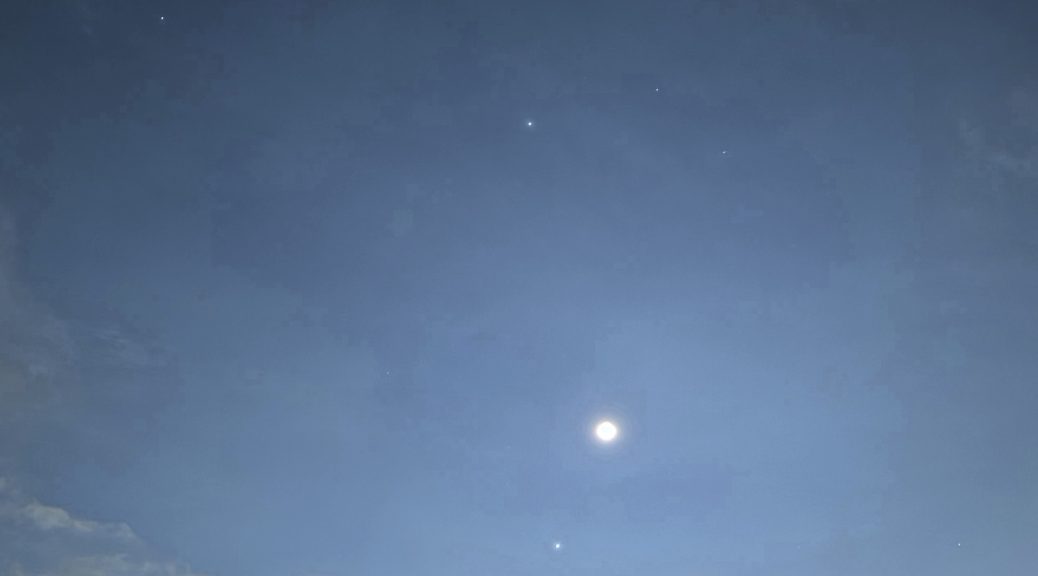
Returning to the rooftop this Wednesday evening, May 20th, 2026, the Bengaluru skies cleared once more to reveal a sight so perfectly geometric, it felt less like random cosmic mechanics and more like deliberate artistry (click on any photo to open it in a new tab)

Moon and Jupiter aligned on a horizontal straight line

It was as if the Divine took a 12-inch ruler, drew a flawless, crisp line across the deep twilight sky, and carefully placed the crescent Moon and Jupiter side-by-side right upon it.

The Shift in the Cosmic Choreography
The Moon is a swift traveler. Just twenty-four hours prior, it hung gracefully as a bridge between brilliant Venus below and regal Jupiter above. Tonight, continuing its eastward journey across the zodiac, the Moon climbed significantly higher, leaving Venus to burn intensely near the horizon while it side-stepped right up to Jupiter.

1. A High-Society Celestial Gathering (7:20 PM – 7:25 PM)

In the early evening frames, the true scale of this planetary mixer became beautifully apparent. While the Moon and Jupiter held center stage, the western sky felt like a bustling social evening for the stars.

Framing the top and sides of the planetary pair were the familiar guardians of Gemini—Castor and Pollux—while surrounding stellar neighbors sparkled through the clean, post-rain atmosphere. The planets weren’t merely passing through empty space; they were attending a brilliantly lit cosmic party.
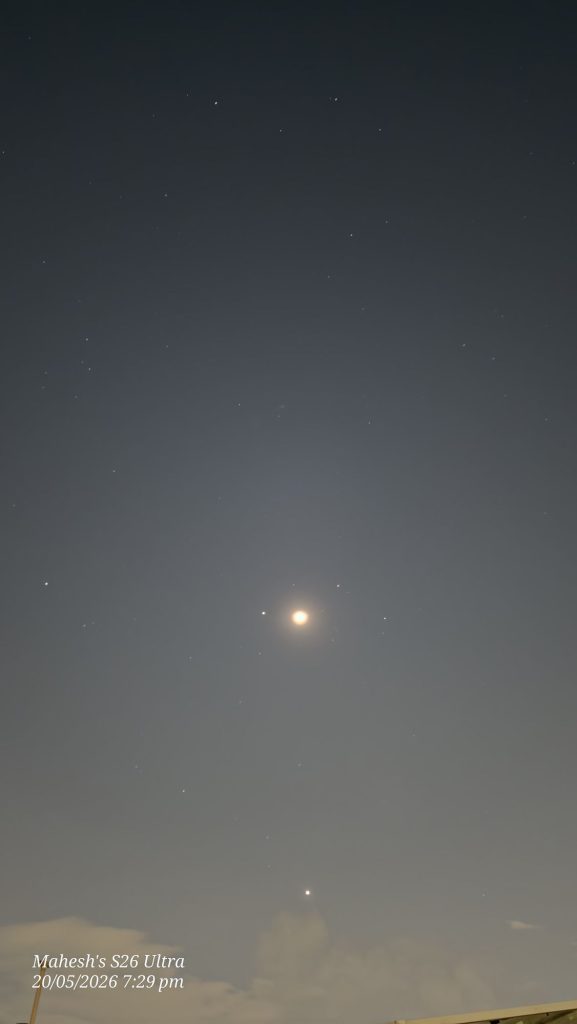
Stellar Party

2. Balanced on a Needle’s Point
As twilight surrendered to the night, the sheer proximity of the two bodies became breathtaking. Looking through the lens, the alignment was strikingly linear.

Jupiter, the king of the planets, shone with a brilliant, steady, diamond-like intensity just a fraction of a degree away from the lunar limb. The perfect horizontal alignment created a powerful sense of balance, symmetry, and cosmic order.

3. The Perfect Da Vinci Glow (7:27 PM & 7:33 PM Close-ups)
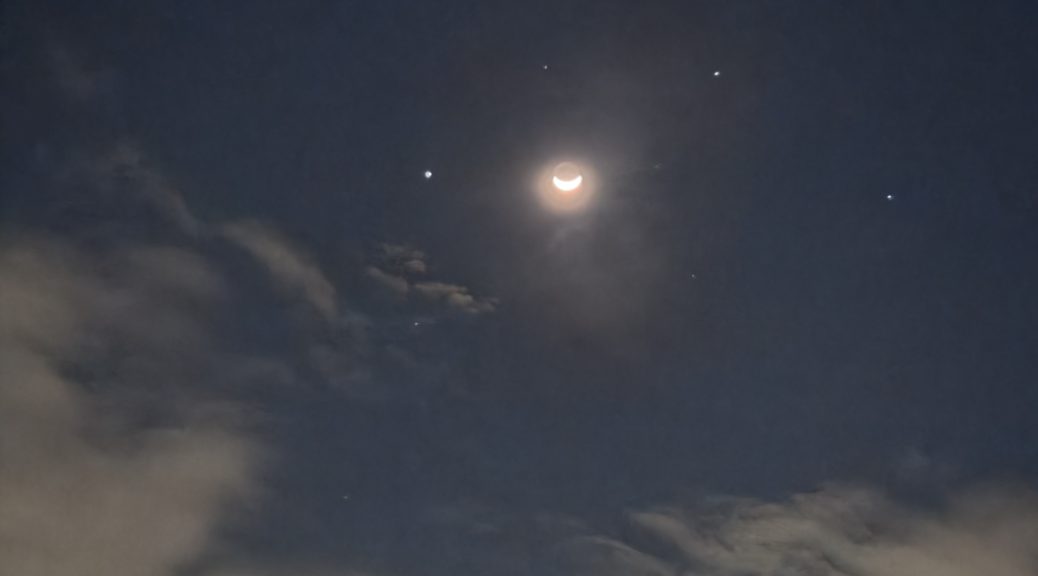
When zooming directly into the pair, the phone’s sensor pulled off a magnificent feat of exposure. In the dedicated close-ups, the blazing, sunlit silver crescent curve is razor-sharp.

Yet, cradled within that bright arc is the unmistakable, ghostly silhouette of Earthshine. The unlit portion of the Moon glows softly with the reflected light of Earth’s oceans and clouds. Capturing this haunting “old Moon in the new Moon’s arms” right next to the piercing point of Jupiter feels incredibly profound.

4. Piercing the Surface: The View Through the Dwarf Mini (7:58 PM)
While the mobile sensor captured the magnificent atmosphere and planetary alignment of the evening, switching over to the smart telescope unlocked an entirely new dimension of the experience.

Stepping away from the wide field and pushing deep into the lunar architecture, the optics resolved the crescent with jaw-dropping clarity.

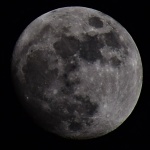
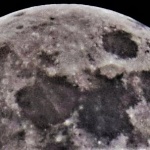
Along the terminator line—the shadow line where lunar day meets night—the stark, dramatic play of sunlight highlights individual crater rims, deep impact basins, and rugged mountain ridges. Seeing the soft, ghostly glow of Earthshine via wide-angle suddenly paired with raw, hard-edged topographical crags brings a beautiful, scientific intimacy to tonight’s stargazing session.


Transcendental Reflection: Trusting the Precision of the Universe
There is immense comfort to be found in looking up at a sky that aligns itself with such absolute, geometric precision.

In our human lives, we often feel like we are navigating chaos. Our schedules cross, our plans drift, and the trajectories of our days can feel cluttered and unaligned. We scramble to find balance, wondering if the pieces of our lives will ever line up.

Yet, the same unseen laws that effortlessly balance a multi-billion-ton planet next to our silver Moon on a perfect, imaginary line—and carve the ancient craters on its surface—are quietly at work behind the scenes of our lives. Tonight’s alignment is a gentle reminder to trust the underlying order of things.

We do not have to force the alignment of our lives; sometimes, we simply need to keep moving along our orbit, trusting that when the timing is right, the clouds will part, the lines will straighten, and everything will balance out perfectly.


Over to You
Did you step outside to see the Moon and Jupiter standing side-by-side tonight?
Piercing the Storm: Capturing the Moon, Venus, Jupiter, and the Twins of Gemini

Piercing the Storm: Capturing the Moon, Venus, Jupiter, and the Twins of Gemini

There is a distinct, breathless magic that occurs when the celestial clockwork aligns perfectly to pierce through a stormy night.

Earlier this evening, right here in Bengaluru, the heavy pre-monsoon clouds parted just enough to reveal a breathtaking cosmic triad: a delicate, glowing crescent Moon suspended beautifully in the western sky, flanked by the two brightest planets in our solar system—Venus and Jupiter.

For those tracking the heavens this week, the Moon has been on an elegant pilgrimage, visiting the evening planets one by one. While the monsoon-laden skies blocked out yesterday’s view, tonight offered a blessed, short-lived window of absolute clarity. It was a visual reminder that no matter how dense the earthly clouds around us become, the grand alignment of the universe remains entirely uninterrupted.

The Evening in Frames: From Dusk to Deep Space
Capturing this event over the span of an hour using a flagship mobile sensor yielded a progression of details that feel deeply intimate yet staggeringly vast.

1. The Twilight Geometry (7:14 PM)
As twilight began to deepen, the sheer scale of the alignment became visible over the urban skyline. Even with city lights and low-hanging moisture, Venus and the crescent Moon pierced the blue hour with remarkable brilliance, hanging like gems over the cityscape.

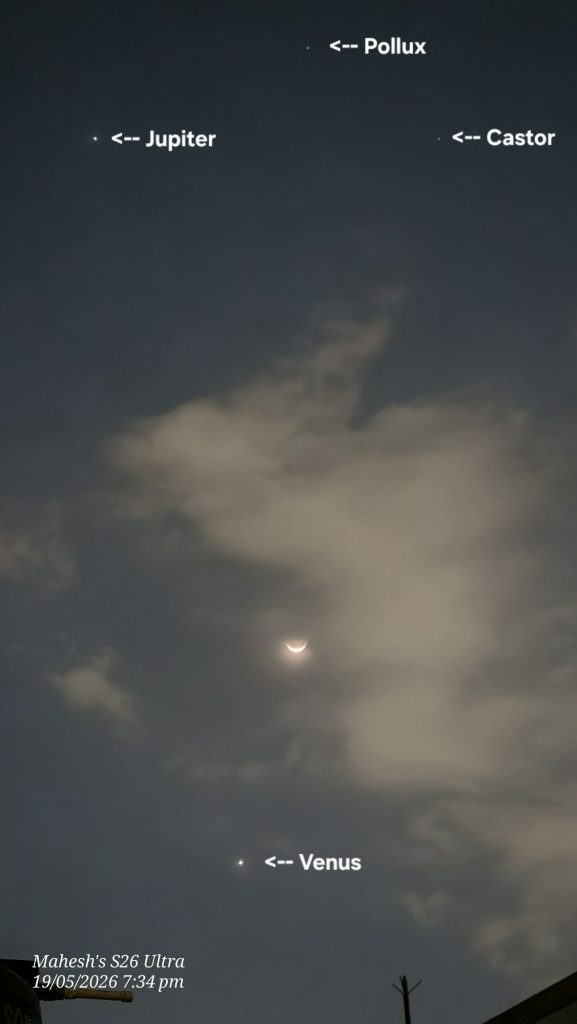
2. Enter the Twins: Castor and Pollux (7:34 PM)
As the sky darkened further, the composition expanded dramatically. The Moon hung in perfect poise—positioned directly above brilliant Venus (blazing at an intense apparent magnitude of roughly -3.9) and just below the majestic authority of Jupiter (shining at magnitude -1.9).

But the real surprise was the appearance of the famous celestial twins of the Gemini constellation. Sitting high above the planetary dance, Pollux (the brighter, golden giant) and Castor (the bright binary system) framed the top of the view, creating a spectacular multi-body celestial matrix.

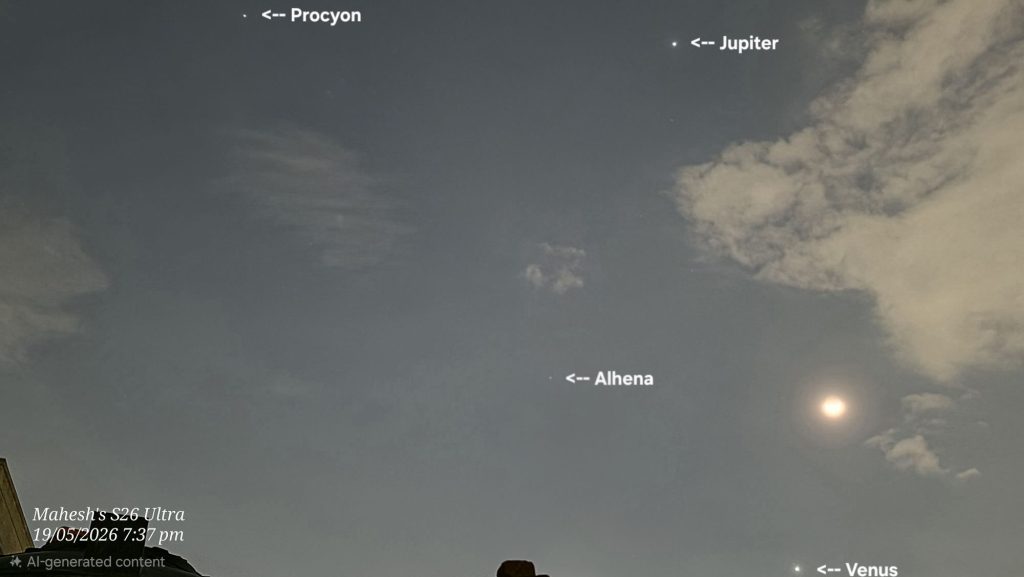
3. The Grand Panoramic Canvas (7:37 PM)
Just a few minutes later, switching to a landscape orientation completely transformed the perspective, turning a tight planetary framing into a sweeping cosmic map. This wide-angle shot beautifully illustrates the massive scale of the celestial neighborhood.

To the far upper left, the brilliant star Procyon—the eighth-brightest star in the night sky and the anchor of Canis Minor—shines with its steady, distinct light.
Right in the center of the frame, standing like a cosmic milestone directly above the rooftop line, sits Alhena (gamma Geminorum). Alhena marks the “left foot” of the twin Pollux in the constellation Gemini. Seeing Alhena, Jupiter, Venus, and the Moon all suspended in a vast, open horizontal plane reveals the beautiful, geometric web that connects our immediate solar system neighbors to stars burning light-years away in the deep background of space.

4. The Ghostly Radiance of Earthshine
Zooming into the lunar disk revealed the spectacular phenomenon of Earthshine —often called the “Da Vinci Glow.” While the sunlit sliver of the crescent burned intensely, the dark, un-illuminated portion of the lunar disk was softly, visibly awake. This ghostly illumination isn’t caused by direct sunlight, but by sunlight reflecting off Earth’s own clouds and vast oceans, bouncing back into the dark spaces of the Moon. It is a profound reminder that even the dark side of our neighbor is gently lit by the home we stand on.

5. Resolving the Deep Space Beacon: Mebsuta
Perhaps the most technically thrilling success of the evening was zooming past our planetary neighbors to capture a true deep-sky beacon sitting just to the upper left of the lunar glow: Mebsuta (epsilon Geminorum). Click on the photo below.

Tucked within the constellation Gemini, Mebsuta is a yellow supergiant stellar engine sitting nearly 900 light-years away from Earth. Remarkably, the phone’s sensor managed to distinctly resolve not just the primary star, but its faint, 9.6-magnitude optical companion star. Resolving a companion star of that magnitude through the atmospheric haze of a post-rain city sky is a true triumph of modern optical stacking and computational mobile photography.


Did you manage to catch a glimpse of the Moon sitting between the two evening giants tonight?

Video of this evening’s alignment
Celestial Whispers: A Night of Automated Discovery

Celestial Whispers: A Night of Automated Discovery

Last night, May 12, 2026, was a testament to how modern technology can bridge the gap between our busy daily lives and the silent, ancient wonders of the cosmos.

Between 7:20 PM and 10:15 PM, while I was indoors attending to other tasks, my gear was outside under the Bengaluru sky, diligently working through a pre-planned cosmic itinerary.

The true hero of this session was the Dwarf Mini’s Scheduler feature. By setting up a sequence in advance, the telescope seamlessly transitioned from one Deep Sky Object (DSO) to the next without any manual intervention.

Connected via STA mode to my home Wi-Fi, I could monitor the live stacks on my S26 Ultra from the couch. It is a profound shift—observing the universe not through shivering hours in the dark, but through a harmonious blend of automation and intentionality.

Observations

1. Markarian’s Chain: A Cosmic Neighborhood

This capture reveals a stretch of galaxies in the heart of the Virgo Cluster. Seeing these massive structures grouped together reminds us that nothing in the universe exists in true isolation; everything is part of a grand, gravitational dance.

Type: A string of galaxies including M84, M86, and the “Eyes” galaxies.

Distance: Approximately 50 to 60 million light-years from Earth.

Significance: Most of these galaxies are moving in a coherent motion, hence the “chain” designation, though some are just line-of-sight coincidences.

Reference: https://apod.nasa.gov/apod/ap190331.html

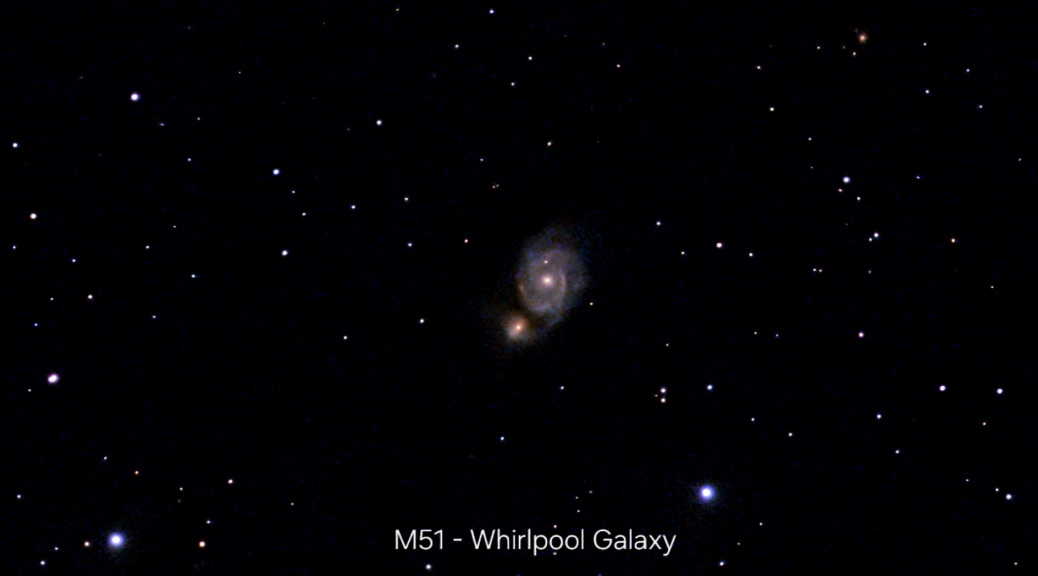
2. M51: The Whirlpool Galaxy

The spiral structure of M51 is perhaps the most iconic “transcendental” image in astronomy. It represents the perfect whirlpool of creation, where the smaller companion galaxy (NGC 5195) is literally tugging on the arms of the larger spiral.

Type: Grand-design spiral galaxy.

Distance: Roughly 31 million light-years away in the constellation Canes Venatici.

Interaction: The gravitational interaction with its companion triggers intense star formation, lighting up the spiral arms with brilliant pink nebulae.

Reference: Explore M51 at the Hubble Site

3. M104: The Sombrero Galaxy

Looking at the Sombrero, one can’t help but see a “crown” or a “brim” of starlight. It is a solitary, majestic object that sits on the edge of the Virgo Cluster, characterized by its unusually large central bulge and a prominent dark dust lane.

Type: Unbarred spiral galaxy (often appearing like an elliptical with a disk).

Distance: About 28 million light-years from Earth.

Feature: It contains a massive central black hole, estimated to be a billion times the mass of our Sun, and a rich system of nearly 2,000 globular clusters.

Reference: M104 Technical Details via Messier-Objects.com


Reflecting on the Night
As I reviewed the final edits on my S26 Ultra, I realized that it isn’t just about the images—it’s about the process. By using the scheduler, we remove the friction of the “how” and allow ourselves to focus on the “why.” We are capturing light that has traveled for millions of years to reach a terrace in Bengaluru.

How do these distant giants change your perspective on the “small” tasks we handle every day?

Images

Archives