Piercing the Storm: Capturing the Moon, Venus, Jupiter, and the Twins of Gemini
There is a distinct, breathless magic that occurs when the celestial clockwork aligns perfectly to pierce through a stormy night.
Earlier this evening, right here in Bengaluru, the heavy pre-monsoon clouds parted just enough to reveal a breathtaking cosmic triad: a delicate, glowing crescent Moon suspended beautifully in the western sky, flanked by the two brightest planets in our solar system—Venus and Jupiter.

For those tracking the heavens this week, the Moon has been on an elegant pilgrimage, visiting the evening planets one by one. While the monsoon-laden skies blocked out yesterday’s view, tonight offered a blessed, short-lived window of absolute clarity. It was a visual reminder that no matter how dense the earthly clouds around us become, the grand alignment of the universe remains entirely uninterrupted.
The Evening in Frames: From Dusk to Deep Space
Capturing this event over the span of an hour using a flagship mobile sensor yielded a progression of details that feel deeply intimate yet staggeringly vast.
1. The Twilight Geometry (7:14 PM)
As twilight began to deepen, the sheer scale of the alignment became visible over the urban skyline. Even with city lights and low-hanging moisture, Venus and the crescent Moon pierced the blue hour with remarkable brilliance, hanging like gems over the cityscape.

2. Enter the Twins: Castor and Pollux (7:34 PM)
As the sky darkened further, the composition expanded dramatically. The Moon hung in perfect poise—positioned directly above brilliant Venus (blazing at an intense apparent magnitude of roughly -3.9) and just below the majestic authority of Jupiter (shining at magnitude -1.9).
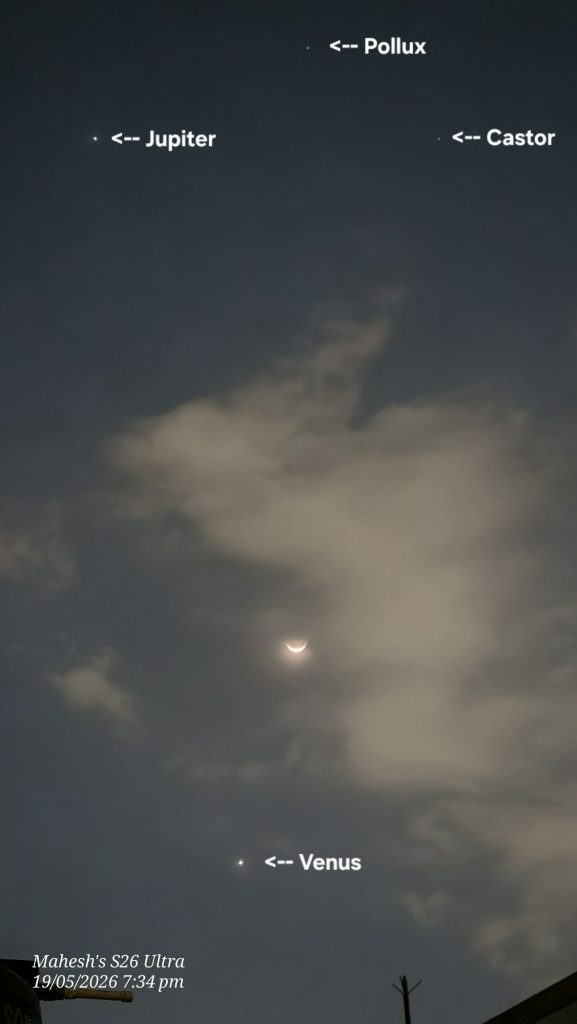
But the real surprise was the appearance of the famous celestial twins of the Gemini constellation. Sitting high above the planetary dance, Pollux (the brighter, golden giant) and Castor (the bright binary system) framed the top of the view, creating a spectacular multi-body celestial matrix.
3. The Grand Panoramic Canvas (7:37 PM)
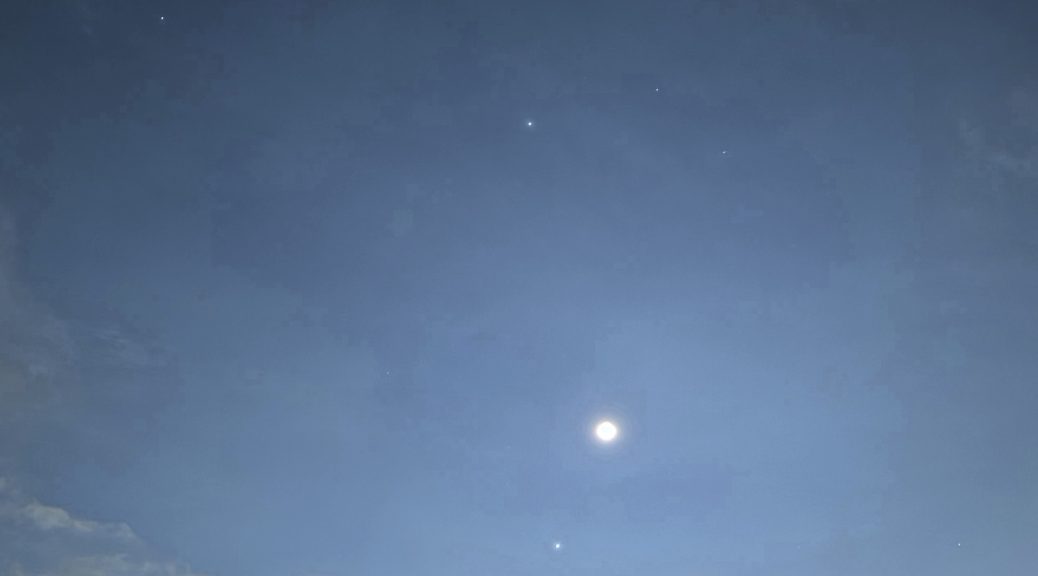
Just a few minutes later, switching to a landscape orientation completely transformed the perspective, turning a tight planetary framing into a sweeping cosmic map. This wide-angle shot beautifully illustrates the massive scale of the celestial neighborhood.
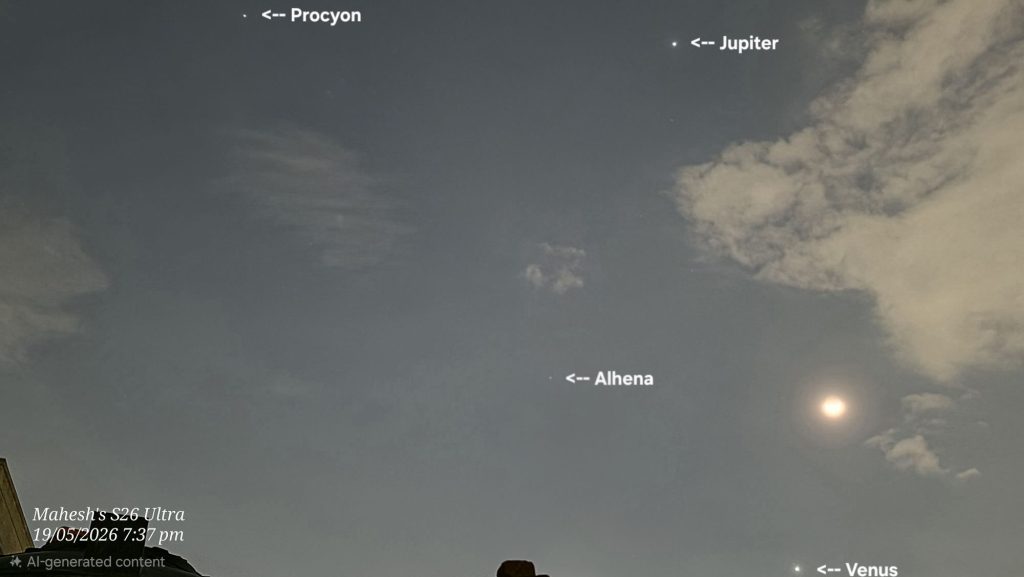
To the far upper left, the brilliant star Procyon—the eighth-brightest star in the night sky and the anchor of Canis Minor—shines with its steady, distinct light.
Right in the center of the frame, standing like a cosmic milestone directly above the rooftop line, sits Alhena (gamma Geminorum). Alhena marks the “left foot” of the twin Pollux in the constellation Gemini. Seeing Alhena, Jupiter, Venus, and the Moon all suspended in a vast, open horizontal plane reveals the beautiful, geometric web that connects our immediate solar system neighbors to stars burning light-years away in the deep background of space.
4. The Ghostly Radiance of Earthshine
Zooming into the lunar disk revealed the spectacular phenomenon of Earthshine —often called the “Da Vinci Glow.” While the sunlit sliver of the crescent burned intensely, the dark, un-illuminated portion of the lunar disk was softly, visibly awake. This ghostly illumination isn’t caused by direct sunlight, but by sunlight reflecting off Earth’s own clouds and vast oceans, bouncing back into the dark spaces of the Moon. It is a profound reminder that even the dark side of our neighbor is gently lit by the home we stand on.


5. Resolving the Deep Space Beacon: Mebsuta
Perhaps the most technically thrilling success of the evening was zooming past our planetary neighbors to capture a true deep-sky beacon sitting just to the upper left of the lunar glow: Mebsuta (epsilon Geminorum). Click on the photo below.

Tucked within the constellation Gemini, Mebsuta is a yellow supergiant stellar engine sitting nearly 900 light-years away from Earth. Remarkably, the phone’s sensor managed to distinctly resolve not just the primary star, but its faint, 9.6-magnitude optical companion star. Resolving a companion star of that magnitude through the atmospheric haze of a post-rain city sky is a true triumph of modern optical stacking and computational mobile photography.

Did you manage to catch a glimpse of the Moon sitting between the two evening giants tonight?