In a world bustling with quests for external validation and temporary pleasures, a timeless truth whispers from the annals of ancient wisdom: true divinity resides not in distant sanctuaries, but within the very essence of our being. Our ancient sages, in their profound spiritual explorations, understood this fundamental reality. They proclaimed that the human form is not merely a physical vessel but a sacred abode, a living temple for the divine. This profound concept is beautifully enshrined in the Upanishads, the foundational texts of Hindu philosophy.
This very truth—that the body is a temple and the indwelling soul is God (Deho devalaya proktaḥ, jivo devah sanatanah)—was a central theme in the discourses of Bhagwan Sri Sathya Sai Baba. He would often remind us that while we spend fortunes building magnificent temples, the most precious temple is the one we already possess: our own body. He taught that the true pilgrimage is not to a holy place but to our inner self, a journey of purity, love, and self-realization.
Join us as we journey into the heart of this timeless wisdom. In this post, we will explore the Upanishadic sources of this divine truth and delve into how Bhagwan Baba’s teachings offer us a practical and inspiring guide to live with this awareness, transforming every moment into an act of worship.
The Upanishadic Sources: A Deeper Look
To ground our understanding in the original texts, it is essential to explore the specific Upanishads where this profound concept is articulated.
1. The Maitreyi Upanishad
This is the most direct and widely cited source. It is a dialogue between Lord Shiva and Sage Maitreya, where Shiva reveals the ultimate truth of self-realization. The specific verse is found in Chapter II, Verse 2.
Context and Meaning: This verse is a powerful declaration that the body is the temple of the Lord, and the individual soul (Jiva) is none other than Shiva himself. The second line adds a crucial instruction: to discard the “faded flower-offerings of ignorance” and worship the divine with the feeling of “I am That” (So'ham Bhāva). This emphasizes an inner, rather than outer, form of worship.
2. The Skanda Upanishad
This short but potent Upanishad, which is also a part of the Krishna Yajurveda, contains a very similar verse, highlighting the essential identity of the individual with the supreme reality. The relevant verses are 10.
Context and Meaning: In the Skanda Upanishad, the verse appears in a discourse between Skanda and Brahman, reinforcing the Advaitic (non-dualistic) principle that the Atma is verily Shiva. The similarity between this verse and the one in the Maitreyi Upanishad underscores that this is a fundamental, shared truth across various Hindu scriptures.
The Inner Sanctuary: A Call to Purity and Purpose
Bhagwan Sri Sathya Sai Baba, in His divine discourses, has repeatedly expounded on this profound truth, giving it a practical and personal application for our daily lives.
In His discourse titled “The House of the Lord,” Bhagwan Baba explains that while we meticulously build houses of brick and mortar for our comfort, the true “house” that deserves our attention is the one we build with our thoughts, words, and deeds. This “house” is our pure and aspiring heart, the true residence of the Lord. The human body is a precious instrument, a sacred gift to be honored and maintained, but its sole purpose is to serve a higher, spiritual aim.
He further clarifies this in “Perform All Actions With Divine Feelings,” where He uses the powerful analogy of a valuable jewel (the Atma) in an iron safe (the body). The body, a mere instrument, is considered auspicious (shivam) only as long as the Atma is present. Without it, the body is but a corpse (shavam). This teaches us that the value of our physical form is not in its external appearance or abilities, but in the divine essence it contains. Therefore, every action we perform should be a sacred offering to the God within (Sarva karma bhagavad preetyartham), undertaken with purity, patience, and perseverance.
Finally, in “Realise the Oneness of the Atmic Principle,” Bhagwan Baba points out that our greatest enemies are not external forces but our own negative qualities, such as ego and anger. The true path to happiness and success lies in recognizing that the same divine principle (Atma) resides in all beings. By seeing this oneness and surrendering our negative traits, we unlock the divine power that is already within us.
Reflection and Application in Modern Life
The profound wisdom of Deho devalaya proktaḥ is not confined to the ancient scriptures; it offers a powerful framework for navigating the complexities of modern life. In a world defined by external validation, constant distraction, and the relentless pursuit of more, this timeless truth invites us to look inward for true peace and purpose.
1. The Body as a Sacred Instrument: In an age where health and wellness are often viewed as a chore or an aesthetic goal, this verse elevates self-care to a spiritual act. Treating our bodies with respect—nourishing them with wholesome food, engaging in mindful movement, and ensuring adequate rest—becomes a form of reverence for the divine that resides within. It shifts the motivation from external appearances to an inner sense of sanctity and gratitude.
2. Every Act as Worship: The Upanishads and Bhagwan Baba teach that our “worship” is not limited to rituals or formal prayers. In modern life, this means our every action can be an offering to the divine. Whether it’s the work we do, the conversations we have, or the simple act of helping a neighbor, performing these tasks with a sense of purpose and integrity transforms them from mundane duties into sacred acts. It’s about bringing the So'ham Bhāva—the feeling of “I am That”—into our jobs, relationships, and daily interactions.
3. The Inner Pilgrimage: We live in a society that encourages seeking happiness in a new purchase, a new destination, or a new accomplishment. This ancient wisdom reminds us that the ultimate pilgrimage is an inward journey. True fulfillment, lasting joy, and unconditional love are not found in external places but are discovered by turning our consciousness inward and connecting with the divine light of our own soul. This practice can be a powerful antidote to stress, anxiety, and the feeling of emptiness that often accompany a purely materialistic life.
By embracing the truth that our body is a temple and our soul is eternal, we can live a life of profound meaning and purpose. This single idea transforms our relationship with ourselves and the world around us, leading us from a life of mere existence to one of conscious, inspired living. It is a powerful message of empowerment, reminding each of us that we are not just creatures of habit, but living, breathing temples of the Divine.
Closing Thoughts
As we conclude this reflection, let us carry the essence of this profound truth with us. The statement Deho devalaya proktaḥ, jivo devah sanatanah is more than a philosophical concept; it is a key to unlocking our true potential and living a life of purpose. It calls us to cease our restless search for God in the external world and turn our gaze inward, to the sacred temple we inhabit.
The wisdom of the Upanishads, illuminated by the teachings of Bhagwan Baba, reminds us that the greatest pilgrimage is the journey to our own heart. By purifying our intentions, sanctifying our actions, and recognizing the divine in ourselves and in every being we encounter, we can transform our ordinary lives into a continuous act of worship.
Let this be our guiding principle: to live with the constant awareness that we are all living temples, housing the eternal divine. It is this realization that brings true peace, lasting joy, and the profound liberation we seek.
Last week, we followed the vibrant counsel of the vānaras — Sugrīva’s caution, Jambavan, Sharabha, and Mainda’s shrewd warnings, and Hanumān’s reassuring clarity — as they weighed the sudden arrival of Vibhīṣaṇa at the gates of their camp. Each voice reflected a different shade of wisdom, yet the question lingered: Should Rāma accept this brother of Rāvaṇa, or reject him as a potential traitor?
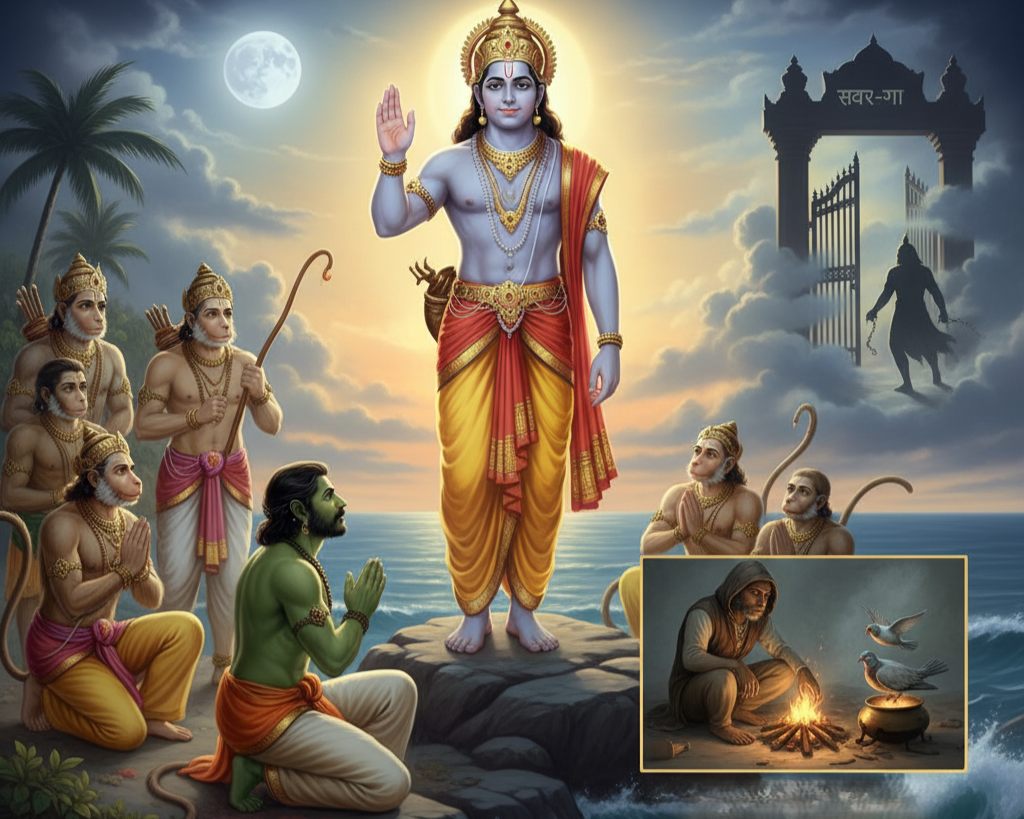
This week, in Sarga 18 of the Yuddha Kāṇḍa (read here), we turn to Rāma himself. From verse 6-18-21 onward, Rāma’s words rise above debate and suspicion. He does not argue strategy, nor does he calculate risk. Instead, he speaks as the embodiment of dharma, unveiling truths about compassion, trust, and the unbreakable vow to protect anyone who seeks refuge.
Here, in the famous promise — “सकृदेव प्रपन्नाय … अभयं सर्वभूतेभ्यो ददाम्येतद् व्रतम् मम ॥ (6-18-33)” — Rāma establishes not just a decision for that moment, but a timeless principle of protection, one that continues to shape the spiritual imagination of seekers across generations.
Categorized Breakdown of Sarga 18 (Verses 6-18-1 to 6-18-39)
Based on the Valmiki Ramayana, Yuddha Kanda, Sarga 18, here is a breakdown of the conversations from verses 1 to 39, categorized by speaker, along with a summary of their key points.
Section
Verses
Speaker
Summary
Rama’s Initial Declaration
1–3
Rama
Rāma, upon hearing Hanumān, states that one who comes to him seeking refuge, even though imperfect, cannot be abandoned if he presents himself with friendly intent. He asks those firmly established in dharma to hear his view regarding Vibhīṣaṇa.
Sugrīva’s First Objection
4–6
Sugrīva
Sugrīva warns Rāma that Vibhīṣaṇa might be a spy sent by Rāvaṇa. He argues that accepting him could endanger their mission.
Rāma’s First Reply
7–15
Rāma
Rāma initially addresses Sugrīva’s suspicion. He explains the principles of kingship, friendship, and the dangers of rejecting allies without reason. He begins laying down the foundations of dharma in leadership.
Sugrīva’s Second Objection
16–20
Sugrīva
Sugrīva reasserts his doubt, emphasizing the risks of deception in war. He counsels caution and argues that apparent gestures of friendship should not be trusted blindly.
Rāma’s Main Speech on Dharma & Refuge
21–39
Rāma
Rāma delivers a comprehensive discourse: • The duties of a king in discerning right conduct. • The inviolable principle of giving refuge: “Whoever seeks shelter, even if once, must be protected — whether friend, enemy, or neutral.” • The supremacy of dharma as protection for all beings. • His personal resolve: having vowed protection, he will never abandon Vibhīṣaṇa. This exposition becomes a classic declaration of śaraṇāgati dharma.
Rama’s Initial Declaration (Verses 6-18-1 to 6-18-3)
After hearing the words from Hanuman about Vibhishana’s arrival, Rama immediately begins the discourse. He states his opinion on the matter, declaring that he will not turn away anyone who approaches with a friendly heart, even if they have some flaw. He affirms that this principle of offering refuge is considered honorable by all good and virtuous people.
Sugreeva’s Counter-Argument (Verses 6-18-4 to 6-18-6)
Sugreeva, the king of the monkeys, closely considers Rama’s words and then presents his opposing view. He expresses his deep suspicion of Vibhishana, questioning why a demon would abandon his own brother in a time of peril. Sugreeva suggests that Vibhishana might be a spy sent by Ravana to infiltrate their army and cause harm.
Rama’s first reply to Sugreeva (6-8-7 to 6-8-15)
Rama then delivers a comprehensive speech that addresses Sugreeva’s concerns and reinforces his own stance on dharma. He presents several points to justify his decision to accept Vibhishana.
Rebuttal of Sugreeva’s Fears (6-18-7 to 6-18-11): Rama calmly explains that it is natural for family members, especially among powerful kings, to become enemies due to ambition and conflict. He asserts that not all brothers are like Bharata, who was devoted to him, and that it is not wise to judge based on family alone.
The Universality of Refuge (6-18-12 to 6-18-15): He argues that as a Kshatriya king, it is his duty to protect anyone who seeks refuge, regardless of who they are or what their background is. He emphasizes that a person seeking refuge should never be turned away.
Sugreeva’s second round of talk(6-18-16 to 6-18-20):
After hearing Rama’s initial argument for accepting Vibhishana, Sugreeva, the highly intelligent king of the monkeys, stands up respectfully and speaks again.
Sugreeva reasserts his belief that Vibhishana is a spy sent by Ravana, referring to him as a “night-rover” (niśācaraṃ) and stating that he should be captured. He believes that Vibhishana has come with a crooked mind (jihmayā buddhyā) under the instructions of the cruel Ravana. He warns that Vibhishana’s true intention is to strike Rama, Lakshmana, or himself when they are off guard. Sugreeva concludes by stating that Vibhishana, along with his advisors, is a danger and should be killed.
Rama’s Code of Protection (6-18-21 to 6-18-34):
After listening to Sugreeva’s second plea to reject Vibhishana, Rama takes a moment to consider the advice before responding with what is arguably the most profound speech in the entire epic.
He begins by calmly and confidently dismissing the fear of Vibhishana’s potential treachery, asserting that regardless of his intentions, the “night-rover” is utterly powerless to cause him even the slightest harm.
Rama then elevates the discussion from one of military strategy to a matter of supreme dharma, and to illustrate his point, he recounts the timeless parable of a dove that honored a fowler—its enemy—who had sought refuge. The dove, despite the fowler having killed its mate, received him with due reverence and hospitality, demonstrating that a righteous being must never abandon a refugee.
To further fortify this principle, Rama quotes the ancient and truthful words of the great sage Kandu, son of sage Kanva.
Here Rama declares his intention to act in full accordance with the excellent and righteous words of the sage Kandu. He confirms that following this teaching—that one must protect a refugee—is not only the most righteous path (dharmiṣṭham) but also an act that will bring him great fame and glory (yaśasyam). Most importantly, Rama recognizes the ultimate spiritual reward for his righteous action, stating that “it leads to heaven as the fruit of the action.” This verse (6-18-32) underscores Rama’s profound understanding of dharma, revealing that his decision to accept Vibhishana is not just a tactical choice but a deliberate and conscious act rooted in ancient, time-honored principles, with a full awareness of its worldly and spiritual consequences.
He warns that a person who has the power to protect a refugee but fails to do so out of fear, ignorance, or desire, commits a great sin that is condemned by the world, leading to a loss of virtue, reputation, and strength.
Rama concludes his monumental speech by transitioning from citing external wisdom to a personal, unshakeable vow.
He declares that his solemn pledge (vrata) is to grant protection to any being who surrenders to him just once, saying “I am yours.”
This sacred promise, he states, applies universally, and he reiterates that he has already granted his protection to Vibhishana, and would do so even for Ravana himself.
This final pronouncement solidifies Rama’s character as the embodiment of an unwavering commitment to the highest principles of dharma, transcending all personal and political considerations.
Sugreeva’s acceptance (6-18-35 to 6-18-39)
In this final set of verses from Sarga 18, Sugreeva’s speech serves as the powerful conclusion to the debate, showcasing the profound impact of Rama’s moral and philosophical argument.
Impelled by a deep sense of friendship and respect, Sugreeva fully retracts his earlier opposition.
He begins by praising Rama as a knower of dharma and a jewel among the lords of the world, stating that it is not surprising that a person of such virtue and integrity would take such a noble stand.
Sugreeva then reveals a significant internal change, admitting that his inner self now recognizes Vibhishana’s purity, a conclusion he reached after a thorough re-evaluation of the circumstances. He moves from a position of suspicion to one of complete trust, and most importantly, urges Rama to act quickly.
He requests that Vibhishana be treated as an equal and welcomed into their alliance as a friend.
The final verse beautifully describes Sugreeva’s supportive words, and the immediate and harmonious result:
Rama, the great king, immediately went to meet Vibhishana, signifying the honorable union of two virtuous beings, much like how Indra, lord of celestials, meets with Garuda, the king of birds.
Reflections – The Essence of Rama’s Dharma on Offering Refuge
Rama’s argument for accepting Vibhishana is based on four core principles:
Unconditional Acceptance: Rama begins by declaring his policy of unconditional refuge. He states that he will never abandon anyone who approaches him with a friendly demeanor, regardless of whether they have a flaw. For Rama, the act of seeking refuge is itself a sacred gesture that must be honored. He says that this principle of acceptance is a fundamental tenet of righteous conduct and is highly valued by good people.
The Solemn Pledge: Rama makes a sacred vow, which is one of the most famous declarations in the epic: “He who seeks refuge in me just once, telling me that ‘I am yours,’ I shall give him assurance of safety against all types of beings. This is my solemn pledge.” He emphasizes that this promise is universal and applies to anyone, even to his most bitter enemy, Ravana, should he ever seek his protection.
The Supreme Duty of a Protector: To further reinforce his point, Rama recounts the story of a dove that offered shelter to a fowler who had just killed its mate. The dove, upholding the duty of a host, provided refuge to its enemy and even offered its own flesh as a meal. This parable highlights the absolute and uncompromising nature of the duty to protect one who seeks shelter, elevating it above personal enmity or loss.
The Consequences of Neglecting Dharma: Rama clearly outlines the grave spiritual and moral repercussions of failing to protect a refugee. He states that a person who is capable of providing protection but fails to do so out of fear, ignorance, or desire, commits a sin that is “reproached by the world.” He asserts that such an act destroys one’s reputation, strength, and valor, and prevents the attainment of heaven. He concludes by stating that protecting a refugee is the most righteous act, one that brings fame and leads to heaven.
In essence, Rama’s talk on refuge transcends the immediate political situation. It is a profound teaching on the principles of compassion, honor, and the unwavering commitment to dharma, showcasing why he is considered the embodiment of righteousness in the Hindu tradition.
Closing Thoughts
Rama’s discourse on refuge in the Ramayana transcends the ancient battlefield, offering a timeless lesson for our own lives. His unwavering commitment to dharma, even when faced with suspicion and practical concerns from his own allies, highlights a profound truth: true leadership and integrity are not defined by convenience, but by an unshakeable adherence to higher principles.
In a world that often prioritizes caution and self-interest, Rama’s example of unconditional compassion and his sacred vow to protect anyone who surrenders provides a powerful guide. It challenges us to consider our own moral codes: Are we willing to extend trust and kindness, even when it seems difficult or risky? Just as Rama’s righteous decision led to the purification of Vibhishana and the victory of dharma, embracing a purpose-driven life rooted in compassion can inspire transformative outcomes in our own lives and communities.
The Ramayana ultimately reminds us that the greatest strength lies not in our might, but in the unwavering purity of our purpose.
The Mudgala Purana: A Guide to Transcending Obstacles and Unlocking Your Purpose
In our modern, fast-paced world, we are often overwhelmed by distractions and external pressures. We yearn for a sense of purpose and a deeper connection to something meaningful. Ancient wisdom traditions, passed down through generations, offer a profound roadmap for this journey—a way to find true peace and empowerment by looking inward.
The Mudgala Purana, a sacred Hindu scripture, is one such timeless guide. It reveals that the key to mastering our external world lies in conquering our inner self.
Unveiling the Wisdom of Ganesha as the Divine
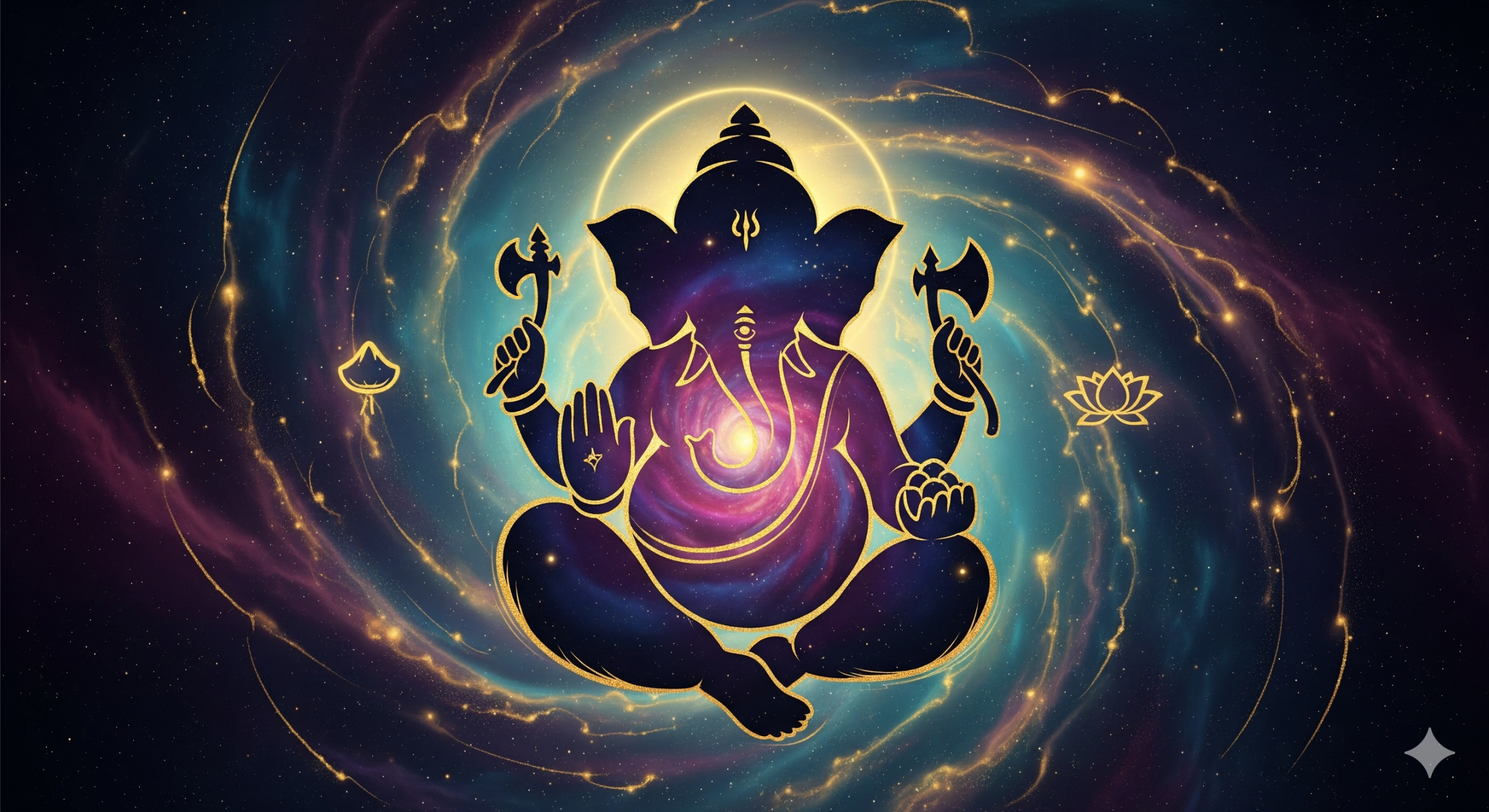
In the pursuit of spiritual knowledge, few texts are as direct and transformative. The Mudgala Purana is one of the two key Upapuranas (minor Puranas), along with the Ganesha Purana, that are central to the worship of Ganesha as the Supreme Brahman—the ultimate, all-encompassing reality.
This aspect and worship of Ganesha as the Supreme Brahman, is also expressed in the verses of the Ganesh Atharva Shirsha Upanishad, as described below:
You alone are the visible Brahman. You alone are the creator. You alone are the sustainer. You alone are the destroyer.
Similar to the Atharva Shirsha Upanishad mantra’s, The Mudgala Purana provides a profound philosophical journey that uses the divine form of Ganesha to explain the unfolding of creation and the path to spiritual liberation.
While many see Ganesha simply as the beloved remover of obstacles, these texts unveil a deeper truth: that the divine consciousness, the very essence of the universe, is embodied in the form of the elephant-headed god.
The Divine as Ganesha: Key Aspects and Reflections
The Purana’s core wisdom is revealed through the mythological and philosophical dimensions of Ganesha. The text is not a dry theological treatise but a vibrant map of our spiritual journey.
The most powerful teaching is found in the concept of Ganesha’s eight incarnations. Each of these forms is a divine manifestation that descends to conquer a specific demon. Yet, the true power of these stories lies in their metaphorical meaning: the demons are not external foes but personifications of our inner vices. Arrogance, greed, delusion, and ego are the very forces that create obstacles in our lives. By meditating on Ganesha’s triumphs over these demons, we are given a clear, actionable guide for conquering our own internal challenges.
Beyond these incarnations, the Purana is a vast compendium of wisdom. It details the cosmology of Ganesha, his relationship with other deities, and the proper rituals for his worship. The text elevates sound itself, asserting that the primordial sound Omkara is a form of Ganesha. This all-encompassing view encourages us to find the divine not just in temples but in the very fabric of existence, in every sound, in every thought.
The Eight Incarnations: A Path to Conquering Our Inner Demons
The heart of the Mudgala Purana lies in its vivid descriptions of Ganesha’s eight incarnations. These are not merely mythical stories; they are powerful allegories for the human struggle against spiritual ignorance. Each incarnation, or avatar, manifests to defeat a specific demon who represents a common human vice.
Vakratunda conquers Matsaryāsura, the demon of envy.
Ekadanta subdues Madāsura, the demon of arrogance.
Mahodara vanquishes Mohāsura, the demon of delusion.
Gajavaktra triumphs over Lobhāsura, the demon of greed.
Lambodara masters Krodhāsura, the demon of anger.
Vikata defeats Kāmāsura, the demon of desire.
Vighnaraja overcomes Mamāsura, the demon of possessiveness.
Dhumravarna triumphs over Ahamkārasura, the demon of ego.
By meditating on these stories, we learn to identify and confront our own inner demons. The Purana teaches us that true spiritual progress is not about fighting external forces but about conquering the negative emotions and attachments that hold us back from our highest potential.
Beyond the Avatars: A Universe of Wisdom
While the eight incarnations provide a clear path for self-improvement, the Mudgala Purana contains much more. It offers a complete spiritual framework, including:
Cosmology: The text provides a unique account of the universe’s creation, explaining how Ganesha, as the formless reality, gradually takes form and unfolds into all of creation.
Mythological Narratives: It weaves together many stories related to Ganesha, his divine family, and his interactions with other gods. These narratives serve to illustrate deep philosophical truths in a memorable way.
Rituals and Worship: The Purana also acts as a practical guide, providing detailed instructions on how to worship Ganesha, the significance of various hymns, and the importance of sacred places (kṣetras).
Theological Debates: The text includes dialogues between sages and gods that explore complex concepts like the nature of the soul, the meaning of liberation (moksha), and the relationship between the divine and humanity.
The Lessons for Modern Life
The timeless wisdom of the Mudgala Purana offers profound lessons we can apply to our daily lives:
Acknowledge Your Obstacles: Ganesha is the remover of obstacles, but the Purana teaches that many of our greatest hurdles are self-imposed. By understanding the vices personified by the demons, we can confront our own weaknesses and begin to heal.
Transcend the Ego: The ultimate goal is to conquer the ego, or ahamkārasura, which is the root of all other vices. The Purana shows us that true freedom comes from stepping beyond the “I” and embracing our connection to the divine.
Find the Divine Within: By elevating Ganesha to the Supreme Brahman, the text encourages us to see the divine not just as an external force but as an ever-present reality that resides within us and in all things.
By engaging with the wisdom of the Mudgala Purana, we can find a deeper purpose, navigate the challenges of life with greater clarity, and embark on a transformative journey from our ego-driven existence to one of spiritual enlightenment.
Closing Thoughts
The Mudgala Purana is, at its heart, a guide to self-realization. It teaches us that the path to spiritual enlightenment is not about seeking a god in a distant heaven, but about recognizing the divine spark that already resides within us.
By understanding that Ganesha is the creator, the sustainer, and the destroyer, we realize that we are part of an endless cosmic dance. Our purpose, then, is to transcend our ego and our attachments—the very demons Ganesha battles—and merge with that ultimate consciousness. This ancient wisdom provides a powerful framework for living a purposeful life, a life where every action, thought, and word becomes an act of a divine being.
This morning, August 24th, 2025, Bangalore’s skies offered a rare treat: a six-planet alignment. Despite heavy clouds, I managed to capture Venus and Jupiter with my mobile phone, along with a sky chart screenshot from the Safari App for reference.
The Planetary Parade
The lineup included: Mercury, Venus, Jupiter, Saturn (naked-eye visible), and Uranus and Neptune (requiring binoculars/telescope). Four bright planets graced the eastern sky before sunrise, while the faint outer planets completed this rare celestial event (People, Aug 2025) .
Observing Highlights
Time: ~5:00–6:00 AM IST (sunrise at 6:05 AM)
Direction: East for the planets
Bonus sighting: Sirius appeared in the Southeast while Venus shone in the Northeast, almost aligned along a horizontal line (Farmers’ Almanac, 2025).
Clouds added a mystical touch, and the fleeting moments of clear sky revealed the beauty of our universe.
Why It’s Special
Such six-planet alignments are rare. Today’s event offered both naked-eye and binocular viewing opportunities. Four bright planets graced the eastern sky before sunrise, with the faint ice giants completing this rare configuration. It won’t happen again until October 2028 (People, Aug 2025).
Even a cloudy morning couldn’t hide the magic—Venus, Jupiter, and Sirius reminded me why we look up in awe.
Here are some photos, you can click on any of them to open in a new tab for clearer visibility.
The above is a screenshot that captured this morning’s sky using the Safari App. Note the positions of the planet in the North-East section, while Sirius in the South-East quadrant. Visually it appeared that both Venus and Sirius were along a straight horizontal line. It was pretty spectacular to see both these objects. Venus is the brightest planet visible and Sirius is the brightest Star of the night sky. They were like two focus lamps placed one in the N-E and the other in the S-E
The above photo shows the eastern morning sky with clouds at around 5:40am.
The above photo is close to a 1x shot of the planets. Note how bright Venus is in spite of the clouds
Slightly zoomed in view of the two planets.
Cropped image of the above photo, to show the planets clearly
The above sky chart clearly maps the positions of the planets to the above photos. Mercury was behind buildings.
For me, this six-planet alignment was more than an astronomical event; it was a quiet, magical morning where the universe felt just a little closer, worth waking up early for 🙂
Yesterday evening around 5.30pm the Sun 🌞 light was coming through the window and falling directly on the statue of Sri Maha Vishnu.
The light rays started from the left highlighting the Chakram, then moved to the right to highlight the face and body. Next the rays moved to the right highlighting the Shankham….