Code of Protection
Introduction

Last week, we followed the vibrant counsel of the vānaras — Sugrīva’s caution, Jambavan, Sharabha, and Mainda’s shrewd warnings, and Hanumān’s reassuring clarity — as they weighed the sudden arrival of Vibhīṣaṇa at the gates of their camp. Each voice reflected a different shade of wisdom, yet the question lingered: Should Rāma accept this brother of Rāvaṇa, or reject him as a potential traitor?
This week, in Sarga 18 of the Yuddha Kāṇḍa (read here), we turn to Rāma himself. From verse 6-18-21 onward, Rāma’s words rise above debate and suspicion. He does not argue strategy, nor does he calculate risk. Instead, he speaks as the embodiment of dharma, unveiling truths about compassion, trust, and the unbreakable vow to protect anyone who seeks refuge.
Here, in the famous promise — “सकृदेव प्रपन्नाय … अभयं सर्वभूतेभ्यो ददाम्येतद् व्रतम् मम ॥ (6-18-33)” — Rāma establishes not just a decision for that moment, but a timeless principle of protection, one that continues to shape the spiritual imagination of seekers across generations.
Categorized Breakdown of Sarga 18 (Verses 6-18-1 to 6-18-39)

Based on the Valmiki Ramayana, Yuddha Kanda, Sarga 18, here is a breakdown of the conversations from verses 1 to 39, categorized by speaker, along with a summary of their key points.
| Section | Verses | Speaker | Summary |
|---|---|---|---|
| Rama’s Initial Declaration | 1–3 | Rama | Rāma, upon hearing Hanumān, states that one who comes to him seeking refuge, even though imperfect, cannot be abandoned if he presents himself with friendly intent. He asks those firmly established in dharma to hear his view regarding Vibhīṣaṇa. |
| Sugrīva’s First Objection | 4–6 | Sugrīva | Sugrīva warns Rāma that Vibhīṣaṇa might be a spy sent by Rāvaṇa. He argues that accepting him could endanger their mission. |
| Rāma’s First Reply | 7–15 | Rāma | Rāma initially addresses Sugrīva’s suspicion. He explains the principles of kingship, friendship, and the dangers of rejecting allies without reason. He begins laying down the foundations of dharma in leadership. |
| Sugrīva’s Second Objection | 16–20 | Sugrīva | Sugrīva reasserts his doubt, emphasizing the risks of deception in war. He counsels caution and argues that apparent gestures of friendship should not be trusted blindly. |
| Rāma’s Main Speech on Dharma & Refuge | 21–39 | Rāma | Rāma delivers a comprehensive discourse: • The duties of a king in discerning right conduct. • The inviolable principle of giving refuge: “Whoever seeks shelter, even if once, must be protected — whether friend, enemy, or neutral.” • The supremacy of dharma as protection for all beings. • His personal resolve: having vowed protection, he will never abandon Vibhīṣaṇa. This exposition becomes a classic declaration of śaraṇāgati dharma. |
Rama’s Initial Declaration (Verses 6-18-1 to 6-18-3)
After hearing the words from Hanuman about Vibhishana’s arrival, Rama immediately begins the discourse. He states his opinion on the matter, declaring that he will not turn away anyone who approaches with a friendly heart, even if they have some flaw. He affirms that this principle of offering refuge is considered honorable by all good and virtuous people.
Sugreeva’s Counter-Argument (Verses 6-18-4 to 6-18-6)
Sugreeva, the king of the monkeys, closely considers Rama’s words and then presents his opposing view. He expresses his deep suspicion of Vibhishana, questioning why a demon would abandon his own brother in a time of peril. Sugreeva suggests that Vibhishana might be a spy sent by Ravana to infiltrate their army and cause harm.
Rama’s first reply to Sugreeva (6-8-7 to 6-8-15)
Rama then delivers a comprehensive speech that addresses Sugreeva’s concerns and reinforces his own stance on dharma. He presents several points to justify his decision to accept Vibhishana.
- Rebuttal of Sugreeva’s Fears (6-18-7 to 6-18-11): Rama calmly explains that it is natural for family members, especially among powerful kings, to become enemies due to ambition and conflict. He asserts that not all brothers are like Bharata, who was devoted to him, and that it is not wise to judge based on family alone.
- The Universality of Refuge (6-18-12 to 6-18-15): He argues that as a Kshatriya king, it is his duty to protect anyone who seeks refuge, regardless of who they are or what their background is. He emphasizes that a person seeking refuge should never be turned away.
Sugreeva’s second round of talk (6-18-16 to 6-18-20):
- After hearing Rama’s initial argument for accepting Vibhishana, Sugreeva, the highly intelligent king of the monkeys, stands up respectfully and speaks again.
- Sugreeva reasserts his belief that Vibhishana is a spy sent by Ravana, referring to him as a “night-rover” (niśācaraṃ) and stating that he should be captured. He believes that Vibhishana has come with a crooked mind (jihmayā buddhyā) under the instructions of the cruel Ravana. He warns that Vibhishana’s true intention is to strike Rama, Lakshmana, or himself when they are off guard. Sugreeva concludes by stating that Vibhishana, along with his advisors, is a danger and should be killed.
Rama’s Code of Protection (6-18-21 to 6-18-34):
- After listening to Sugreeva’s second plea to reject Vibhishana, Rama takes a moment to consider the advice before responding with what is arguably the most profound speech in the entire epic.
- He begins by calmly and confidently dismissing the fear of Vibhishana’s potential treachery, asserting that regardless of his intentions, the “night-rover” is utterly powerless to cause him even the slightest harm.
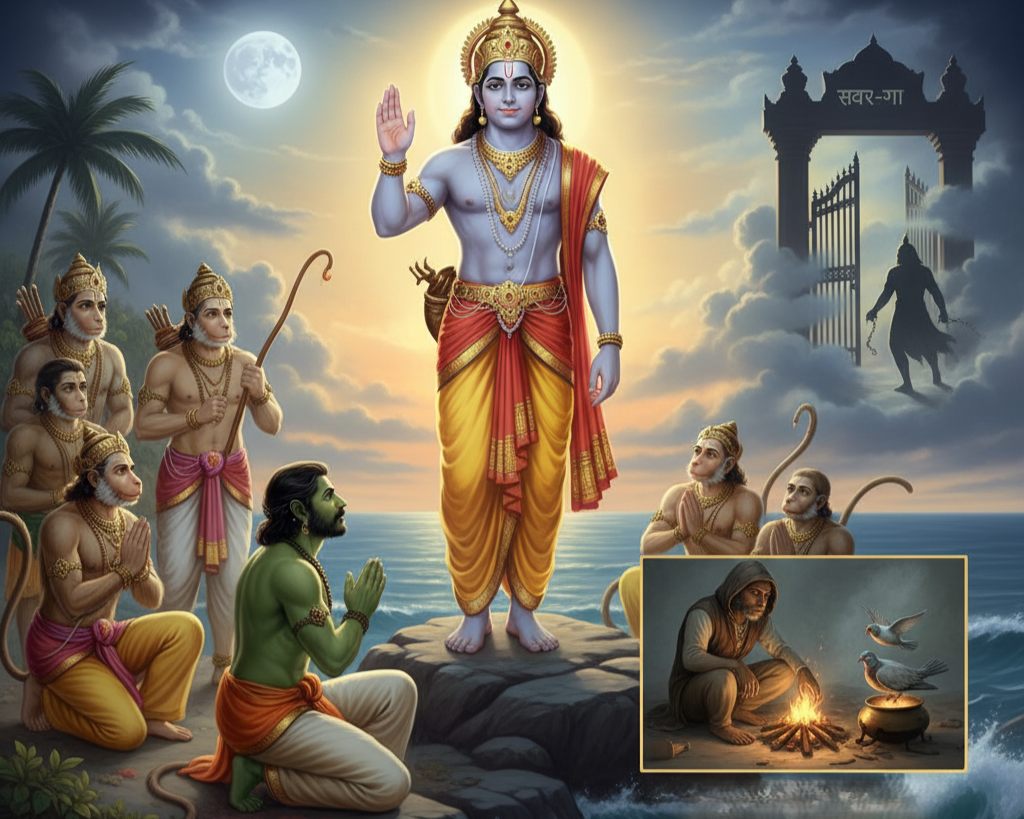
- Rama then elevates the discussion from one of military strategy to a matter of supreme dharma, and to illustrate his point, he recounts the timeless parable of a dove that honored a fowler—its enemy—who had sought refuge. The dove, despite the fowler having killed its mate, received him with due reverence and hospitality, demonstrating that a righteous being must never abandon a refugee.
- To further fortify this principle, Rama quotes the ancient and truthful words of the great sage Kandu, son of sage Kanva.
- Here Rama declares his intention to act in full accordance with the excellent and righteous words of the sage Kandu. He confirms that following this teaching—that one must protect a refugee—is not only the most righteous path (
dharmiṣṭham) but also an act that will bring him great fame and glory (yaśasyam). Most importantly, Rama recognizes the ultimate spiritual reward for his righteous action, stating that “it leads to heaven as the fruit of the action.” This verse (6-18-32) underscores Rama’s profound understanding of dharma, revealing that his decision to accept Vibhishana is not just a tactical choice but a deliberate and conscious act rooted in ancient, time-honored principles, with a full awareness of its worldly and spiritual consequences. - He warns that a person who has the power to protect a refugee but fails to do so out of fear, ignorance, or desire, commits a great sin that is condemned by the world, leading to a loss of virtue, reputation, and strength.
- Rama concludes his monumental speech by transitioning from citing external wisdom to a personal, unshakeable vow.
- He declares that his solemn pledge (vrata) is to grant protection to any being who surrenders to him just once, saying “I am yours.”
- This sacred promise, he states, applies universally, and he reiterates that he has already granted his protection to Vibhishana, and would do so even for Ravana himself.
- This final pronouncement solidifies Rama’s character as the embodiment of an unwavering commitment to the highest principles of dharma, transcending all personal and political considerations.
Sugreeva’s acceptance (6-18-35 to 6-18-39)
- In this final set of verses from Sarga 18, Sugreeva’s speech serves as the powerful conclusion to the debate, showcasing the profound impact of Rama’s moral and philosophical argument.
- Impelled by a deep sense of friendship and respect, Sugreeva fully retracts his earlier opposition.
- He begins by praising Rama as a knower of dharma and a jewel among the lords of the world, stating that it is not surprising that a person of such virtue and integrity would take such a noble stand.
- Sugreeva then reveals a significant internal change, admitting that his inner self now recognizes Vibhishana’s purity, a conclusion he reached after a thorough re-evaluation of the circumstances. He moves from a position of suspicion to one of complete trust, and most importantly, urges Rama to act quickly.
- He requests that Vibhishana be treated as an equal and welcomed into their alliance as a friend.
- The final verse beautifully describes Sugreeva’s supportive words, and the immediate and harmonious result:
- Rama, the great king, immediately went to meet Vibhishana, signifying the honorable union of two virtuous beings, much like how Indra, lord of celestials, meets with Garuda, the king of birds.
Reflections – The Essence of Rama’s Dharma on Offering Refuge
Rama’s argument for accepting Vibhishana is based on four core principles:
- Unconditional Acceptance: Rama begins by declaring his policy of unconditional refuge. He states that he will never abandon anyone who approaches him with a friendly demeanor, regardless of whether they have a flaw. For Rama, the act of seeking refuge is itself a sacred gesture that must be honored. He says that this principle of acceptance is a fundamental tenet of righteous conduct and is highly valued by good people.
- The Solemn Pledge: Rama makes a sacred vow, which is one of the most famous declarations in the epic: “He who seeks refuge in me just once, telling me that ‘I am yours,’ I shall give him assurance of safety against all types of beings. This is my solemn pledge.” He emphasizes that this promise is universal and applies to anyone, even to his most bitter enemy, Ravana, should he ever seek his protection.
- The Supreme Duty of a Protector: To further reinforce his point, Rama recounts the story of a dove that offered shelter to a fowler who had just killed its mate. The dove, upholding the duty of a host, provided refuge to its enemy and even offered its own flesh as a meal. This parable highlights the absolute and uncompromising nature of the duty to protect one who seeks shelter, elevating it above personal enmity or loss.
- The Consequences of Neglecting Dharma: Rama clearly outlines the grave spiritual and moral repercussions of failing to protect a refugee. He states that a person who is capable of providing protection but fails to do so out of fear, ignorance, or desire, commits a sin that is “reproached by the world.” He asserts that such an act destroys one’s reputation, strength, and valor, and prevents the attainment of heaven. He concludes by stating that protecting a refugee is the most righteous act, one that brings fame and leads to heaven.
In essence, Rama’s talk on refuge transcends the immediate political situation. It is a profound teaching on the principles of compassion, honor, and the unwavering commitment to dharma, showcasing why he is considered the embodiment of righteousness in the Hindu tradition.
Closing Thoughts

Rama’s discourse on refuge in the Ramayana transcends the ancient battlefield, offering a timeless lesson for our own lives. His unwavering commitment to dharma, even when faced with suspicion and practical concerns from his own allies, highlights a profound truth: true leadership and integrity are not defined by convenience, but by an unshakeable adherence to higher principles.
In a world that often prioritizes caution and self-interest, Rama’s example of unconditional compassion and his sacred vow to protect anyone who surrenders provides a powerful guide. It challenges us to consider our own moral codes: Are we willing to extend trust and kindness, even when it seems difficult or risky? Just as Rama’s righteous decision led to the purification of Vibhishana and the victory of dharma, embracing a purpose-driven life rooted in compassion can inspire transformative outcomes in our own lives and communities.
The Ramayana ultimately reminds us that the greatest strength lies not in our might, but in the unwavering purity of our purpose.
References
Valmiki Ramayana, Yuddha Kanda, Sarga 18
Samastah Lokah Sukhino Bhavanthu
May All the beings in All the Worlds be Happy!

Jai Sai Ram!
Please note all images and content generated using AI Tools