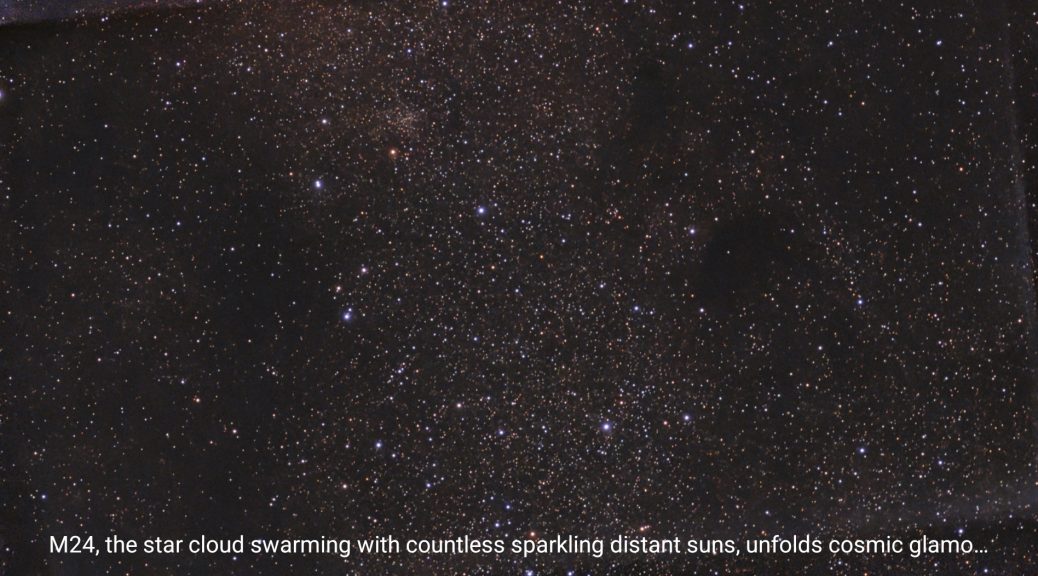
This is Messier 24, widely known as the Sagittarius Star Cloud. You are looking through a gap in the Milky Way’s dust lanes, that is 600 light years wide. Its like gazing through a natural cosmic window into millions of background stars extending 10,000 to 16,000 light-years deep toward the core of our galaxy.
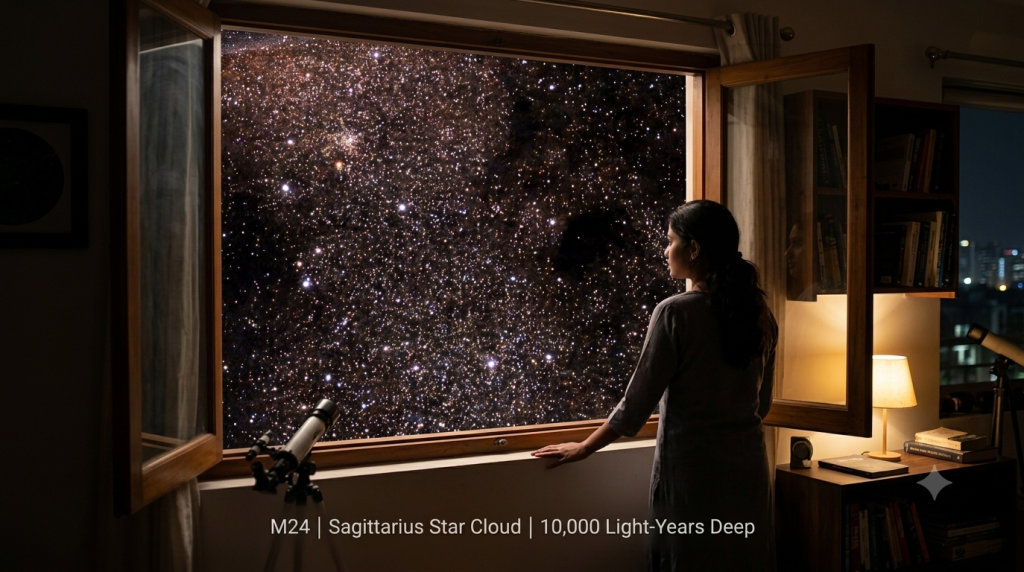
AI generated image
The above ai generated image captures the feeling of viewing the final photo. We visualize the enormous M24 star cloud as a true ‘cosmic window.’ What you are seeing through the window is a real hole/opening in the galaxy’s dusty wall.
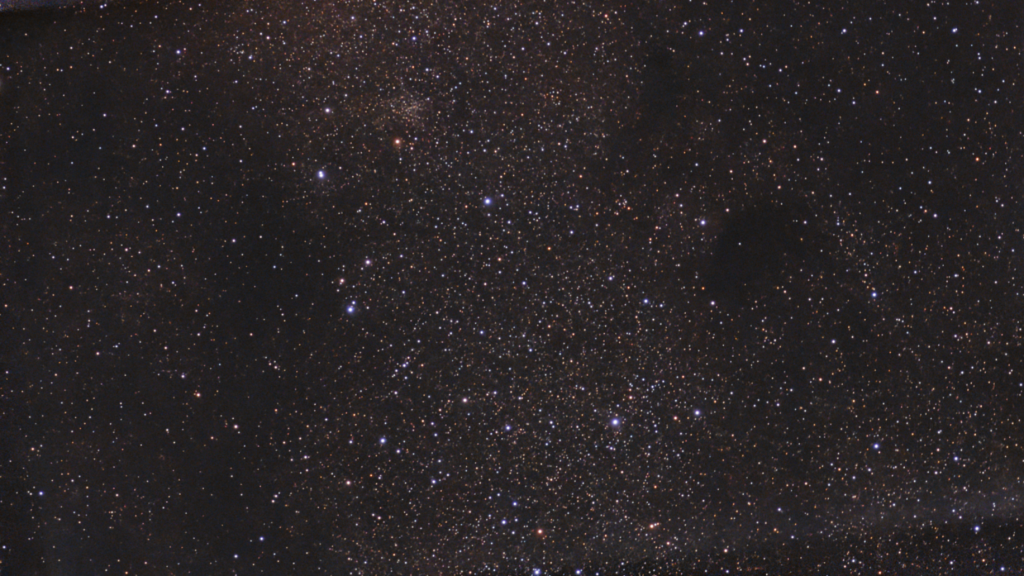
Close-up view
Imagine that distant opening in space is 600 light-years wide, and your mind has been transported right in front of it to look inside the opening, which is 10,000 to 16,000 light years deep!!.
Unlike a single star cluster, M24 is a vast aperture through interstellar dust, revealing a rich tapestry of stellar and nebular structures.
Nestled near the upper left is NGC 6603, a compact open star cluster containing dozens of bright stars over 9,000 light-years away.
Meanwhile, the pitch-black void on the right isn’t an empty absence of stars—it is Barnard 92, a cold, 45-light-year-wide cloud of interstellar dust and gas blocking thousands of background stars behind it,
Flanked nearby by the elongated dark ribbon of Barnard 93. These dense clouds of cosmic gas and dust hold immense potential; under gravitational contraction over millions of years, they serve as the stellar nurseries where entirely new stars will eventually be born.
Technical and Capture Details
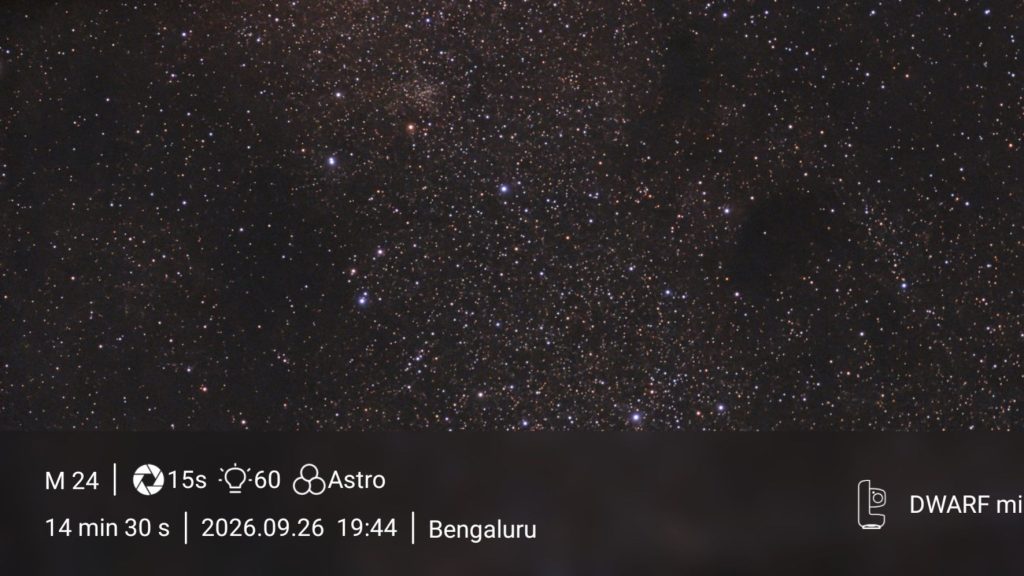
The photograph was captured directly from a terrace setup in Bengaluru using a smart telescope targeting the Sagittarius constellation.
The final image comprises a total exposure integration time of 14 minutes and 30 seconds (composed of individual 15-second sub-exposures at gain settings optimized for astro-imaging).
The frame below clearly resolves both the high star density of the Galactic Bulge and dark absorption features across the field of view.
The starlight captured in this single frame spent over 10,000 years traveling through the interstellar medium at 300,000 km/s before hitting the camera sensor.
Sometimes the most memorable astrophotography sessions are not the ones where everything goes according to plan. They are the ones where the universe quietly places something extraordinary in the frame, and you only discover it later.
That is exactly what happened to me on the night of 9 September 2026.
Click on any image below to open in a separate tab.
An Evening with Caldwell 30
Dwarf Mini Smart Telescope
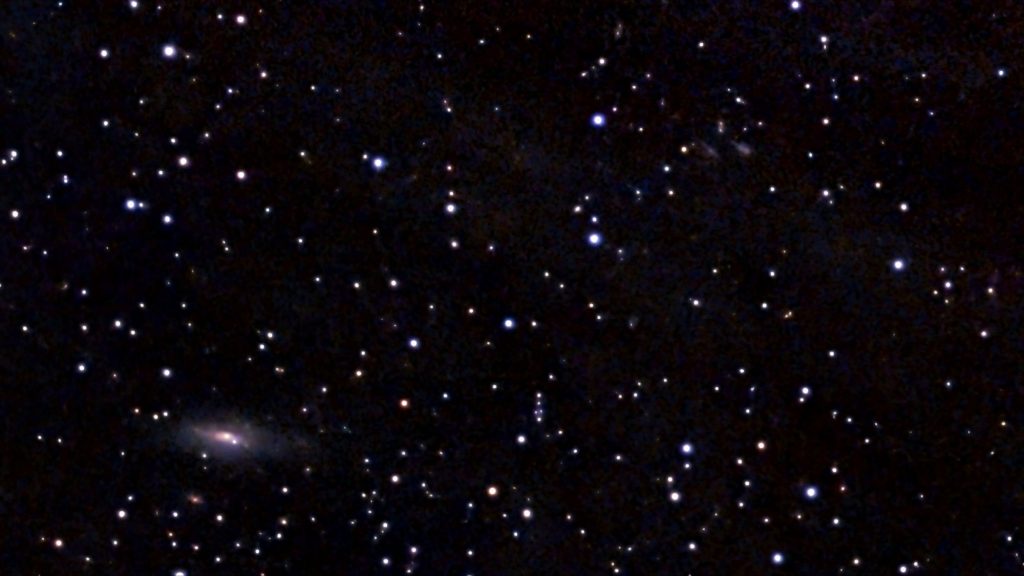
I had set up my Dwarf Mini Smart Telescope to image Caldwell 30 (NGC 7331), the magnificent spiral galaxy in Pegasus. Along with it, I hoped to capture members of the Deer Lick Group, a collection of distant galaxies that appear near NGC 7331 from our perspective on Earth.
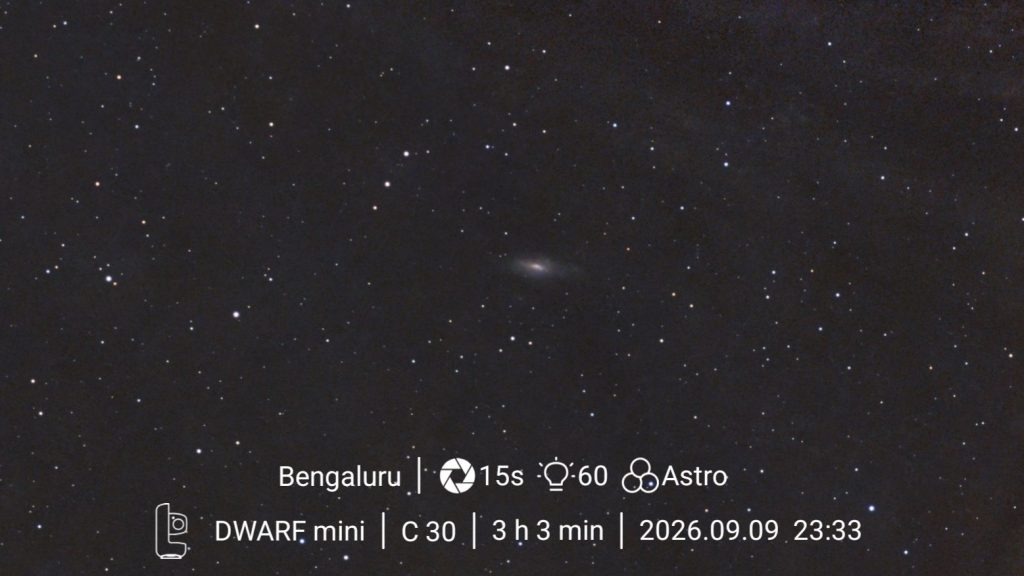
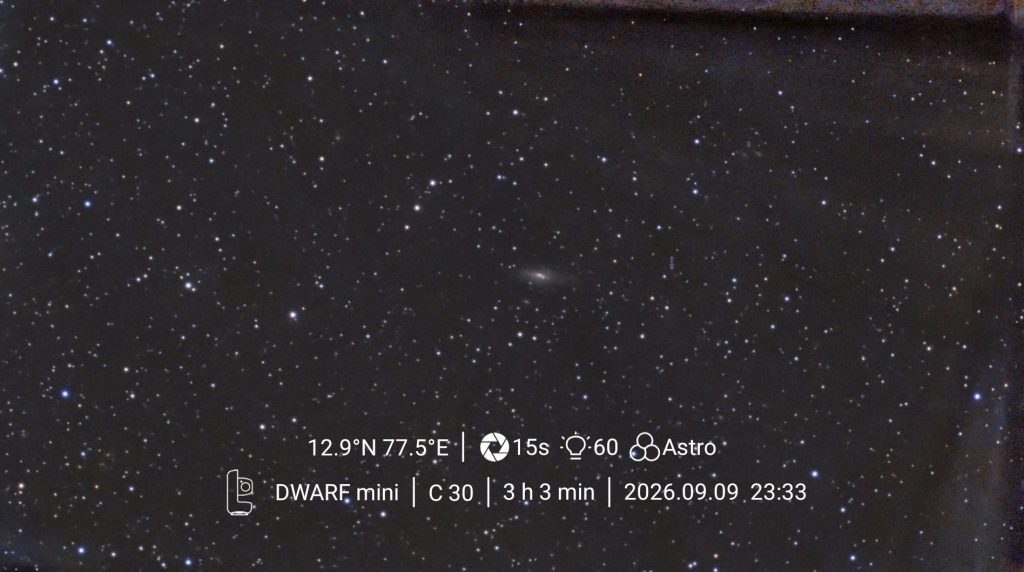
After more than three hours of imaging, I reviewed the results and was delighted to see the familiar elongated shape of NGC 7331 standing out against a rich star field. Near the edge of the frame, I could also make out a faint fuzzy patch that appeared to be Stephan’s Quintet, one of the most famous galaxy groups in the sky.
C30/NGC 7331
I considered the session a success.
At that point, I had no reason to think there was anything unusual about the image.
The Discovery Came Days Later
A few days later, while revisiting the image and examining the field more carefully, I noticed an unusually bright stellar point embedded within NGC 7331.
At first, I assumed it was simply a foreground star aligned with the galaxy.
But the position seemed curious.
After comparing the image with recent astronomy reports and using AI-assisted identification tools to investigate the field, I realised that the bright point was not an ordinary star at all.
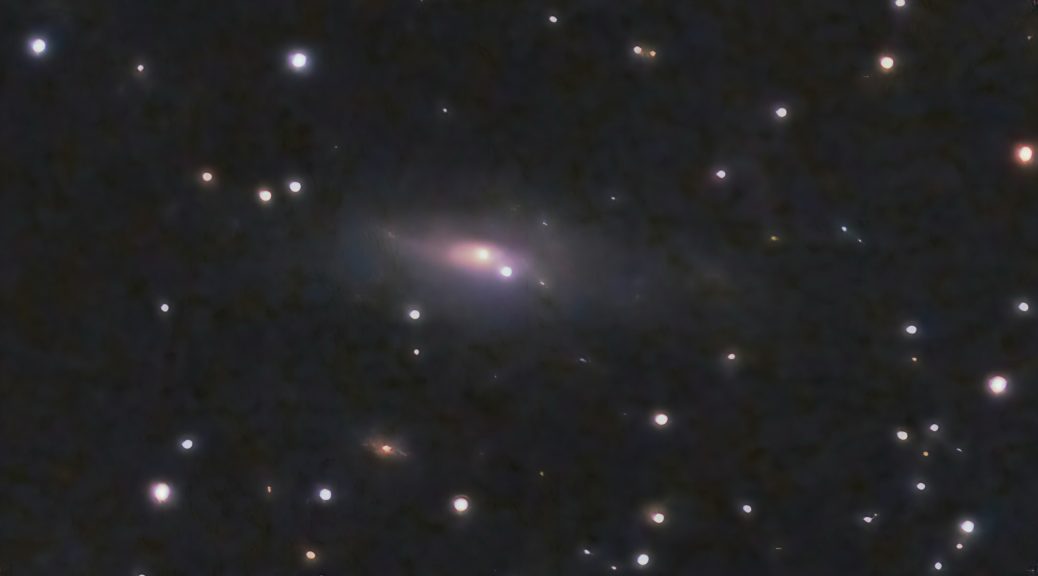
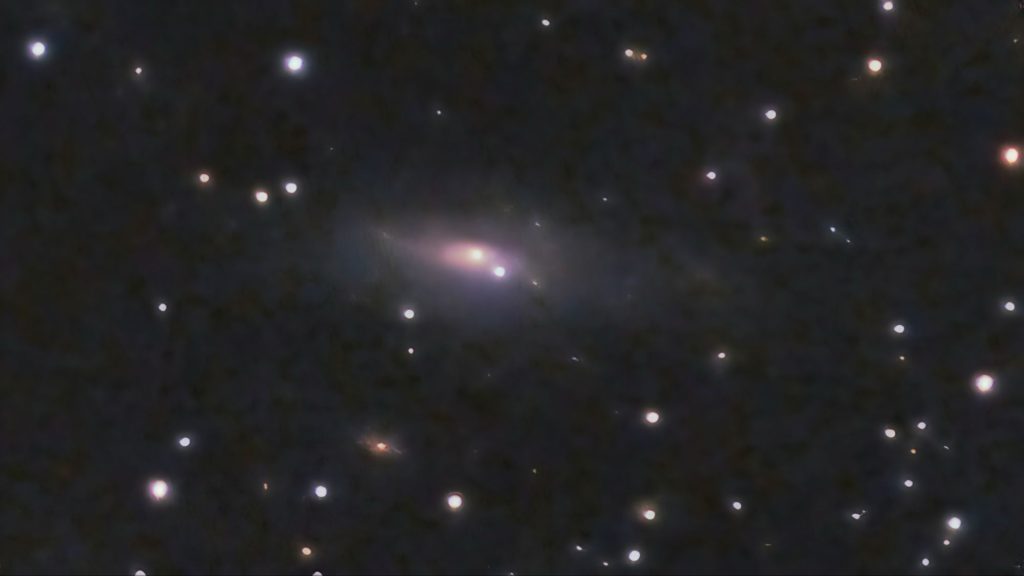
Supernova SN 2026aaiv in C30/NGC 7331
It was SN 2026aaiv, a recently discovered Type Ia supernova in NGC 7331.
Suddenly, the image became something far more special than I had originally thought.
A Star That Wasn’t There Before
Unlike the countless stars visible in an astrophotograph, this point of light was not part of the scene a few weeks earlier.
Somewhere in NGC 7331, approximately 40 million light-years away, a white dwarf star had reached a catastrophic tipping point and exploded in a thermonuclear event. The light from that explosion travelled across intergalactic space for millions of years before finally reaching Earth.
And on the night of 9 September 2026, some of those photons ended their journey on the sensor of my Dwarf Mini.
When I started the imaging session, I had absolutely no idea I was recording the aftermath of a stellar explosion.
The discovery only came later.
Caldwell 30: The Main Attraction
Even without the supernova, NGC 7331 is a spectacular target.
Often described as one of the spiral galaxies most similar in appearance to our own Milky Way, it features a bright central bulge surrounded by an extensive disk of stars, dust and gas.
For amateur astrophotographers, it is one of the finest galaxy targets of the autumn sky.
In my image, the galaxy’s central core is clearly visible, and its elongated structure stands out despite being tens of millions of light-years away.
What I did not realise at the time was that a supernova had quietly stolen the spotlight.
Stephan’s Quintet: A Tiny Smudge with a Big Story
Another unexpected pleasure was finding Stephan’s Quintet in the same field.
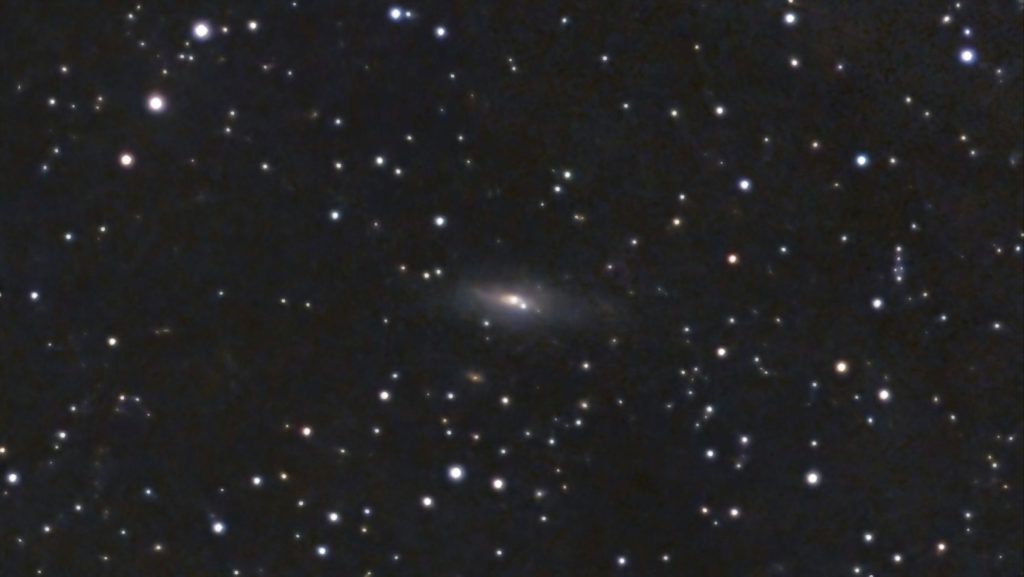
NGC 7331 bottom left, Stephan’s Quintet top right
Located near the upper-right region of the image, it appears only as a faint and delicate smudge. Yet its characteristic shape is still recognisable.
That faint smudge represents one of the most studied compact galaxy groups in astronomy.
To many people, it might look insignificant.
To an astronomer, it represents billions of stars spread across multiple interacting galaxies.
The fact that NGC 7331 and Stephan’s Quintet can be captured together is one of the reasons this area of Pegasus is so popular among astrophotographers.
Captured with a Dwarf Mini Smart Telescope
One of the most remarkable aspects of this image is the equipment used.
The entire observation was captured using a Dwarf Mini Smart Telescope, a compact telescope small enough to fit into a backpack.
Modern smart telescopes have made deep-sky imaging more accessible than ever. They combine tracking, image stacking and computational photography into a highly portable package, allowing amateur astronomers to record objects that once required far larger and more expensive equipment.
Capture Details
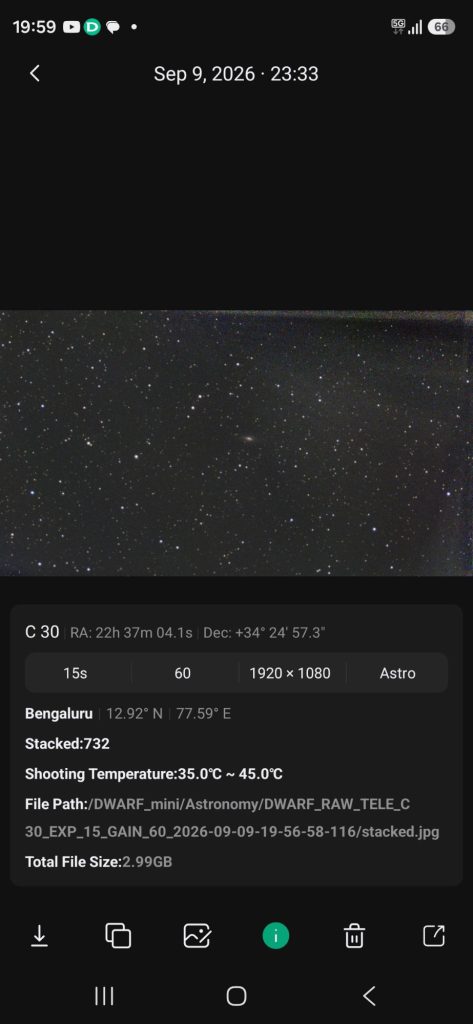
Target: Caldwell 30 (NGC 7331) Date: 9 September 2026 Location: Bengaluru, India Coordinates: 12.92° N, 77.59° E
Equipment
Dwarf Mini Smart Telescope
Astro Mode
Exposure Settings
Exposure Time: 15 seconds
Gain: 60
Resolution: 1920 × 1080
Integration
Frames Stacked: 732
Total Integration Time: Approximately 3 hours 3 minutes
Environmental Conditions
Shooting Temperature: 35°C to 45°C
Cloudy night
Considering the urban environment of Bengaluru and the compact size of the telescope, the result exceeded my expectations. Post processing done on android mobile using gallery app.
A Frame Full of Perspective
What fascinates me most about this photograph is the scale it contains.
In a single image are:
Stars belonging to our own Milky Way.
NGC 7331, roughly 40 million light-years away.
A supernova that briefly became bright enough to stand out within its host galaxy.
Stephan’s Quintet, one of the most famous galaxy groups ever observed.
At first glance, it looks like a field of stars with a few faint smudges.
But every one of those smudges is a galaxy.
And one of those bright points is the explosion of a star.
The Universe Will Not Wait
Looking back at the image now, I no longer see just Caldwell 30.
I see a spiral galaxy.
I see Stephan’s Quintet.
I see the light from a stellar explosion that travelled for millions of years before reaching a small telescope in Bengaluru.
Most importantly, I see a reminder that the universe is constantly changing, whether we notice it or not.
I did not set out to photograph a supernova.
I simply pointed a telescope at a beautiful galaxy and collected photons.
Only days later did I realise that hidden within those photons was a story far bigger than I had imagined.
The universe will not wait.
But sometimes, if we’re paying attention, it leaves us a postcard!
The Bubble Nebula – A Star Blowing a Giant Bubble in Space
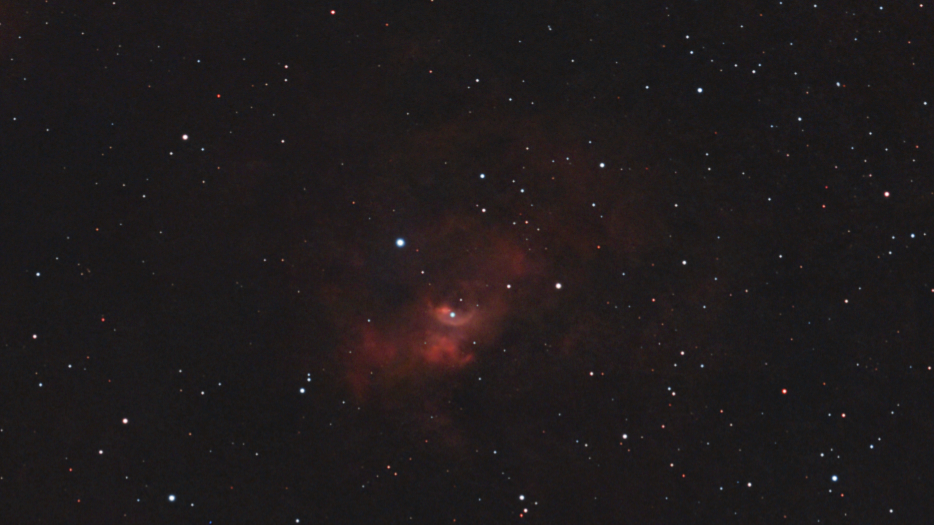
Photographing the night sky from Bengaluru, I captured this faint reddish cloud in the constellation Cassiopeia: NGC 7635, famously known as the Bubble Nebula.
Click any image to open full view in a new tab.
Bubble Nebula
While it looks like a peaceful cosmic cloud, it is actually the visible evidence of a huge astronomical process—a massive star reshaping space itself.
Anatomy of the Cosmic Bubble
Object: NGC 7635 (Bubble Nebula) | Constellation: Cassiopeia
Nearby Field Targets: Messier 52 (Open Cluster), NGC 7538 (Northern Lagoon)
Location: Bengaluru, India
Look closely at the bright central region of the image:
The Shell Composition: The distinct spherical shell is composed of glowing red, ionized hydrogen gas and interstellar dust. It isn’t a solid surface, but a razor-thin shockwave boundary glowing under intense ultraviolet radiation.
The Snowplough Mechanism: At the center lies BD+60°2522, an O-type star roughly 45 times more massive than our Sun. It blasts a ferocious stellar wind at over 4 million mph (~6.4 million km/h). As this wind pushes outward, it slams into the cold interstellar cloud, sweeping surrounding gas into a spherical bubble shell.
Why it’s Asymmetric: The bubble isn’t perfectly round, and the star is visibly off-center. On one side, the wind encounters a wall of dense molecular gas that resists the push and slows expansion. On the opposite side, it pushes into a lower-density region, allowing the shell to balloon outward much farther.
Size: The bubble is ~7 light-years across (66 trillion km)—about 1.5 times the distance from our Sun to our nearest star system, Alpha Centauri.
Distance: ~7,100 light-years away. The light captured in this image left the nebula 7,100 years ago during the dawn of human civilization.
Reading the Close-up Shot
Astrophotography turns a faint patch of light into a living story of stellar power, deep time, and massive scale.
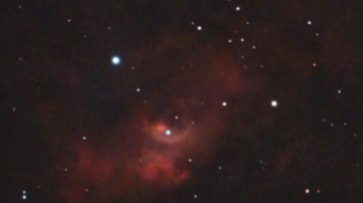
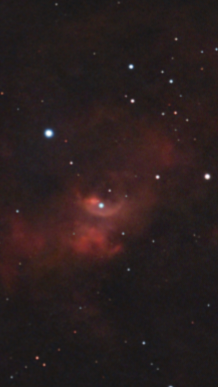
Close-up of the Bubble and the main star inside
The Bright Star (BD+60°2522): The bright star nestled inside the arc—this is the engine driving the entire structure. This 4-million-year-old star will eventually end its short life in a supernova in about 10 to 20 million years.
The Dense Gas Barrier (Lower-Left Arc): Notice how bright and tight the shell is on the lower-left. The stellar wind is crashing directly into a wall of dense cold gas, halting its expansion and making that edge glow intensely.
Free Expansion (Upper-Right Shell): On the opposite side, the gas is thinner, allowing the wind to push out farther into a smooth, faint bubble boundary.
The Red Glow: The surrounding ambient interstellar hydrogen gas, glowing red under the central star’s fierce ultraviolet radiation.
Distinction: Bubble Shell vs. Red Glow
It helps to separate the two main structures in the shot:
The Inner Bubble: The small, bright curved boundary shaped directly by the stellar wind (~7 light-years across).
The Outer Red Glow: The much larger surrounding emission nebula—ambient gas energized and set ablaze by the star’s radiation.
Wide-Angle Perspective: A 3D View of Cassiopeia
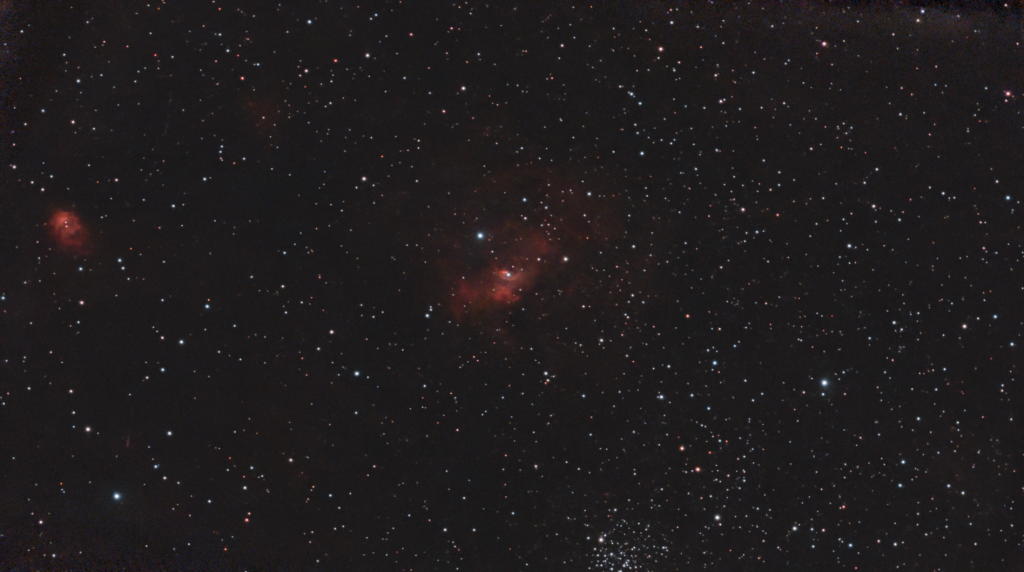
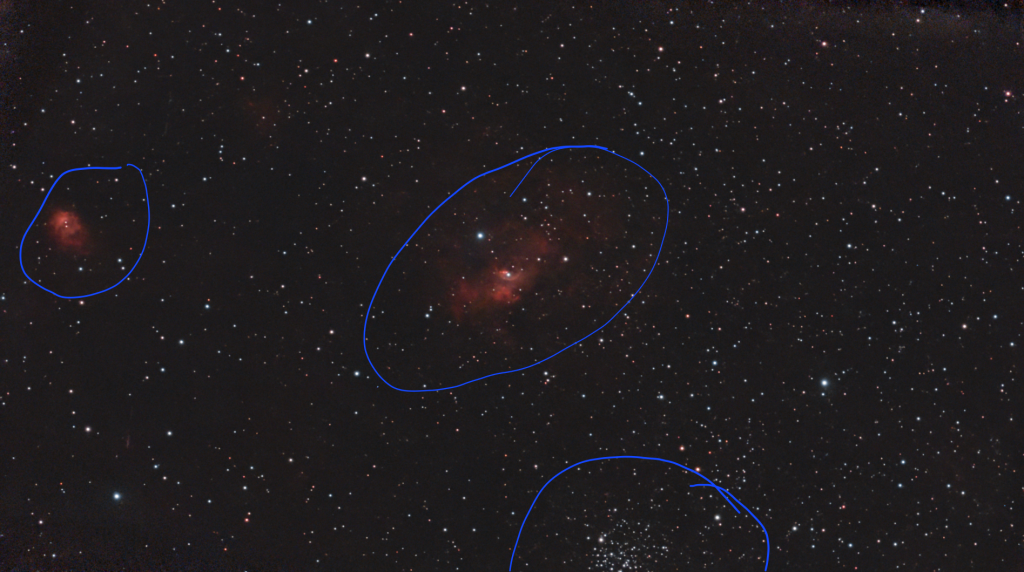
Step back into the full wide-field frame, and the neighborhood comes alive with three distinct deep-sky objects sharing the same patch of night sky:
M52 -Bottom, NGC7635- Center, NGC7538- Left
Messier 52 (Bottom Edge): The dense, glittering cluster of stars along the bottom frame is M52, a rich open star cluster containing thousands of young stars.
NGC 7538 (Far Left): The active star-forming red cloud on the left margin is NGC 7538, often called the Northern Lagoon Nebula for its striking structural resemblance to the famous southern Lagoon.
The 3D Illusion: While all three objects fit together inside this single frame, they are actually separated by vast depths of interstellar space along our line of sight:
Messier 52: ~5,000 light-years away (closest to us)
Bubble Nebula (NGC 7635): ~7,100 light-years away (sitting in the mid-ground)
Northern Lagoon (NGC 7538): ~9,100 light-years away (deep in the background)
In the 2D photograph, M52 and the Bubble Nebula appear side-by-side—separated by just 0.5 degrees (roughly the width of a full moon)—yet M52 sits more than 2,000 light-years closer to Earth!