The Wonder of Messier 24
Peering Through the Cosmic Window

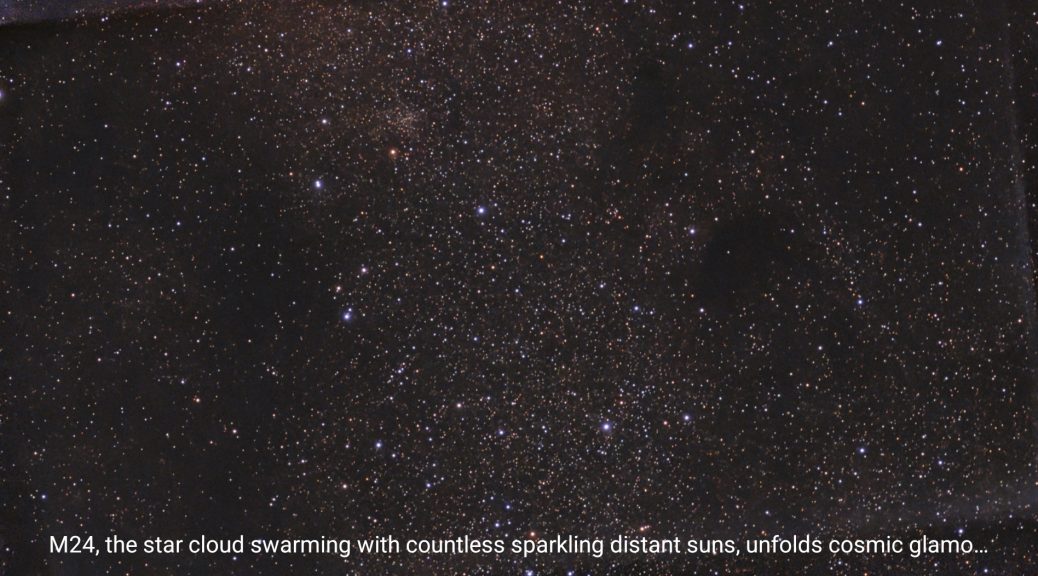
This is Messier 24, widely known as the Sagittarius Star Cloud. You are looking through a gap in the Milky Way’s dust lanes, that is 600 light years wide. Its like gazing through a natural cosmic window into millions of background stars extending 10,000 to 16,000 light-years deep toward the core of our galaxy.
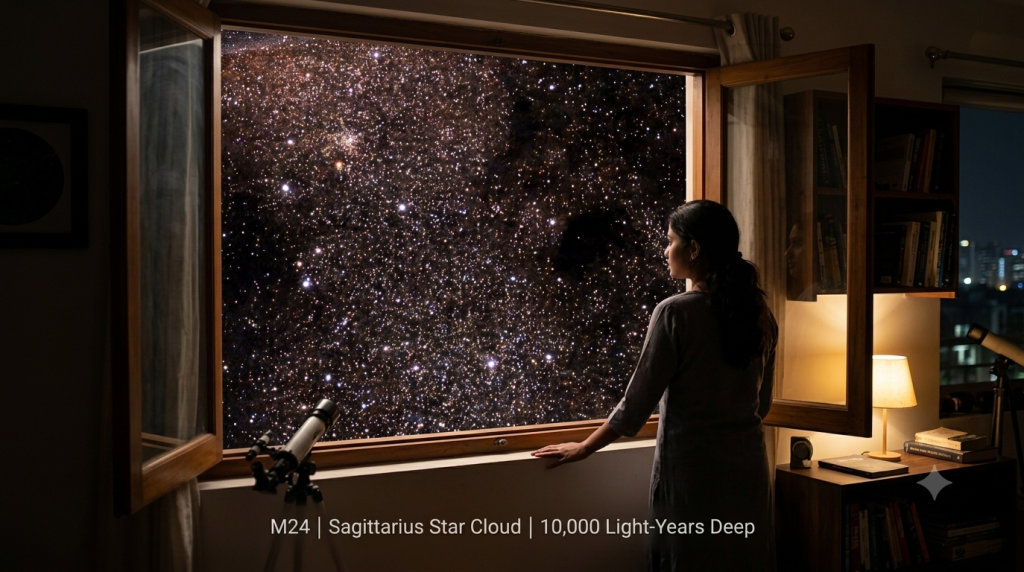
The above ai generated image captures the feeling of viewing the final photo. We visualize the enormous M24 star cloud as a true ‘cosmic window.’ What you are seeing through the window is a real hole/opening in the galaxy’s dusty wall.

Imagine that distant opening in space is 600 light-years wide, and your mind has been transported right in front of it to look inside the opening, which is 10,000 to 16,000 light years deep!!.
Unlike a single star cluster, M24 is a vast aperture through interstellar dust, revealing a rich tapestry of stellar and nebular structures.
- Nestled near the upper left is NGC 6603, a compact open star cluster containing dozens of bright stars over 9,000 light-years away.
- Meanwhile, the pitch-black void on the right isn’t an empty absence of stars—it is Barnard 92, a cold, 45-light-year-wide cloud of interstellar dust and gas blocking thousands of background stars behind it,
- Flanked nearby by the elongated dark ribbon of Barnard 93. These dense clouds of cosmic gas and dust hold immense potential; under gravitational contraction over millions of years, they serve as the stellar nurseries where entirely new stars will eventually be born.
Technical and Capture Details
The photograph was captured directly from a terrace setup in Bengaluru using a smart telescope targeting the Sagittarius constellation.
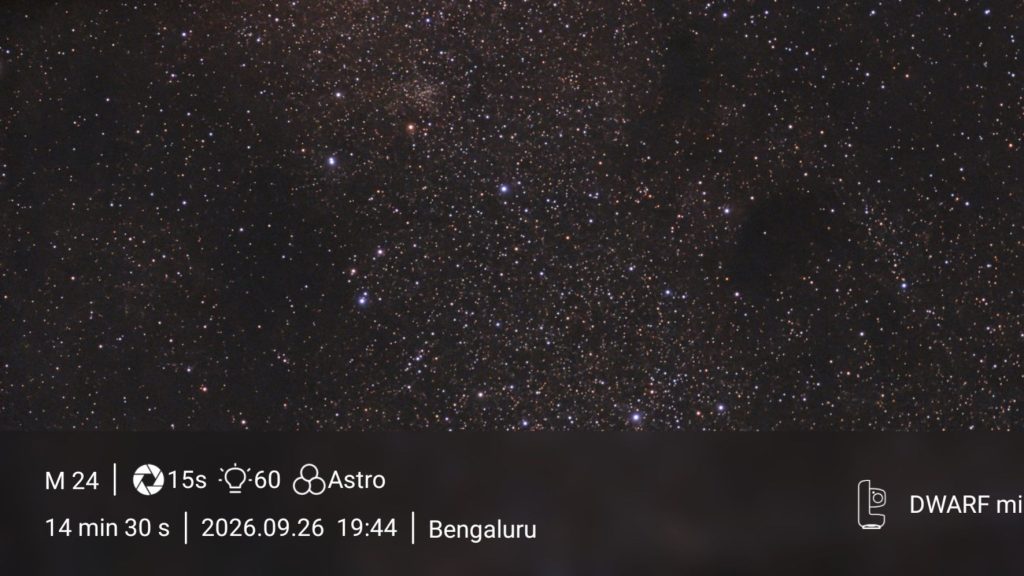
The final image comprises a total exposure integration time of 14 minutes and 30 seconds (composed of individual 15-second sub-exposures at gain settings optimized for astro-imaging).
The frame below clearly resolves both the high star density of the Galactic Bulge and dark absorption features across the field of view.
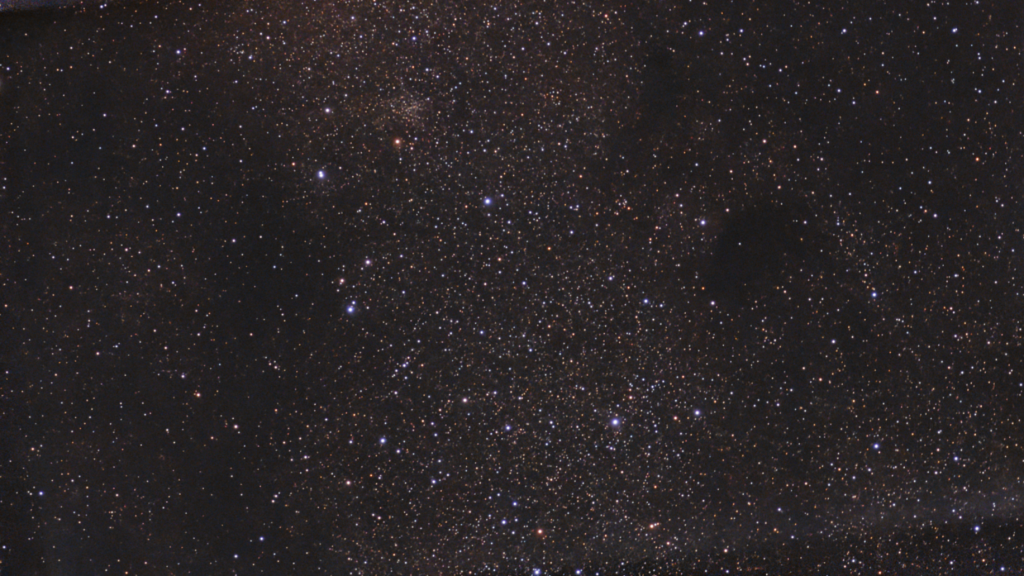
The starlight captured in this single frame spent over 10,000 years traveling through the interstellar medium at 300,000 km/s before hitting the camera sensor.
Thank you!