Golden Presence
Introduction
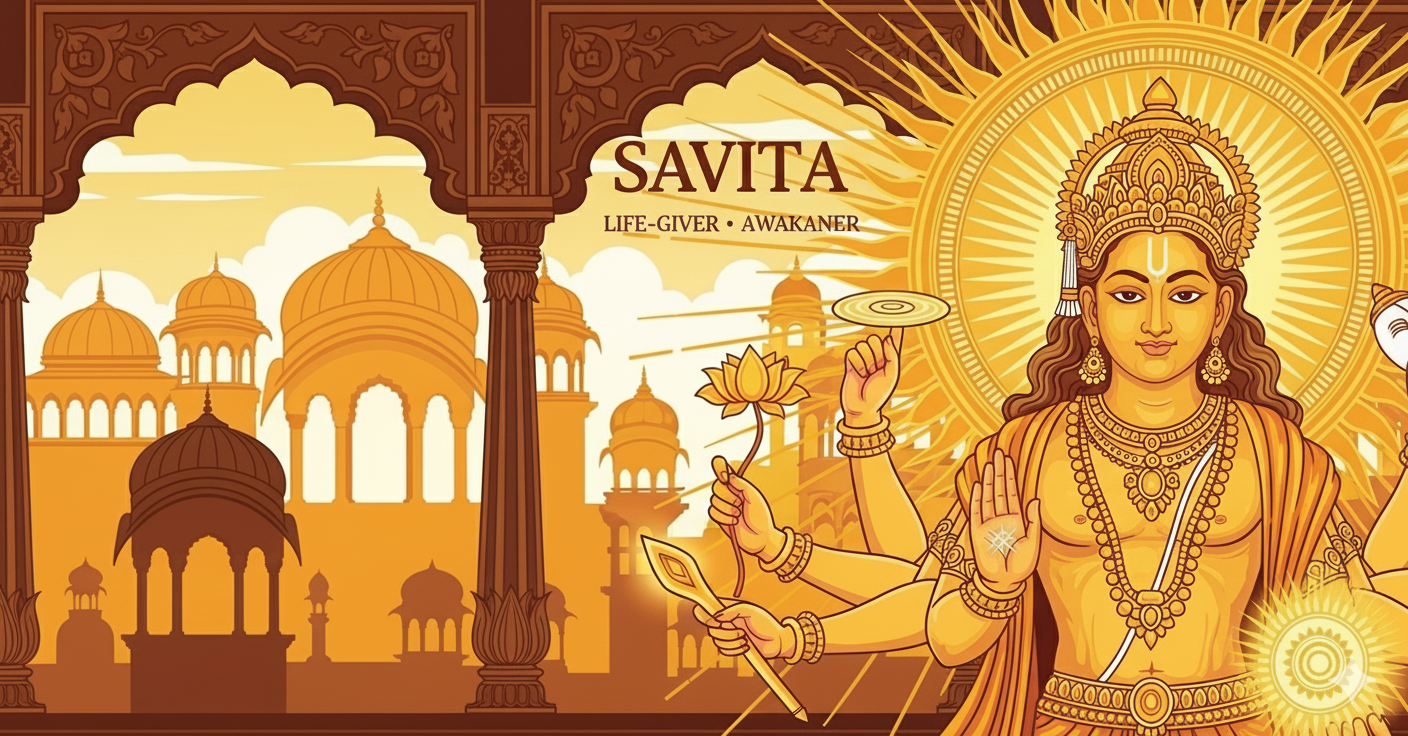
Light has always been a symbol of wisdom, purity, and divinity. In the Vedas, this light is not merely the physical radiance of the Sun but the eternal presence of the Divine that sustains and illumines all of creation. Among the many hymns that glorify the Sun (Surya), the figure of Savita — the life-giver and awakener — stands out as a profound symbol.
The Sun, in this vision, is more than a celestial body. It is the radiant expression of the Divine, the cosmic witness who envelops the worlds with golden rays and shines within us as awareness. It is this dimension of Savita that finds expression in todays post’s verses – both in the Navagraha Suktam and the Surya Upanishad, and which is illuminated further in the teachings of Bhagawan Sri Sathya Sai Baba.
Context
To appreciate the verses we are about to explore, it helps to recall the vision of the rishis. The Sun is both outer and inner: outwardly, it governs time, seasons, and life itself; inwardly, it represents the unfailing light of consciousness that dispels ignorance.
In the Navagraha Suktam, the seer describes this aspect through the imagery of the Sun’s golden rays — an “envelope” that surrounds and protects the worlds. In the Surya Upanishad, the same truth is declared more explicitly: Surya is none other than the Supreme Being, present everywhere and in everything.
Together, these texts form a bridge — moving from the symbolic imagery of light to the direct affirmation of divinity. This bridge becomes even more meaningful when we reflect on how Bhagawan Baba often emphasized the omnipresence of God, guiding us to recognize the Divine not only in the cosmos but in our own hearts.
Verses
Before we step into the verses, let us listen with the same reverence as the ancient rishis — who saw in the Sun not just a source of light, but the very presence of the Divine. The Navagraha Suktam begins by unveiling this vision through a prayer to Surya, the golden-hued one who envelopes and sustains all the worlds.
Verse 1 – Navagraha Suktam

Sanskrit
ॐ आसत्येन रजसा वर्तमानो निवेशयन्नमृतं मर्त्यं च ।
हिरण्ययेन सविता रथेनाऽऽदेवो याति भुवना विपश्यन् ॥
अग्निं दूतं वृणीमहे होतारं विश्ववेदसम् ।
अस्य यज्ञस्य सुक्रतुम् ॥
येषाम् ईशे पशुपतिः पशूनां चतुष्पदाम् च द्विपदाम् ।
निष्क्रीतोऽयं यज्ञियं भागमेतु रायस्पोषा यजमानस्य सन्तु ॥

ॐ अधिदेवता प्रत्यधिदेवता सहिताय आदित्याय नमः ॥
Transliteration
Om āsatyena rajasā vartamāno niveśayann amṛtaṃ martyaṃ ca |
hiraṇyayena savitā rathenā devo yāti bhuvanā vipashyan ||
Agniṃ dūtaṃ vṛṇīmahe hotāraṃ viśvavedasam |
asya yajñasya sukratum ||
Yeṣām īśe paśupatiḥ paśūnāṃ catuṣpadām ca dvipadām |
niṣkrīto ’yaṃ yajñiyaṃ bhāgam etu rāyaspoṣā yajamānasya santu ||
Om adhidevatā pratyadhidevatā sahitāya ādityāya namaḥ ||
Meaning
- Surya as Savita
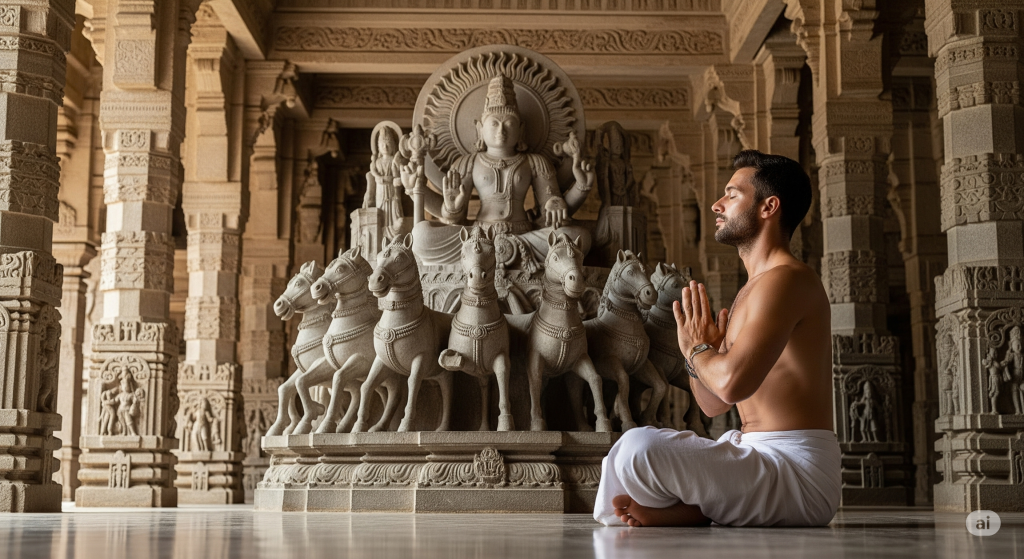
The divine Savita (Sun), moving through the worlds with his golden chariot, illumines both the mortal and immortal realms, beholding all beings. - Agni as Messenger
We invoke Agni, the divine messenger, the priest who knows all, the one who guides the sacrifice rightly. - Pashupati as Protector
Lord Pashupati, the master of all creatures—both four-legged and two-legged—accepts the offering. May the yajamāna (worshipper) be blessed with prosperity and abundance. - Salutations
Om, salutations to Āditya (Surya), along with his adhidevata and pratyadhidevata.
Adhidevata & Pratyadhidevata of Surya
- Adhidevata (Presiding Deity): Agni
Agni is invoked as Surya’s adhidevata because both are luminous, purifying, and the conveyors of divine will. Agni ensures that the prayers and offerings reach the celestial realms. - Pratyadhidevata (Secondary Deity): Pashupati (Rudra/Shiva)
Pashupati, Lord of all beings, represents the protective and sustaining power of Surya. He governs both bipeds and quadrupeds, symbolizing life in its entirety.
Explanation
This opening hymn from the Navagraha Suktam invokes Savitṛ (the Sun as divine inspirer):
- “आसत्येन रजसा वर्तमानो” – The Sun moves through the heavens, pervading both the immortal (divine) and the mortal (earthly) realms, binding them with his radiant energy.
- “हिरण्ययेन सविता रथेन” – He rides his golden chariot, surveying all the worlds, ever-watchful and ever-sustaining.
- The verse then calls upon Agni (fire) as the divine messenger, the knower of all, who carries offerings to the gods and ensures that the sacred ritual bears fruit.
- The hymn acknowledges Pashupati (Lord of all beings) as the sovereign over all creatures, both four-footed and two-footed.
- It closes with the dedication to Āditya (Sun) as the presiding deity, along with the attendant deities (pratyadhidevatas), offering salutations to his all-encompassing radiance.
✨ Reflection: This verse establishes the Sun as both the cosmic witness and the life-giving force. He bridges mortality and immortality, while Agni carries our prayers upward. It reminds us that every living being is sustained by the divine order, and that surrendering our offerings leads to nourishment, prosperity, and harmony.
Verse from the Sūryopaniṣad
Sanskrit Text
सविताḥ पुरस्तात् ।
सविताḥ पश्चात् ।
सविताḥ ऊर्ध्वम् ।
सविताḥ अधः ।
Transliteration
savitaḥ purastāt ।
savitaḥ paścāt ।
savitaḥ ūrdhvam ।
savitaḥ adhaḥ ।
Meaning (simple translation)
- Savitā is in front.
- Savitā is behind.
- Savitā is above.
- Savitā is below.
Explanation

This verse is an affirmation of Savitā (the Sun as the divine life-giver) as the all-encompassing presence. It declares that the radiance of Savitā is not confined to one direction or moment, but surrounds us entirely: before us, behind us, above, and below.
- सविताḥ पुरस्तात् (Savitāḥ purastāt — in front)
– The Sun lights the path ahead, guiding our steps, symbolizing foresight, clarity, and direction in life. - सविताḥ पश्चात् (Savitāḥ paścāt — behind)
– The Sun supports from behind, reminding us that the divine always stands as our protector and unseen strength, carrying us forward. - सविताḥ ऊर्ध्वम् (Savitāḥ ūrdhvam — above)
– The Sun is above, the highest illumination. This represents the aspiration of the soul toward the Supreme, the source of inspiration and higher wisdom. - सविताḥ अधः (Savitāḥ adhaḥ — below)
– The Sun is below, sustaining even the earth beneath us. This symbolizes firm grounding, nourishment, and stability, reminding us that divine presence is the very foundation of existence.
Taken together, the mantra is not merely about the astronomical Sun, but about the inner Sun—the ātman. It is a meditative contemplation that wherever one turns, there is only the golden presence of the Divine, pervading all directions.
Reflective Note
By chanting this verse, a devotee inwardly acknowledges: “I am always in the embrace of Savitā’s light. There is no place where He is not.” This brings deep reassurance, stillness, and a sense of being surrounded by grace.
Bhagawan Sri Sathya Sai Baba’s Guidance
Bhagawan Baba has emphasized this same truth in His discourses many times. In one such message, He said:
“As long as you have faith in God, you have nothing to fear. May you all enjoy safety and security! Wherever you go, whatever you do, have firm conviction that God is always with you, in you, around you, above you, below you. Do not be carried away by what others say. Have God firmly installed in your heart.”
(Source: Discourse, Sathya Sai Speaks)
In another teaching, reaffirming the same truth, He emphasized:
“You trust your friend whom you have met only a few years ago, but not God who is with you, in you, around you, throughout your life.” (Source: Divine Discourse, Shivarathri Feb 1999)

These are not mere words—they are living affirmations that bring the Upanishadic declaration into our personal, everyday experience. Where the Sūrya Upaniṣad states the omnipresence of Savitā, Baba’s words give us a heartfelt reminder that God is our constant companion in all circumstances—empowering us, protecting us, guiding us, and residing within our very hearts.
These words are a living echo of the Upanishadic declaration. Just as the Sūrya Upaniṣad assures us of Savitā’s omnipresence, Baba translates this ancient wisdom into a practical assurance for the devotee: God’s presence surrounds us at all times — protecting, guiding, and uplifting. The radiance of the Divine is not only cosmic but also deeply personal, assuring safety, peace, and fearlessness for every seeker who keeps faith alive.
The Three Declarations United

- Navagraha Suktam: Savita illumines all with golden rays — an enveloping presence.
- Surya Upanishad: Savita is everywhere — before, behind, above, below.
- Bhagawan Baba: God is always with you, in you, around you, above you, below you.
Together, these affirm that the Divine is Omnipresent — not distant, but ever-present as light and love, surrounding and pervading us at every moment.
Reflections & Key Takeaways
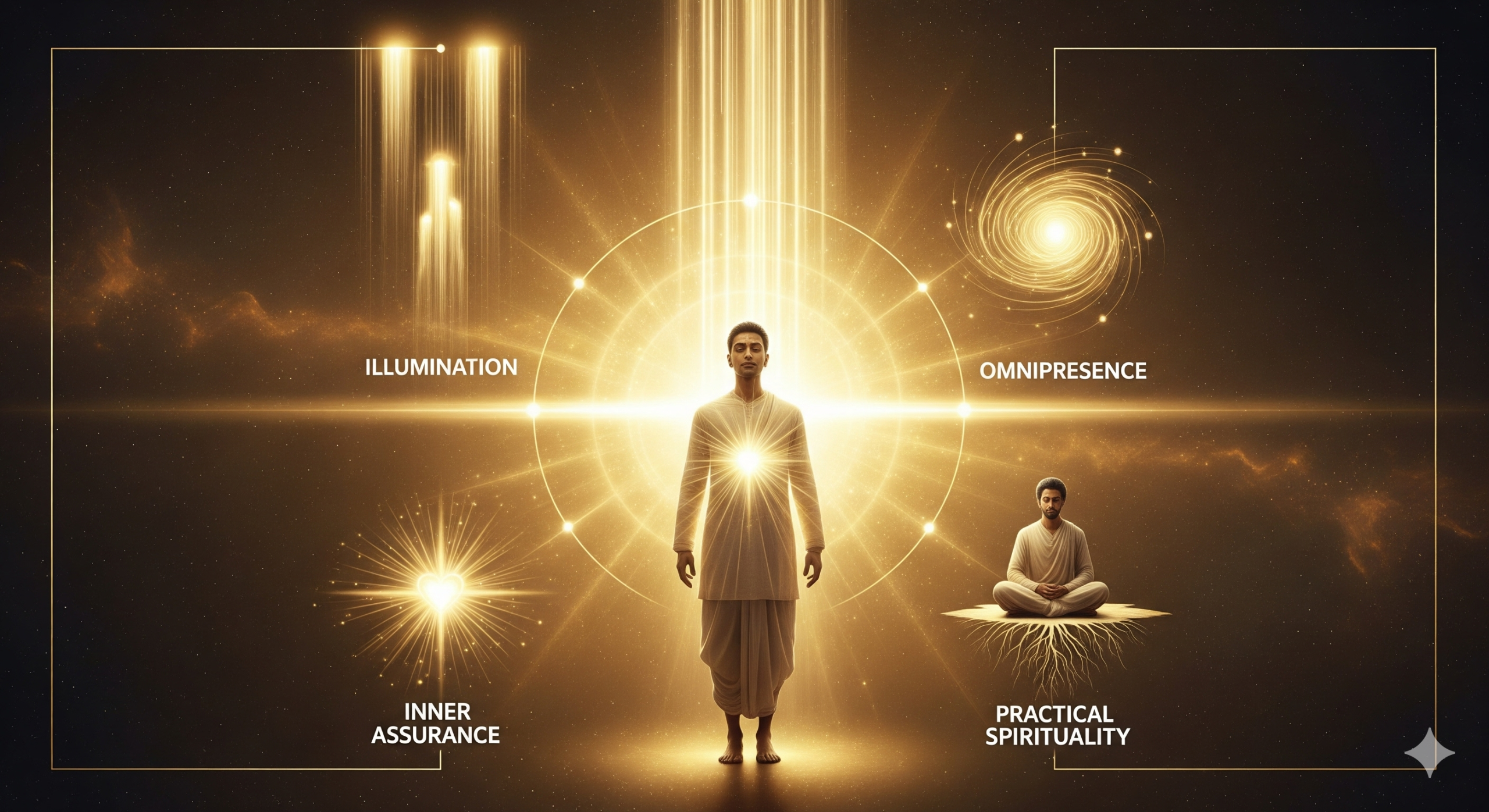
Meditating on these verses and recalling Baba’s assurance helps nurture unshakeable faith. It transforms the abstract idea of omnipresence into a tangible inner reality: a light that is ever-present, faithful, and guiding—day and night, in every step we take.
- Illumination: Like the golden rays of Savita, God’s grace shines upon all, without distinction.
- Omnipresence: The Divine presence is not limited by direction, time, or space — it is all-pervading.
- Inner Assurance: With faith, one realizes that God is not only beyond but also within the heart — the truest source of safety and security.
- Practical Spirituality: Remembering this omnipresence transforms fear into courage and uncertainty into peace.
Closing Thoughts

On this Sunday dedicated to Surya, let us meditate on Savita — the radiant Sun who illumines our lives.
The Navagraha Suktam, the Surya Upanishad, and Bhagawan Baba’s words together remind us that the same Divine Light that moves across the heavens also shines within us and around us, always.
May we live in that awareness, in light, fearlessness, and faith. – The Golden Presence
Citations & References
- Navagraha Suktam – Krishna Yajur Veda – traditionally recited in praise of the nine grahas, with the opening verses dedicated to Surya as Savitā.
- Surya Upanishad – From the Atharva Veda, highlighting Surya as the source of illumination, energy, and spiritual awakening.
Samastah Lokah Sukhini Bhavanthu
May all beings in all the worlds be happy!

Jai Sai Ram!
Please note all content and images generated using AI Tools