Seva to Anugraha
From Darshan to Embrace: Hanuman’s Journey of Devotion

In the sacred rhythm of Ramayana, Hanuman’s journey is not marked by conquest or recognition—but by seva, the quiet offering of selfless love. He does not seek reward, nor does he ask for liberation. His only desire is to serve.
And yet, in that very surrender, the Divine responds—not with accolades, but with anugraha. Seeta’s glance becomes his sanctum. Rama’s embrace becomes his liberation. The servant becomes the beloved.
This is not a tale of achievement. It is a revelation: That when devotion flows without demand, grace arrives without condition.
Introduction
In the quiet sanctum of devotion, Hanuman stands—not as a warrior, not as a scholar, but as a servant. His every breath is an offering, his every action a hymn. He asks for nothing, yet gives everything.
This is not the story of a hero seeking glory. It is the unfolding of seva—pure, unadorned, and unwavering. And in that purity, the Divine responds. Not with reward, but with anugraha—grace that flows like the Ganga, unbidden and boundless.
When Hanuman beholds Seeta, it is not a mere sight—it is darshan, the soul’s recognition of the eternal. When Rama embraces him, it is not a gesture—it is moksha, the liberation born of love.
This is the path from offering to embrace, from effort to grace. This is Seva to Anugraha.
The Sacred Unfolding

This post is a meditative journey into one of the most tender and transformative moments in the Ramayana—Hanuman’s encounter with Seeta and Rama. Through carefully chosen verses, we witness not just events, but spiritual thresholds: where devotion deepens into darshan, and darshan dissolves into grace.
We explore:
- Hanuman’s approach to Seeta — marked by humility, reverence, and the sacred weight of his message
- Seeta’s silent recognition — a glance that carries lifetimes of trust and divine affirmation
- Rama’s embrace of Hanuman — where the servant is not rewarded, but absorbed into love itself
Each verse is a portal. Each reflection, a step deeper into the mystery of anugraha. This is not a study—it is a sacred unfolding.
Darshan and Divine Embrace
In the vast ocean of the Rāmāyaṇa, few moments shine with the purity and power of Hanuman’s journey to Lanka and Rama’s embrace upon his return. These two Sargas—Sundarakāṇḍa Sarga 65 and Yuddha Kāṇḍa Sarga 1—are not merely episodes of reconnaissance and reward. They are spiritual archetypes: the devotee’s fearless leap into darkness for the sake of the Divine, and the Lord’s overflowing love in response to selfless Seva.
Hanuman’s Darshan of Seeta is not a sight—it is a revelation. He beholds the Goddess in exile, radiant in tapasya, unwavering in her surrender. His words to Rama are not a report—they are śrī-vākya, sacred utterance. And Rama’s response is not a royal commendation—it is Divine Union, the embrace that sanctifies all effort.
Together, these chapters offer a blueprint for devotion:
Leap with love. → Serve with surrender. → Speak with truth. → Receive with grace.
Darshan in Lanka: Hanuman’s Sacred Encounter with Mother Seeta

Upon his triumphant return from Lanka, Hanuman was welcomed not with fanfare, but with eager anticipation. Sugreeva, Rama, and the assembled ministers gathered around him—not to hear of battles or burnt palaces, but to receive the most precious news: the well-being of Seeta. Prompted by their heartfelt inquiries, Hanuman bowed reverently in the direction of Seeta and began to recount his sacred Darshan. What unfolded was not a mere report—it was a devotional offering, a first-hand glimpse into the sanctity, sorrow, and spiritual radiance of Seeta in Ashoka Vatika.
The verses that follow, drawn from Sundarakāṇḍa – Sarga 65, capture this moment of reverent narration. Hanuman’s words are not just descriptive—they are imbued with emotion, reverence, and the subtle grace of one who has truly seen.

Sundarakāṇḍa – Sarga 65, Verses 7 to 11, 15 to 19
View full Sarga 65 on ValmikiRamayan.net
Verse 5-65-7
Transliteration: śrutvā tu vacanaṃ teṣām hanūmān māruta ātmajaḥ | praṇamya śirasā devyai sītāyai tām diśam prati || uvāca vākyam vākyajñaḥ sītāyā darśanam yathā
Translation: Hearing their words, Hanuman, son of the wind-god, bowed his head toward the direction of Seeta and spoke, being wise in speech, of the Darshan he had of her.
Commentary: Hanuman’s bow is not ritual—it is reverence toward the Divine Feminine. Even before speaking, he invokes Seeta’s presence, acknowledging her as Maha Lakshmi. His words are not a report—they are a sacred offering, a retelling of Darshan, not mere sight.
Verse 5-65-8
Transliteration: samudram laṅghayitvā aham śata yojanam āyatam | agaccham jānakīm sītām mārgamāṇo didṛkṣayā
Translation: Crossing the vast ocean a hundred yojanas wide, I arrived in search of Seeta, daughter of Janaka, driven by the desire to behold her.
Commentary: Hanuman’s leap is the soul’s flight toward the Divine, propelled by śraddhā and seva. The ocean becomes saṃsāra, and his yearning to see Seeta is the seeker’s longing for Darshan of the Goddess.
Verse 5-65-9
Transliteration: tatra laṅkā iti nagarī rāvaṇasya durātmanaḥ | dakṣiṇasya samudrasya tīre vasati dakṣiṇe
Translation: There lies the city of Lanka, ruled by the wicked Ravana, situated on the southern shore of the ocean.
Commentary: Lanka is not just a fortress—it is the symbol of ego and adharma. Hanuman’s entry into this realm is the penetration of light into darkness, the devotee’s fearless march into illusion to reclaim the Divine.
Verse 5-65-10
Transliteration: tatra dṛṣṭā mayā sītā rāvaṇa antaḥ pure satī | samnyasya tvayi jīvantī rāma rāma mano ratham
Translation: There, in Ravana’s inner chambers, I saw Seeta—chaste and devoted—living only for you, having surrendered herself to you, her mind yoked to Rama alone.
Commentary: This is the moment of Darshan. Hanuman beholds Seeta not as a captive, but as Lakshmi in tapasya, radiant in her surrender. Her body may be confined, but her soul is merged in Rama, her mind a chariot drawn by devotion.
Verse 5-65-11
Transliteration: dṛṣṭā me rākṣasī madhye tarjyamānā muhuḥ muhuḥ | rākṣasībhiḥ virūpābhī rakṣitā pramadā vane
Translation: I saw her among hideous demonesses, repeatedly threatened and guarded in the pleasure garden.
Commentary: Even surrounded by tormentors, Seeta remains untouched in spirit. Her suffering is not defeat—it is austerity, her silence a mantra, her presence a flame of Shakti. Hanuman’s Darshan is of the Goddess in her most sublime resilience.
Verse 5-65-15
Transliteration: ikṣvāku vaṃśa vikhyātim śanaiḥ kīrtayata anagha | sa mayā nara śārdūla viśvāsam upapāditā
Translation: I gently narrated the glory of the Ikṣvāku lineage, O sinless one, and thus instilled trust in her.
Commentary: Hanuman’s speech is śrī-vākya—sacred utterance. By invoking Rama’s dharma and heritage, he rekindles Seeta’s hope. This is bhakti through remembrance, where storytelling becomes a bridge to grace.
Verse 5-65-16–17
Transliteration: tataḥ sambhāṣitā devī sarvam artham ca darśitā | rāma sugrīva sakhyam ca śrutvā prītim upāgatā | niyataḥ samudācāro bhaktiḥ ca asyāḥ tathā tvayi
Translation: Then the divine Seeta spoke with me, revealing everything. Hearing of Rama’s alliance with Sugreeva, she was pleased. Her conduct is disciplined, and her devotion to you remains unwavering.
Commentary: Seeta’s response is Lakshmi’s grace in speech. She doesn’t just speak—she reveals, she blesses. Her joy upon hearing of Rama’s alliance is the Goddess responding to Dharma, and her unwavering devotion is the anchor of the universe’s balance.
Verse 5-65-18
Transliteration: evam mayā mahābhāgā dṛṣṭā janaka nandinī | ugreṇa tapasā yuktā tvat bhaktyā puruṣa ṛṣabha
Translation: Thus I saw the illustrious daughter of Janaka, endowed with intense austerity and deep devotion to you, O best of men.
Commentary: Hanuman’s Darshan is of Lakshmi in her ascetic form—a paradox of divine beauty and fierce penance. Her devotion is not passive—it is active tapas, a blazing fire of love that sanctifies even the soil of Lanka.
Verse 5-65-19
Transliteration: abhijñānam ca me dattam yathā vṛttam tava antike | citra kūṭe mahāprājña vāyasam prati rāghava
Translation: She gave me a token of remembrance—a story of the crow at Chitrakuta—to confirm her identity and love for you, O wise Rama.
Commentary: The crow story is not just a memory—it is prasāda, a sacred token from the Goddess. It affirms her intimacy with Rama, her unbroken connection, and her spiritual sovereignty. Hanuman receives it not as proof, but as blessing.
The Divine Reward for Seva: Rama’s Embrace of Hanuman

After Hanuman completes his sacred mission and narrates Seeta’s condition with reverence and clarity, the atmosphere shifts. Rama, Sugreeva, and the ministers listen not as kings and warriors, but as seekers receiving the fragrance of devotion. Moved by Hanuman’s selfless service, Rama responds—not with royal reward, but with something far greater: anugraha. He speaks words that elevate Hanuman above even the gods, and then, in a moment of pure grace, embraces him.
The verses that follow, drawn from Yuddha Kāṇḍa – Sarga 1, capture this divine response. Rama’s embrace is not symbolic—it is the culmination of seva, the soul’s merging with the Divine through love, loyalty, and surrender.
Yuddha Kāṇḍa – Sarga 1, Verses 1–14
Full Sarga 1 on ValmikiRamayan.net
Verse 6-1-1
Transliteration: śrutvā hanumato vākyam yathāvadbhibhāṣitam | rāmaḥ prītisamāyukto vākyam uttaram abravīt
Translation: Hearing Hanuman’s words, spoken with precision and truth, Rama—filled with joy—spoke in reply.
Commentary: Rama’s joy is not ordinary—it is Divine delight in the perfection of Seva. Hanuman’s speech is not mere reporting; it is truth offered with love, and Rama responds not with command, but with blessing.
Verse 6-1-2
Transliteration: kṛtam hanumatā kāryam sumahadbhuvi durlabham | manasāpi yadanyena na śakyam dharaṇītale
Translation: Hanuman has accomplished a task so great, so rare on earth, that even in thought it could not be achieved by another.
Commentary: This is Rama’s glorification of Seva. Hanuman’s act transcends physical effort—it is unthinkable, a feat of bhakti-infused courage. Rama acknowledges that such service is beyond imagination, even for gods.
Verse 6-1-3
Transliteration: na hi tam paripaśyāmi yastaret mahodadhim | anyatra garuḍādvāyoranyatra ca hanūmataḥ
Translation: I see no one who could cross the great ocean, except Garuda, Vayu, or Hanuman.
Commentary: Rama places Hanuman among divine beings. This is not flattery—it is recognition of Hanuman’s divinity through devotion. Seva has elevated him to the ranks of eternal forces.
Verse 6-1-4
Transliteration: devadānavayakṣāṇām gandharvoragarakṣasām | apradhṛṣyām purīm laṅkām rāvaṇena surakṣitām || praviṣṭaḥ sattvam āśritya jīvan ko nāma niṣkramet
Translation: Who could enter Lanka, protected by Ravana and impenetrable even to gods, demons, and celestial beings—and still return alive, relying only on inner strength?
Commentary: Hanuman’s entry into Lanka is not a conquest—it is a spiritual penetration. He enters the fortress of ego and illusion, relying not on weapons but on śakti (divine energy), dhṛti (resolute fortitude), and bhakti (devotional love).
Verse 6-1-5
Transliteration: ko viśet sudurādharṣām rākṣasaiśca surakṣitām | yo vīryabalasaṃpanno na samaḥ syād hanūmataḥ
Translation: Who could enter that fiercely guarded city, protected by rakshasas, and match Hanuman in strength and valor?
Commentary: Rama declares Hanuman incomparable. This is not about muscle—it is about spiritual might, the strength born of selflessness and surrender.
Verse 6-1-6
Transliteration: bhṛtyakāryam hanumatā sugrīvasya kṛtam mahat | evam vidhāya svabalam sadṛśam vikramasya ca
Translation: Hanuman has fulfilled the servant’s duty to Sugreeva, displaying strength and valor worthy of his own greatness.
Commentary: Hanuman’s loyalty is multi-layered—to Sugreeva, to Rama, and to Dharma. His Seva is not transactional, but transformational, revealing the soul’s alignment with cosmic order.
Verse 6-1-7
Transliteration: yo hi bhṛtyo niyuktaḥ san bhartrā karmaṇi duṣkare | kuryāt tadunurāgeṇa tam āhuḥ puruṣottamam
Translation: He who, appointed by his master to a difficult task, performs it out of love is called the best among men.
Commentary: This is the essence of Seva: not duty alone, but love-infused action. Rama defines Puruṣottama not by birth or power, but by loving service.
Verse 6-1-8
Transliteration: yo niyuktaḥ param kāryam na kuryān nṛpateḥ priyam | bhṛtyo yuktaḥ samarthaśca tam āhur madhyam naram
Translation: He who is appointed to a great task but does not fulfill the king’s wish, though capable, is called mediocre.
Commentary: Rama teaches discernment in Dharma. Capability without commitment is incomplete. True greatness lies in wholehearted execution of sacred duty.
Verse 6-1-9
Transliteration: niyukto nṛpateḥ kāryam na kuryād yaḥ samāhitaḥ | bhṛtyo yuktaḥ samarthaśca tam āhuḥ puruṣādhamam
Translation: He who, though appointed and capable, does not perform the king’s task with focus is called the lowest among men.
Commentary: This verse is a mirror for the ego. Rama warns that neglect of Dharma, even with ability, leads to spiritual downfall. Hanuman, by contrast, is the highest, because he is focused, devoted, and fearless.
Verse 6-1-10
Transliteration: tanniyoge niyuktena kṛtam hanumatā | na cātmā laghatām nītaḥ sugrīvaścāpi toṣitaḥ
Translation: Hanuman, appointed to this task, has fulfilled it without diminishing himself, and Sugreeva too is pleased.
Commentary: Seva does not reduce Hanuman—it reveals his true stature. In fulfilling another’s command, he becomes greater, not lesser. This is the paradox of humility.
Verse 6-1-11
Transliteration: aham ca raghavaṃśaśca lakṣmaṇaśca mahābalaḥ | vaidehyā darśanena adya dharmataḥ parirakṣitāḥ
Translation: Today, I, the Raghu lineage, and mighty Lakshmana are all protected by Dharma through the sight of Vaidehi.
Commentary: Seeta’s Darshan is not just a reunion—it is a restoration of Dharma. Her presence sanctifies the mission, and Hanuman becomes the instrument of cosmic balance.
Verse 6-1-12
Transliteration: idam tu mama dīnasya mano bhūyaḥ prakarṣati | yadīhāsya priyākhyātur na kurmi sadṛśam priyam
Translation: Yet my heart, humble and yearning, is troubled that I cannot offer Hanuman a gift equal to the joy he has given me.
Commentary: Rama’s humility is divine sweetness. Though he is the Lord, he feels indebted to his devotee. This is Bhagavan’s vulnerability, where love outweighs power.
Verse 6-1-13
Transliteration: eṣa sarvasvabhūtas tu pariṣvaṅgo hanumataḥ | mayā kālam imam prāpya dattas tasya mahātmanaḥ
Translation: This embrace of Hanuman, which is my all, I now offer to him, the great soul, at this moment.
Commentary: This is the climax of Seva. Rama’s embrace is not a reward—it is Divine Union. Hanuman becomes one with the Lord, not by ritual, but by pure devotion.
Word-by-Word Translation
| Sanskrit | Meaning |
|---|---|
| eṣaḥ | this |
| sarvasva-bhūtaḥ | having become the entirety / supreme wealth |
| tu | indeed / but |
| pariṣvaṅgaḥ | embrace |
| hanumataḥ | of Hanuman |
| mayā | by me |
| kālam imam | this moment / this time |
| prāpya | having attained / upon reaching |
| dattas | has been given |
| tasya | to him |
| mahātmanaḥ | the great-souled one / noble-hearted |
Rama doesn’t just reward Hanuman—He offers himself.
The embrace is not a gesture, but a declaration: “You are my everything.” The phrase sarvasvabhūtaḥ elevates the act to a spiritual pinnacle, where the Divine acknowledges the devotee as its own essence.
Key Takeaways: Wisdom from the Two Sargas

| Theme | Insight from Sundarakāṇḍa 65 | Insight from Yuddha Kāṇḍa 1 |
|---|---|---|
| Seva as Tapasya | Hanuman’s leap is not physical—it is the soul’s flight toward the Divine. | Rama declares Hanuman’s act as unparalleled, even among gods. |
| Darshan as Revelation | Seeta is seen not as captive, but as Lakshmi in austerity—her silence is mantra. | Her Darshan sanctifies Rama, Lakshmana, and the entire Raghu lineage. |
| Speech as Offering | Hanuman’s words are sacred, invoking lineage and Dharma to restore Seeta’s hope. | Rama’s reply is filled with love, humility, and spiritual discernment. |
| Master–Servant Dharma | Hanuman fulfills Sugreeva’s command with devotion, not ego. | Rama defines Puruṣottama as one who serves with love, not just skill. |
| Recognition of Bhakti | Hanuman receives Seeta’s token—not as proof, but as prasāda. | Rama’s embrace is his “all”—the highest gift to the devotee. |
Closing Reflections: When Seva Becomes Anugraha
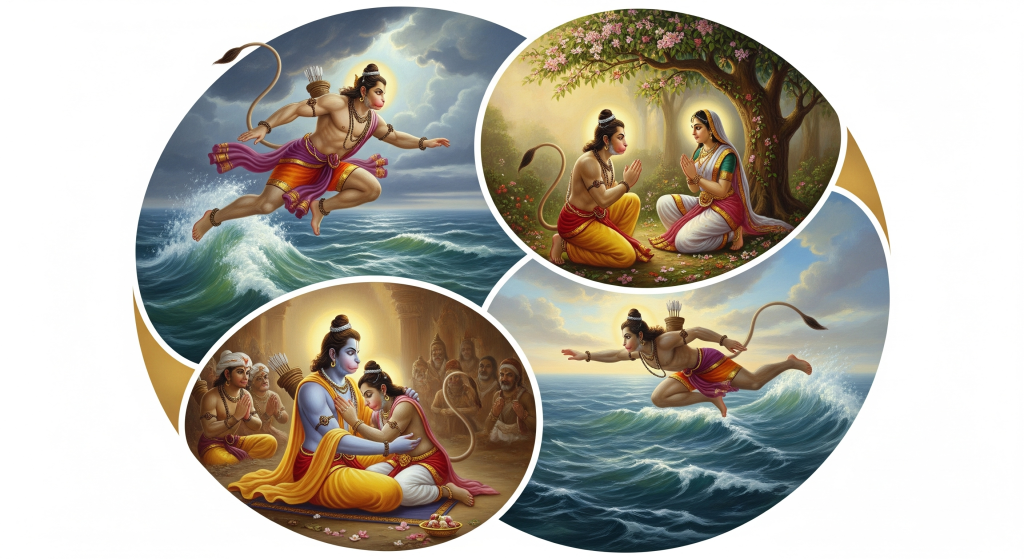
In Hanuman’s journey, we witness the transformation of effort into grace. His leap across the ocean is the devotee’s plunge into the unknown, guided only by love. His Darshan of Seeta is the soul’s glimpse of the Divine Feminine in her most sublime resilience. And his return to Rama is the culmination of Seva—not with fanfare, but with an embrace.
- Rama’s words teach us that greatness is not in power, but in loving service.
- Hanuman becomes the embodiment of Puruṣottama, not by conquest, but by surrender.
Hanuman’s story reminds us that the Divine does not measure achievement by scale, but by intention, purity, and love.
As we prepare to explore Vibhīṣaṇa’s surrender next week, let us carry this truth:
The path of devotion is not linear—it is circular. It begins with longing for the Divine, moves through service, and returns to the embrace of the Divine.
Citations
- Valmiki Ramayana – Sundarakāṇḍa, Sarga 65 Verses 7–11, 15–19 View full Sarga 65 on ValmikiRamayan.net
- Valmiki Ramayana – Yuddha Kāṇḍa, Sarga 1 Verses 1.1–1.20 (with emphasis on Hanuman’s reception and Rama’s embrace) View full Sarga 1 on ValmikiRamayan.net

Samastha Lokah Sukhino Bhavanthu
May all the beings in all the worlds be happy

Jai Sai Ram!