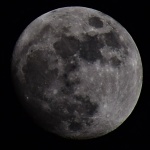
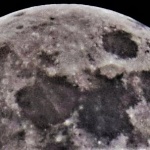
Moon 4th Oct 2025
Exploring the Moon — Observations from October 4, 2025
Location: Bengaluru, India
Telescope: 127mm Maksutov-Cassegrain
Camera: ZWO ASI 462MC
Lunar Phase: Waxing Moon (~43% illuminated)
Seeing Conditions: Good (7/10), thin passing clouds
A Night of Lunar Detail

The Moon was in a perfect position tonight for high-contrast views along the terminator, where sunlight rakes across crater rims and mountain slopes.
Using the 127mm MAK-CAS with the ZWO ASI 462MC camera, I was able to capture both wide-field and close-up views of several craters, mountain ranges, and maria.
Featured Craters
Composite image showing several of the observed craters.
1. Copernicus – ~93 km wide and 3.8 km deep.
Bright ray systems and central peaks make it a favorite for lunar observers.


2. Tycho – ~85 km wide and 4.8 km deep.
One of the youngest craters, famous for rays extending over 1,500 km.

3. Plato – ~101 km in diameter with a dark, basaltic floor near Mare Imbrium.
Smooth and subtle, ideal for testing seeing stability.

4. Archimedes – 83 km wide, with a bright rim and lava-flooded interior.
5. Aristillus – 55 km across, showing sharp walls and a distinct central peak complex.
6. Cassini – 57 km in diameter, with two smaller inner craters (Cassini A and B).
7. Aristoteles – 87 km wide with 3.3 km high terraced walls, bordering Mare Frigoris.
8. Eudoxus – 67 km across, located just south of Aristoteles — together they form one of the Moon’s most picturesque crater pairs.
Mountain Ranges
The Apennine Mountains marking the Imbrium Basin’s rim.

Montes Apenninus – Stretching over 600 km, with peaks rising above 5 km, this range forms a dramatic arc along Mare Imbrium’s southeastern rim.
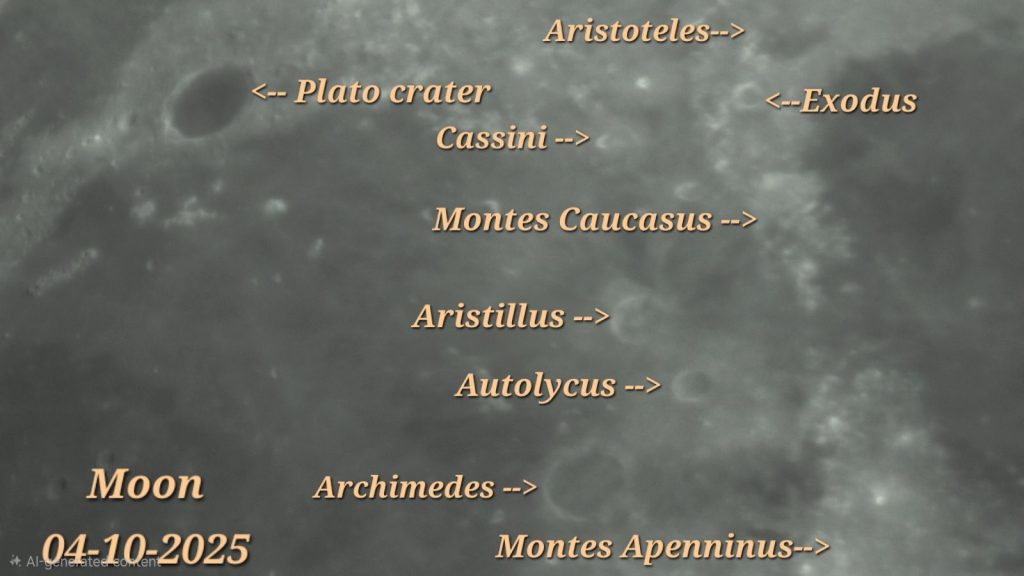
Montes Caucasus – Extending roughly 445 km, these rugged peaks bridge the Apenninus and Haemus ranges, outlining the Imbrium Basin’s northern boundary.
Lunar Sea
The Sea of Serenity — a vast, smooth lava plain with a soft bluish tint.

Mare Serenitatis (Sea of Serenity) – Roughly 700 km in diameter, this ancient basaltic plain shows a gentle bluish tone through color imaging — a striking contrast to the bright crater rims nearby.
Reflections
Even after countless observing sessions, the Moon always feels new.
Tonight’s combination of clear air, steady seeing, and moderate illumination revealed an extraordinary sense of texture — from the razor-sharp crater rims of Copernicus and Tycho to the serene lava plains of Serenitatis.
Each feature is a frozen moment in the Moon’s history — a record of impacts, volcanic floods, and cosmic time, captured from a quiet night here on Earth.
Image Notes
Most craters were captured together in a single wide-field image, while a few — including Tycho and Copernicus — have individual close-ups.
All frames were processed with gentle sharpening to retain a natural look.