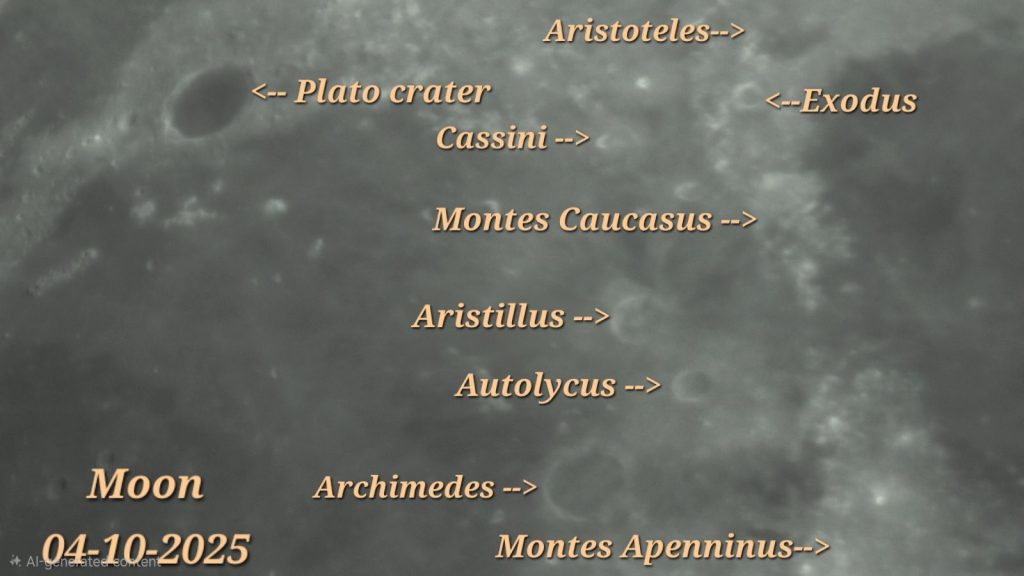
Exploring the Moon — Observations from October 4, 2025
Location: Bengaluru, India Telescope: 127mm Maksutov-Cassegrain Camera: ZWO ASI 462MC Lunar Phase: Waxing Moon (~43% illuminated) Seeing Conditions: Good (7/10), thin passing clouds
A Night of Lunar Detail
The Moon was in a perfect position tonight for high-contrast views along the terminator, where sunlight rakes across crater rims and mountain slopes.
Using the 127mm MAK-CAS with the ZWO ASI 462MC camera, I was able to capture both wide-field and close-up views of several craters, mountain ranges, and maria.
Featured Craters
Composite image showing several of the observed craters.
1. Copernicus – ~93 km wide and 3.8 km deep. Bright ray systems and central peaks make it a favorite for lunar observers.
2. Tycho – ~85 km wide and 4.8 km deep. One of the youngest craters, famous for rays extending over 1,500 km.
3. Plato – ~101 km in diameter with a dark, basaltic floor near Mare Imbrium. Smooth and subtle, ideal for testing seeing stability.
4. Archimedes – 83 km wide, with a bright rim and lava-flooded interior.
5. Aristillus – 55 km across, showing sharp walls and a distinct central peak complex.
6. Cassini – 57 km in diameter, with two smaller inner craters (Cassini A and B).
7. Aristoteles – 87 km wide with 3.3 km high terraced walls, bordering Mare Frigoris.
8. Eudoxus – 67 km across, located just south of Aristoteles — together they form one of the Moon’s most picturesque crater pairs.
Mountain Ranges
The Apennine Mountains marking the Imbrium Basin’s rim.
Montes Apenninus – Stretching over 600 km, with peaks rising above 5 km, this range forms a dramatic arc along Mare Imbrium’s southeastern rim.
Montes Caucasus – Extending roughly 445 km, these rugged peaks bridge the Apenninus and Haemus ranges, outlining the Imbrium Basin’s northern boundary.
Lunar Sea
The Sea of Serenity — a vast, smooth lava plain with a soft bluish tint.
Mare Serenitatis (Sea of Serenity) – Roughly 700 km in diameter, this ancient basaltic plain shows a gentle bluish tone through color imaging — a striking contrast to the bright crater rims nearby.
Reflections Even after countless observing sessions, the Moon always feels new.
Tonight’s combination of clear air, steady seeing, and moderate illumination revealed an extraordinary sense of texture — from the razor-sharp crater rims of Copernicus and Tycho to the serene lava plains of Serenitatis.
Each feature is a frozen moment in the Moon’s history — a record of impacts, volcanic floods, and cosmic time, captured from a quiet night here on Earth.
Image Notes Most craters were captured together in a single wide-field image, while a few — including Tycho and Copernicus — have individual close-ups.
All frames were processed with gentle sharpening to retain a natural look.
The nine nights of Navaratri culminated yesterday with the blessing of ultimate fulfillment from Maa Siddhidātrī. Today, the tenth day, is Vijaya Dashami (The Victorious Tenth Day), a sacred threshold that marks the triumph of divine power over all limitations.
This day is not just an end; it is the Manifestation of the entire Navaratri sādhana. It represents the moment the inner victories over ego, inertia, and ignorance (symbolized by the demons) translate into outer success, wisdom, and righteousness in the world.
Vijaya Dashami ensures that the spiritual energy gathered over the last nine days transforms into unstoppable momentum for your greatest purpose.
The Significance of Vijaya Dashami
Vijaya Dashami is celebrated across India for two great victories, both embodying the triumph of righteous action (Dharma) over evil:
1. The Victory of the Divine Mother
This is the day when Mahishasura Mardini (a collective name for Durgā-Caṇḍikā) concluded her epic, nine-day battle by finally slaying the buffalo demon Mahishasura.
The Spiritual Meaning: The ten days represent the ten stages of the inner battle. Mahishasura, the buffalo-demon, symbolizes ego (ahamkāra), which is rooted in ignorance and stubbornness. The nine nights represent the cleansing of the mind and senses, and the tenth day is the moment the ego is finally dissolved, allowing the truth of your divine nature to shine through.
2. The Victory of Rāma (Dussehra)
Vijaya Dashami is also celebrated as Dussehra, marking the day Lord Rāma defeated the demon-king Rāvaṇa.
The Practical Meaning: Rāvaṇa, with his ten heads, represents the ten undesirable qualities of the human mind: Lust, Anger, Delusion, Greed, Pride, Envy, Attraction, Attachment, Ego, and Unrighteousness. The defeat of Rāvaṇa signifies the conquest of the senses and the complete establishment of Dharma (righteous order) in life.
The Hymn of Victory: Mahishasura Mardini Stotram Summary
This famous hymn, composed by Adi Shankaracharya, is a joyous and detailed poetic summary of the Devi’s magnificent victory over Mahishasura and perfectly embodies the spirit of this final day.
The Grand Invocation and Call to Arms (Verses 1-5)
The Stotram begins with a glorious invocation, immediately declaring the Devi as Mahishasura Mardini (Slayer of the Buffalo Demon). The opening lines, “Ayigiri Nandini Nandita Medini” (Daughter of the Mountain, She who delights the Earth), establish her divine lineage and presence in the world. She is praised as Viśvavinodini (She who entertains the universe) and Śitikaṇṭhakuṭumbini (Wife of the Blue-throated Shiva) [V. 1]. The verses vividly describe her as the warrior who crushes the demon armies and whose head is adorned with beautiful, coiled locks, Ramyakapardini [V. 1]. The devotee seeks her grace, recognizing her as the conqueror who frees the three worlds from great fear [V. 2].
The Cosmic Warrior and Her Power (Verses 6-10)
The next five verses detail the sheer cosmic scale of her battle and her divine attributes. The battle is a terrifying yet beautiful dance, where the defeated demons’ blood is sucked up, and the demon hordes tremble. Her roar, Nija Huṃkṛtimātra Nirākṛta (dispelling just by her hum-sound) [V. 7], instantly destroys the demon Dhumralochana. The rhythmic sounds of her instruments, Dumi Dumi Tāmara Duṃdubhināda (the great roar of the war-drums) [V. 6] and the jingle of her anklets, Nūpura Siñjita (the sweet sound of her anklets) [V. 9], fill the battlefield. This section celebrates her dynamic force, proving that she is the embodiment of joyous, righteous action (Harṣarate) [V. 2].
The Embodiment of All Virtues (Verses 11-15)
These verses shift to praising the Devi’s role as the foundation of all righteous existence and human virtue. She is described as being surrounded by various groups of celestial and forest beings, like the Bhīllikabhīllikavargavṛte (groups of forest dwelling women) [V. 11], affirming her accessibility to all. She is the essence of all beauty and artistic expression, Sakalavilāsakalānilayakrama (the source of all arts, grace, and skills) [V. 13]. Her features are praised as exquisite, from her lotus-petal eyes to her face, which shames the moon (Candrarūce) [V. 15]. The devotee recognizes that she is the divine power who resides in the most beautiful aspects of nature, dwelling in the mountain groves where the cuckoos sing sweetly, Karamuralīrava Vījita Kūjita Lajjita Kokila [V. 14].
The Final Dedication and Promise of Liberation (Verses 16-20)
The concluding verses bring the focus back to the devotee, assuring them of the rewards of chanting the Stotram. The Devi is celebrated as the one who fulfills all sincere prayers, whether they are for worldly enjoyment (Bhukti) or ultimate freedom (Mukti). The hymn draws a direct connection to the seekers in the Devi Mahatmyam, invoking the term Surathasamādhi Samānasamādhi (the meditation equal to that of Suratha and Samādhi) [V. 16]. The final promise of the hymn, captured in the beautiful phrase Padakamalaṁ Karuṇānilaye (Your lotus feet, the abode of compassion) [V. 17], states that seeking refuge in her guarantees not just happiness, but Parampadam (the supreme state/liberation) [V. 17]. The devotee takes refuge in her, praying, “Mama Tu Mataṃ Śivanāmadhane” (My mind is dedicated to the wealth of Shiva’s name) [V. 19], knowing that her grace is the final word on all success.
The Great Ritual: Shastra(Ayudha) Puja (Worship of Instruments)
A key tradition on Vijaya Dashami is Shastra Puja, the worship of one’s tools or instruments.
In Ancient Times: Warriors worshiped their weapons (Shastra), and artisans worshiped their tools. This ritual honors the instruments of one’s livelihood and the skills that reside within them.
Modern Transcendence: Your Shastra is whatever you use to interact with the world and create value—your computer, your business, your pen, your kitchen, or your car. Worshipping these tools is an act of gratitude and a spiritual commitment. It elevates your daily work from mere labor to a sacred service, ensuring that every action you take in the coming year is guided by divine intention.
Modern Application: Hold a small ceremony today for your professional tools. Clean them, decorate them, and dedicate them to the higher purpose you clarified during Navaratri.
Reflections & Modern Applications: The Unstoppable You
Vijaya Dashami is the ultimate lesson to transform your inner world so that you can conquer your outer world with grace.
The Inner Rāma-Rāvaṇa War: Every day, you face the same ten temptations (Rāvaṇa’s heads) that distract you from your purpose. The nine days of practice empowered the inner Rāma (your conscious, moral, and divine self). Action Item: Identify one “Rāvaṇa-head” that blocks your purpose (e.g., procrastination, cynicism, self-doubt) and consciously destroy it today by taking decisive action toward your goal.
Manifesting the Siddhi: Maa Siddhidātrī promised Siddhi (perfection) to the merchant. Vijaya Dashami is the day you claim that perfection. It is an affirmation that the obstacles you thought were mountains are now merely stepping stones. Action Item: Do not wait. Launch the project, start the conversation, or commit to the change you’ve been contemplating. Today, the cosmic energy is aligned for success.
The Vow of Victory: The word Vijaya means special or certain victory. It’s a promise, not a wish. The cosmos guarantees the win if you put forth the pure, committed effort. Action Item: Take one final, potent vow today—a non-negotiable commitment that will define the next year of your life. Write it down and dedicate it to the Divine Mother.
Closing Thoughts
You have completed the full circle of transformation. May the Vijaya Dashami energy anoint you with unstoppable success (Vijaya), granting you the power to realize every dream you nurtured over the past nine sacred nights.
References:
Mahishasura Mardini Stotram – Stotrasangrah from Mata Vaishno Devi site – PDF file
Samastah Lokah Sukhino Bhavanthu May All biengs in All the Worlds be Happy!
Jai Sai Ram!
Please note all content and images are generated using AI Tools
Welcome to Day 9, the finale of the Devi Mahatmyam! Today, we witness the granting of the ultimate boons, as the Divine Mother keeps the promises made in the Phala Shruti (Chapter 12).
Chapter 13 shifts entirely from cosmic battles to individual transformation. It is the story of King Suratha and the merchant Samādhi, who, having heard the Devi’s glories, performed severe penance. Their requests demonstrate two distinct paths—the desire for worldly success (Bhukti) and the aspiration for final liberation (Mukti). The Devi grants both, affirming her role as the bestower of all things (Bhuktimuktipradāyinī).
This chapter brings the entire narrative, which began in Chapter 1, full circle, illustrating the power of devotion to resolve the paradoxes of human life.
Chapter 13: The Granting of the Boons
The Sage Medhas concludes his narration, and the focus returns to King Suratha and the merchant Samādhi who are sitting in his forest ashram, tormented by their attachments.
The Penance and the Vision
Inspired by the stories of the Devi’s power, the King and the Merchant dedicate themselves to intense spiritual practice (sādhana). They settle by a river, fast, chant the Devi-Sūkta, and even fashion an earthen image of the Goddess.
After three years of disciplined worship, Caṇḍikā (the fierce aspect of the Devi) is pleased and appears before them. She offers a boon to each, declaring, “That which you desire… receive all that from Me”.
The Two Desires
Their choices beautifully summarize the two aims of human existence:
King Suratha’s Wish (The Path of Bhukti): Though he had renounced his kingdom, the King was still governed by his Kṣatriya Dharma. He requested to reclaim his kingdom from his enemies in this life, followed by an imperishable kingdom in the next life. The Devi grants his wish, promising he will regain his kingdom and later be reborn as Sāvarṇi, the Manu (lord of an age).
Merchant Samādhi’s Wish (The Path of Mukti): The merchant, whose disillusionment was complete, asked for knowledge (Jñāna) that completely dissolves the ego and removes the attachment of “mine and I” (mametyahamiti). The Devi grants him the supreme liberating knowledge.
The Devi, having granted both worldly enjoyment and final liberation, immediately vanishes, concluding the scripture.
A Glimpse into the Original Text
The Conclusion (Chapter 13, Verse 2)
Following the intense battle narrative, the Sage Medhas formally presents the story to the King as a spiritual gift.
Sanskrit (V. 2): एतत्ते कथितं भूप देवीमाहात्म्यमुत्तमम् । एवंप्रभावा सा देवी ययेदं धार्यते जगत् ॥ २ ॥
Translation (V. 2): Thus have I related to you, O King, this supreme glorification of the Devī: such is the splendor of the Devī, by whom this world is upheld.
Commentary: This verse serves as the final statement of the entire work, affirming that the magnificent story just narrated is the “supreme glorification” (uttamam) of the Goddess. It reminds the King (and the devotee) that the purpose of the Devi’s actions is not just warfare but the upholding (dhāryatē) of the entire universe.
The Sage’s Final Counsel (Chapter 13, Verse 5)
The Sage Medhas’s final words to the King and the Merchant summarize the Devi’s omnipotence.
Sanskrit (V. 5): तामुपैहि महाराज शरणं परमेश्वरीम् । आराधितै सा नृणां भोगस्वर्गापवर्गदा ॥ ५ ॥
Translation (V. 5): O great King, take refuge in Her, the Supreme Sovereign. When worshiped, She truly confers enjoyment, heaven, and final release (liberation) on humanity.
Commentary: The verse encapsulates the Devi’s power by listing the three highest goals: Bhoga (enjoyment/prosperity), Svarga (heaven/happiness), and Apavarga (final liberation/Moksha). This is the conclusive proof of her all-encompassing grace—she is the single source for everything the soul desires.
The Climax of Penance (Chapter 13, Verses 12 & 13)
This stanza marks the dramatic moment when the Goddess responds to the sustained devotion of the King and the Merchant.
Sanskrit (V. 12-13): एवं समाराधयतोस्त्रिभिर्वर्षैर्यतातमनोः । परितुष्टा जगद्धात्री प्रत्यक्षम प्राह चण्डिका ॥ १२ ॥ १३ ॥
Translation (V. 12-13): When they, with controlled minds, propitiated Her thus for three years, Caṇḍikā, the Upholder of the World (Jagaddhātrī), was well pleased and spoke to them in visible form (Pratyakṣam Prāha).
Commentary: The key takeaway here is the dedication required: three years of unwavering focus (yatātmanōḥ). This sincerity moves the Goddess to appear in Her fierce but benevolent form as Caṇḍikā, literally showing Herself to the devotees and proving the rewards are tangible.
The Granting of Liberation (Chapter 13, Verses 24 & 25)
This is the Devi’s direct promise of the ultimate spiritual reward to the Merchant Samādhi.
Sanskrit (V. 24-25): वैश्यवर्य त्वया यश्च वरोऽस्मतोऽभिवान्छितः । तं प्रयच्छामि संसिद्धयै तव ज्ञानं भविष्यति ॥ २४ ॥ २५ ॥
Translation (V. 24-25): And the boon which you, O best of merchants, desire from Me—that I grant you. You shall have the Knowledge (Jñānaṁ) that leads to Perfect Realization (Saṁsiddhyai).
Commentary: This confirms the Merchant’s desire for Mukti. The Devi uses the powerful word Saṁsiddhyai (perfect realization/fulfillment), proving that the ultimate goal of spiritual perfection is granted by her grace, making her the “Giver of Siddhi” herself.
Devi of the Day – Day 9: Siddhidātrī
The final day of Navaratri is dedicated to Devi Siddhidātrī (The Giver of all Supernatural Powers).
Symbolism: Her name combines Siddhi (perfection, spiritual attainment) and Dātrī (giver). She is the one who grants the eight Siddhis and all forms of success (Siddhi). She often holds a discus and conch, symbolizing divine authority and the sound of creation.
Connection to Chapter 13: Siddhidātrī is the perfect culmination of the Devi Mahatmyam. She is the bestower of the exact things requested in Chapter 13: Worldly Power (granted to the King) and Spiritual Perfection (Siddhi, granted to the Merchant). Worshipping her on this day symbolizes the fulfillment of all spiritual practices undertaken during the nine nights.
Reflections & Modern Applications
Chapter 13 is the Mandala of Manifestation:
The Power of Clarity: Suratha and Samādhi got exactly what they asked for because they were clear about their final goal after intense self-reflection. Modern lesson: Before you can ask for transformation, you must first clarify what you truly desire—worldly success or inner freedom.
Integration, Not Avoidance: The King’s path teaches that it is possible to live a righteous life of duty (Dharma) and prosperity (Bhukti) while still achieving a great spiritual reward (being a Manu). Modern lesson: Spiritual practice does not demand that you quit your job or abandon your family; it requires you to integrate devotion into your daily duties.
The Ultimate Fulfillment: The Devi granting both Bhukti and Mukti reveals the non-dualistic nature of the Goddess. She is not against the world; she is the source of the world. Modern lesson: Do not limit your prayers. The Divine Mother can provide both immediate relief from your worldly struggles and the ultimate wisdom that ends suffering forever.
Closing Thoughts
On this final, most auspicious day, we bow to Maa Siddhidātrī, the Bestower of Perfection. As we conclude the reading of the Devi Mahatmyam, may the clarity and compassion of the Goddess shine upon you, bringing the perfection you seek—in your family, your career, and your spirit.