Sometimes the most memorable astrophotography sessions are not the ones where everything goes according to plan. They are the ones where the universe quietly places something extraordinary in the frame, and you only discover it later.
That is exactly what happened to me on the night of 9 September 2026.
Click on any image below to open in a separate tab.
An Evening with Caldwell 30
Dwarf Mini Smart Telescope
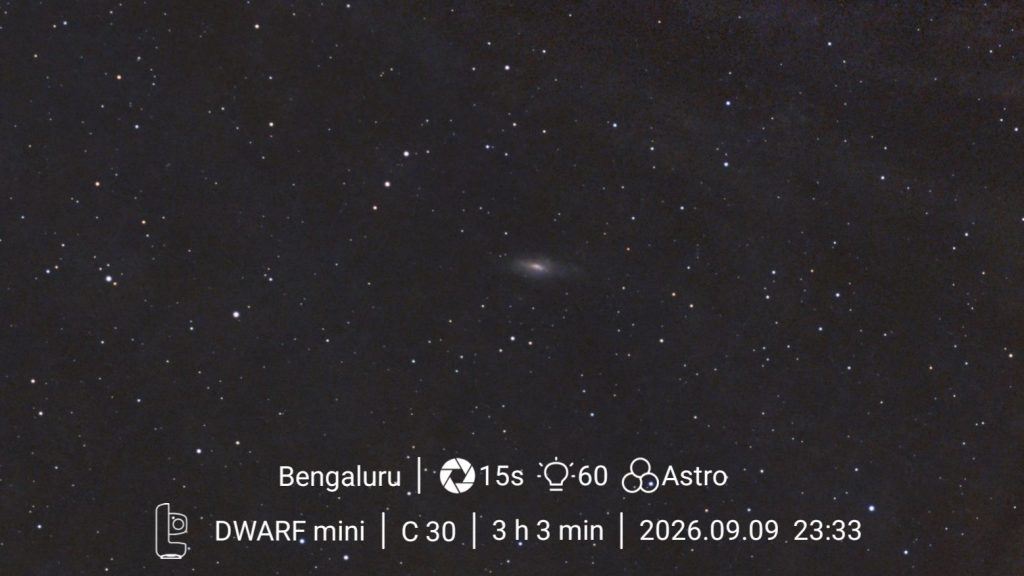
I had set up my Dwarf Mini Smart Telescope to image Caldwell 30 (NGC 7331), the magnificent spiral galaxy in Pegasus. Along with it, I hoped to capture members of the Deer Lick Group, a collection of distant galaxies that appear near NGC 7331 from our perspective on Earth.
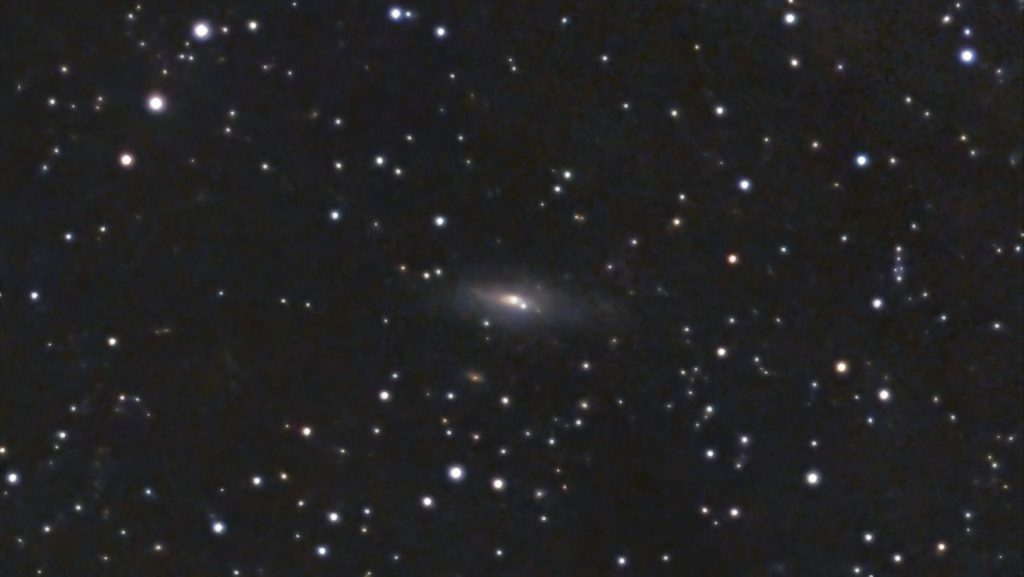
After more than three hours of imaging, I reviewed the results and was delighted to see the familiar elongated shape of NGC 7331 standing out against a rich star field. Near the edge of the frame, I could also make out a faint fuzzy patch that appeared to be Stephan’s Quintet, one of the most famous galaxy groups in the sky.
C30/NGC 7331
I considered the session a success.
At that point, I had no reason to think there was anything unusual about the image.
The Discovery Came Days Later
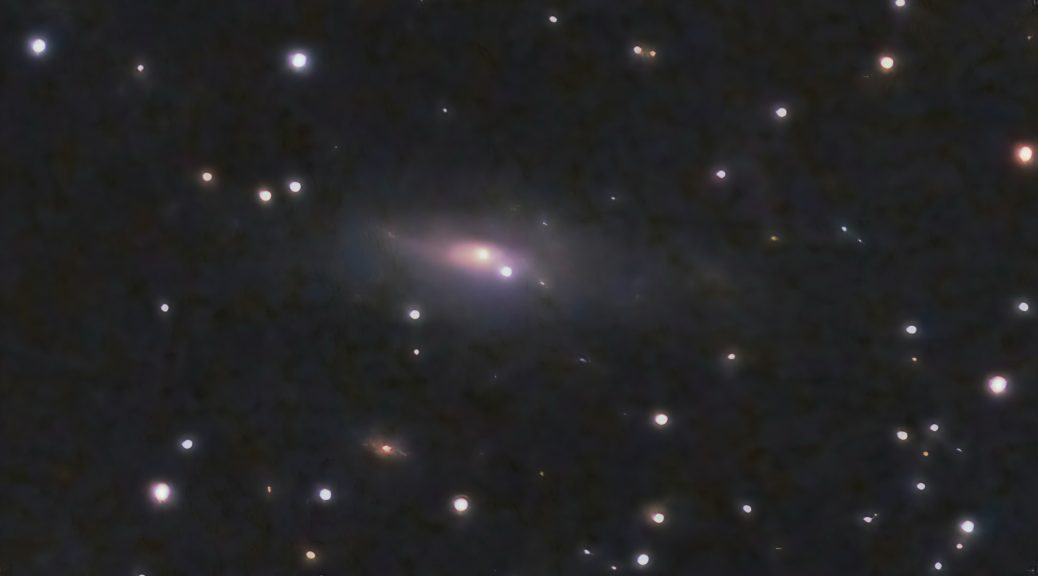
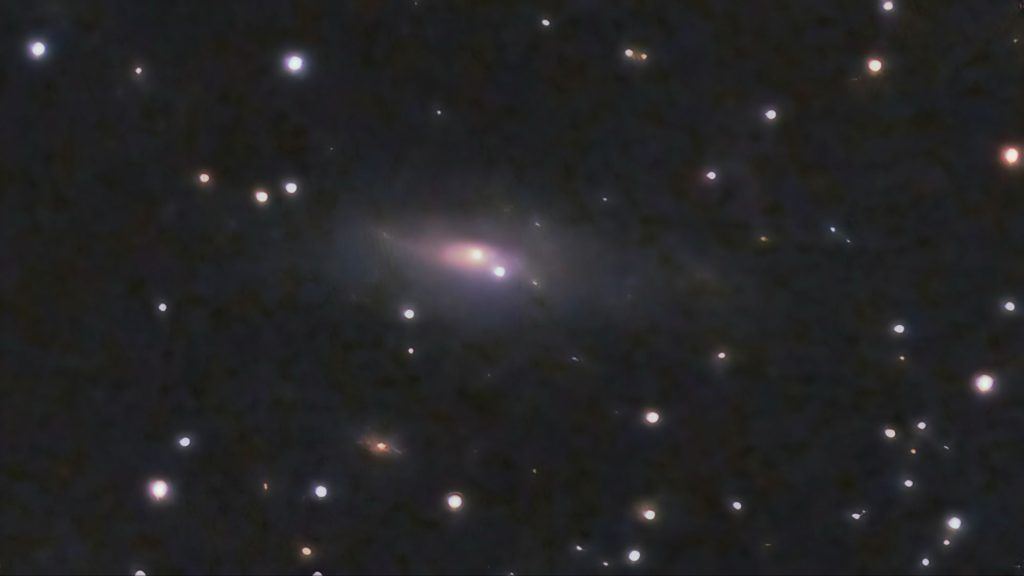
A few days later, while revisiting the image and examining the field more carefully, I noticed an unusually bright stellar point embedded within NGC 7331.
At first, I assumed it was simply a foreground star aligned with the galaxy.
But the position seemed curious.
After comparing the image with recent astronomy reports and using AI-assisted identification tools to investigate the field, I realised that the bright point was not an ordinary star at all.
Supernova SN 2026aaiv in C30/NGC 7331
It was SN 2026aaiv, a recently discovered Type Ia supernova in NGC 7331.
Suddenly, the image became something far more special than I had originally thought.
A Star That Wasn’t There Before
Unlike the countless stars visible in an astrophotograph, this point of light was not part of the scene a few weeks earlier.
Somewhere in NGC 7331, approximately 40 million light-years away, a white dwarf star had reached a catastrophic tipping point and exploded in a thermonuclear event. The light from that explosion travelled across intergalactic space for millions of years before finally reaching Earth.
And on the night of 9 September 2026, some of those photons ended their journey on the sensor of my Dwarf Mini.
When I started the imaging session, I had absolutely no idea I was recording the aftermath of a stellar explosion.
The discovery only came later.
Caldwell 30: The Main Attraction
Even without the supernova, NGC 7331 is a spectacular target.
Often described as one of the spiral galaxies most similar in appearance to our own Milky Way, it features a bright central bulge surrounded by an extensive disk of stars, dust and gas.
For amateur astrophotographers, it is one of the finest galaxy targets of the autumn sky.
In my image, the galaxy’s central core is clearly visible, and its elongated structure stands out despite being tens of millions of light-years away.
What I did not realise at the time was that a supernova had quietly stolen the spotlight.
Stephan’s Quintet: A Tiny Smudge with a Big Story
Another unexpected pleasure was finding Stephan’s Quintet in the same field.
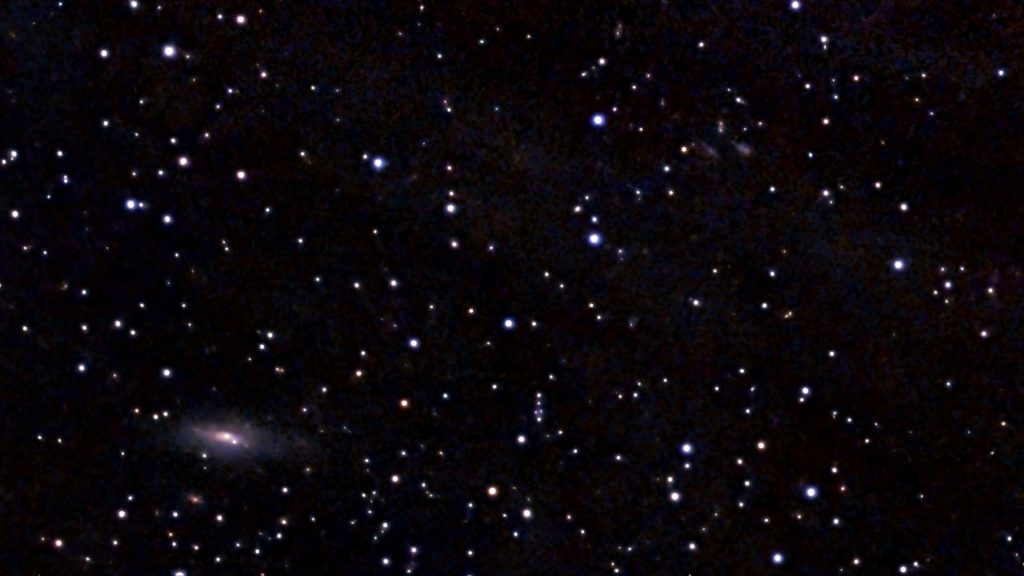
NGC 7331 bottom left, Stephan’s Quintet top right
Located near the upper-right region of the image, it appears only as a faint and delicate smudge. Yet its characteristic shape is still recognisable.
That faint smudge represents one of the most studied compact galaxy groups in astronomy.
To many people, it might look insignificant.
To an astronomer, it represents billions of stars spread across multiple interacting galaxies.
The fact that NGC 7331 and Stephan’s Quintet can be captured together is one of the reasons this area of Pegasus is so popular among astrophotographers.
Captured with a Dwarf Mini Smart Telescope
One of the most remarkable aspects of this image is the equipment used.
The entire observation was captured using a Dwarf Mini Smart Telescope, a compact telescope small enough to fit into a backpack.
Modern smart telescopes have made deep-sky imaging more accessible than ever. They combine tracking, image stacking and computational photography into a highly portable package, allowing amateur astronomers to record objects that once required far larger and more expensive equipment.
Capture Details
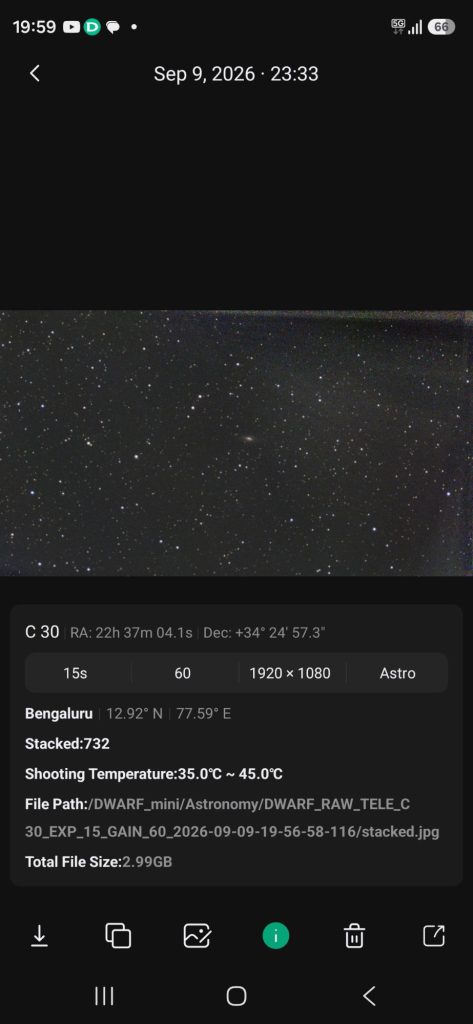
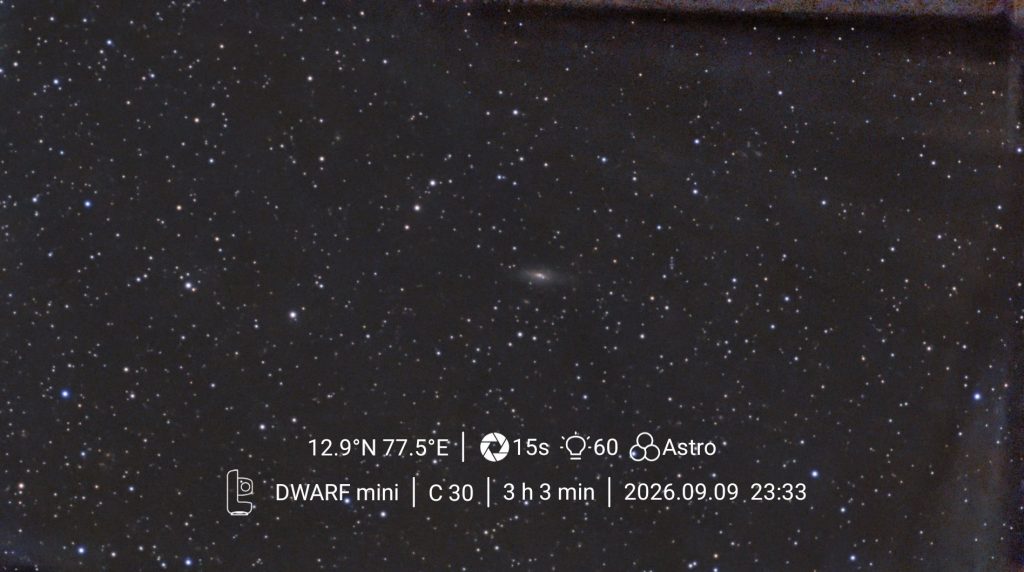
Target: Caldwell 30 (NGC 7331) Date: 9 September 2026 Location: Bengaluru, India Coordinates: 12.92° N, 77.59° E
Equipment
Dwarf Mini Smart Telescope
Astro Mode
Exposure Settings
Exposure Time: 15 seconds
Gain: 60
Resolution: 1920 × 1080
Integration
Frames Stacked: 732
Total Integration Time: Approximately 3 hours 3 minutes
Environmental Conditions
Shooting Temperature: 35°C to 45°C
Cloudy night
Considering the urban environment of Bengaluru and the compact size of the telescope, the result exceeded my expectations. Post processing done on android mobile using gallery app.
A Frame Full of Perspective
What fascinates me most about this photograph is the scale it contains.
In a single image are:
Stars belonging to our own Milky Way.
NGC 7331, roughly 40 million light-years away.
A supernova that briefly became bright enough to stand out within its host galaxy.
Stephan’s Quintet, one of the most famous galaxy groups ever observed.
At first glance, it looks like a field of stars with a few faint smudges.
But every one of those smudges is a galaxy.
And one of those bright points is the explosion of a star.
The Universe Will Not Wait
Looking back at the image now, I no longer see just Caldwell 30.
I see a spiral galaxy.
I see Stephan’s Quintet.
I see the light from a stellar explosion that travelled for millions of years before reaching a small telescope in Bengaluru.
Most importantly, I see a reminder that the universe is constantly changing, whether we notice it or not.
I did not set out to photograph a supernova.
I simply pointed a telescope at a beautiful galaxy and collected photons.
Only days later did I realise that hidden within those photons was a story far bigger than I had imagined.
The universe will not wait.
But sometimes, if we’re paying attention, it leaves us a postcard!
The Bubble Nebula – A Star Blowing a Giant Bubble in Space
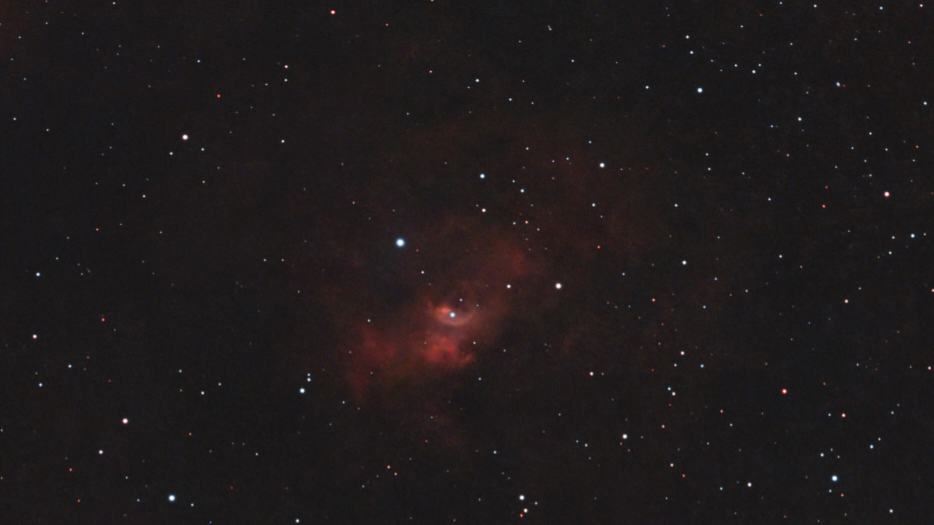
Photographing the night sky from Bengaluru, I captured this faint reddish cloud in the constellation Cassiopeia: NGC 7635, famously known as the Bubble Nebula.
Click any image to open full view in a new tab.
Bubble Nebula
While it looks like a peaceful cosmic cloud, it is actually the visible evidence of a huge astronomical process—a massive star reshaping space itself.
Anatomy of the Cosmic Bubble
Object: NGC 7635 (Bubble Nebula) | Constellation: Cassiopeia
Nearby Field Targets: Messier 52 (Open Cluster), NGC 7538 (Northern Lagoon)
Location: Bengaluru, India
Look closely at the bright central region of the image:
The Shell Composition: The distinct spherical shell is composed of glowing red, ionized hydrogen gas and interstellar dust. It isn’t a solid surface, but a razor-thin shockwave boundary glowing under intense ultraviolet radiation.
The Snowplough Mechanism: At the center lies BD+60°2522, an O-type star roughly 45 times more massive than our Sun. It blasts a ferocious stellar wind at over 4 million mph (~6.4 million km/h). As this wind pushes outward, it slams into the cold interstellar cloud, sweeping surrounding gas into a spherical bubble shell.
Why it’s Asymmetric: The bubble isn’t perfectly round, and the star is visibly off-center. On one side, the wind encounters a wall of dense molecular gas that resists the push and slows expansion. On the opposite side, it pushes into a lower-density region, allowing the shell to balloon outward much farther.
Size: The bubble is ~7 light-years across (66 trillion km)—about 1.5 times the distance from our Sun to our nearest star system, Alpha Centauri.
Distance: ~7,100 light-years away. The light captured in this image left the nebula 7,100 years ago during the dawn of human civilization.
Reading the Close-up Shot
Astrophotography turns a faint patch of light into a living story of stellar power, deep time, and massive scale.
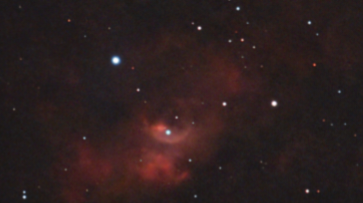
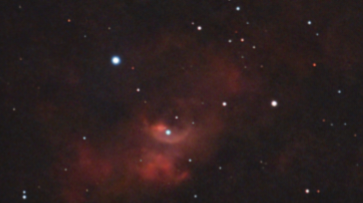
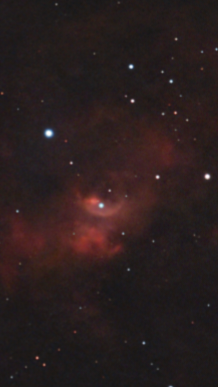
Close-up of the Bubble and the main star inside
The Bright Star (BD+60°2522): The bright star nestled inside the arc—this is the engine driving the entire structure. This 4-million-year-old star will eventually end its short life in a supernova in about 10 to 20 million years.
The Dense Gas Barrier (Lower-Left Arc): Notice how bright and tight the shell is on the lower-left. The stellar wind is crashing directly into a wall of dense cold gas, halting its expansion and making that edge glow intensely.
Free Expansion (Upper-Right Shell): On the opposite side, the gas is thinner, allowing the wind to push out farther into a smooth, faint bubble boundary.
The Red Glow: The surrounding ambient interstellar hydrogen gas, glowing red under the central star’s fierce ultraviolet radiation.
Distinction: Bubble Shell vs. Red Glow
It helps to separate the two main structures in the shot:
The Inner Bubble: The small, bright curved boundary shaped directly by the stellar wind (~7 light-years across).
The Outer Red Glow: The much larger surrounding emission nebula—ambient gas energized and set ablaze by the star’s radiation.
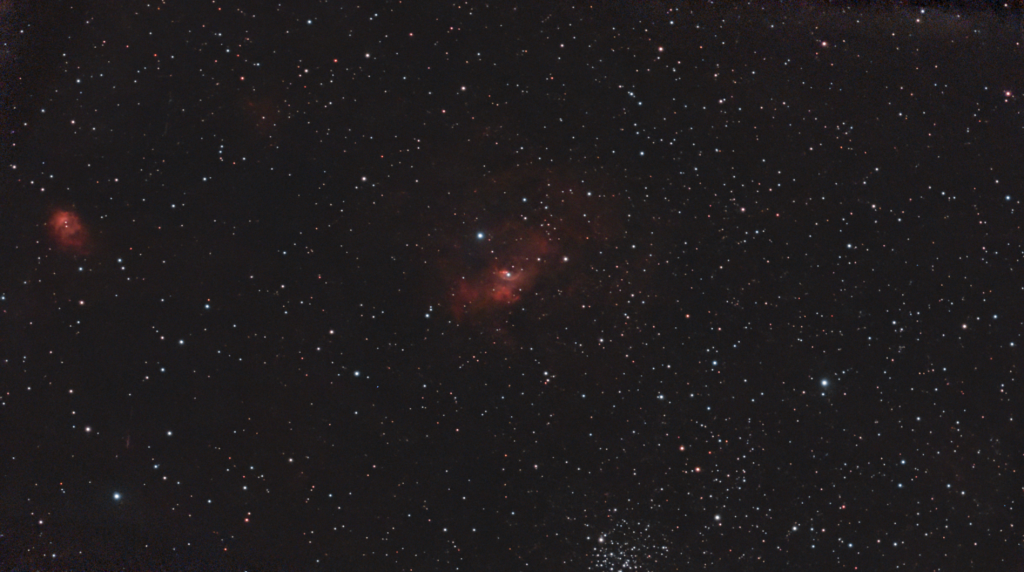
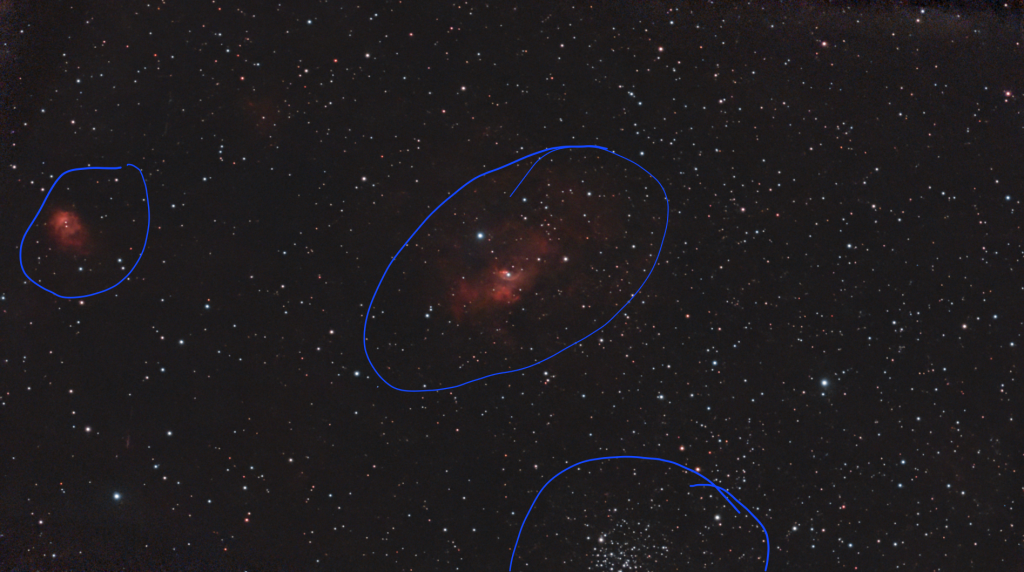
Wide-Angle Perspective: A 3D View of Cassiopeia
Step back into the full wide-field frame, and the neighborhood comes alive with three distinct deep-sky objects sharing the same patch of night sky:
M52 -Bottom, NGC7635- Center, NGC7538- Left
Messier 52 (Bottom Edge): The dense, glittering cluster of stars along the bottom frame is M52, a rich open star cluster containing thousands of young stars.
NGC 7538 (Far Left): The active star-forming red cloud on the left margin is NGC 7538, often called the Northern Lagoon Nebula for its striking structural resemblance to the famous southern Lagoon.
The 3D Illusion: While all three objects fit together inside this single frame, they are actually separated by vast depths of interstellar space along our line of sight:
Messier 52: ~5,000 light-years away (closest to us)
Bubble Nebula (NGC 7635): ~7,100 light-years away (sitting in the mid-ground)
Northern Lagoon (NGC 7538): ~9,100 light-years away (deep in the background)
In the 2D photograph, M52 and the Bubble Nebula appear side-by-side—separated by just 0.5 degrees (roughly the width of a full moon)—yet M52 sits more than 2,000 light-years closer to Earth!
Date: April 26, 2026 Location: Bengaluru, India Equipment: DWARF mini Smart Telescope Processing: Live Stacking via App & Stellar Studio
There is a unique kind of magic that happens on the terrace in Bengaluru. Between the hum of the city and a sky occasionally draped in clouds, you wouldn’t expect to find the birthplace of stars or the heart of distant galaxies. Yet, tonight, the DWARF mini proved that the universe is always waiting—you just need the right lens to see it.
The Thrill of the “Live Reveal“ If you’ve never experienced Live Stacking, it’s hard to describe the sensation. You start with a blank, dark screen. Then, frame by frame, the light begins to accumulate. What looked like an empty patch of space slowly reveals a spiral arm, a glowing gas cloud, or a dense core of a million suns. Tonight was a marathon of these “Aha!” moments.
Tonight’s Cosmic Catalog 1. The Giants of the South We started strong with Omega Centauri. At a 6-minute exposure, this globular cluster looked like a shimmering ball of diamonds.
Shortly after, we swung over to the Carina Nebula. Despite the city lights and some cloud interference, the reddish glow of hydrogen gas began to bleed through the darkness—a testament to the device’s ability to “see” through the haze.
2. A Tale of Two Galaxies: M81 & M82 The highlight for me was capturing Bode’s Galaxy and the Cigar Galaxy in a single frame. Watching the smooth, regal spiral of M81 contrast with the chaotic, starburst energy of M82 appearing live on my phone screen was truly intriguing.
It’s a perspective of the cosmos I had never seen for this long, and it was worth every second of the 12-minute wait.
3. Deep into the Virgo Cluster For the Virgo Galaxy Cluster, I decided to let the AI take the wheel, setting the gain to 40 and letting the “Auto” shutter handle the light. The plate-solving algorithm is incredibly sophisticated; it calibrated on the fly, centered the target, and began tracking with surgical precision. Catching M86 and its neighbors felt like peering into a secret corner of the local supercluster.
4. Clusters and Beehives We rounded out the session with the Hercules Globular Cluster (M13) and the Beehive Cluster (M44).
M13 resolved beautifully into a dense, bright core, while the Beehive showed off its scattered, colorful gems, reminding us that even “nearby” objects have a grandeur all their own.
Lessons from the Terrace Tonight wasn’t just about the photos; it was about learning the dance of gain and shutter speeds. Even when the clouds threatened to end the session, the Mini kept stacking, only dropping a frame or two.
The Stellar Studio tools in the app handled the post-cleanup and captions effortlessly, leaving me more time to simply marvel at the screen.
As I plan to push our next session to a 45-minute deep-dive, I’m reminded that the sky isn’t the limit—it’s just the beginning.
Clear Skies, Mahesh P Devarakonda
“Ancient wisdom tells us we are made of stardust; tonight, I watched that stardust come back to life on a digital screen.“
In the last two days, my terrace in Bengaluru transformed into an intense night sky viewing altar. With the S26 Ultra acting as my “Modern Drik”—a contemporary lens of divine perception—I tracked the “Jewels” of the cosmos, connecting the dots between the stars above and the profound wisdom of many ancient verses.
Through this lens, the act of photography becomes a ritual, turning a simple observation of the heavens into a bridge between our modern world and the eternal truths of the past.
I. The Sun as the Visible God
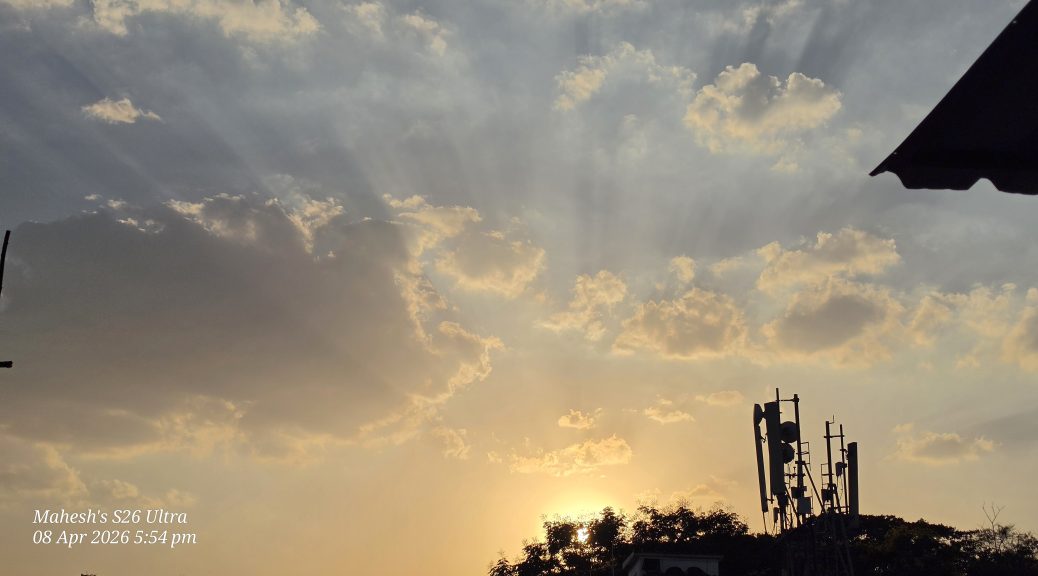
Before the stars emerge, the Sun sets the stage. This evening’s sunset (captured at 5:54 PM) felt like a divine blessing. We often chant “āditya‑rūpeṇa śrī‑rudraṁ namāmi“ – I bow to Śrī Rudra, appearing in the form of the Sun.
Seeing those rays pierce the clouds felt like the “kindling” of the cosmic fire, a reminder that the same light in our hearts is the light that fuels the galaxies.
The Aditya Altar: Kindling the evening fire at 5:54 PM.
II. The Guardians of the North: Sapta Rishi & Dhruva
As night fell, the Sapta Rishi Mandala (The Big Dipper) stood tall. These seven sages are the administrators of Rta (Cosmic Order). By tracing the “Pointers,” I found Dhruva (Polaris)—the unmoving anchor. In a world of constant motion, these stars remind us to find our own “Fixed Point” of Truth.
The Celestial Counsel: The Seven Sages keeping watch.
III. The Subtle Threads: Coma Berenices
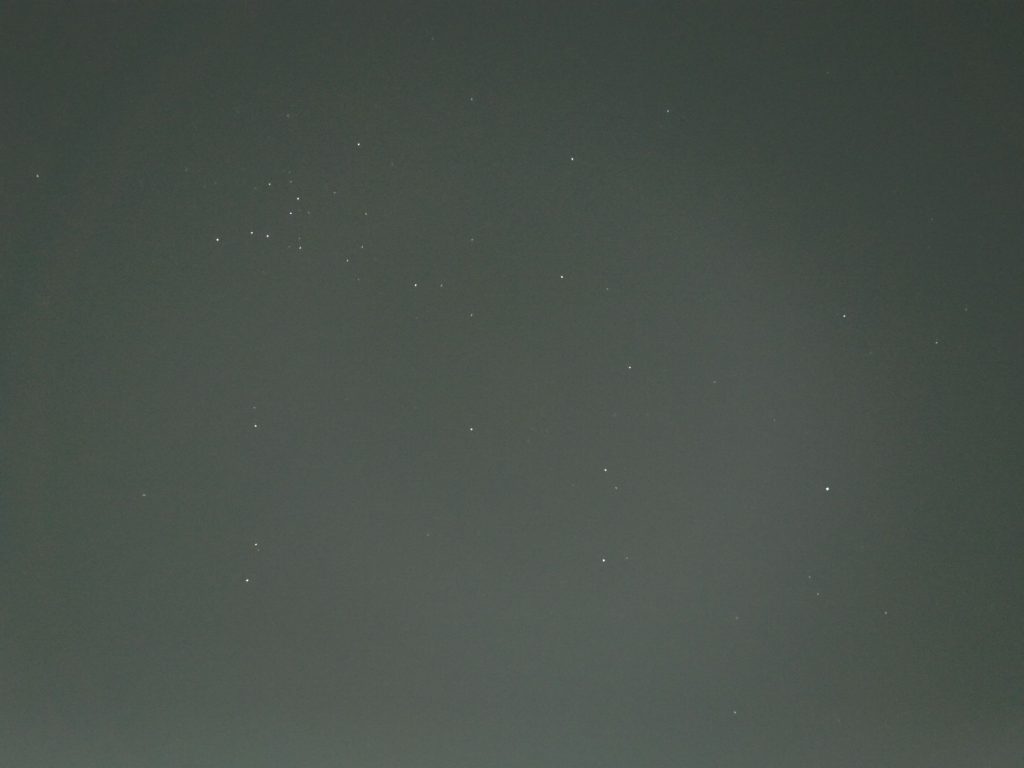
Hidden near the Lion’s tail, I captured the Coma Berenices cluster. This is the “Sukshma” (subtle) side of creation—thousands of stars woven together like a silver braid. It represents the delicate, interconnected threads of energy that hold our lives together, often invisible until we take the time to truly look.
The Subtle Weave: Where a thousand lights become one. Screenshot from Sky Safari app showing the constellation.
IV. The Pillar of the South: The Radiant Crux
Looking toward the South, the Crux (Southern Cross) appeared as a brilliant, steady anchor. This constellation acts as a celestial compass, providing the foundational light needed to navigate our journey with purpose and grace.
The Southern Pillar: Anchoring our journey across the cosmic ocean.
V. The Beehive: M44
Though clouds played hide-and-seek with its inner jewels, the Beehive Cluster (M44) in the East revealed itself—a literal honeycomb of stars. As the heart of the Pushya Nakshatra, it reminds us of the “Nectar of Knowledge” (Madhu) that nourishes our spiritual growth.
M44 Beehive cluster of stars in the center.
The Nectar of Pushya: A cosmic honeycomb found exactly when nourishment was needed.
VI. The Conclusion: Orion’s Final Bow
Finally, I watched Orion (Mrigashirsha) setting in the West. As this “Giant of Time” dipped below the horizon, it signaled the completion of a cycle. Just as the Vedic rituals conclude with a Purnahuti (final offering), Orion’s setting is a graceful exit, making way for the new dawn.
As I closed my lens and viewed the photos and the experience of seeing the grandeur of the cosmos, I realized we do not just live under the sky; we are a part of its breathing, rhythmic dance.
Portraits, Bokeh, and Joy: Why the Nifty Fifty Belongs in Every Camera Bag
How the Canon RF 50mm f/1.8 transforms everyday moments into vibrant portraits with creamy blur and effortless charm.
This afternoon I stepped out with my Canon R7 and my new Canon RF 50mm f/1.8 lens, and it turned into a revelation. Sometimes the simplest gear can surprise you, and this little lens—often nicknamed the “nifty fifty”—did exactly that.
Portrait Power On the R7’s APS-C sensor, the 50mm translates to about 80mm, which is a sweet spot for portraits and close-ups. It gives subjects a natural, flattering look, whether it’s people or flowers. The perspective feels intimate without being intrusive.
Ornamental plant with architectural backdrop — showing how the lens frames subjects with clarity and depth.
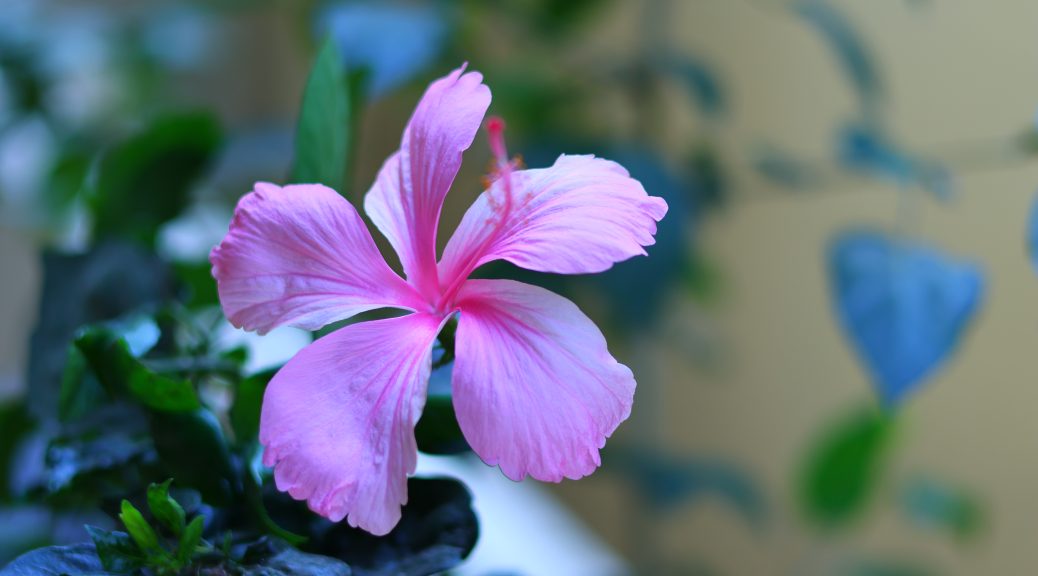
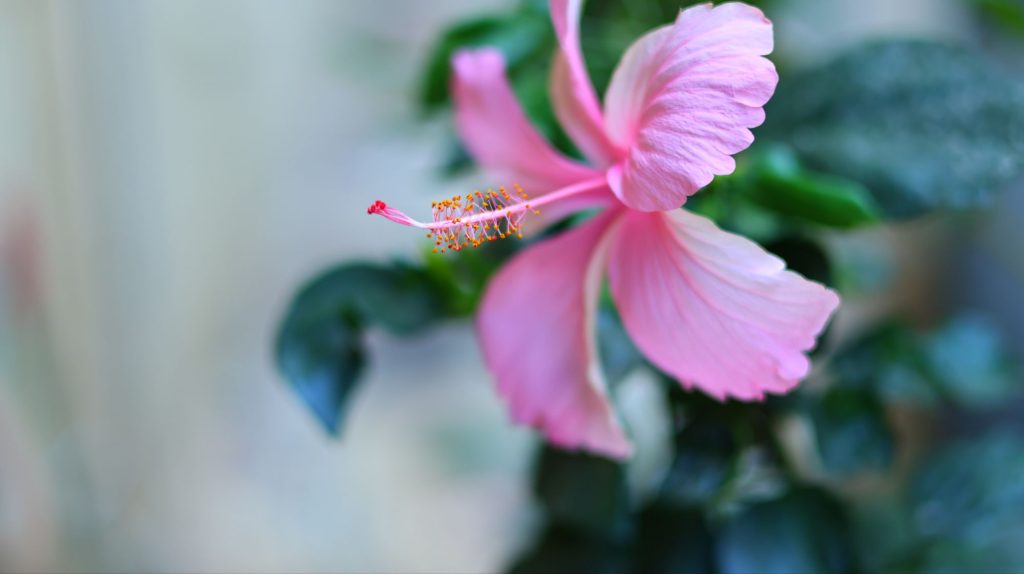
Beautiful Background Blur Wide open at f/1.8, the lens creates that creamy bokeh effect photographers love. The hibiscus bloom stood out beautifully against a soft, dreamy background. It’s the kind of separation that makes everyday scenes look cinematic.
Hibiscus in full bloom — a perfect example of subject isolation and creamy bokeh.
Light Gathering Ability Even in shaded corners of the garden, the lens pulled in enough light to keep images sharp and vibrant. Afternoon greenery came alive with detail and color, proving that you don’t always need heavy gear to make the most of natural light.
Dark green leaves with budding flowers — captured with rich detail even in softer light.
Everyday Versatility Compact and lightweight, the RF 50mm f/1.8 is the kind of lens that encourages you to carry your camera more often. From flowers to family portraits, it’s versatile enough to handle a wide range of subjects without fuss. Affordable, approachable, and fun—this lens makes photography feel effortless.
Trailing succulent with pink blossoms — playful detail that shows the lens’s versatility beyond portraits.
Closing Thought Sometimes the simplest gear brings the biggest joy. The nifty fifty proves that less really can be more.
The nine nights of Navaratri culminated yesterday with the blessing of ultimate fulfillment from Maa Siddhidātrī. Today, the tenth day, is Vijaya Dashami (The Victorious Tenth Day), a sacred threshold that marks the triumph of divine power over all limitations.
This day is not just an end; it is the Manifestation of the entire Navaratri sādhana. It represents the moment the inner victories over ego, inertia, and ignorance (symbolized by the demons) translate into outer success, wisdom, and righteousness in the world.
Vijaya Dashami ensures that the spiritual energy gathered over the last nine days transforms into unstoppable momentum for your greatest purpose.
The Significance of Vijaya Dashami
Vijaya Dashami is celebrated across India for two great victories, both embodying the triumph of righteous action (Dharma) over evil:
1. The Victory of the Divine Mother
This is the day when Mahishasura Mardini (a collective name for Durgā-Caṇḍikā) concluded her epic, nine-day battle by finally slaying the buffalo demon Mahishasura.
The Spiritual Meaning: The ten days represent the ten stages of the inner battle. Mahishasura, the buffalo-demon, symbolizes ego (ahamkāra), which is rooted in ignorance and stubbornness. The nine nights represent the cleansing of the mind and senses, and the tenth day is the moment the ego is finally dissolved, allowing the truth of your divine nature to shine through.
2. The Victory of Rāma (Dussehra)
Vijaya Dashami is also celebrated as Dussehra, marking the day Lord Rāma defeated the demon-king Rāvaṇa.
The Practical Meaning: Rāvaṇa, with his ten heads, represents the ten undesirable qualities of the human mind: Lust, Anger, Delusion, Greed, Pride, Envy, Attraction, Attachment, Ego, and Unrighteousness. The defeat of Rāvaṇa signifies the conquest of the senses and the complete establishment of Dharma (righteous order) in life.
The Hymn of Victory: Mahishasura Mardini Stotram Summary
This famous hymn, composed by Adi Shankaracharya, is a joyous and detailed poetic summary of the Devi’s magnificent victory over Mahishasura and perfectly embodies the spirit of this final day.
The Grand Invocation and Call to Arms (Verses 1-5)
The Stotram begins with a glorious invocation, immediately declaring the Devi as Mahishasura Mardini (Slayer of the Buffalo Demon). The opening lines, “Ayigiri Nandini Nandita Medini” (Daughter of the Mountain, She who delights the Earth), establish her divine lineage and presence in the world. She is praised as Viśvavinodini (She who entertains the universe) and Śitikaṇṭhakuṭumbini (Wife of the Blue-throated Shiva) [V. 1]. The verses vividly describe her as the warrior who crushes the demon armies and whose head is adorned with beautiful, coiled locks, Ramyakapardini [V. 1]. The devotee seeks her grace, recognizing her as the conqueror who frees the three worlds from great fear [V. 2].
The Cosmic Warrior and Her Power (Verses 6-10)
The next five verses detail the sheer cosmic scale of her battle and her divine attributes. The battle is a terrifying yet beautiful dance, where the defeated demons’ blood is sucked up, and the demon hordes tremble. Her roar, Nija Huṃkṛtimātra Nirākṛta (dispelling just by her hum-sound) [V. 7], instantly destroys the demon Dhumralochana. The rhythmic sounds of her instruments, Dumi Dumi Tāmara Duṃdubhināda (the great roar of the war-drums) [V. 6] and the jingle of her anklets, Nūpura Siñjita (the sweet sound of her anklets) [V. 9], fill the battlefield. This section celebrates her dynamic force, proving that she is the embodiment of joyous, righteous action (Harṣarate) [V. 2].
The Embodiment of All Virtues (Verses 11-15)
These verses shift to praising the Devi’s role as the foundation of all righteous existence and human virtue. She is described as being surrounded by various groups of celestial and forest beings, like the Bhīllikabhīllikavargavṛte (groups of forest dwelling women) [V. 11], affirming her accessibility to all. She is the essence of all beauty and artistic expression, Sakalavilāsakalānilayakrama (the source of all arts, grace, and skills) [V. 13]. Her features are praised as exquisite, from her lotus-petal eyes to her face, which shames the moon (Candrarūce) [V. 15]. The devotee recognizes that she is the divine power who resides in the most beautiful aspects of nature, dwelling in the mountain groves where the cuckoos sing sweetly, Karamuralīrava Vījita Kūjita Lajjita Kokila [V. 14].
The Final Dedication and Promise of Liberation (Verses 16-20)
The concluding verses bring the focus back to the devotee, assuring them of the rewards of chanting the Stotram. The Devi is celebrated as the one who fulfills all sincere prayers, whether they are for worldly enjoyment (Bhukti) or ultimate freedom (Mukti). The hymn draws a direct connection to the seekers in the Devi Mahatmyam, invoking the term Surathasamādhi Samānasamādhi (the meditation equal to that of Suratha and Samādhi) [V. 16]. The final promise of the hymn, captured in the beautiful phrase Padakamalaṁ Karuṇānilaye (Your lotus feet, the abode of compassion) [V. 17], states that seeking refuge in her guarantees not just happiness, but Parampadam (the supreme state/liberation) [V. 17]. The devotee takes refuge in her, praying, “Mama Tu Mataṃ Śivanāmadhane” (My mind is dedicated to the wealth of Shiva’s name) [V. 19], knowing that her grace is the final word on all success.
The Great Ritual: Shastra(Ayudha) Puja (Worship of Instruments)
A key tradition on Vijaya Dashami is Shastra Puja, the worship of one’s tools or instruments.
In Ancient Times: Warriors worshiped their weapons (Shastra), and artisans worshiped their tools. This ritual honors the instruments of one’s livelihood and the skills that reside within them.
Modern Transcendence: Your Shastra is whatever you use to interact with the world and create value—your computer, your business, your pen, your kitchen, or your car. Worshipping these tools is an act of gratitude and a spiritual commitment. It elevates your daily work from mere labor to a sacred service, ensuring that every action you take in the coming year is guided by divine intention.
Modern Application: Hold a small ceremony today for your professional tools. Clean them, decorate them, and dedicate them to the higher purpose you clarified during Navaratri.
Reflections & Modern Applications: The Unstoppable You
Vijaya Dashami is the ultimate lesson to transform your inner world so that you can conquer your outer world with grace.
The Inner Rāma-Rāvaṇa War: Every day, you face the same ten temptations (Rāvaṇa’s heads) that distract you from your purpose. The nine days of practice empowered the inner Rāma (your conscious, moral, and divine self). Action Item: Identify one “Rāvaṇa-head” that blocks your purpose (e.g., procrastination, cynicism, self-doubt) and consciously destroy it today by taking decisive action toward your goal.
Manifesting the Siddhi: Maa Siddhidātrī promised Siddhi (perfection) to the merchant. Vijaya Dashami is the day you claim that perfection. It is an affirmation that the obstacles you thought were mountains are now merely stepping stones. Action Item: Do not wait. Launch the project, start the conversation, or commit to the change you’ve been contemplating. Today, the cosmic energy is aligned for success.
The Vow of Victory: The word Vijaya means special or certain victory. It’s a promise, not a wish. The cosmos guarantees the win if you put forth the pure, committed effort. Action Item: Take one final, potent vow today—a non-negotiable commitment that will define the next year of your life. Write it down and dedicate it to the Divine Mother.
Closing Thoughts
You have completed the full circle of transformation. May the Vijaya Dashami energy anoint you with unstoppable success (Vijaya), granting you the power to realize every dream you nurtured over the past nine sacred nights.
References:
Mahishasura Mardini Stotram – Stotrasangrah from Mata Vaishno Devi site – PDF file
Samastah Lokah Sukhino Bhavanthu May All biengs in All the Worlds be Happy!
Jai Sai Ram!
Please note all content and images are generated using AI Tools
Welcome to Day 9, the finale of the Devi Mahatmyam! Today, we witness the granting of the ultimate boons, as the Divine Mother keeps the promises made in the Phala Shruti (Chapter 12).
Chapter 13 shifts entirely from cosmic battles to individual transformation. It is the story of King Suratha and the merchant Samādhi, who, having heard the Devi’s glories, performed severe penance. Their requests demonstrate two distinct paths—the desire for worldly success (Bhukti) and the aspiration for final liberation (Mukti). The Devi grants both, affirming her role as the bestower of all things (Bhuktimuktipradāyinī).
This chapter brings the entire narrative, which began in Chapter 1, full circle, illustrating the power of devotion to resolve the paradoxes of human life.
Chapter 13: The Granting of the Boons
The Sage Medhas concludes his narration, and the focus returns to King Suratha and the merchant Samādhi who are sitting in his forest ashram, tormented by their attachments.
The Penance and the Vision
Inspired by the stories of the Devi’s power, the King and the Merchant dedicate themselves to intense spiritual practice (sādhana). They settle by a river, fast, chant the Devi-Sūkta, and even fashion an earthen image of the Goddess.
After three years of disciplined worship, Caṇḍikā (the fierce aspect of the Devi) is pleased and appears before them. She offers a boon to each, declaring, “That which you desire… receive all that from Me”.
The Two Desires
Their choices beautifully summarize the two aims of human existence:
King Suratha’s Wish (The Path of Bhukti): Though he had renounced his kingdom, the King was still governed by his Kṣatriya Dharma. He requested to reclaim his kingdom from his enemies in this life, followed by an imperishable kingdom in the next life. The Devi grants his wish, promising he will regain his kingdom and later be reborn as Sāvarṇi, the Manu (lord of an age).
Merchant Samādhi’s Wish (The Path of Mukti): The merchant, whose disillusionment was complete, asked for knowledge (Jñāna) that completely dissolves the ego and removes the attachment of “mine and I” (mametyahamiti). The Devi grants him the supreme liberating knowledge.
The Devi, having granted both worldly enjoyment and final liberation, immediately vanishes, concluding the scripture.
A Glimpse into the Original Text
The Conclusion (Chapter 13, Verse 2)
Following the intense battle narrative, the Sage Medhas formally presents the story to the King as a spiritual gift.
Sanskrit (V. 2): एतत्ते कथितं भूप देवीमाहात्म्यमुत्तमम् । एवंप्रभावा सा देवी ययेदं धार्यते जगत् ॥ २ ॥
Translation (V. 2): Thus have I related to you, O King, this supreme glorification of the Devī: such is the splendor of the Devī, by whom this world is upheld.
Commentary: This verse serves as the final statement of the entire work, affirming that the magnificent story just narrated is the “supreme glorification” (uttamam) of the Goddess. It reminds the King (and the devotee) that the purpose of the Devi’s actions is not just warfare but the upholding (dhāryatē) of the entire universe.
The Sage’s Final Counsel (Chapter 13, Verse 5)
The Sage Medhas’s final words to the King and the Merchant summarize the Devi’s omnipotence.
Sanskrit (V. 5): तामुपैहि महाराज शरणं परमेश्वरीम् । आराधितै सा नृणां भोगस्वर्गापवर्गदा ॥ ५ ॥
Translation (V. 5): O great King, take refuge in Her, the Supreme Sovereign. When worshiped, She truly confers enjoyment, heaven, and final release (liberation) on humanity.
Commentary: The verse encapsulates the Devi’s power by listing the three highest goals: Bhoga (enjoyment/prosperity), Svarga (heaven/happiness), and Apavarga (final liberation/Moksha). This is the conclusive proof of her all-encompassing grace—she is the single source for everything the soul desires.
The Climax of Penance (Chapter 13, Verses 12 & 13)
This stanza marks the dramatic moment when the Goddess responds to the sustained devotion of the King and the Merchant.
Sanskrit (V. 12-13): एवं समाराधयतोस्त्रिभिर्वर्षैर्यतातमनोः । परितुष्टा जगद्धात्री प्रत्यक्षम प्राह चण्डिका ॥ १२ ॥ १३ ॥
Translation (V. 12-13): When they, with controlled minds, propitiated Her thus for three years, Caṇḍikā, the Upholder of the World (Jagaddhātrī), was well pleased and spoke to them in visible form (Pratyakṣam Prāha).
Commentary: The key takeaway here is the dedication required: three years of unwavering focus (yatātmanōḥ). This sincerity moves the Goddess to appear in Her fierce but benevolent form as Caṇḍikā, literally showing Herself to the devotees and proving the rewards are tangible.
The Granting of Liberation (Chapter 13, Verses 24 & 25)
This is the Devi’s direct promise of the ultimate spiritual reward to the Merchant Samādhi.
Sanskrit (V. 24-25): वैश्यवर्य त्वया यश्च वरोऽस्मतोऽभिवान्छितः । तं प्रयच्छामि संसिद्धयै तव ज्ञानं भविष्यति ॥ २४ ॥ २५ ॥
Translation (V. 24-25): And the boon which you, O best of merchants, desire from Me—that I grant you. You shall have the Knowledge (Jñānaṁ) that leads to Perfect Realization (Saṁsiddhyai).
Commentary: This confirms the Merchant’s desire for Mukti. The Devi uses the powerful word Saṁsiddhyai (perfect realization/fulfillment), proving that the ultimate goal of spiritual perfection is granted by her grace, making her the “Giver of Siddhi” herself.
Devi of the Day – Day 9: Siddhidātrī
The final day of Navaratri is dedicated to Devi Siddhidātrī (The Giver of all Supernatural Powers).
Symbolism: Her name combines Siddhi (perfection, spiritual attainment) and Dātrī (giver). She is the one who grants the eight Siddhis and all forms of success (Siddhi). She often holds a discus and conch, symbolizing divine authority and the sound of creation.
Connection to Chapter 13: Siddhidātrī is the perfect culmination of the Devi Mahatmyam. She is the bestower of the exact things requested in Chapter 13: Worldly Power (granted to the King) and Spiritual Perfection (Siddhi, granted to the Merchant). Worshipping her on this day symbolizes the fulfillment of all spiritual practices undertaken during the nine nights.
Reflections & Modern Applications
Chapter 13 is the Mandala of Manifestation:
The Power of Clarity: Suratha and Samādhi got exactly what they asked for because they were clear about their final goal after intense self-reflection. Modern lesson: Before you can ask for transformation, you must first clarify what you truly desire—worldly success or inner freedom.
Integration, Not Avoidance: The King’s path teaches that it is possible to live a righteous life of duty (Dharma) and prosperity (Bhukti) while still achieving a great spiritual reward (being a Manu). Modern lesson: Spiritual practice does not demand that you quit your job or abandon your family; it requires you to integrate devotion into your daily duties.
The Ultimate Fulfillment: The Devi granting both Bhukti and Mukti reveals the non-dualistic nature of the Goddess. She is not against the world; she is the source of the world. Modern lesson: Do not limit your prayers. The Divine Mother can provide both immediate relief from your worldly struggles and the ultimate wisdom that ends suffering forever.
Closing Thoughts
On this final, most auspicious day, we bow to Maa Siddhidātrī, the Bestower of Perfection. As we conclude the reading of the Devi Mahatmyam, may the clarity and compassion of the Goddess shine upon you, bringing the perfection you seek—in your family, your career, and your spirit.
Welcome to Day 8 of our sacred journey! After witnessing the fierce battles (Chapters 1-10) and offering the ultimate hymn of praise and realization (Chapter 11), the narrative now moves to its conclusion with Chapter 12, the Phala Shruti—literally, “The Hearing of the Fruit.” This chapter is the Divine Mother’s direct, loving assurance to the gods (and to us) that devotional practice is never in vain.
The Phala Shruti is the heart of the Devi Mahatmyam’s promise. It details the specific spiritual, protective, and material rewards granted simply by reciting, hearing, or studying the accounts of the Devi’s glories. It confirms that the greatest blessing is the Divine Mother’s perpetual grace and protection, guaranteeing that the effort we invest in remembering her will return to us a thousandfold.
Chapter 12: The Phala Shruti (Benefits of Listening)
Chapter 12 is presented as the Goddess’s loving address to the gods who just offered the Narayani Stuti. Having accepted their devotion, she promises them—and all future devotees—a direct return on their faith. The Phala Shruti is a comprehensive list of boons and protections that cover all aspects of human existence.
This chapter contains two distinct sections that guide the listener to liberation:
The first portion, up to verse 30, is the Devi’s direct voice of assurance. Here, the Divine Mother outlines a comprehensive spiritual covenant, unequivocally promising to remove every type of distress and danger faced by anyone who hears, recites, or remembers her glory. She assures her devotees that they will be protected from all evil spirits, natural calamities, and fear of enemies, and will be blessed with health, wealth, and the supreme merit that leads to her eternal abode. Her promise is one of complete liberation from suffering, encapsulated in the assurance that the devotee will be “sarvābādhāvinirmukto” (freed from all afflictions). This section establishes the power and benevolence of her direct, limitless grace.
The rest of the chapter, from verse 31 onwards, transitions into the voice of the supreme narrator, the sage Mārkaṇḍeya. He takes over to summarize the totality of the promised boons and stresses the importance of regularly performing this sacred recitation. This framing confirms the teaching’s ultimate truth: that the Goddess, though eternal, will manifest “nityāpi punaḥ punaḥ” (again and again) to carry out the “jagataḥ paripālanam” (protection of the world). This powerful narrative shift assures the original recipients of the teaching—King Suratha and the merchant Samādhi—that these benefits are real, verifiable, and achievable simply through faith and dedication to the text itself.
Key Thematic Breakdown of the Phala Shruti:
The Devi explicitly outlines three main categories of benefits that accrue to those who sincerely engage with the Devi Mahatmyam:
Ultimate Spiritual Benefits (Mokṣa-Phala):
The primary benefit is the acquisition of supreme merit (puṇya) and the freedom from all sins committed.
It promises a final end to rebirth and the attainment of Mokṣa (liberation), ensuring the devotee is never born into misfortune.
The Result: The devotee becomes fearless, purified, and dwells in the divine realm of the Devi.
Divine Protection and Removal of Fear (Sarva-Bādhā Mukti):
The Devi assures absolute protection from all dangers. The recitation is called the destroyer of all calamities.
Specific promises include protection from fear of kings, evil spirits, and natural disasters like fire, flood, and war.
The Result: The devotee lives a life free from fear, protected from the seen and unseen forces of evil.
Material and Worldly Blessings (Bhukti-Phala):
The Phala Shruti guarantees the fulfillment of all righteous worldly desires.
It explicitly promises the attainment of wealth (dhana), prosperity (aiśvarya), and progeny (santāna).
The Result: The devotee attains a full, healthy, and prosperous life, overcoming poverty and disease.
A Glimpse into the Original Text
The protective power promised in the Phala Shruti is articulated clearly, offering deep reassurance to the devotee. This direct covenant from the Divine Mother establishes the primary benefit of remembering her glories.
The Core Promise (Chapter 12, Verse 2):
This verse immediately follows the Devi’s address and sets the definitive tone for the entire Phala Shruti.
The Devī said: “I shall, without doubt, destroy every misfortune of those who with concentrated mind shall praise Me always with these hymns.”
Commentary: With just “samāhitaḥ” (concentrated mind) as the only requirement, the Devi promises to destroy “sakalāṁ bādhāṁ” (all afflictions) and confirms this pledge “a saṁśayam” (without any doubt). The Devi takes on the responsibility of shielding the devotee from all physical and spiritual harm.
The Blessings Defined (Chapter 12, Verses 4 & 5):
These two verses define the optimal timing for recitation and list the specific, tangible results of devotion.
Content
Details
Sanskrit (V. 4)
अष्टम्यां च चतुर्दश्यां नवम्यां चैकचेतसः। श्रोष्यन्ति चैव ये भक्त्या मम माहात्म्यमुत्तमम्॥ ४ ॥
Transliteration (V. 4)
Aṣṭamyāṁ ca caturdaśyāṁ navamyāṁ caikacetasaḥ. *Śroṣyanti caiva ye bhaktyā mama māhātmyamuttamam.
Translation (V. 4)
Those who, with single-mindedness (Eikacetasaḥ), shall listen with devotion to this Supreme Poem of My Glory on the eighth, fourteenth, and ninth days (of the lunar fortnight).
Sanskrit (V. 5)
न तेषां दुष्कृतं किञ्चिद् दुष्कृतोत्था न चापदः। भविष्यति न दारिद्र्यं न चैवेष्टवियोजनम्॥ ५ ॥
Transliteration (V. 5)
Na teṣāṁ duṣkṛtaṁ kiñcid duṣkṛtōtthā na cāpadaḥ. *Bhaviṣyati na dāridryaṁ na caivēṣṭaviyōjanam.
Translation (V. 5)
For them there shall be no evil of any kind, nor misfortunes arising from wrong-doing, nor shall there be poverty (Dāridryaṁ), nor separation from loved ones (Iṣṭaviyōjanam).
Commentary: Verse 4 pinpoints the Astami, Chaturdashi, and Navami days as particularly potent times for this practice, emphasizing “Eikacetasaḥ” (single-mindedness). Verse 5 then explicitly outlines the fulfillment of two of the highest human desires: freedom from material suffering (“na dāridryaṁ” – no poverty) and emotional suffering (“na caivēṣṭaviyōjanam” – no separation from loved ones).
The Promise of Perpetual Presence (Chapter 12, Verse 9):
This verse assures the devotee that the location where the recitation takes place becomes a permanent sanctuary for the Goddess.
Content
Details
Sanskrit (V. 9)
यत्रैतत्पठ्यते सम्यङ् नित्यमायतनं मम। सदा न तद्विमोक्ष्यामि सांनिध्यं तत्र मे स्थितम्॥ ९ ॥
Transliteration (V. 9)
Yatraitat paṭhyate samyag nityam āyatanaṁ mama. *Sadā na tadvimōkṣyāmi sāṁnidhyaṁ tatra me sthitam.
Translation (V. 9)
Wherever this (My Glory) is always and rightly recited, that place is My permanent sanctuary. I shall never abandon it; My presence is established there forever.
Commentary: This verse elevates the practice from merely gaining personal boons to creating a sacred space. It declares that the place of sincere recitation (the “sanctuary,” āyatanaṁ) becomes a permanent abode of the Devi, who vows “Sadā na tadvimōkṣyāmi” (I shall never abandon it).
The Annual Worship Benefit (Chapter 12, Verses 12 & 13):
These verses specifically connect the benefits of the recitation to the most significant festival, confirming the twin blessings of freedom and prosperity.
Content
Details
Sanskrit (V. 12)
शरत्काले महापूजा क्रियते या च वार्षिकी। तस्यां ममैतन्माहात्म्यं श्रुत्वा भक्तिसमन्वितः॥ १२ ॥
Transliteration (V. 12)
Śaratkālē mahāpūjā kriyatē yā ca vārṣikī. *Tasyāṁ mamaitammāhātmyam śrutvā bhaktisamanvitaḥ.
Translation (V. 12)
At the great worship which is performed annually in the autumn season, whoever hears this My Glorification with devotion…
Sanskrit (V. 13)
सर्वाबाधाविनिर्मुक्तो धनधान्यसुतान्वितः। मनुष्यो मत्प्रसादेन भविष्यति न संशयः॥ १३ ॥
Transliteration (V. 13)
Sarvābādhāvinirmuktō dhanadhānyasutānvitaḥ. *Manuṣyō matprasādēna bhaviṣyati na saṁśayaḥ.
Translation (V. 13)
…that person, freed from all afflictions (Sarvābādhāvinirmuktō), and endowed with wealth, grain, and progeny, shall become (prosperous) through My grace. Of this there is no doubt.
Commentary: Verse 12 explicitly refers to the Sharadkāla Mahāpūjā (the annual worship in the autumn season, i.e., Navaratri). Verse 13 then reinforces the holistic benefit: the person is “Sarvābādhāvinirmuktō” (freed from all afflictions) and receives all forms of worldly blessing (“dhanadhānyasutānvitaḥ” – wealth, grain, and children).
The Spiritual Cleansing (Chapter 12, Verse 22):
This verse emphasizes the internal and purifying power of hearing the Devi Mahatmyam.
Content
Details
Sanskrit (V. 22)
प्रीतिं मे क्रियते सास्मिन् सकृत्सुचरिते श्रुते। श्रुतं हरति पापनि तथाऽऽरोग्यं प्रयच्छति॥ २२ ॥
If this sacred history is heard even once, it brings satisfaction to Me. When heard, it removes all sins (pāpāni) and likewise grants good health (ārogyaṁ).
Detailed Commentary: This verse highlights the profound simplicity and power of devotion. The Devi states that merely hearing this sacred text “sakṛt” (even once) brings her satisfaction. Crucially, the verse assures the devotee of two essential outcomes: “Śrutaṁ harati pāpāni” (hearing removes sins) and “tathā”rōgyaṁ prayacchati” (it grants health). This links spiritual purification directly to physical well-being, demonstrating the text’s ability to cleanse the inner self while ensuring harmony in the outer world. It emphasizes that the root of disease and misfortune is often sin or karmic imbalance, which the power of the Devi’s story directly removes.
Devi of the Day – Day 8: Mahagauri
The eighth day of Navaratri is dedicated to Devi Mahagauri (The Great White Goddess). This day is also celebrated as Durga Ashtami and is one of the most significant.
Symbolism: Mahagauri is depicted as extremely fair and serene, dressed in a white silk saree with a red gold border, seated on a bull. She holds a trident and a damaru (drum). Her serenity symbolizes purification and atonement. After intense penance, her dark skin was washed clean by the waters of the Ganga, giving her the name Mahagauri (Great White).
Connection to Chapter 12: Mahagauri perfectly embodies the ultimate spiritual benefit promised in the Phala Shruti. Just as the Devi cleanses her own form after intense struggle, listening to the Saptashati cleanses the devotee of all sins and afflictions. The result is the attainment of the same purity (Gauri) and serenity that she embodies. Mahagauri signifies the final, purified state of the soul that is the guaranteed reward for the journey of devotion.
Reflections and Modern Applications
The Phala Shruti transcends ancient promises to offer us a fundamental lesson in Spiritual Consistency.
In modern life, we often look for instant gratification, but the Phala Shruti reminds us that rewards are a direct function of sustained effort. The Phala (fruit/benefit) is not a magic spell, but the inevitable, cumulative result of focusing our mind on the highest reality.
The Law of Spiritual Return: The Phala Shruti assures us that engaging with divine wisdom—whether through reading, contemplation, or meditation—changes our internal vibration. This internal change naturally leads to external protection (less reactive to stress) and prosperity (better decision-making).
Fearlessness Through Association: The promise of protection from fear is attained by constantly reminding ourselves of the supreme power (Devi) that is the core of our being. When we truly understand this, external dangers lose their psychological grip.
The Phala Shruti is our spiritual contract, assuring us that when we remember the Divine Mother, she inherently remembers and sustains us.
Closing Thoughts
On this eighth day of Navaratri, as we honor Devi Mahagauri, let us internalize the ultimate promise of the Phala Shruti. May the purity of the Great White Goddess cleanse all our past afflictions, and may the blessings of her perpetual grace guide us to lasting peace, prosperity, and the final liberation promised in Chapter 12.
References
Devi Mahatmyam Text and Commentary (Chapter 12 – Phala Shruti):
Introduction: Victory Leads to Devotion and Auspiciousness
Welcome to Day 7 of our sacred journey! After the spectacular climax of Day 6, the universe is restored to peace. Chapter 11 marks a profound shift from the intensity of battle to the serenity of unreserved devotion.
As the gods offer their gratitude, they utter the ultimate prayer, a verse that has become a powerful mantra for millions: “Sarva Maṅgala Māṅgalye…” They recognize the Divine Mother as the source of all auspiciousness and the fulfiller of every purpose. Today, we delve into this central chapter, which contains the Narayani Stuti (Praise of Narayani). This comprehensive hymn is the philosophical heart of the Devi Mahatmyam, elevating the Goddess to the Supreme Reality and establishing her as the eternal source of all power, knowledge, and grace.
Chapter 11: The Narayani Stuti in Full Detail
Chapter 11 is dedicated almost entirely to this great hymn, which is recited by the gods in a mood of deep reverence and total surrender. They praise the Devi by her name Narayani—the power that resides in and supports Lord Narayana (Vishnu)—thereby establishing her as the ultimate foundation of the entire cosmic order.
The Beginning and End of Chapter 11
The Start: The chapter immediately begins with the gods, led by Indra, offering the profound hymn after the dust has settled from the final battle. This is the conscious act of surrender, acknowledging that the victory was a result of divine grace alone.
The End (The Promise of Grace): After the gods complete the hymn and request the Devi’s continued protection, she grants them the ultimate boon: a promise that whenever the gods or the universe are troubled by demons or calamity, she will instantly manifest to destroy the evil. This closing promise is the definition of Devi’s Grace—it assures her perpetual presence and immediate intervention for those who remember her.
Key Thematic Breakdown of the Narayani Stuti:
The Narayani Stuti (Hymn to Narayani) is the core devotional section of the Eleventh Chapter (Ekādaśo’dhyāyaḥ) of the Devi Mahatmyam.
While the chapter contains 55 verses in total, the central hymn of praise offered by the gods, which specifically invokes the various forms and powers of Goddess Narayani, is predominantly contained within the section spanning from Verse 8 up to Verse 23. This potent collection of verses is considered the heart of the hymn, offering both protection and the path to liberation.The Stuti progresses through several vital themes, acknowledging the Devi’s presence in all aspects of life and consciousness, giving structure to the entire hymn:
The Source of All Power (Śakti-svarūpiṇī): The hymn acknowledges her as the one unified source from whom the Matrikas emerged. She is praised for her unified, terrible might used to vanquish evil, the ultimate form of energy (śakti).
The Embodiment of All Qualities (Sarva-svarūpiṇī): The Devi is praised as the very essence of existence, identified as the power of Good Fortune (Lakṣmī), the power of Intellect (Buddhi), the power of Sleep (Nidrā), and the supreme power of Knowledge (Vidyā). Every quality is a facet of her being.
The Annihilator of Calamity (Sarva-bādhā-praśamanī): This section focuses on the Devi’s protective role, praising her as the one who destroys every kind of fear, grief, and poverty. The invocation is universal: she is the eternal protector from all sin and calamity (sarva-bādhā-praśamanī – the remover of all afflictions).
The Giver of Salvation and Liberation (Mokṣa-dāyinī): Crucially, the hymn praises her as the ultimate source of Moksha (salvation). She is the power that binds the unrighteous and the one who grants the supreme path to liberation for those who are devoted (mokṣa-dāyinī – the giver of liberation).
A Glimpse into the Original Text
The climax of the devotion is found in these powerful words of praise, where the gods articulate the deepest truth of the Goddess’s nature.
The Verse of Universal Benevolence (Chapter 11, Verse 3)
This verse is the foundational prayer of the gods, asking the Divine Mother to be gracious and to protect the entire universe.
“O Goddess (Devi), You who remove the distress of those who have taken refuge (in You), be gracious! O Mother of the entire universe, be gracious! O Sovereign of the world, be gracious and protect the world, for You are the ruling power of all creation, both moving and unmoving.”
Commentary:
The core of this verse is the potent, repeated plea: Prasīda (Be Gracious). This is a transcendental tool for shifting our mindset from anxious struggle to reliance on grace.
The prayer has three stages, reflecting the path to transformation:
Personal Relief: We first address her as Prapannārti Hare (Remover of the distress of the surrendered), seeking inner calm for our personal anxieties.
Universal Love: Next, we call her Mātar Jagato’khilasya (Mother of the entire universe), expanding our focus to the well-being of all creation.
Cosmic Faith: Finally, we acknowledge her as Viśveśvarī (Sovereign of the World) and the Īśvarī (ruling power) of all things, seeking Pāhi Viśvam (protection for the world).
Chanting this verse is a complete spiritual exercise: it inspires personal surrender, cultivates universal empathy, and reinforces faith in the cosmic order that governs and protects the carācara (moving and unmoving) world.
How Divine Illusion Becomes the Path to Freedom – (Chapter 11, Verse 5)
“You are the Vaiṣṇavī Śakti (power of Viṣṇu) of endless valor. You are the Supreme Māyā (Divine Illusion), the seed of the universe. O Devi, by you is all this world deluded. When you are pleased, you truly become the cause of liberation on this Earth.”
Commentary:
This verse defines the Divine Mother as the ultimate paradox: the power that binds and the power that frees. The Devi is the Supreme Māyā—the creative force that serves as the seed of the universe and the beautiful, captivating illusion that causes the entire world to be deluded (sammohitaṁ). The modern spiritual lesson here is that our feelings of being “stuck” or perpetually distracted are simply the operation of this divine power. Crucially, the verse reveals that this very power holds the key to release: when the Goddess is pleased (prasannā), she becomes the direct cause of liberation (muktihetuḥ).
Therefore, our path to freedom is not to fight the world, but to align our mind and actions with a purpose that transcends the self—one that generates good for all—thus transforming the illusionary trap into a gateway of divine grace and lasting inner peace.
The Maha-Mantra (Chapter 11, Verse 10):
This verse is the most famous and widely chanted portion of the entire Devi Mahatmyam.
Translation: “Salutations to you, O Nārāyaṇi, who are the auspiciousness of all auspiciousness, the auspicious one, the accomplisher of all ends (purposes), the refuge, the three-eyed one, and the fair-complexioned one.”
Commentary: This single verse is a complete prayer, a condensed philosophy that acts as a Maha-Mantra. It recognizes the Devi as the source of all that is auspicious (Maṅgala), the embodiment of purity and beneficence (Śiva), and the one who can fulfill every goal (Sarvārtha Sādhike), whether material or spiritual. By addressing her as the refuge (Śaraṇye) and Nārāyaṇi, the gods declare their complete surrender to the ultimate cosmic power. Chanting this verse is believed to bring all good fortune and remove every obstacle.
The Verse of Universal Refuge (Chapter 11, Verse 12)
This verse encapsulates the Divine Mother’s role as the selfless protector of all beings, establishing her as the ultimate sanctuary for the suffering.
शरणगतदीनार्तपरित्राणपरायणे । सर्वस्यार्तिहरे देवि नारायणि नमोऽस्तु ते ॥ १२ ॥
Śaraṇāgata Dīnārta Paritrāṇa Parāyaṇe | Sarvasyārti Hare Devi Nārāyaṇi Namo’stu Te || 11.12 ||
Translation: “O Goddess Nārāyaṇi, who is completely devoted to protecting the poor, the distressed, and the suffering who have sought refuge, and who removes the distress of all, our salutations to You.”
Commentary:
This verse is the very definition of grace and Divine intervention. It assures us that the cosmic energy (Nārāyaṇi) is not passive, but Paritrāṇa Parāyaṇe—actively and supremely committed to the rescue of those who feel helpless and have nowhere else to turn (śaraṇāgata).
In modern life, we often feel the distress (ārti) of burnout, anxiety, and loneliness. The wisdom of this verse offers a powerful psychological shift: by simply declaring our surrender (namo’stu te), we immediately activate a state of inner refuge.
The title Sarvasyārti Hare means “Remover of the distress of all.” This goes beyond personal relief; it reminds us that the power we invoke for our own solace is a universal force. By connecting with this principle, we transform from individual sufferers into conscious channels of that distress-removing energy, aligning our personal struggles with the universal quest for peace. The verse is a profound tool for inspiring both self-compassion and universal empathy.
Devi of the Day – Day 7: Kalaratri
The seventh day of Navaratri is dedicated to Devi Kalaratri. Her name means “The Night of Time” or “The Destroyer of Darkness.”
Symbolism: Kalaratri is the fiercest form of the Devi, dark in complexion, with dishevelled hair, and wearing a garland that shines like lightning. She has three eyes, a dreadful countenance, and rides a donkey. However, despite her terrifying form, she is deeply benevolent, bestowing boons and inspiring fearlessness in her devotees. She is the annihilator of time and all obstacles.
Connection to Chapter 11: Kalaratri’s intense, dark form perfectly mirrors the power described in the Narayani Stuti—the power to destroy all darkness, fear, and the limitations of time. The victory achieved in the previous chapters is fully realized under Kalaratri’s energy. Just as the Narayani Stuti praises the Devi as the destroyer of every calamity, Kalaratri’s appearance signifies the complete annihilation of ignorance, leading to the ultimate spiritual clarity and peace described in the hymn.
Reflections and Modern Applications
The Narayani Stuti offers the single most important lesson for Transcendental Blogging methodology: The Power of Gratitude and Spiritual Remembrance.
We spend much of our energy fighting the demons in our lives (stress, debt, bad habits). The Slaying of Shumbha/Nishumbha represents the victory over those struggles. Chapter 11 reminds us that the job is not complete until we stop and recognize the source of that strength.
The Narayani Stuti teaches us to:
Acknowledge the Source: Recognize that every power, talent, or piece of good fortune we experience is an expression of the one unified, divine energy.
Internalize the Victory: The Stuti is a practice of spiritual memory, reminding us to internalize the peace and clarity achieved by the destruction of the ego.
Surrender in Gratitude: By surrendering our individual victories to the Universal Mother, we solidify the removal of the ego’s final argument, ensuring lasting peace and preventing new “demons” from arising. It transforms our life from a battlefield to a sanctuary.
Closing Thoughts
On this seventh day of Navaratri, as we honor Devi Kalaratri, let us move beyond the fight and embrace the powerful stillness of gratitude. Let the words of the ‘Sarva Maṅgala’ Mantra become our own, a continuous prayer that recognizes the Divine Mother as the sole power, the ultimate knowledge, and our eternal protector, leading us to all auspiciousness.
Samastah Lokah Sukhino Bhavanthu May Allthebeings be Happy in All the Worlds
Jai Sai Ram!
Please note all images and content created using AI Tools
Welcome back, spiritual seekers, to Day 6 of our sacred journey! After the ferocious intensity of Day 5, where the Divine Mother and the Matrikas conquered the self-perpetuating problem of Raktabīja, the narrative now reaches its inevitable and powerful climax. Today, we delve into Chapters 9 and 10, which detail the final, decisive battles against the twin forces of arrogance and ignorance: the demon kings Nishumbha and Shumbha.
These chapters are not just about physical war; they are a profound philosophical statement on the nature of reality. They showcase the ultimate truth that no power, no matter how immense, can stand against the unified, supreme consciousness of the Divine Mother. Prepare to witness the final, glorious victory that restores balance to the cosmos and signifies the complete annihilation of the ego.
Chapter 9 & 10: The Slaying of Nishumbha and Shumbha
The demons Shumbha and Nishumbha, enraged and desperate after the destruction of their armies and generals (including Dhumralochana, Chanda, Munda, and Raktabīja), now take the battlefield themselves.
Chapter 9: The Slaying of Nishumbha
Chapter 9 focuses on the intense battle between the Devi and Nishumbha. Nishumbha, filled with a thirst for vengeance for his fallen comrades, charges into the fight with overwhelming force. The Devi, accompanied by her fierce lion and the Matrikas, meets him with unyielding strength. A fierce and prolonged duel ensues, with the Devi countering every weapon and illusion Nishumbha throws at her. In a climactic moment, Nishumbha attempts to attack the Devi’s lion, but is intercepted. Using her trident, the Devi pierces Nishumbha’s body. As another demon emerges from the wounded Nishumbha’s body, the Devi instantly beheads him, and then finally slays the main body of Nishumbha, bringing his tyranny to an end.
Chapter 10: The Slaying of Shumbha and the Final Truth
The death of his beloved brother throws Shumbha, the chief demon king, into a blinding fury. He challenges the Devi directly, hurling insults and accusing her of relying on the Matrikas for her strength. This accusation prompts one of the most significant philosophical declarations in the entire text.
The Devi delivers a powerful, non-dualistic truth: she declares that the Matrikas did not assist her; they are her own energies. With this declaration, all the Matrikas—Brahmani, Maheshwari, Kaumari, Vaishnavi, and the others—merge back into the body of the one supreme Goddess. Having unified her power, the Devi faces Shumbha alone. A final, terrifying battle unfolds across the skies. The Devi mocks his ego and, after a spectacular duel, she leaps onto Shumbha and pierces him with her trident, slaying the chief demon and restoring eternal peace and dharma to the universe.
A Glimpse into the Original Text
The final confrontation is captured through a powerful sequence of verses: The scale of the war, The ultimate philosophical truth, and The resulting peace.
1. The Final Battle Begins (Chapter 9, Verse 9):
This verse sets the scene for the intensity of the final battle, comparing it to a natural calamity.
ततो युद्धमतीवासीद्देव्या शुम्भनिशुम्भयोः। शरवर्षमतीवोग्रं मेघयोरिव वर्षतोः॥ ९ ॥
Tato yuddhamatīvāsīd devyā śumbhaniśumbhayoḥ. Śaravarṣamatīvoghaṁ meghayoriva varṣatoḥ. || 9.9 ||
Translation: “Then a great battle took place between the Devi and Shumbha and Nishumbha, as they showered extremely fierce torrents of arrows, just as two thunder-clouds pour down rain.”
2. The Ultimate Truth (Chapter 10, Verse 5):
This is the Devi’s direct response to Shumbha’s arrogance, asserting her singular, supreme identity before the final blow.
देव्युवाच ॥ ४ ॥
एकैवाहं जगत्यत्र द्वितीया का ममापरा। पश्यैता दुष्ट मय्येव विशन्त्यो मद्विभूतयः॥ ५ ॥
Translation: The Devi said: “I am alone here in the world. Who is there other than me? See, O evil one, these Goddesses who are only My own powers, are now entering into Me.”
3. The Restoration of Peace (Chapter 10, Verse 28):
This verse perfectly concludes the battle narrative, describing the immediate, tangible effects of the victory.
ततः प्रसन्नमखिलं हते तस्मिन् दुरात्मनि। जगत्स्वास्थ्यमतीवाप निर्मलं चाभवन्नभः॥ २८ ॥
Translation: Then, with that evil-minded one destroyed, the entire world became joyful. The world attained supreme health, and the sky became clear.
Commentary: This final verse is the fruit of the Devi’s victory. The destruction of the “evil-minded one” (Shumbha, representing the final veil of ego) results in three immediate blessings: joy in all creation, supreme health (both physical and spiritual), and clear skies (a symbol of peace and clarity of mind). This teaches us that the ultimate consequence of transcending our ego is not just personal enlightenment, but the restoration of harmony and health to our entire inner and outer world.
Devi of the Day – Day 6: Katyayani
The sixth day of Navaratri is dedicated to Devi Katyayani, the fierce warrior Goddess. She is considered one of the most violent forms of the Devi, having been born from the combined rage of all the gods to destroy the demon Mahishasura (whose final defeat we explored on Day 2).
Symbolism: Devi Katyayani is depicted with four arms, holding a sword, a lotus, and seated on a lion. She symbolizes the direct, assertive action required to destroy evil and injustice. Her form embodies the pinnacle of courage and power, representing the ultimate triumph of good over evil.
Connection to Chapters 9 & 10: Katyayani’s symbolism perfectly aligns with the climax of the battle. She is the embodiment of the unified power of the gods, and it is this unified, ultimate power that the Devi demonstrates when the Matrikas merge back into her before slaying Shumbha. Just as Katyayani was born to destroy the first great demon, the actions in these chapters complete the destruction of the second great demonic regime, bringing the cosmic struggle to a definitive close. She represents the final, powerful assertion of truth that leads to total victory.
Reflections and Modern Applications
Chapters 9 and 10 provide the blueprint for the final, transformative stage of spiritual growth. Shumbha and Nishumbha represent the twin aspects of the ego that must be overcome for ultimate liberation:
Nishumbha (Self-Doubt/Negative Tendencies): Represents the inner obstacles, the negative habits, and the limiting beliefs that continually attack our peace. His slaying signifies the necessity of actively overcoming these secondary, internal obstacles.
Shumbha (Arrogance/Pride): Represents the final, core obstacle—the illusion of the separate self (“I am the doer”). Shumbha’s question to the Devi (“Why do you need help?”) is the ego’s final argument, claiming individuality. The Devi’s response—the merging of the Matrikas—is the ultimate spiritual realization: You are not separate. The final slaying of Shumbha is the permanent annihilation of this core ego, leading to enlightenment and lasting peace.
The lesson for us is profound: Do not rely on fragmented efforts. True victory comes only when we unify all our energies and talents (the Matrikas) and focus them back on their single source (the Devi within). Surrender the final illusion of the individual ego, and lasting spiritual victory is guaranteed.
Closing Thoughts
On this sixth day of Navaratri, we celebrate the ultimate victory of truth over illusion. The final, triumphant battle against Shumbha and Nishumbha is a cosmic assurance that the unified power of divine consciousness always prevails.
Let us honor Devi Katyayani by unifying our own inner energies, dissolving the final vestiges of our ego, and stepping into the peace that follows the ultimate spiritual victory.
Samastah Lokah Sukhino Bhavanthu May All Beings in All the Worlds be Happy!
Jai Sai Ram!
Please note all images and content is generated using AI Tools






1240914032577021369.jpg)



1698822108455658237.jpg)