Sacred Strength
Introduction
The Devī Atharvaśīrṣa is a radiant jewel of the Atharva Veda. These mantras reveal the Divine Mother not as an external power but as the very source of strength, wisdom, and protection within us. Each verse is a reminder that the Goddess is ever-present—guiding, shielding, and uplifting the seeker.
As we reach the closing section of this sacred text, the teachings emphasize protection from fear, removal of obstacles, and ultimate liberation from the ocean of worldly existence. These verses are not just hymns of praise—they are living truths, offering refuge and empowerment for all who recite and reflect upon them.
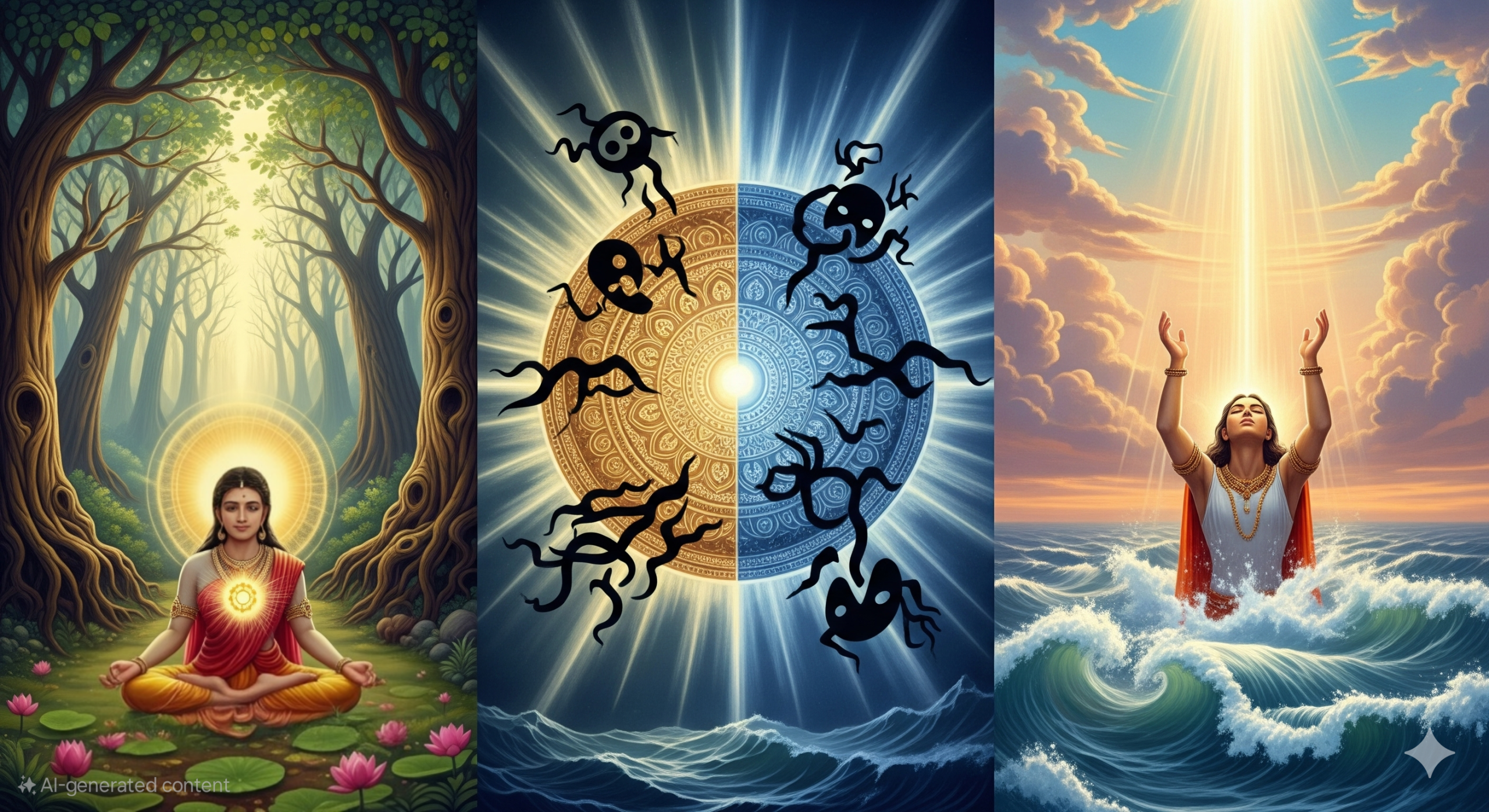
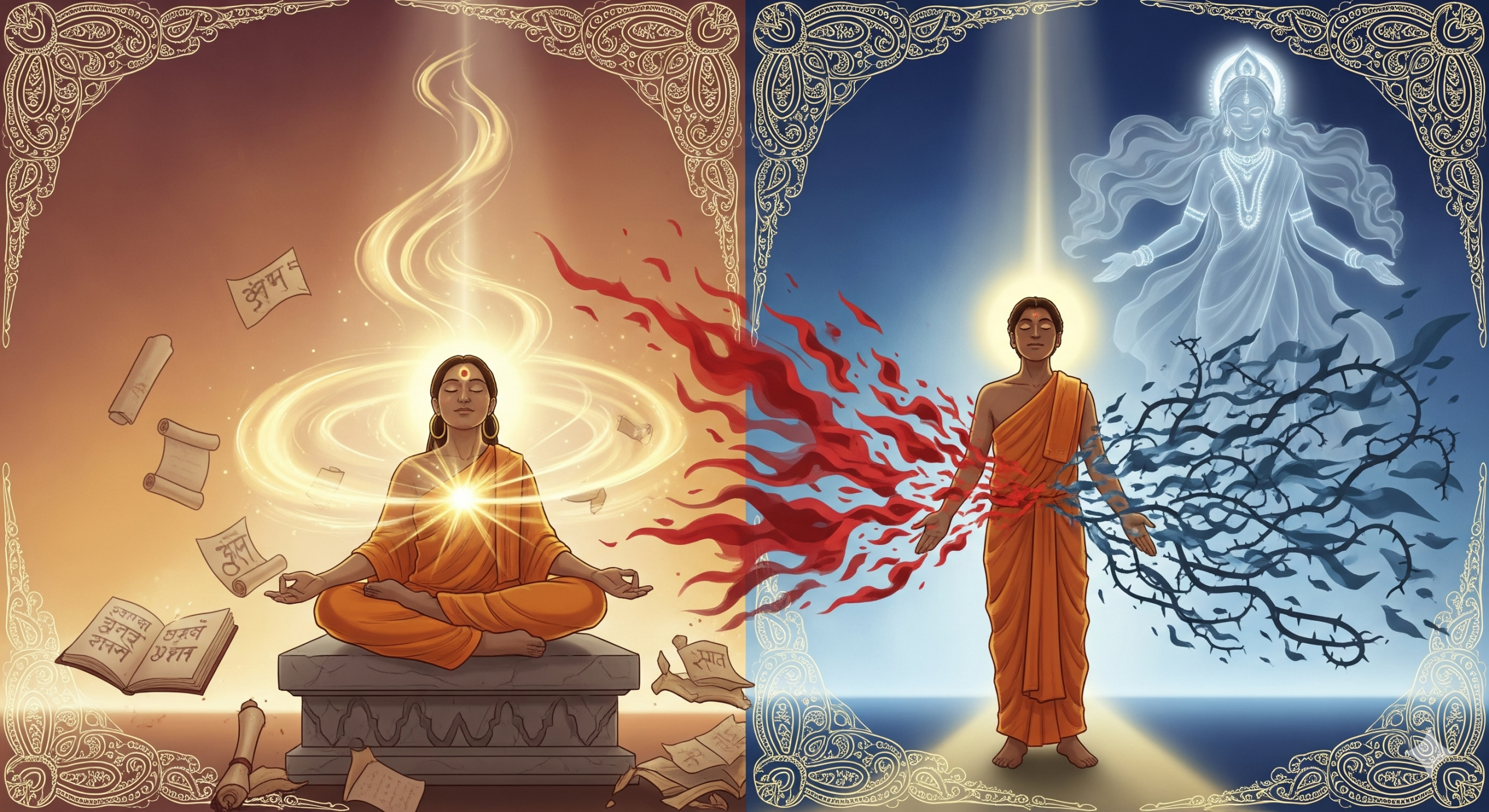
This image visually narrates the spiritual journey described in the verses. The first panel shows the awakening of inner strength and wisdom. The center panel depicts the divine shield of protection that helps us overcome fears and obstacles. The final panel illustrates the ultimate liberation and transcendence that comes from this inner connection.
Summary of Earlier Verses (18–19, 21-22)
Two weeks ago, we reflected on the middle section of the Devī Atharva Śīrṣa, where the Goddess was revealed in Her profound cosmic and subtle forms. Those verses (18,19–21,22) described Her as the very essence of the bija mantra, shining like the crescent moon, as the eternal source of all fulfillment. The supreme Brahman meditated upon by the pure-hearted sages, the power behind speech and sound, Devī was revealed as residing in the heart-lotus, radiant as the morning sun, with the noose and goad, offering boons and fearlessness to devotees. She was adored as the supreme Mother, the remover of fear and the great alleviator of suffering—an embodiment of compassion and divine grace.
- Verse 18 revealed the bīja of the Goddess — joined with space, fire, and the crescent moon — as the seed that fulfills all purposes.
- Verse 19 declared that this one-syllabled Brahman is meditated upon by sages of pure mind, immersed in the ocean of bliss and knowledge.
- Verse 21 presented a beautiful image of the Goddess in the heart-lotus: radiant like the morning sun, holding the noose and goad, with hands bestowing fearlessness and boons, three-eyed, clad in red garments, fulfilling the wishes of Her devotees.
- Verse 22 concluded this section with a direct salutation: “I bow to You, the great Goddess, destroyer of great fears, who calms the greatest obstacles, and whose very form is supreme compassion.”
This verse (22) forms the bridge, connecting Her supreme transcendental nature with the Phala Śruti, the declaration of blessings that follow from worship and recitation.
Today’s Verses(22-26)
Verse 22
This verse is repeated from the previous time to set the context
Sanskrit:
नमामि त्वां महादेवीं महाभयविनाशिनीम् ।
महादुर्गप्रशमनीं महाकारुण्यरूपिणीम् ॥ २२ ॥
Transliteration:
namāmi tvāṁ mahādevīṁ mahābhaya-vināśinīm ।
mahādurgapraśamanīṁ mahākāruṇyarūpiṇīm ॥ 22 ॥
Meaning:
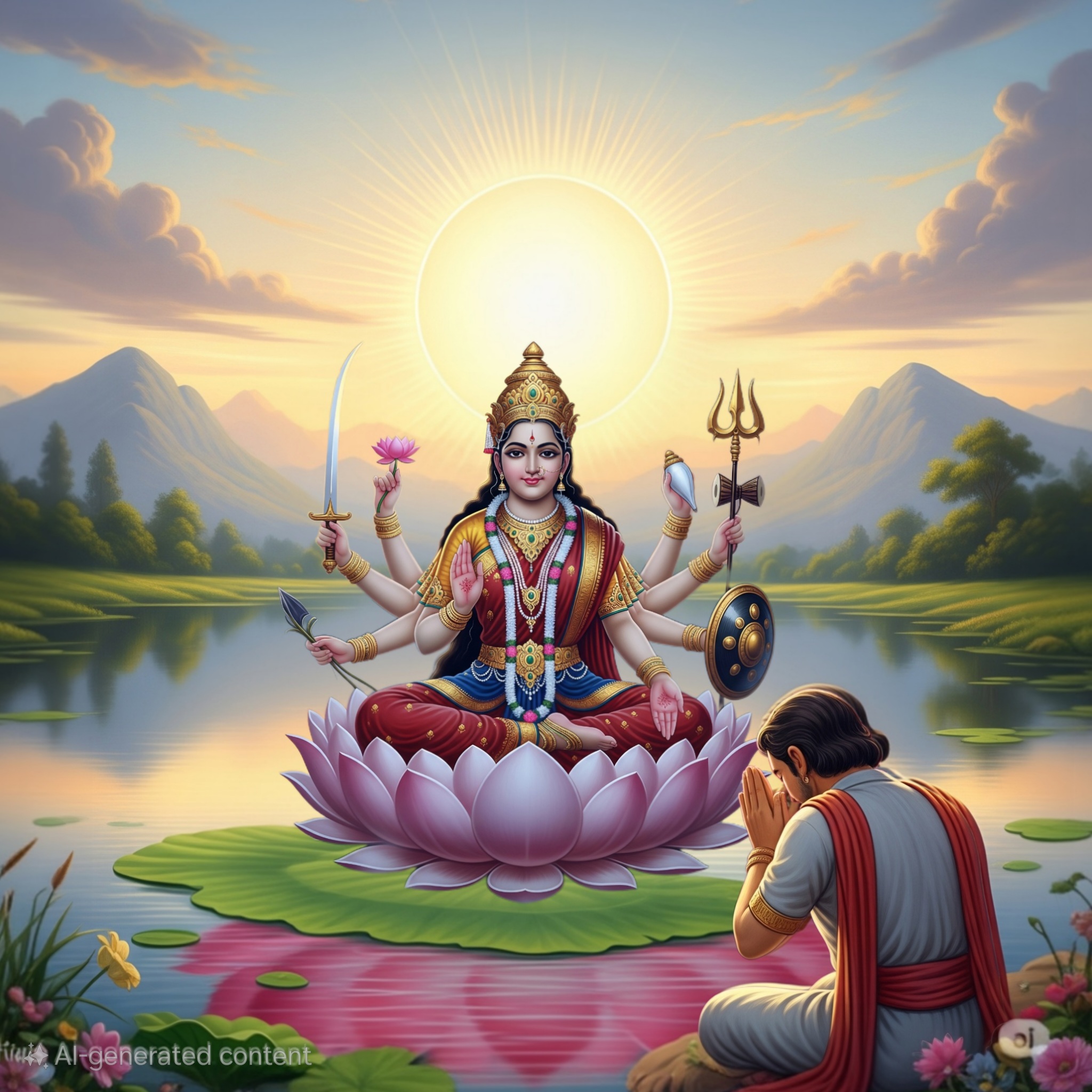
I bow to You, the great Goddess, destroyer of great fears, who pacifies the most formidable obstacles, whose very form is supreme compassion.
Commentary: This verse serves as a powerful invocation, setting the stage for the entire hymn. It immediately addresses the Goddess as the ultimate refuge. The phrase “destroyer of great fears” (mahābhaya-vināśinīm) doesn’t just refer to a feeling of being scared; it speaks to existential dread—the fear of death, loss, and the unknown. This ancient wisdom reminds us that by connecting with the Divine Feminine, we can confront our deepest anxieties. The term “pacifies the most formidable obstacles” (mahādurgapraśamanīm) relates to the word Durga, which means “fortress” or “difficult to cross.” This speaks to both external challenges and our own internal blockages—mental strongholds, stubborn habits, and emotional walls. The Goddess is invoked here as the force that can dismantle these seemingly insurmountable barriers. Finally, the description of Her form as “supreme compassion” (mahākāruṇyarūpiṇīm) reframes the powerful, sometimes fierce, aspect of the Goddess.
Her destructive power is not born of anger, but of a boundless, unconditional love that seeks to remove what harms us, both within and without. This is a profound spiritual lesson: true power is rooted in compassion.
Verse 23

Sanskrit:
यस्याः स्वरूपं ब्रह्मादयो न जानन्ति तस्मादुच्यते अज्ञेया ।
यस्या अन्तो न लभ्यते तस्मादुच्यते अनन्ता ।
यस्या लक्ष्यं नोपलक्ष्यते तस्मादुच्यते अलक्ष्या ।
यस्या जननं नोपलभ्यते तस्मादुच्यते अजा ।
एकैव सर्वत्र वर्तते तस्मादुच्यते एका ।
एकैव विश्वरूपिणी तस्मादुच्यते नैका ।
अत एवोच्यते अज्ञेयानन्तालक्ष्याजैका नैकेति ॥ २३ ॥
Transliteration:
yasyāḥ svarūpaṁ brahmādayo na jānanti tasmād ucyate ajñeyā ।
yasyā anto na labhyate tasmād ucyate anantā ।
yasyā lakṣyaṁ nopalakṣyate tasmād ucyate alakṣyā ।
yasyā jananaṁ nopalabhyate tasmād ucyate ajā ।
ekaiva sarvatra vartate tasmād ucyate ekā ।
ekaiva viśvarūpiṇī tasmād ucyate naikā ।
ata evocyate ajñeyā-anantā-alakṣyā-ajekā-naiketi ॥ 23 ॥
Meaning:
Her true form even Brahmā and the gods cannot know, hence She is called Agyeyā (unknowable).
Her end cannot be found, hence She is Anantā (infinite).
Her goal cannot be perceived, hence She is Alakṣyā (imperceptible).
Her birth cannot be determined, hence She is Ajā (unborn).
She alone pervades everywhere, hence She is Ekā (One).
Yet She appears as the cosmic form, hence She is Naikā (many).
Therefore, She is described as Agyeyā, Anantā, Alakṣyā, Ajā, Ekā, and Naikā.
Commentary: This verse beautifully uses a series of philosophical pairs to describe the transcendent nature of the Goddess. This isn’t a list of facts to be memorized, but a set of paradoxical truths designed to shatter our limited, dualistic understanding. The Upanishad reminds us that the ultimate reality is beyond our intellectual grasp. The concept of Agyeyā (unknowable) challenges our modern impulse to understand everything rationally. It suggests that profound truths are experienced, not just known. The contrast between Ekā (One) and Naikā (many) is a cornerstone of non-dual philosophy. The Goddess is the singular, unified reality underlying all existence, yet She manifests as the rich, diverse, and sometimes chaotic multiplicity of the cosmos. This teaches us a fundamental spiritual principle: we are all individual expressions of a single divine consciousness. By recognizing the divine in ourselves and in others, we connect to the One (Ekā) in the many (Naikā).
Verse 24

Sanskrit:
मन्त्राणां मातृका देवी शब्दानां ज्ञानरूपिणी ।
ज्ञानानां चिन्मयातीता शून्यानां शून्यसाक्षिणी ।
यस्याः परतरं नास्ति सैषा दुर्गा प्रकीर्तिता ॥ २४ ॥
Transliteration:
mantrāṇāṁ mātṛkā devī śabdānāṁ jñānarūpiṇī ।
jñānānāṁ cinmayātītā śūnyānāṁ śūnyasākṣiṇī ।
yasyāḥ parataraṁ nāsti saiṣā durgā prakīrtitā ॥ 24 ॥
Meaning:
She is the Mother of all mantras, the essence of all sound, the embodiment of knowledge.
She is beyond even the highest wisdom, the witness of the void itself.
Since nothing is higher than Her, She is praised as Durgā.
Commentary: This verse expands on the Goddess’s role in creation and consciousness. The phrase “Mother of all mantras” (mantrāṇāṁ mātṛkā devī) is deeply significant. Mantras are not just sounds; they are potent vibrations that embody a specific aspect of consciousness. The Goddess is the source of all these vibrations, the very matrix of sound from which language, creation, and spiritual power emerge. She is the “essence of all sound” and the “embodiment of knowledge,” reminding us that true wisdom is not just accumulated information but a living, vibrant force. The most profound line is “the witness of the void itself.” This takes the concept of the Goddess beyond form and sound and into the realm of pure, unmanifested potential—the space before creation. She is the consciousness that observes even the absence of everything. This teaches us that the core of our being is not the thoughts, feelings, or external realities we experience, but the silent, unchanging witness that observes them all.
Verse 25

Sanskrit:
तां दुर्गां दुर्गमां देवीं दुराचारविघातिनीम् ।
नमामि भवभीतोऽहं संसारार्णवतारिणीम् ॥ २५ ॥
Transliteration:
tāṁ durgāṁ durgamāṁ devīṁ durācāra-vighātinīm ।
namāmi bhava-bhīto ’haṁ saṁsārārṇava-tāriṇīm ॥ 25 ॥
Meaning:
I bow to that Goddess Durgā, difficult to approach, destroyer of evil conduct.
Fearing worldly existence, I surrender to Her, who carries us across the ocean of saṁsāra.
Commentary: This verse shifts from philosophical description to a personal declaration of devotion. The term “difficult to approach” (durgamāṁ) is a play on the name Durgā, but it is not a negative trait. It signifies that the path to Her is not a casual one; it requires discipline, sincerity, and inner purification. She destroys “evil conduct” (durācāra-vighātinīm), which refers not only to outward actions but, more importantly, to the inner tendencies and thoughts that lead us astray. This is the heart of the transformational process. The devotee expresses a fear of “worldly existence” (saṁsāra)—the endless cycle of birth, death, and suffering driven by ignorance and desire. The final line offers a solution: surrendering to the Goddess. She is the divine boat that “carries us across the ocean of saṁsāra.” This is a powerful metaphor for personal liberation. It implies that we don’t have to navigate the turbulent waters of life alone; by connecting with the divine, we gain the grace and guidance needed to reach the shore of spiritual freedom.
Verse 26
Sanskrit:
इदमथर्वशीर्षं योऽधीते स पञ्चाथर्वशीर्षजप-फलमाप्नोति ।
इदमथर्वशीर्षमज्ञात्वा योऽर्चां स्थापयति —
शतलक्षं प्रजप्त्वापि सोऽर्चासिद्धिं न विन्दति ।
शतमष्टोत्तरं चास्य पुरश्चर्याविधिः स्मृतः ।
दशवारं पठेद् यस्तु सद्यः पापैः प्रमुच्यते ।
महादुर्गाणि तरति महादेव्याः प्रसादतः ॥ २६ ॥
Transliteration:
idam atharvaśīrṣaṁ yo ’dhīte sa pañcātharvaśīrṣa-japa-phalam āpnoti ।
idam atharvaśīrṣam ajñātvā yo ’rcāṁ sthāpayati —
śata-lakṣaṁ prajaptvāpi so ’rcā-siddhiṁ na vindati ।
śatam aṣṭottaraṁ cāsya puraścaryā-vidhiḥ smṛtaḥ ।
daśa-vāraṁ paṭhed yastu sadyaḥ pāpaiḥ pramucyate ।
mahādurgāṇi tarati mahādevyāḥ prasādataḥ ॥ 26 ॥
Meaning:
He who studies this Atharva Śīrṣa obtains the fruit of reciting all the five Atharva Śīrṣas.
He who installs an image of the Goddess without knowing this hymn — even if he recites a hundred thousand times — does not attain perfection in worship.
Its prescribed puraścaraṇa 1is 108 recitations.
Whoever recites it ten times is freed immediately from sins.
By the grace of the great Goddess, he crosses the greatest difficulties.
Commentary: This final verse highlights the immense spiritual power and practical benefits of the hymn. The statement that reciting this one hymn is equivalent to all five Atharva Śīrṣas underscores its exceptional status and transformative potential. It teaches a crucial lesson about the difference between rote ritual and conscious devotion: “He who installs an image of the Goddess without knowing this hymn… does not attain perfection in worship.“ This is a profound critique of blind faith and mechanical practice. The verse emphasizes that true worship requires knowledge and understanding of the Divine’s nature as described in the hymn. The knowledge (gnosis) must accompany the devotion (bhakti). The specific instructions for recitation—108 for puraścaraṇa (a preparatory ritual) and 10 times for immediate purification—provide a tangible spiritual practice. The final promise is a powerful one: through the grace of the Goddess, one can overcome even the most formidable obstacles in life, both spiritual and material. It is a promise of divine aid for the one who sincerely engages with this ancient wisdom.
Reflections

While the earlier verses pointed to the mystical vision of Devī — as mantra, as cosmic sound, as the inner light — the Phala Śruti now shifts to the practical fruits of devotion. The Upaniṣad reassures us that invoking the Mother is not merely symbolic; it directly transforms life: fears are removed, difficulties are overcome, knowledge awakens, and liberation becomes possible.
For us today, these verses invite a shift from theory to practice. It is not enough to admire the vision of Devī as cosmic energy; we are encouraged to recite, remember, and live by this Vidyā.
In doing so, we discover courage in fear, clarity in confusion, and grace in our struggles — the same grace the sages promised thousands of years ago.
Applications in Modern Life

The above verses from the Devi Atharva Shirsha Upanishad offer a profound and timeless roadmap for navigating our modern existence.
- Beyond Definition (Verse 23): We live in an age that demands certainty, where we often try to define ourselves and others with labels, metrics, and data. This first verse challenges that by describing the divine as unknowable (Agyeyā) and infinite (Anantā). This wisdom invites us to find peace in the mystery of life, reminding us that our true potential and essence cannot be confined by a resume, a social media profile, or a job title. It’s an invitation to embrace the ever-evolving, boundless nature of our own being.
- The Power of Words and Knowledge (Verse 24): This verse highlights that the Goddess is the mother of all mantras and the essence of all knowledge. In our modern context, this points to the profound power of our words and thoughts. What we say and what we think creates our reality. It’s a call to be mindful of the information we consume and the language we use, recognizing that they are not just tools but are imbued with a fundamental creative energy.
- Confronting Inner Obstacles (Verse 25): The verse describes the Goddess as the destroyer of evil conduct (durācāra-vighātinīm). This can be interpreted as an inner strength that helps us overcome our own destructive patterns. Our modern “evil conduct” often manifests as negative self-talk, fear-driven procrastination etc. This verse offers the wisdom that we can call upon a higher, inner resolve to overcome these patterns and find the courage to cross the “ocean of saṁsāra,” or the difficult challenges of our daily lives.
- Grace and Effort (Verse 26): This final verse offers a beautiful balance of personal effort and higher grace. It states that by understanding and reciting the hymn, we can cross the greatest difficulties. This teaches us that while our actions—our spiritual practice, our good deeds—are important, true liberation and the ability to overcome life’s biggest hurdles come from divine grace. It’s a powerful reminder that we don’t have to carry the burden of our struggles alone.
Closing Thoughts

As the Upaniṣad itself declares:
“In this way, the greatness of the Devī Atharva Śīrṣa has been revealed. This sacred Vidyā bestows liberation upon all and brings auspiciousness.”
These verses from the Devi Atharva Shirsha Upanishad offer a timeless roadmap for living a more fulfilled life. They invite us to let go of our need for complete control and embrace the mystery, to use our words and thoughts mindfully, to face our inner demons with courage, and to ultimately trust that a higher grace will help us through our darkest moments. By reflecting on this ancient wisdom, we can find a path to inner peace and strength in an ever-changing world.

May you carry these verses in your heart, for they remind us that the Divine Mother is both infinite and intimate—beyond comprehension, yet dwelling within you, ever ready to guide you across the ocean of life. Look within. She is the guide. She is the light — The Sacred Strength
Digital Version Source
- PDF title: Devi Atharvashirsha
- Website: Navratri.SahajaYogaOnline.com
- Direct link: devi-atharvashirsha.pdf
Samastah Lokah Sukhino Bhavanthu
May all the beings in all the worlds be happy

Jai Sai Ram!
- Puraścaraṇa means “a prescribed discipline or practice performed before (or along with) mantra japa (repetition).”
Practical sense:
It refers to a set of ritualistic disciplines (like mantra japa, homa, tarpana, mārjana, brāhmaṇa-bhojana) undertaken systematically to energize and fully realize the mantra’s power. It’s like preparing the ground so the mantra can bear its full fruit.
In this context:
When the text says “Its prescribed puraścaraṇa is 108 recitations”, it means that to properly invoke the Devi Atharvaśīrṣa, one should ideally perform 108 full recitations of the stotra as a sacred discipline. That number of repetitions is believed to activate the mantra’s potency and bestow the promised benefits (śakti, protection, realization).
In short: Puraścaraṇa = the systematic practice of mantra repetition, with rituals, done in a set number (here, 108 times) to energize the mantra and receive its full blessing. ↩︎
Please note all content and images are created using AI Tools