Whispers from the Triangulum

Some astrophotography targets reveal themselves immediately.
Others make you earn every photon.
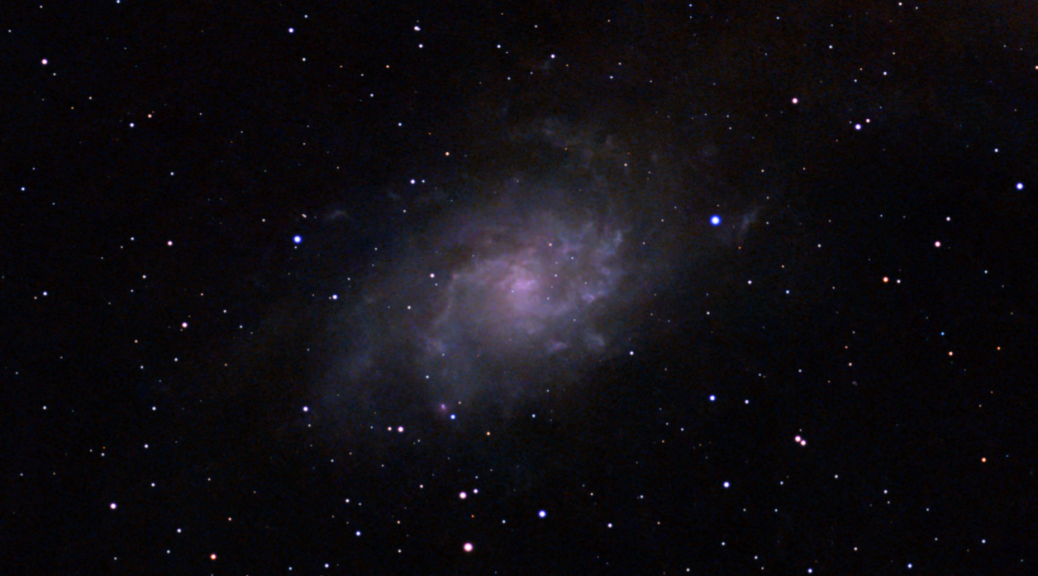
A few weeks ago, I set out to capture Messier 33 (M33), the Triangulum Galaxy, a faint spiral galaxy hiding in the constellation Triangulum. Located roughly 3 million light-years from Earth, M33 is the third-largest member of the Local Group, after the Milky Way and Andromeda.
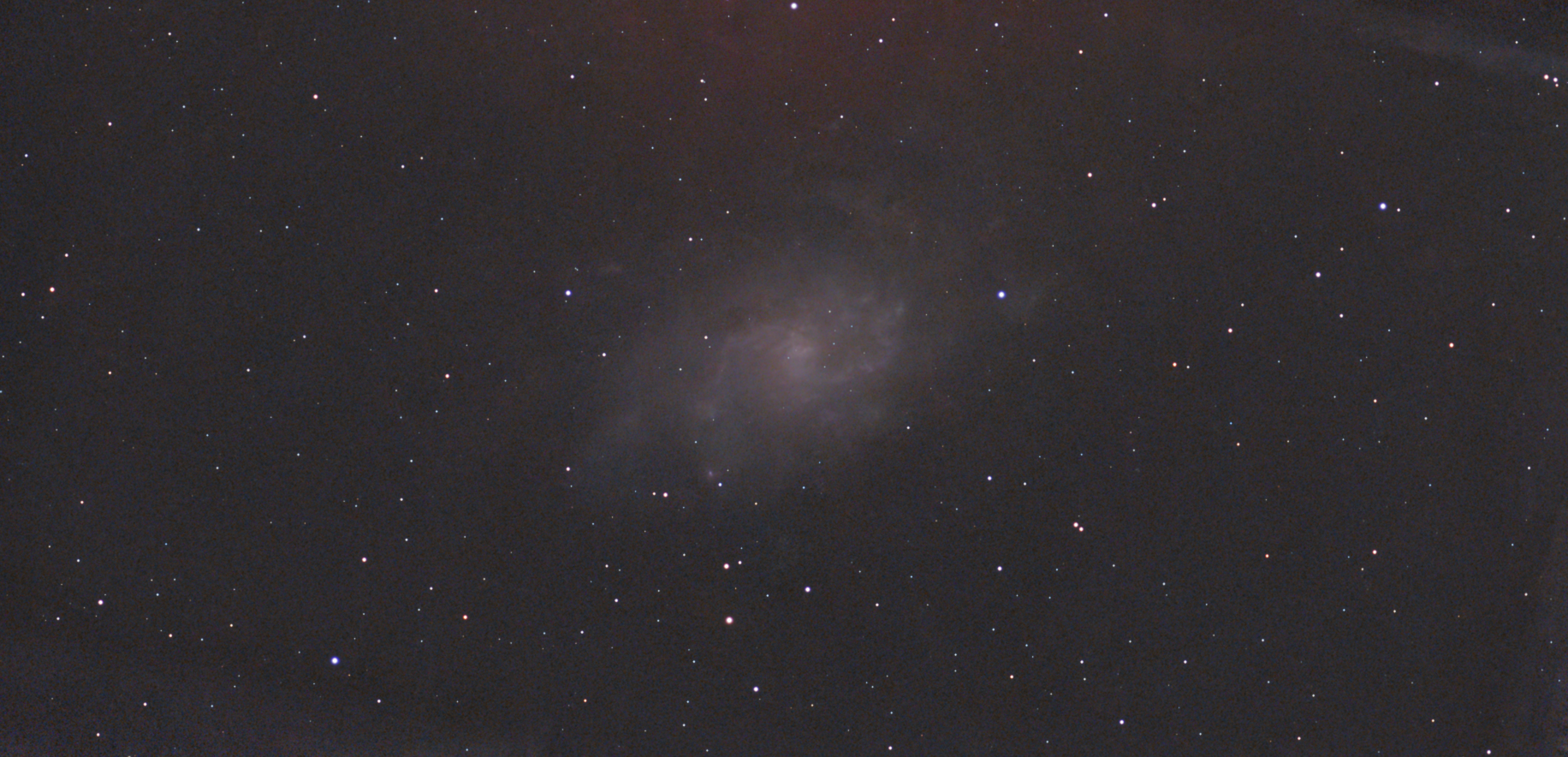
What makes M33 particularly challenging is its low surface brightness. Although it is bright enough to be visible through amateur instruments, its light is spread across a large area of sky, making it appear as little more than a faint glow in individual exposures.
That challenge was exactly what attracted me to it.
After several attempts and 1 hour 34 minutes of integration time, the galaxy finally began to emerge from the darkness.
Why M33 Matters
Beyond its beauty, M33 is one of the most scientifically important galaxies in our cosmic neighbourhood.
According to NASA’s Hubble Messier Catalog, M33 is approximately half the size of the Milky Way and hosts widespread regions of active star formation.
Because we view the galaxy almost face-on, astronomers can study its spiral structure, stellar populations, and star-forming regions in remarkable detail. Observations by the Hubble Space Telescope have shown that M33 is actively producing new stars across its spiral arms.

Every faint detail visible in this image represents real astrophysical processes unfolding millions of light-years away.
What This Image Reveals

When I first examined the raw frames, M33 appeared as little more than a faint smudge surrounded by hundreds of foreground stars.
Nothing spectacular.
But with every additional exposure, the signal slowly strengthened.
- The core became more distinct.
- The surrounding disk expanded.
- Hints of spiral structure began to emerge.
What started as a barely detectable glow gradually transformed into a recognizable galaxy.

Looking at the final image, I am reminded of one of the most rewarding truths in astrophotography:
The details are already there. Patience is what reveals them.
Every photon recorded in this image began its journey around three million years ago, travelling through intergalactic space before finally reaching my camera sensor.
That thought never stops being extraordinary.
Technical Summary
| Parameter | Value |
|---|---|
| Common Name | Triangulum Galaxy |
| Messier Designation | M33 |
| NGC Designation | NGC 598 |
| Object Type | Spiral Galaxy |
| Constellation | Triangulum |
| Distance from Earth | ~3 million light-years |
| Apparent Magnitude | ~5.7 |
| Diameter | More than 50,000 light-years |
| Local Group Status | Third-largest member after the Milky Way and Andromeda |
| Relative Size | About half the size of the Milky Way |
| Orientation | Nearly face-on from Earth |
| Scientific Interest | Active star-forming regions throughout the galaxy |
| Total Integration Time,including Mega stacking two differentsessions | 2 hour 49 minutes |
| Observer / Imager | Mahesh P. Devarakonda |
Reflections
Some astrophotography sessions are about collecting data.
Others become memories.
For me, this was one of those memorable nights.
M33 didn’t reveal itself easily. It demanded patience, persistence, and trust in the process. Yet that challenge is precisely what makes this image meaningful.
What began as a faint patch of light eventually became an entire galaxy containing billions of stars.
Somewhere along the way, M33 stopped being just another catalogue entry and became a personal milestone.
Standing beneath the night sky, collecting ancient light from a neighbouring galaxy, I was reminded why I love astrophotography:
It allows us to connect with places we can never visit, yet somehow bring them a little closer to home.