Celestial Whispers:Southern Pinwheel
Capturing a high-fidelity image of a distant barred spiral galaxy requires precision, patience, and the right processing workflow.
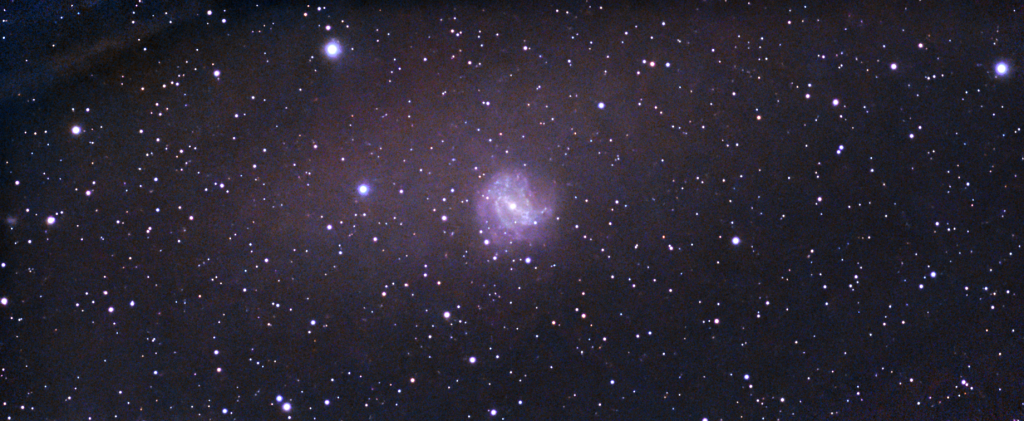
Below is the technical breakdown of a deep-space imaging session targeting Messier 83 (M83), commonly known as the Southern Pinwheel Galaxy.

The data was collected using a DWARFLAB DWARF mini smart telescope over an integration window of 59 minutes and 15 seconds.
What’s in a Name? Why the “Pinwheel”?
For readers wondering about its distinctive nickname, the galaxy is called a Pinwheel because of its beautifully defined, symmetric spiral arms that gracefully sweep out from a central bar.

When viewed face-on from Earth, these star-studded arms resemble a classic, spinning child’s toy wheel. Because it is located in the southern sky within the constellation Hydra, astronomers appended “Southern” to differentiate it from its northern counterpart, Messier 101.
Orbital Mechanics & Spatial Coordinates
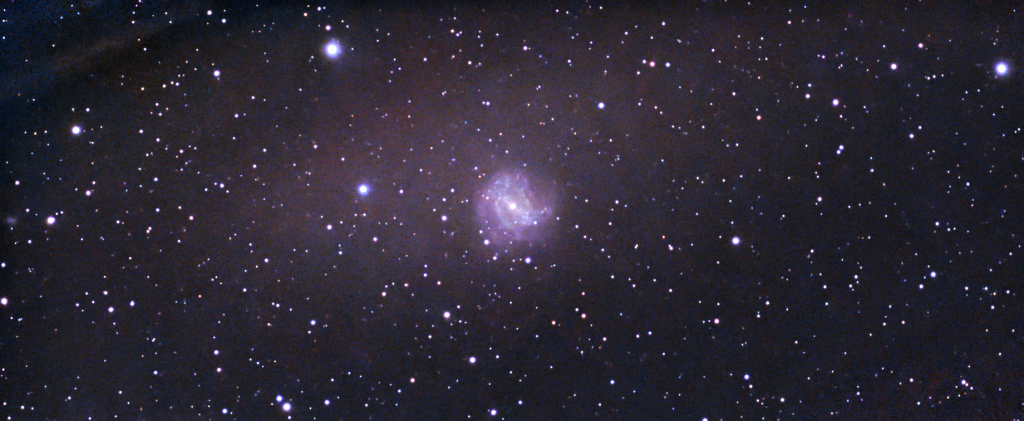
To resolve M83, the smart telescope’s GoTo mount registers specific coordinates within the southern celestial hemisphere. M83 sits on the border of the constellations Hydra and Centaurus.
Right Ascension (RA): 13h 37m 00.9s
Declination (Dec): −29° 51′ 56″
Apparent Magnitude: +7.6 (requires optimal sensor sensitivity to cleanly pull from background noise)
Distance: Approximately 15 million light-years from Earth.
Resolving Power of the DWARF mini
Integrating for nearly an hour (59m 15s) allows the DWARF mini’s automated stacking algorithm to build up the signal-to-noise ratio (SNR). This exposure window is critical for overcoming light pollution and drawing out the faint, loosely wound arms classified under its SAB(s)c barred spiral profile.
The resulting data frames clearly resolve the bright central bar structure, along with the distinct asymmetrical glow of its outer stellar nurseries.

The Dwarf Mini’s Stellar Studio provided ‘Auto’ correction to noise removal and star corrections. Finally, I used the Samsung S26 Ultra photo editor for the final edits.
Comparative Analysis: M83 vs. M101
When optimizing exposure times, it helps to analyze structural morphology against an evolutionary counterpart. Astronomers often compare M83 to Messier 101 (M101), the Northern Pinwheel Galaxy.

While they share physical similarities, their scale and star-forming dynamics differ dramatically:
Mass Density & Star Count: M101 is an expansive grand design spiral housing roughly 1 trillion stars across a 252,000 light-year diameter. Conversely, M83 is far more compact, containing 40 billion stars spanning roughly 55,000 to 118,000 light-years.
Starburst Dynamics: Despite its smaller size, M83 exhibits massive starburst activity. Its core acts as a high-density star factory fueled by dense H II regions.
Supernova Frequency: M83 is an incredibly volatile environment. Six supernovae have been cataloged here within the modern era (including SN 1923A, SN 1950B, and SN 1983N), showcasing rapid stellar lifecycle turnover compared to more stable spiral structures.
Technical Reference Links
Structural & Historical Overview: Detailed documentation via the Wikipedia Messier 83 Page.
Positional Ephemerides: Coordinate mapping and target visibility guides on the AstroPixels Messier 83 Database.
Deep-Space Imaging Analysis: Space-telescope observations and multi-wavelength profiles on the European Southern Observatory (ESO) M83 Index.