Celestial Whispers: A Night of Automated Discovery
Last night, May 12, 2026, was a testament to how modern technology can bridge the gap between our busy daily lives and the silent, ancient wonders of the cosmos.
Between 7:20 PM and 10:15 PM, while I was indoors attending to other tasks, my gear was outside under the Bengaluru sky, diligently working through a pre-planned cosmic itinerary.
The true hero of this session was the Dwarf Mini’s Scheduler feature. By setting up a sequence in advance, the telescope seamlessly transitioned from one Deep Sky Object (DSO) to the next without any manual intervention.
Connected via STA mode to my home Wi-Fi, I could monitor the live stacks on my S26 Ultra from the couch. It is a profound shift—observing the universe not through shivering hours in the dark, but through a harmonious blend of automation and intentionality.
Observations
1. Markarian’s Chain: A Cosmic Neighborhood

This capture reveals a stretch of galaxies in the heart of the Virgo Cluster. Seeing these massive structures grouped together reminds us that nothing in the universe exists in true isolation; everything is part of a grand, gravitational dance.
Type: A string of galaxies including M84, M86, and the “Eyes” galaxies.
Distance: Approximately 50 to 60 million light-years from Earth.
Significance: Most of these galaxies are moving in a coherent motion, hence the “chain” designation, though some are just line-of-sight coincidences.

Reference: https://apod.nasa.gov/apod/ap190331.html
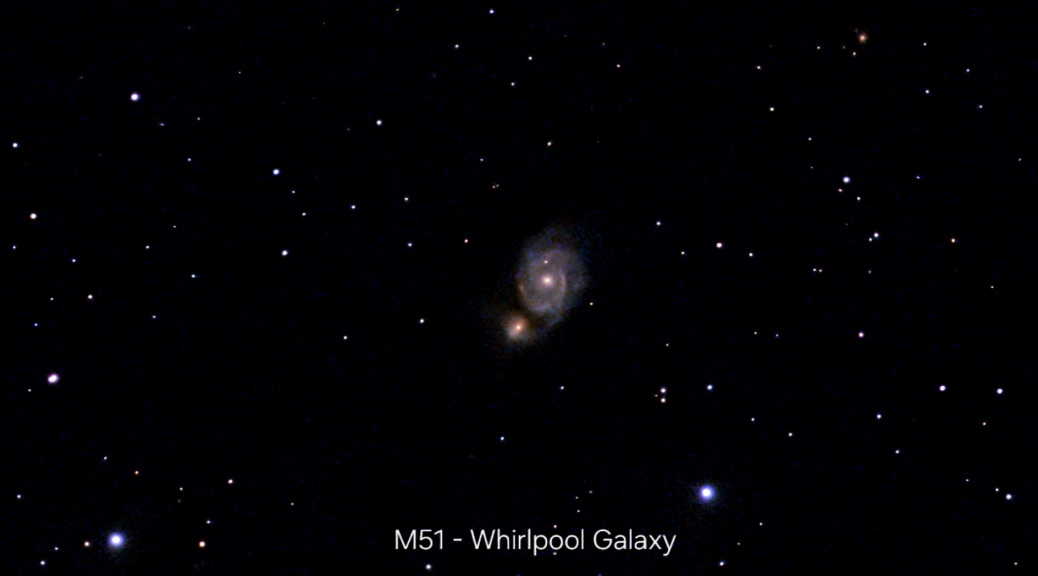
2. M51: The Whirlpool Galaxy

The spiral structure of M51 is perhaps the most iconic “transcendental” image in astronomy. It represents the perfect whirlpool of creation, where the smaller companion galaxy (NGC 5195) is literally tugging on the arms of the larger spiral.
Type: Grand-design spiral galaxy.
Distance: Roughly 31 million light-years away in the constellation Canes Venatici.
Interaction: The gravitational interaction with its companion triggers intense star formation, lighting up the spiral arms with brilliant pink nebulae.

Reference: Explore M51 at the Hubble Site
3. M104: The Sombrero Galaxy

Looking at the Sombrero, one can’t help but see a “crown” or a “brim” of starlight. It is a solitary, majestic object that sits on the edge of the Virgo Cluster, characterized by its unusually large central bulge and a prominent dark dust lane.
Type: Unbarred spiral galaxy (often appearing like an elliptical with a disk).
Distance: About 28 million light-years from Earth.
Feature: It contains a massive central black hole, estimated to be a billion times the mass of our Sun, and a rich system of nearly 2,000 globular clusters.

Reference: M104 Technical Details via Messier-Objects.com
Reflecting on the Night
As I reviewed the final edits on my S26 Ultra, I realized that it isn’t just about the images—it’s about the process. By using the scheduler, we remove the friction of the “how” and allow ourselves to focus on the “why.” We are capturing light that has traveled for millions of years to reach a terrace in Bengaluru.
How do these distant giants change your perspective on the “small” tasks we handle every day?