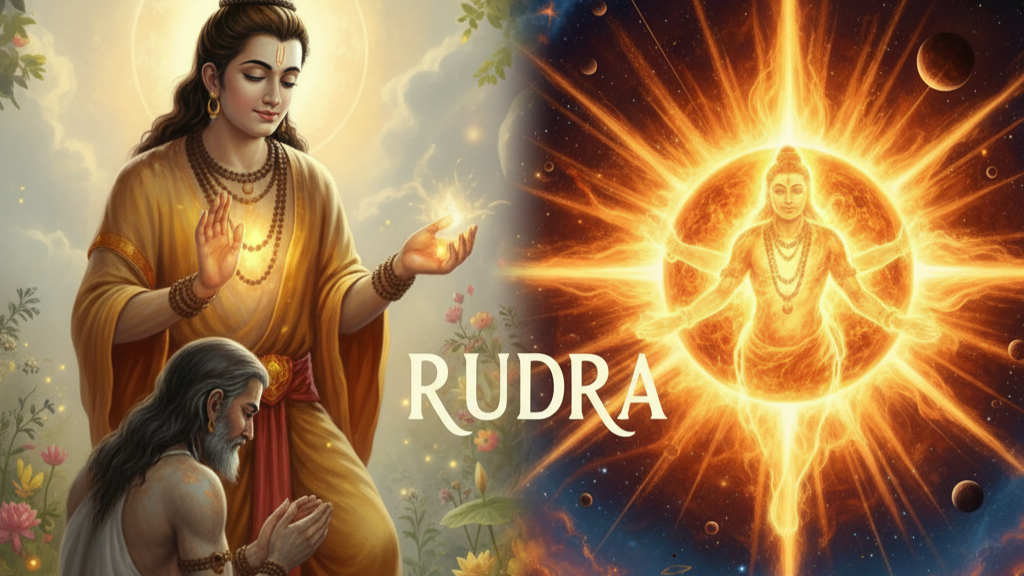
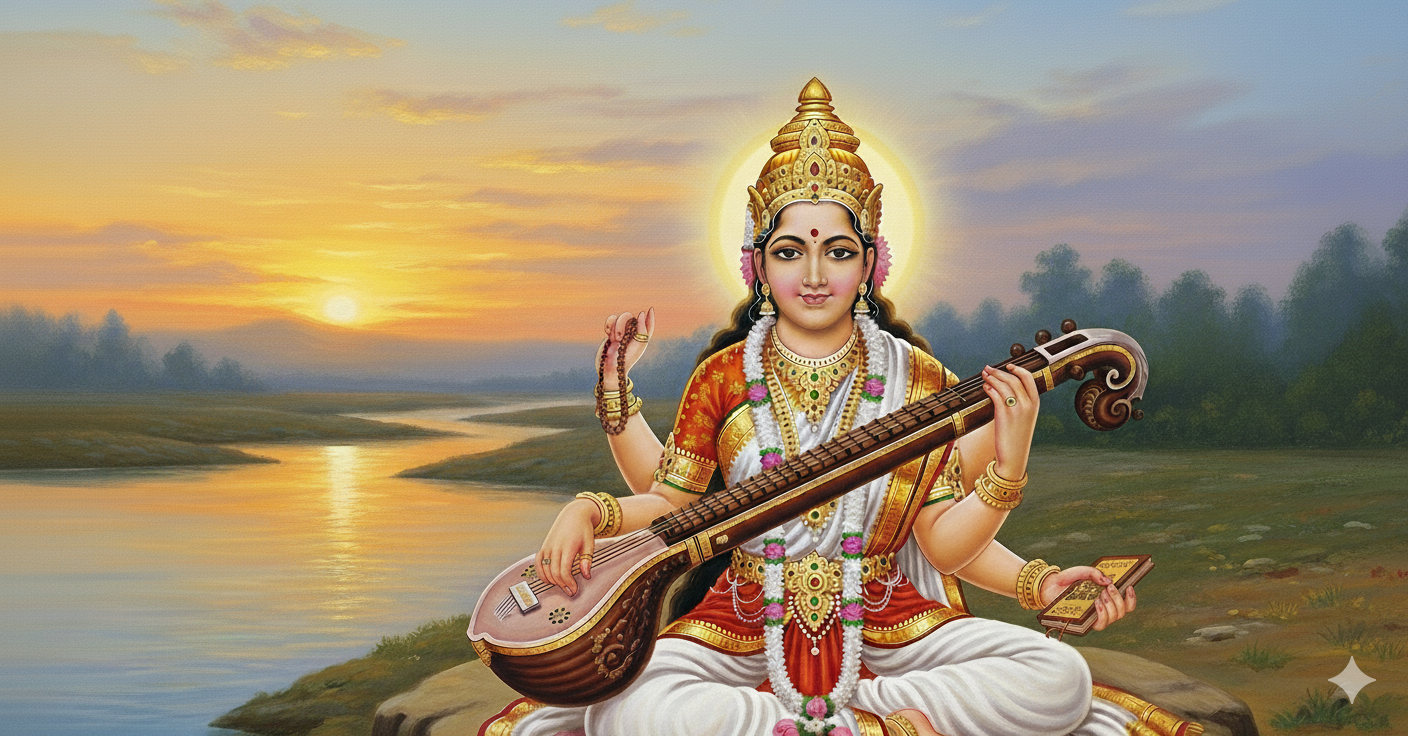
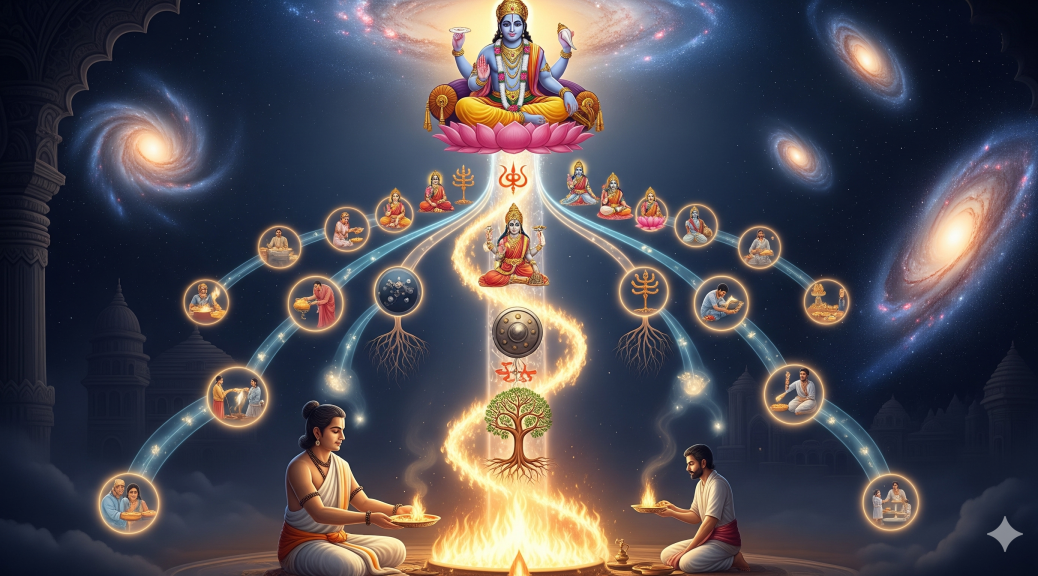
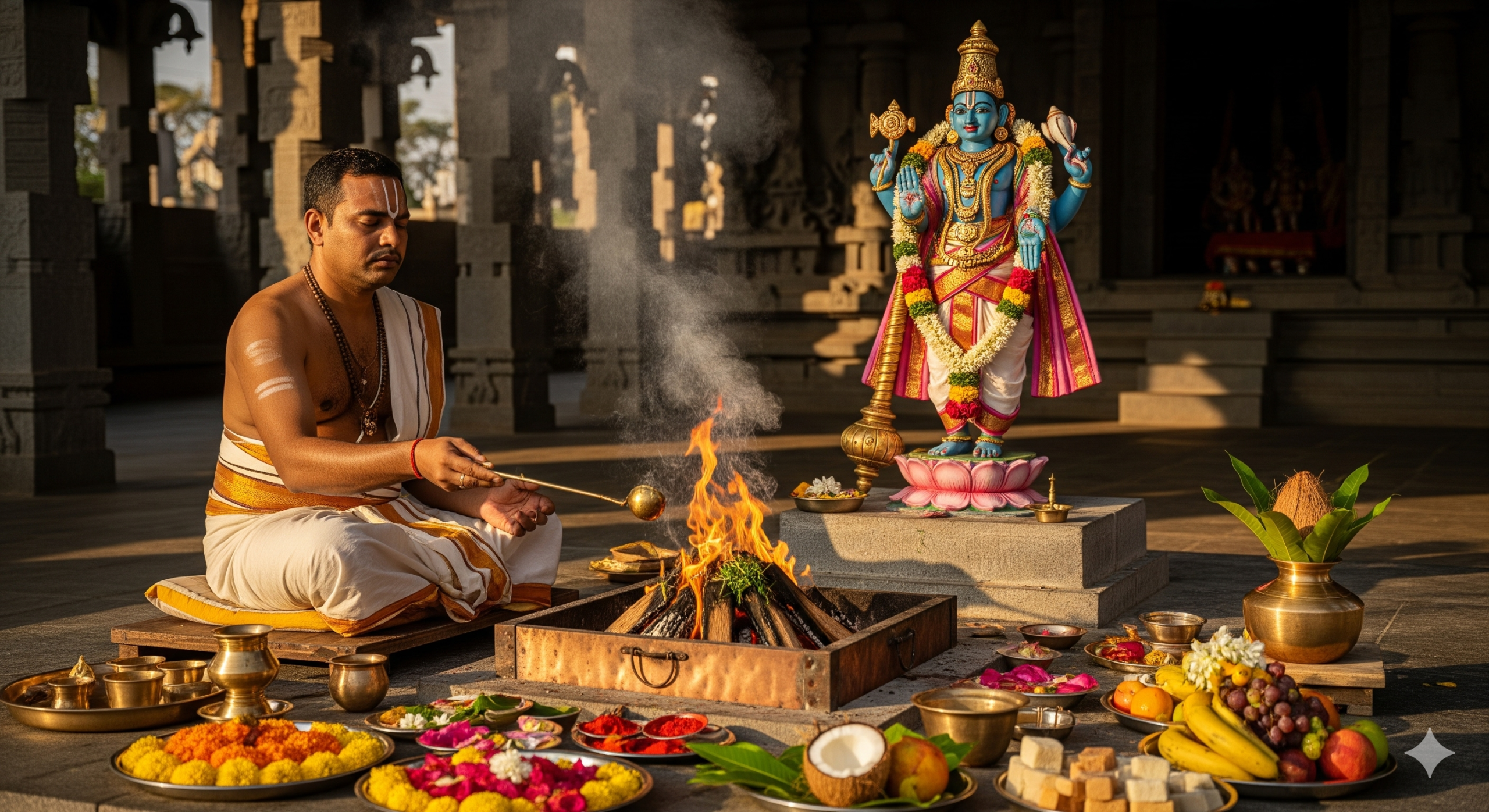
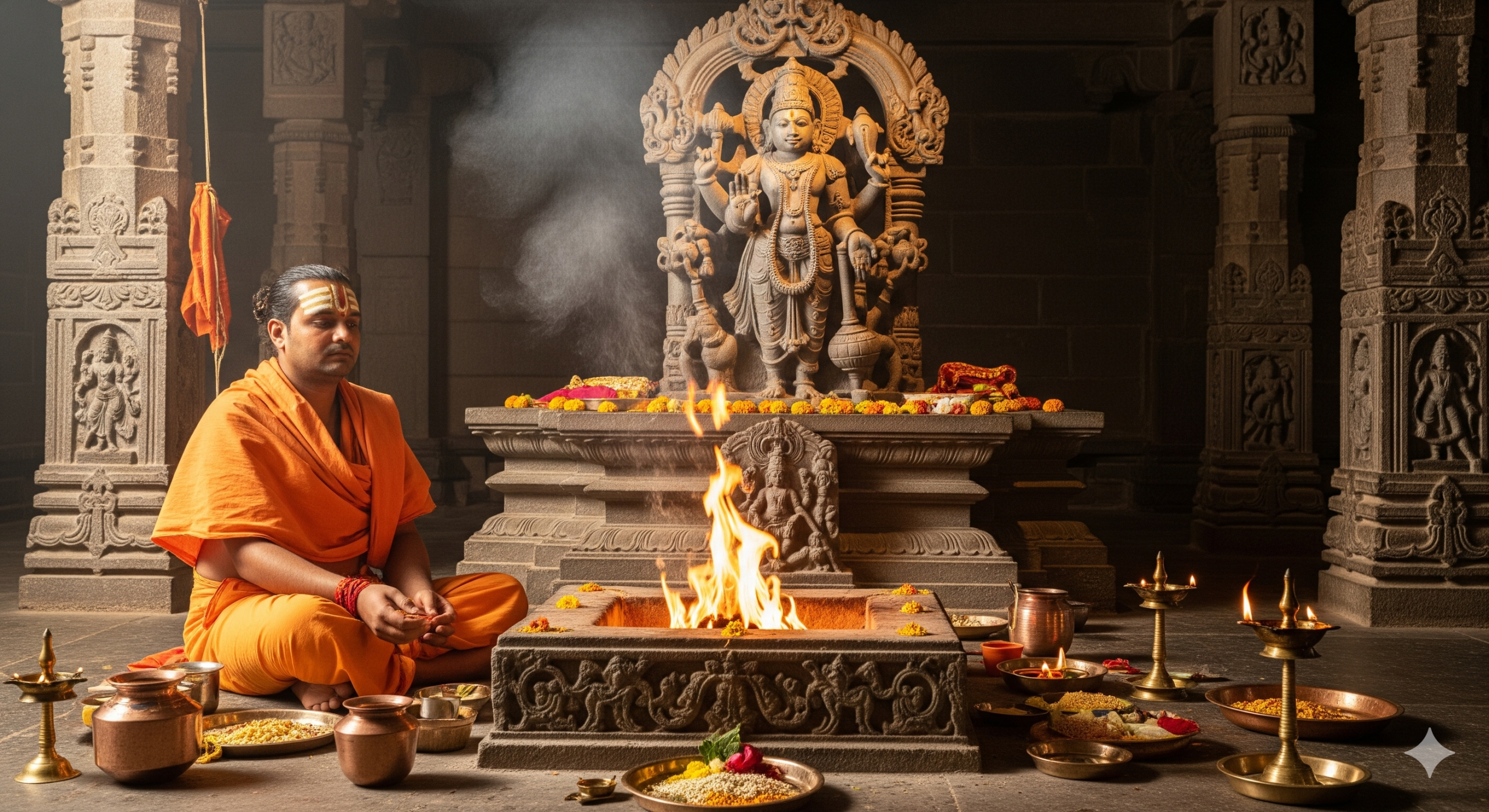
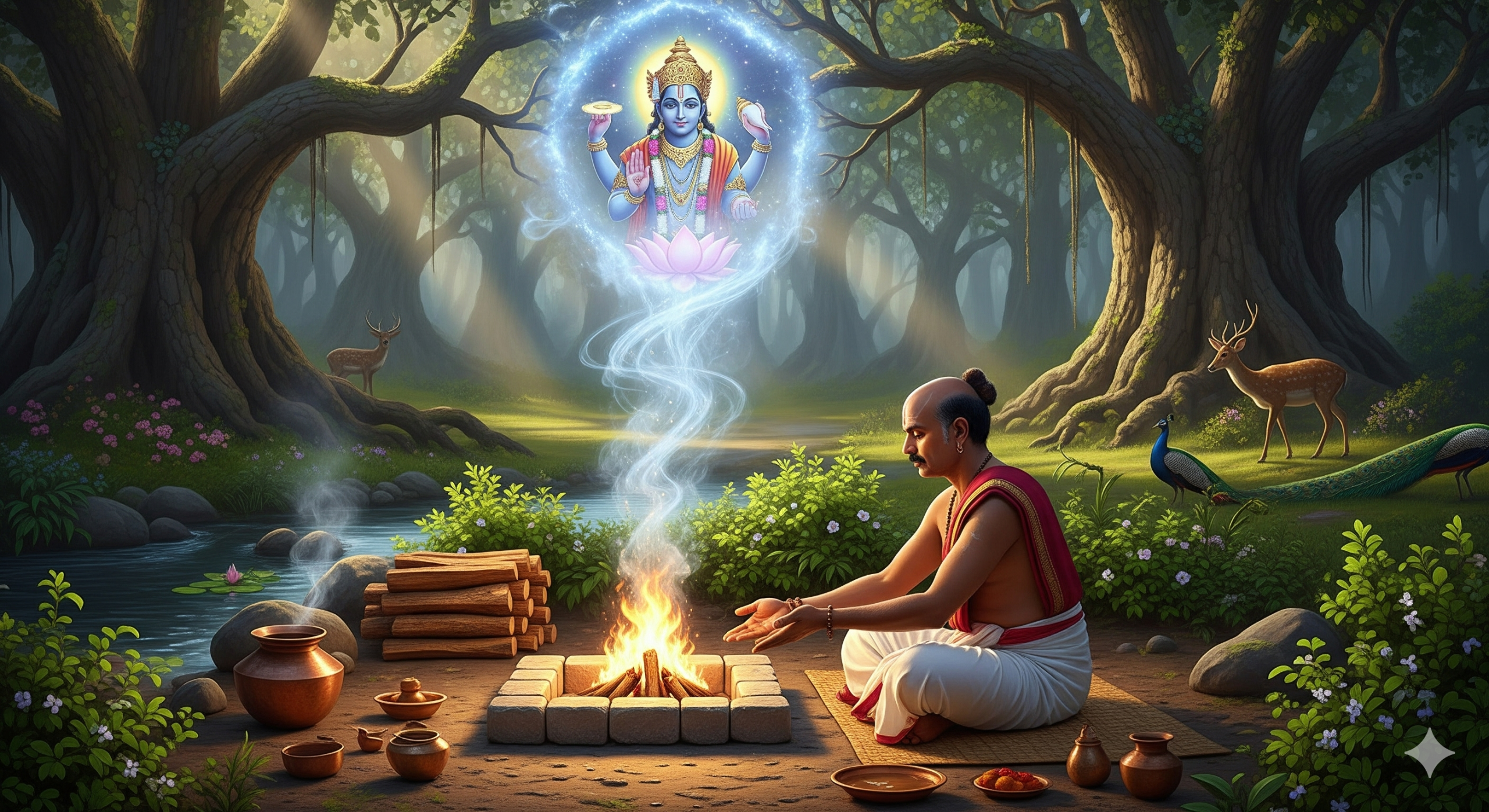
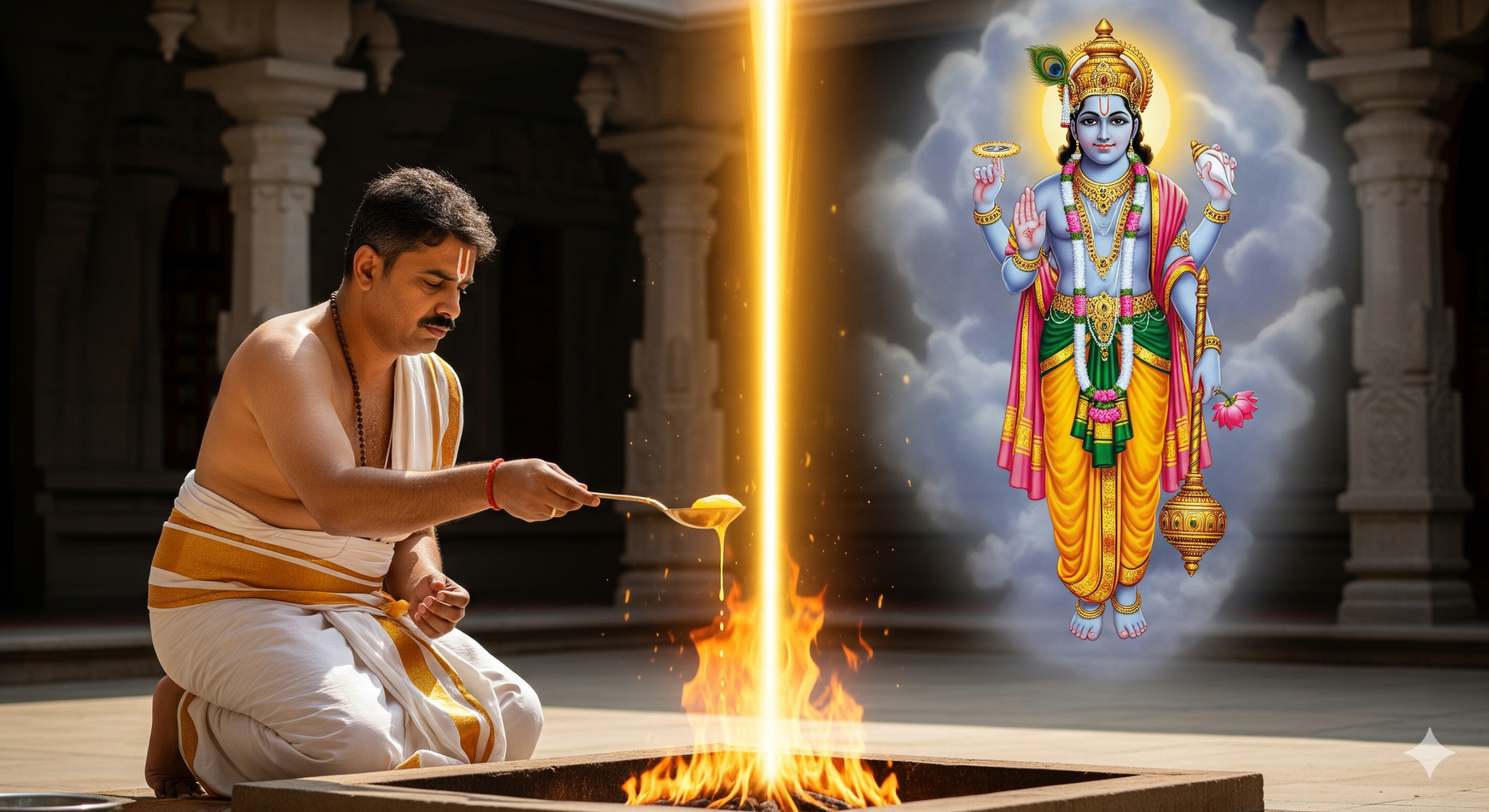
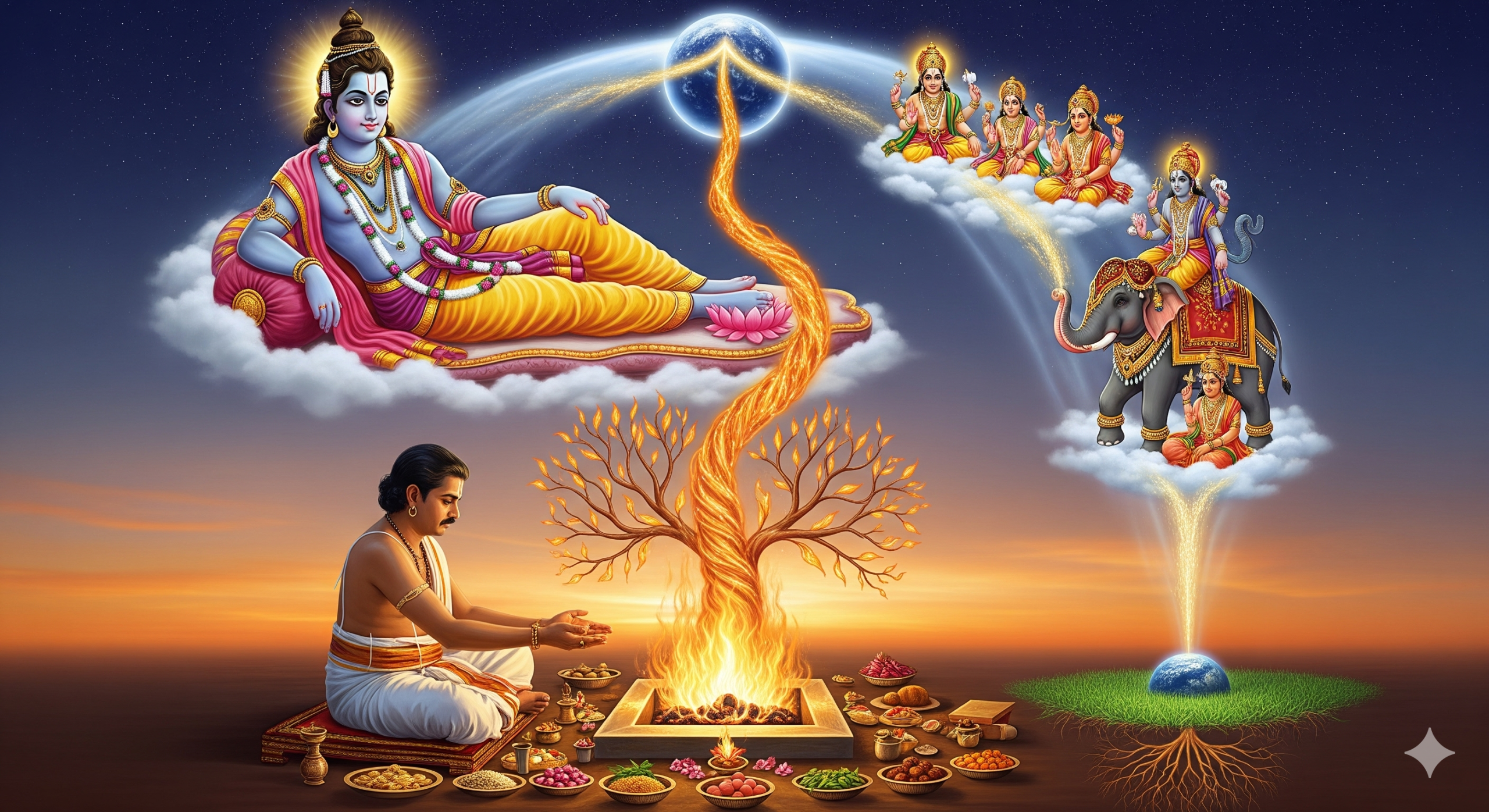
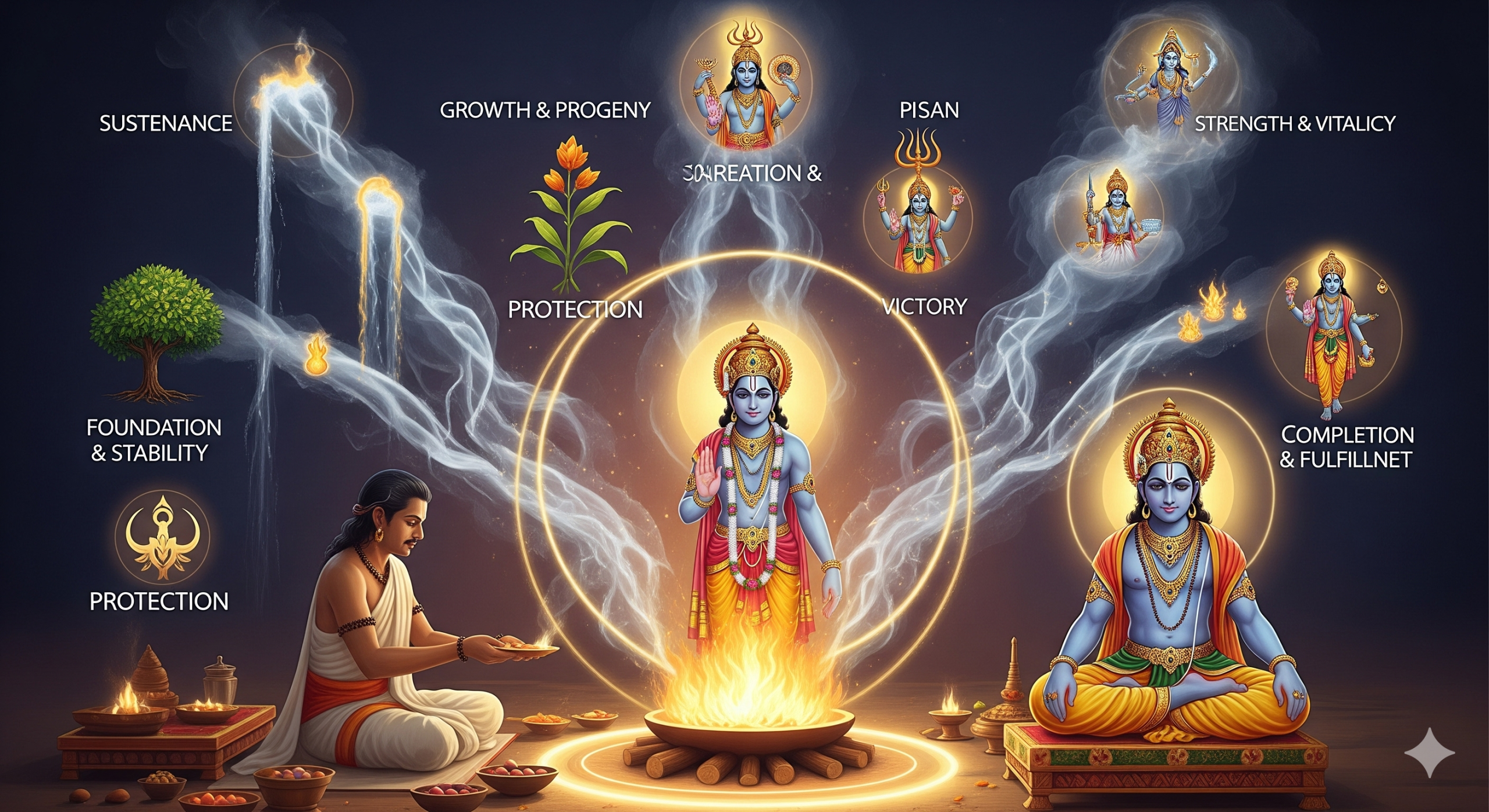
In our last reflection on the first Anuvāka of the Śrī Rudram, we paused with verses 3 and 4. Those mantras reminded us that Rudra’s immense power can also be a source of shelter and protection when approached with reverence.
Continuing this journey, verses 6 and 7 take us deeper — portraying Rudra as both the supreme healer and the one who intercedes for devotees, and as the solar, auspicious power shining in all directions. Together, they balance intimacy and awe: Rudra is near and compassionate, yet cosmic and vast.
Context
These verses shift the focus from a protective plea to a recognition of Rudra’s healing and cosmic presence. Verse 6 depicts Rudra as the divine physician who removes both visible and invisible dangers. Verse 7 then expands our awareness to the sunlike Rudra and his countless hosts spread across all directions.
Transliteration adhyāvocat adhivaktā prathamo daivyo bhīṣak | ahiṃś ca sarvāñ jambhayant sarvāś ca yātudhānyaḥ || 6 ||
Translation “May He, the Guiding voice, the foremost divine Physician, speak on our behalf — He who destroys dangers and subdues all hostile beings, seen and unseen.”
Commentary
This verse is striking because Rudra is called adhivaktā (the presence that speaks for us) and bhīṣak (healer, physician). He is not only a mighty force but also the one who intercedes for the devotee and restores balance. The threats named — serpents, beasts, yātudhānas — can be understood both literally (dangers faced by people in ancient life) and symbolically (inner poisons such as fear, anger, envy). Rudra, then, is invoked as the divine energy that dispels both external harm and internal obstacles.
Verse 7
Sanskrit असौ यस्ताम्रो अरुण उत बभ्रुः सुमङ्गलः । ये चेमारुद्रा अभितो दिक्षु श्रिताः सहस्रशोऽवैषाहेड ईमहे ॥ ७ ॥
Translation “That Rudra, coppery, reddish, and golden-tawny, ever auspicious — and those Rudras who dwell in all directions in thousands — we propitiate, seeking the pacification of their wrath.”
Commentary
Here Rudra is pictured in the colours of sunrise — tāmra (coppery), aruṇa (rosy), babhru (golden-tawny). This imagery links Rudra to the life-giving sun, symbolizing renewal and auspiciousness. Yet the verse also acknowledges the countless Rudras spread across the directions, whose energies must be respected and pacified. It conveys the dual truth: Rudra’s presence is both cosmic in scale and benevolent in intent when approached with devotion.
Reflection
Together, verses 6 and 7 offer two complementary visions. Rudra is the healer who stands with us, protecting and interceding — reminding us to place our trust in divine grace. At the same time, Rudra is the cosmic, sunlike force whose vast energies surround and sustain creation. The verses teach us to live in balance: to honour Rudra with reverence, but also to rest in the confidence that His power can bring healing, renewal, and auspiciousness.
Practical Application
These mantras invite simple, accessible practice for daily life. Verse 6 inspires us to turn to Rudra as protector and healer in times of difficulty. Verse 7, with its dawn imagery, calls us to begin each day with gratitude and an awareness of auspicious renewal.
Verse 6: Recite once during a quiet moment to invite Rudra’s protection, healing and to listen His guiding voice within.
Verse 7: At sunrise, repeat the verse silently while watching the changing colours of the sky.
Closing Thoughts
Samastah Lokah Sukhino Bhavanthu May all the beings in all the worlds be happy!
Jai Sai Ram!
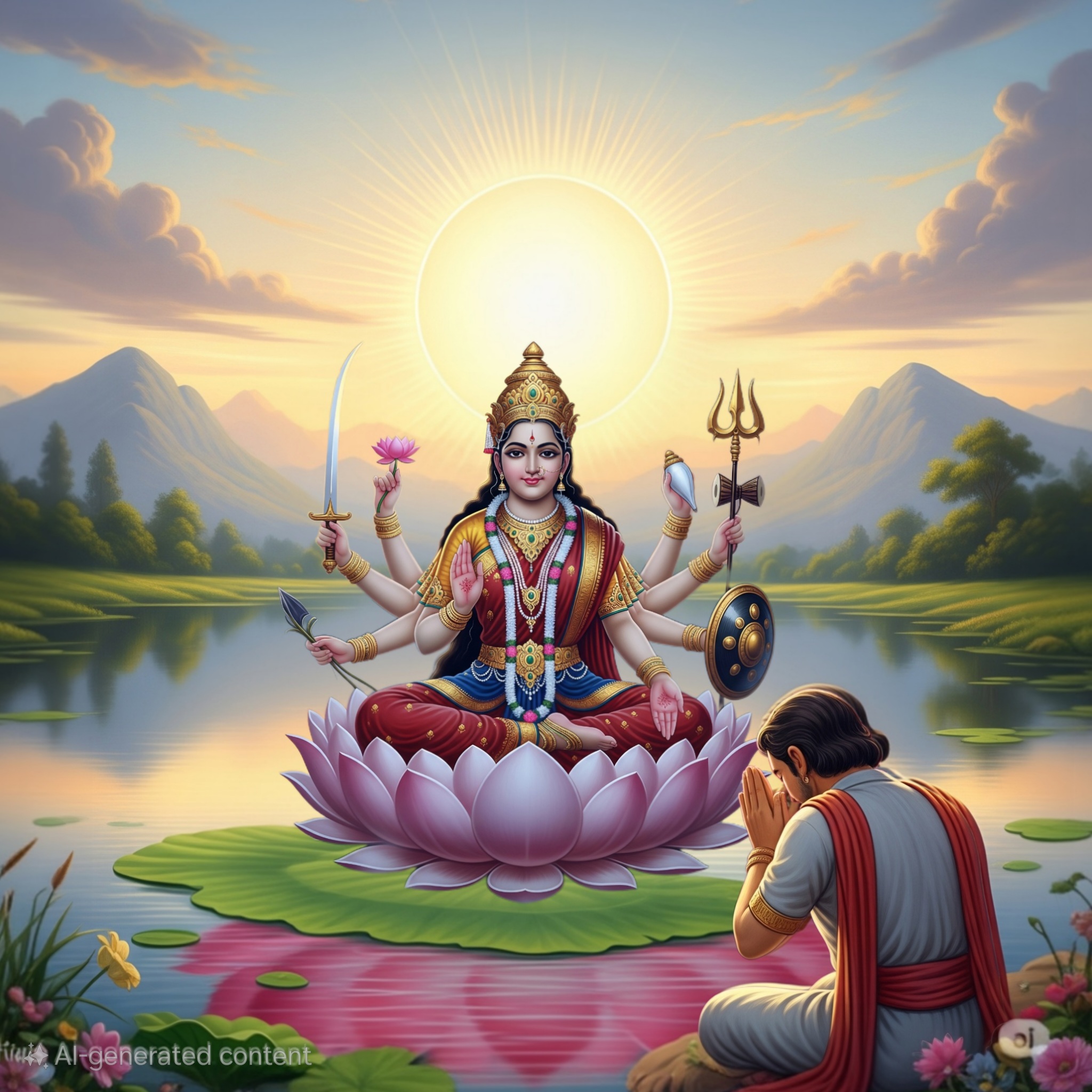
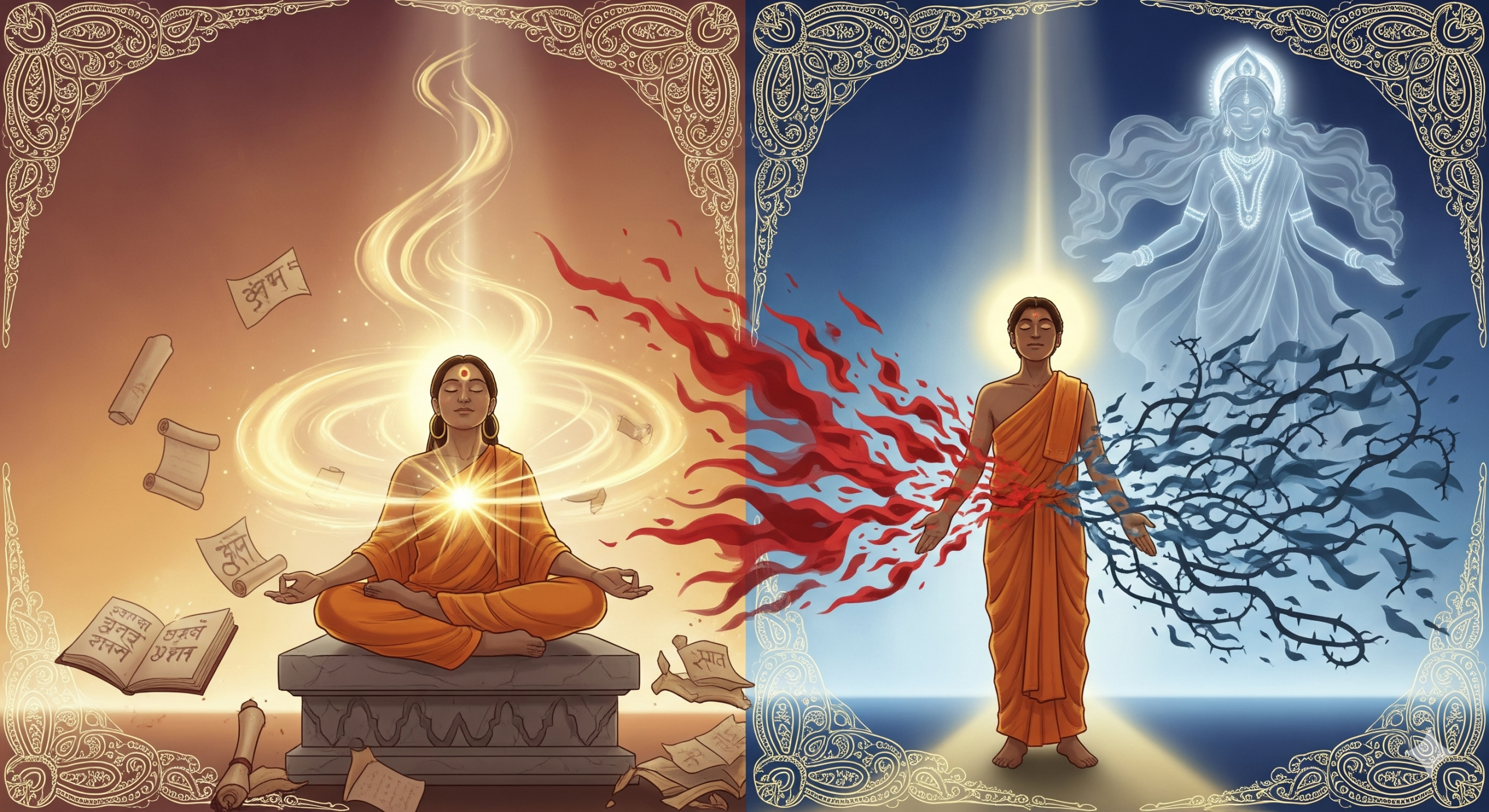
Please note all images and content created using AI Tools. Faced some technical challenges while generating todays images, apologize for the inconsistency
Among the countless deities revered in the Vedic tradition, Sūrya, the Sun, stands apart as the most visible and constant presence in our lives. The Vedas call him the jagad-eka-cakṣuḥ — the single eye of the universe. Without the Sun, there is no light, no warmth, and no life. All creation depends upon his energy; all movement and time itself are marked by his rising and setting.
The Śrī Sūrya Maṇḍala Aṣṭaka Stotram is a 13-verse hymn found in the Āditya Hṛdayam. It is composed in praise of the cosmic Sun, not merely as a physical orb but as the very embodiment of divinity, wisdom, and spiritual illumination. In these verses, Sūrya is described as:
The sustainer of creation, preservation, and dissolution.
The embodiment of the three Vedas and the three guṇas.
The remover of poverty, sorrow, and disease.
The supreme light worshipped by gods, sages, and yogis.
Reciting this stotram daily is said to purify the mind, remove obstacles, and bless the devotee with vitality, clarity, and inner strength.
A Journey Through the Hymn
This hymn unfolds like a radiant meditation on the Sun. It begins by saluting Sūrya as the single eye of the universe, the source of creation, preservation, and dissolution. It then praises the brilliance of the solar orb as the remover of poverty and sorrow, and celebrates it as the deity revered by gods and sages alike. As the verses progress, the Sun is described as the embodiment of knowledge, the awakener of higher understanding, and the sustainer of dharma. The hymn further extols Sūrya as the destroyer of sins and diseases, the light proclaimed in the Vedas, and the inner guide of yogis. He is also recognized as the cosmic regulator of time, from the rhythm of days and nights to the vast spans of kalpas. The hymn culminates by seeing the Sun as the very essence of Viṣṇu, the supreme Self beyond all, accessible only through the subtle path of yoga. Finally, it assures the devotee that reciting this hymn purifies the heart and grants a radiant place in the realm of the Sun.
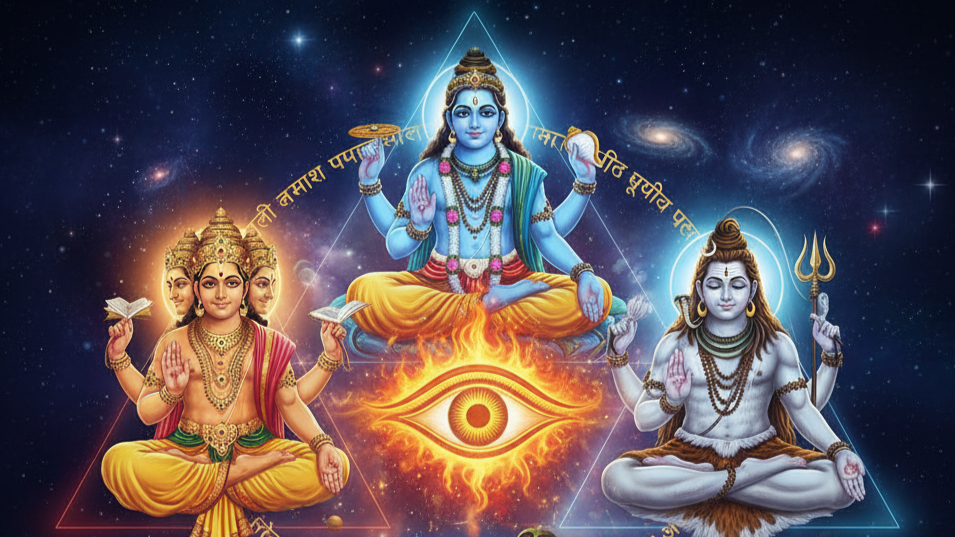
Translation: Salutations to Savitṛ, the single eye of the universe, The cause of creation, preservation, and dissolution of the worlds. He embodies the three Vedas, upholding the three guṇas, And manifests as Brahmā, Viṣṇu, and Śiva.
Transliteration: yan-maṇḍalaṁ dīptikaraṁ viśālaṁ ratna-prabhaṁ tīvram anādi-rūpam । dāridrya-duḥkha-kṣaya-kāraṇaṁ ca punātu māṁ tat savitur-vareṇyam ॥
Translation: That radiant, vast solar orb, Shining with the brilliance of precious gems, beginningless and intense, The remover of poverty and sorrow — May that most excellent Savitṛ purify me.
Reflection
The Cosmic Eye: Verse 1 reveals Sūrya as the eka-cakṣuḥ — the singular eye that watches over and pervades the entire universe. His light is not only physical but also symbolic of awareness itself. Just as nothing can hide from the Sun’s rays, nothing within us can remain hidden from inner awareness.
Radiance that Heals: Verse 2 speaks of the Sun’s brilliance as a source of renewal, dispelling sorrow and poverty. This can be understood materially — by blessing us with energy, vitality, and abundance — and spiritually — by burning away the inner poverty of ignorance and hopelessness.
Eco-Spiritual Awareness The Sun sustains all life on earth. Honoring Surya can inspire us to live in greater harmony with nature, respecting renewable sources of energy and caring for the environment. Spirituality here becomes practical stewardship of creation.
Practical Application
Mind–Body Renewal The Sun is life-giver and energy-source. A daily practice like Surya Namaskara or even a few mindful moments of sunlight in the early morning can align our body, breath, and spirit with cosmic rhythm.
Inner Clarity Just as the Sun removes darkness, these verses remind us that the light of awareness within us can remove sorrow, fear, and aimlessness. Reflecting on Surya as “the eye of the universe” encourages us to cultivate clarity and right vision in our lives.
Practical Takeaway:
Each morning, face the rising Sun for a few minutes in silence. Breathe deeply and visualize its rays not only warming your body but also cleansing the mind of negativity, fear, and fatigue. Let this become a daily ritual of renewal.
Closing Thoughts
The Surya Maṇḍala Aṣṭakam is more than a stotra of praise — it is a cosmic meditation. Each verse unfolds the Sun as visible deity, universal principle, and inner guide. To chant it is not only to worship the Sun, but to remember the sustaining rhythm of life itself.
As we conclude, let us remember the Upanishadic verse — a reminder that beyond even the radiance of the Sun shines the Supreme Light, the source of all illumination.
Sanskrit: न तत्र सूर्यः भाति न चन्द्रतारकं नेमा विद्युतो भान्ति कुतोऽयमग्निः । तमेव भान्तमनुभाति सर्वं तस्य भासा सर्वमिदं विभाति ॥
Transliteration: na tatra sūryaḥ bhāti na candratārakaṁ nemā vidyuto bhānti kuto’yam agniḥ । tam eva bhāntam anubhāti sarvaṁ tasya bhāsā sarvam idaṁ vibhāti ॥
Translation: There the Sun does not shine, nor the moon and stars; Neither do flashes of lightning, nor this earthly fire. That Self alone shining, everything else shines; By Its light, all this is illumined.
Thus, the Surya Maṇḍala Aṣṭakam can be seen as a journey — from outer light to inner light, from the visible Sun to the ultimate Self. In this sense, Sūrya is truly the Cosmic Eye, watching over all creation, illuminating the universe, and guiding us to clarity, awareness, and spiritual insight.
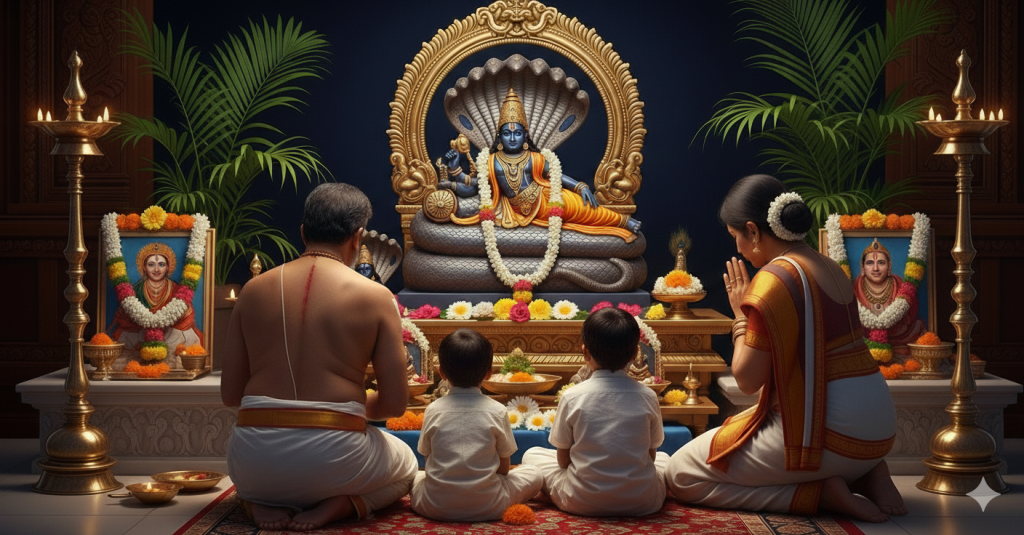
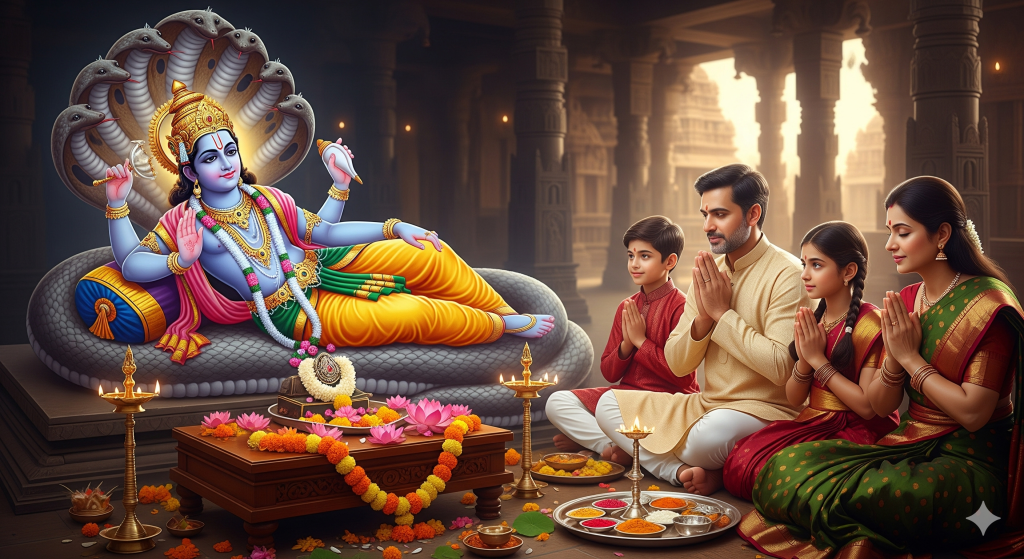
Today marks the auspicious occasion of Ananta Padmanabha Vratam, a deeply revered vrata dedicated to Lord Vishnu in His infinite form as Ananta Padmanabha Swamy. Observed on the Chaturdashi (14th day) of the bright fortnight of Bhadrapada month, this vrata is performed by devotees seeking divine protection, prosperity, harmony in family life, and spiritual upliftment.
Significance of Ananta Padmanabha
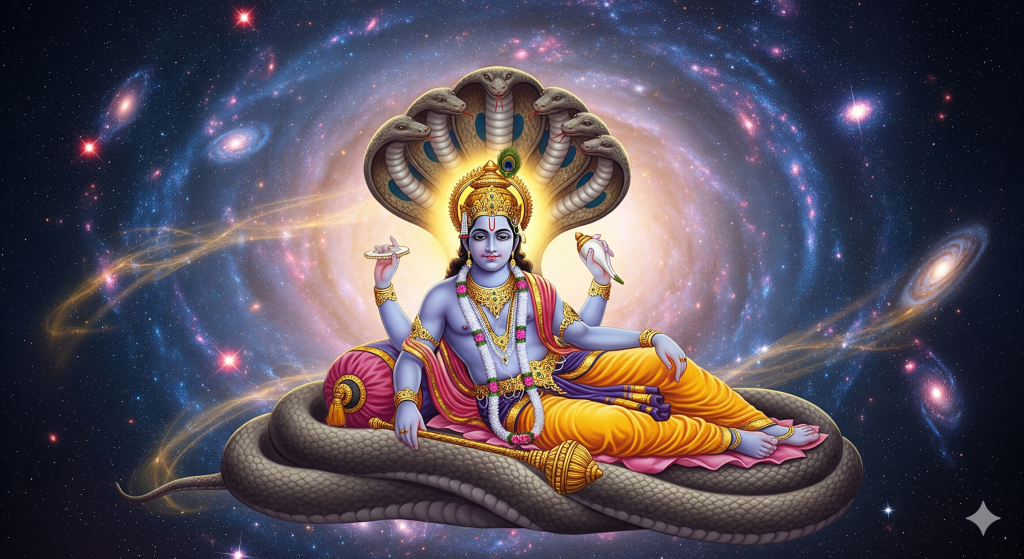
The word Ananta means “endless, infinite,” symbolizing the eternal presence of Lord Vishnu. In His reclining form on the cosmic serpent Adiśeṣa, Lord Padmanabha represents the eternal truth that sustains the universe. Performing this vrata is believed to bestow peace, remove obstacles, and ensure well-being for generations.
Translation: O Lord of Infinite Lords, bestower of boundless fruits, You are the embodiment of eternal bliss— I bow to You in reverence. Salutations to the Infinite.
Rituals of the Vratam
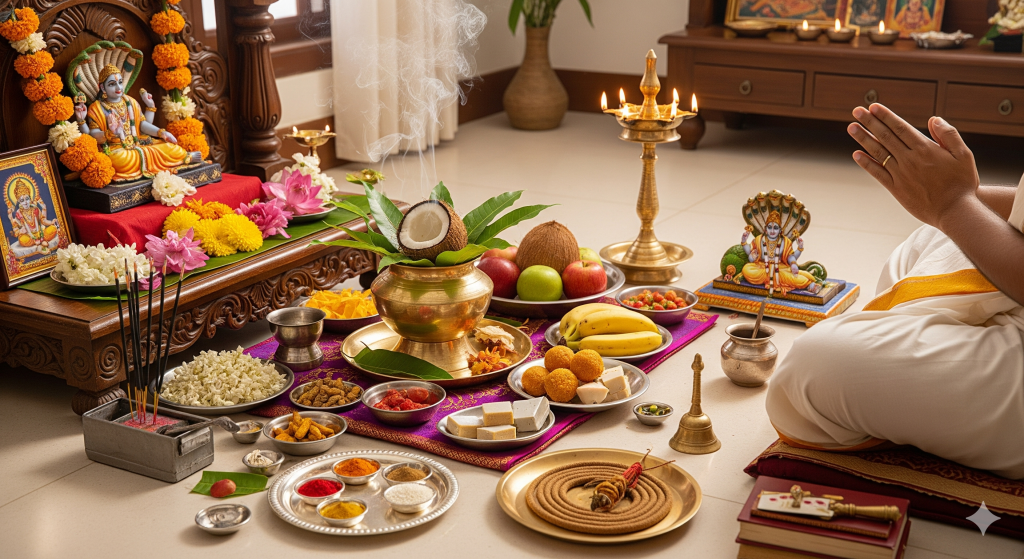
On this sacred day, devotees:
Purify the home and heart with prayers, cleanliness, and devotion.
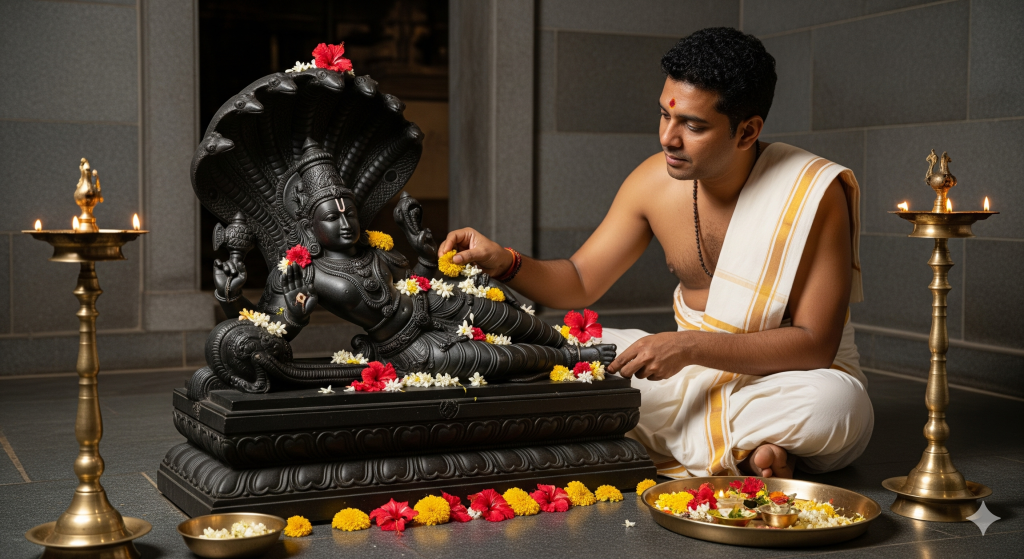
Invoke Lord Ananta Padmanabha with special puja, offerings, and recitation of stotras and Vishnu Sahasranāma.
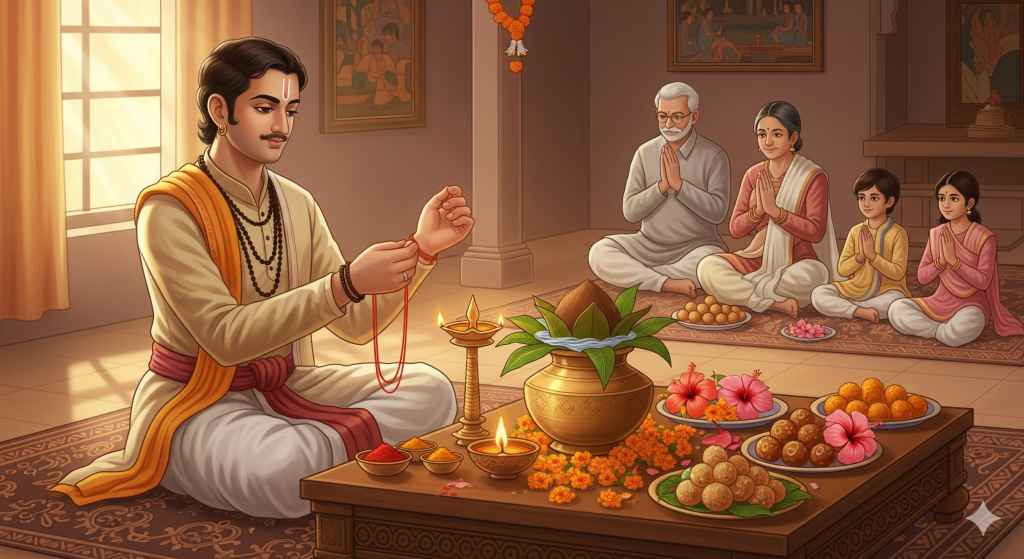
Tie the sacred Ananta Sutra (a thread, usually red and yellow with 14 knots) around the wrist after worship, symbolizing protection and commitment to dharma.
Observe fasting or simple satvik meals with deep contemplation and remembrance of the Lord.
The Vrata Katha – The Story Behind the Puja(shortened)
The origin of the Ananta Vratam is narrated in the Mahābhārata. After the dice game and years of exile, Yudhishthira, the eldest of the Pāṇḍavas, was instructed by Lord Krishna to observe this sacred vrata to restore peace and prosperity.
The vrata katha also speaks of a pious Brahmin couple. The wife, Sushila, tied the sacred Ananta Sutra after performing the vrata with great devotion. Her husband, Kaudinya, however, disregarded the sanctity of the thread and removed it in anger. Soon after, misfortunes struck the couple. Realizing his mistake, Kaudinya repented and undertook penance. Finally, Lord Ananta appeared before him, blessed him, and restored prosperity to their household.
This story conveys the importance of faith, devotion, and respect for sacred vows, reminding devotees that Ananta Padmanabha’s blessings flow only when the vrata is observed with sincerity and humility.
Sacred Verses for Devotional Recitation
These verses and mantras are an integral part of the puja, helping devotees focus their minds and connect with the divine.
**The following verses are derived from various pooja manuals and are part of the traditional ritualistic chants for the vratam.**
Sacred Invocations for Worship
These mantras are traditionally recited during various stages of the Ananta Padmanabha Vratam, especially while making offerings, invoking the deity, and entering into ritual presence.
Invoking Lord Ananta
Transliteration
Translation
ॐ अनन्ताय नमः
Om anantāya namaḥ
Salutations to the Infinite One
This mantra is used to invoke the presence of Lord Ananta, the boundless and eternal form of Vishnu, before beginning the ritual.
Yamuna Pūja – Honoring the Sacred River
Before the worship of Lord Ananta begins, devotees traditionally offer prayers to the Yamuna River, invoking her purity and grace. This act is not merely symbolic—it’s a spiritual preparation, a cleansing of the inner and outer self before approaching the Infinite.
Why Yamuna?
Purity and Flow: Yamuna is revered as the embodiment of sacred flow—both literal and spiritual. Her waters are said to cleanse sins and purify intentions.
Krishna Leela: Yamuna is intimately connected with Lord Krishna, who performed many divine acts along her banks. Since Ananta Padmanabha is a form of Vishnu, invoking Yamuna recalls the playful and loving aspect of the Divine.
Ritual Sequence: In many traditions, the Yamuna Pūjanam is performed before the main Ananta Padmanabha worship. Red akṣatā (colored rice) is often offered to Yamuna Devi, symbolizing auspiciousness and readiness.
Spiritual Gateway: Just as Yamuna flows toward the ocean, the devotee’s prayer flows toward the Infinite. She becomes the river of surrender, carrying the devotee’s intentions to the feet of Ananta.
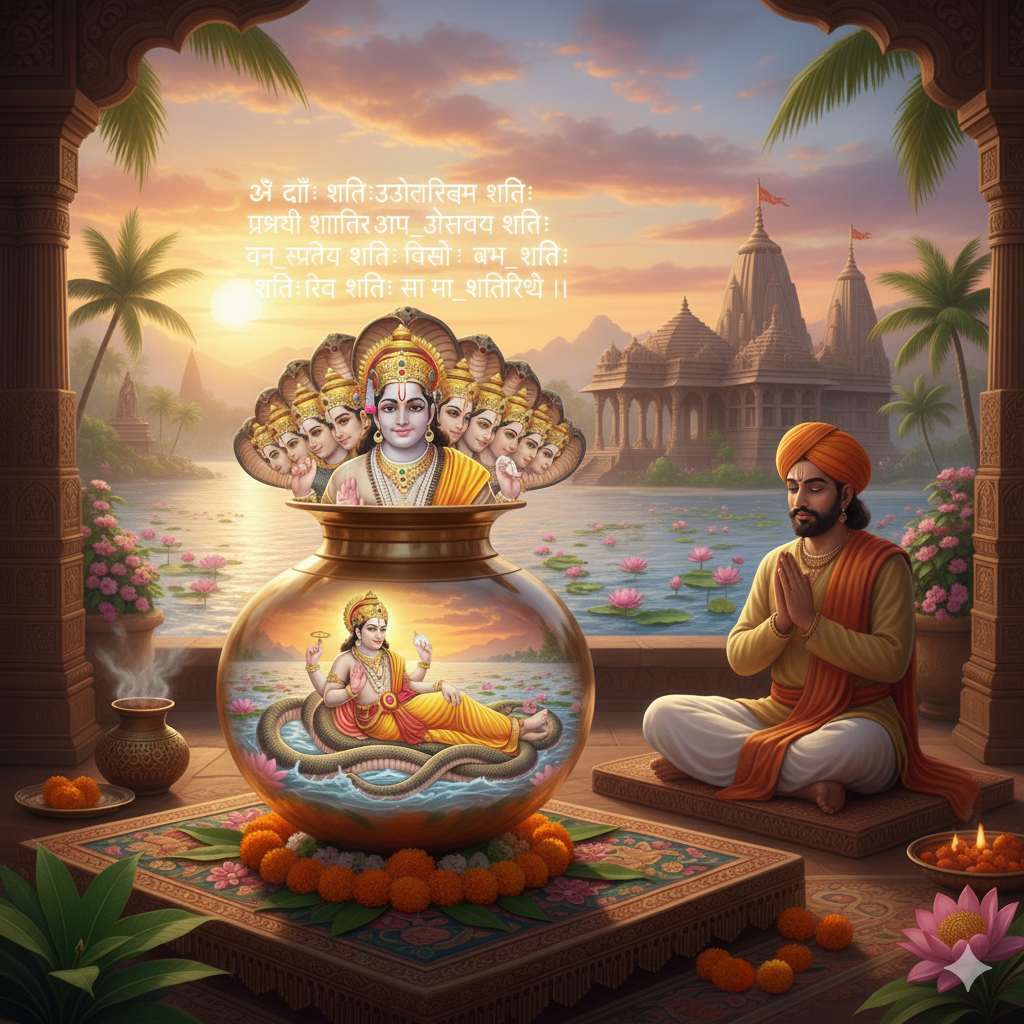
I meditate upon the Infinite Lord of Lords, Clad in radiant yellow garments, the changeless Narayana. His form is as tender as new mango leaves, With tawny brows and eyes shining with divine brilliance. He wears the golden robe, and holds the conch, discus, and mace— His form vast as the universe, origin of all worlds, Revered by all, the supreme Hari. Thousand-headed Vishnu, known as Ananta, Consort of Lakshmi, reclining upon the cosmic ocean. Adorned and majestic, manifesting the universal form— Within this sacred kalasha, I invoke and meditate upon Him.
Symbolic Highlights
Navāmra-pallava-nibhaṁ: His form is as fresh and tender as new mango leaves—symbolizing renewal and auspiciousness.
Piṅga-bhrūṣma-śrī-locanam: His eyes and brows radiate divine intensity and compassion.
Viśvākāraṁ: He embodies the entire cosmos—echoing the Viśvarūpa of the Bhagavad Gita.
Śeṣasañjñaṁ: Reclining on Ananta Shesha, the thousand-headed serpent—symbol of infinite time and cosmic support.
Kalasha reference: The kalasha becomes a sacred vessel, housing the Infinite during the ritual.
Dorāgranthi Pūjā – Worship of the 14 Sacred Knots
In the Ananta Padmanabha Vratam, the sacred thread (dora) is not merely a ritual object—it is a symbolic bridge between the devotee and the Divine. Tied with 14 knots, each granthi represents a distinct Shakti. Before the thread is tied, it is placed reverently before Lord Ananta and worshipped invoking blessings for spiritual strength, purity, victory, and infinite grace.
Transliteration
Om śrīyai namaḥ | prathamagranthiṁ pūjayāmi | Om mohinyai namaḥ | dvitīyagranthiṁ pūjayāmi | Om mahābalāyai namaḥ | tṛtīyagranthiṁ pūjayāmi | Om ajāyai namaḥ | caturthagranthiṁ pūjayāmi | Om maṅgalāyai namaḥ | pañcamagranthiṁ pūjayāmi | Om śubhāyai namaḥ | ṣaṣṭhagranthiṁ pūjayāmi | Om jayāyai namaḥ | saptamagranthiṁ pūjayāmi | Om vijayāyai namaḥ | aṣṭamagranthiṁ pūjayāmi | Om jayantyai namaḥ | navamagranthiṁ pūjayāmi | Om pāpanāśinyai namaḥ | daśamagranthiṁ pūjayāmi | Om viśvarūpāyai namaḥ | ekādaśagranthiṁ pūjayāmi | Om sarvamaṅgalāyai namaḥ | dvādaśagranthiṁ pūjayāmi | Om mahānīyāyai namaḥ | trayodaśagranthiṁ pūjayāmi | Om mahālakṣmyai namaḥ | caturdaśagranthiṁ pūjayāmi |
Symbolic Mapping of the Granthis
Granthi
Invoked Shakti
Symbolic Essence
1
Śrī
Prosperity, grace
2
Mohinī
Enchantment, divine illusion
3
Mahābalā
Strength, resilience
4
Ajā
The unborn, eternal principle
5
Maṅgalā
Auspiciousness, sacred beginnings
6
Śubhā
Purity, goodness
7
Jayā
Victory, triumph
8
Vijayā
Overcoming obstacles
9
Jayantī
Celebrated success, divine fame
10
Pāpanāśinī
Destruction of sin
11
Viśvarūpā
Universal form of the Divine
12
Sarvamaṅgalā
All-auspiciousness
13
Mahānīyā
Reverence, supreme worthiness
14
Mahālakṣmī
Abundance, fulfillment, divine grace
Aṅga Pūjā – Worship of the Divine Limbs of Lord Ananta
In this sacred offering, each limb of Lord Ananta is worshipped with flowers and a unique name that reflects His cosmic attributes. This ritual is a meditative unfolding of the Divine form—limb by limb, name by name.
Transliteration
Om anantāya namaḥ | pādau pūjayāmi | Om śeṣāya namaḥ | gulphau pūjayāmi | Om kālakālātmane namaḥ | jaṅghe pūjayāmi | Om viśvarūpāya namaḥ | jānunī pūjayāmi | Om upamāhīnāya namaḥ | ūrū pūjayāmi | Om kālātmane namaḥ | kaṭiṁ pūjayāmi | Om jagannāthāya namaḥ | guhāṁ pūjayāmi | Om padmanābhāya namaḥ | nābhiṁ pūjayāmi | Om sarvātmane namaḥ | kukṣiṁ pūjayāmi | Om śrīvatsavate namaḥ | vakṣaḥ pūjayāmi | Om cakrahastāya namaḥ | hastān pūjayāmi | Om ājānubāhave namaḥ | bāhūn pūjayāmi | Om vācaspataye namaḥ | vaktraṁ pūjayāmi | Om keśavāya namaḥ | nāsikāṁ pūjayāmi | Om nārāyaṇāya namaḥ | netre pūjayāmi | Om govindāya namaḥ | śrotre pūjayāmi | Om anantapadmanābhāya namaḥ | śiraḥ pūjayāmi | Om viṣṇave namaḥ | sarvāṅgāni pūjayāmi |
Symbolic Commentary
Each name reveals a facet of Vishnu’s cosmic embodiment:
Limb
Invoked Name
Symbolic Meaning
Feet
Ananta
Infinite foundation
Ankles
Śeṣa
Cosmic serpent, support of creation
Shanks
Kālakālātmā
Time beyond time
Knees
Viśvarūpa
Universal form
Thighs
Upamāhīna
Beyond comparison
Waist
Kālātmā
Lord of time
Organ
Jagannātha
Lord of the universe
Navel
Padmanābha
Lotus-naveled creator
Stomach
Sarvātmā
Self of all beings
Chest
Śrīvatsavān
Bearer of the Śrīvatsa mark
Hands
Cakrahasta
Holder of the discus
Arms
Ājānubāhu
Long-armed protector
Mouth
Vācaspati
Lord of speech
Nose
Keśava
Beautiful and radiant
Eyes
Nārāyaṇa
All-pervading vision
Ears
Govinda
Knower of all sounds
Head
Anantapadmanābha
Infinite lotus-naveled one
Whole Body
Viṣṇu
All-pervading Divine
Ananta Vratam Prayer – A Mantra of Surrender and Refuge
This prayer is recited to express complete surrender to Lord Ananta—the Infinite One. It encapsulates the essence of the vratam: offering oneself fully, seeking refuge in the boundless grace of the Divine.
Anantāya namo namaḥ | Anantāya sarvaṁ samarpaye | Anantāya namo namaḥ | Anantāya śaraṇaṁ gataḥ ||
Translation
“Salutations to the Infinite One, I surrender everything to the Infinite One. Salutations to the Infinite One, I have taken refuge in the Infinite One.”
Commentary
This mantra is not just a prayer—it is a declaration of spiritual intimacy. It affirms:
Surrender (samarpaye): Offering not just ritual items, but the heart, the ego, the self.
Refuge (śaraṇaṁ gataḥ): Seeking shelter in the Infinite—not out of fear, but out of love.
Repetition (namo namaḥ): A rhythmic bowing, echoing the eternal nature of devotion.
This verse can be recited at the end of the pūjā, during silent meditation, or even as a daily invocation—threading the Infinite into every breath.
Vishnu Sahasranāma – Names Reflecting the Infinite
From the Vishnu Sahasranāma, many names glorify the boundless aspect of Lord Ananta Padmanabha. A few that resonate with this vrata are:
भुजगोत्तमः (Bhujagottamaḥ) – “The supreme serpent,” a nod to Adiśeṣa/Ananta.
हिरण्यनाभः (Hiraṇyanābhaḥ) – “He with the golden navel,” recalling the cosmic lotus.
पद्मनाभः (Padmanābhaḥ) – “Lotus-navelled One,” a primary epithet of Vishnu.
अनादिनिधानः (Anādi-nidhānaḥ) – “Without beginning or end,” describing the eternal infinite.
अनन्तरूपः (Ananta-rūpaḥ) – “Of countless forms,” reflecting His limitless manifestations.
These names remind us that the infinite Lord pervades creation in countless ways, sustaining the universe with His eternal presence.
Blessings of Ananta Padmanabha
The story of the Ananta Vratam reminds us that when devotion is sincere and vows are honored, the Lord’s grace flows endlessly. Just as Yudhishthira regained harmony and prosperity by observing this vrata, and Kaudinya’s life was restored after his repentance, so too does Lord Ananta Padmanabha bless His devotees with peace, stability, and abundance.
The sacred thread tied on this day is more than a symbol — it is a reminder that the Lord’s protection and compassion are boundless, extending to all who surrender with faith.
As you reflect on this vratam, may your life be filled with unshakable stability, inner harmony, and the gentle assurance of divine presence. May Lord Ananta Padmanabha’s grace ever guide and protect you and your family, bringing prosperity in the material world and progress on the spiritual path.
॥ ॐ अनन्ताय नमः ॥ Om Anantāya Namaḥ — Salutations to the Infinite One.
Full Pooja Method
For those wishing to perform the Ananta Padmanabha Vratam in its complete traditional form, a detailed step-by-step Pooja Vidhi is available on SanskritDocuments.org. This includes preparations, kalasha setup, shodasha-upachara worship, special offerings, and the sacred thread (dora) rituals.
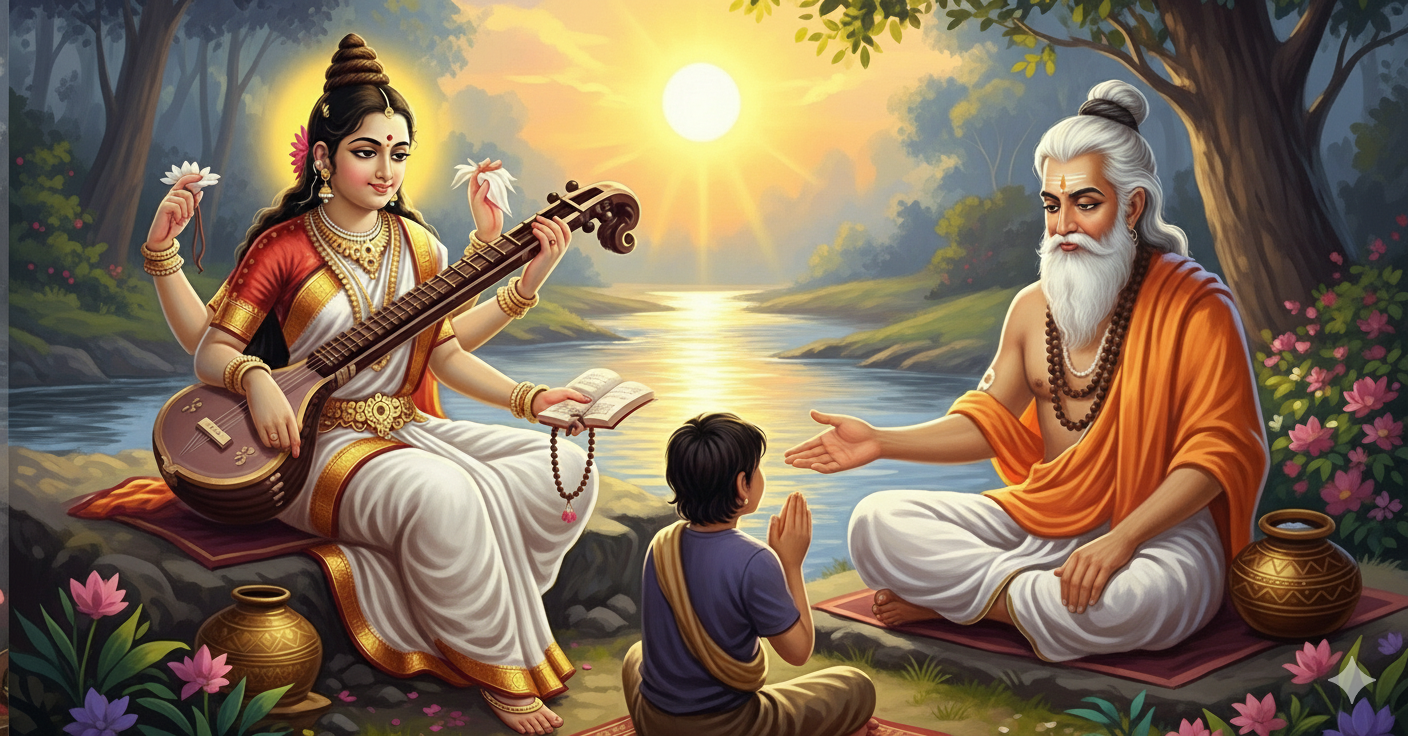
On this sacred occasion of Teachers’ Day, we first offer our humble salutations to Bhagawan Sri Sathya Sai Baba, the eternal teacher, who through His boundless grace has illumined our intellects and shown us the path of seva and dharmic living. His life and message stand as a timeless guide, inspiring us to learn, live, and share knowledge with love and selflessness.
Teachers’ Day is celebrated on 5 September across India to honor the birth anniversary of Dr. Sarvepalli Radhakrishnan (1888–1975)—a revered philosopher, teacher, and the nation’s second President. When his students approached him seeking to celebrate his birthday, he humbly proposed instead that the day be observed as Teachers’ Day, to honor the pivotal role educators play in society. This practice began in 1962, and since then, educational institutions nationwide have marked the day with expressions of gratitude—through cultural programs, heartfelt tributes, and acts of appreciation. Source: Unacademy.
On this day, we remember with gratitude all those who guide us in the journey of knowledge.
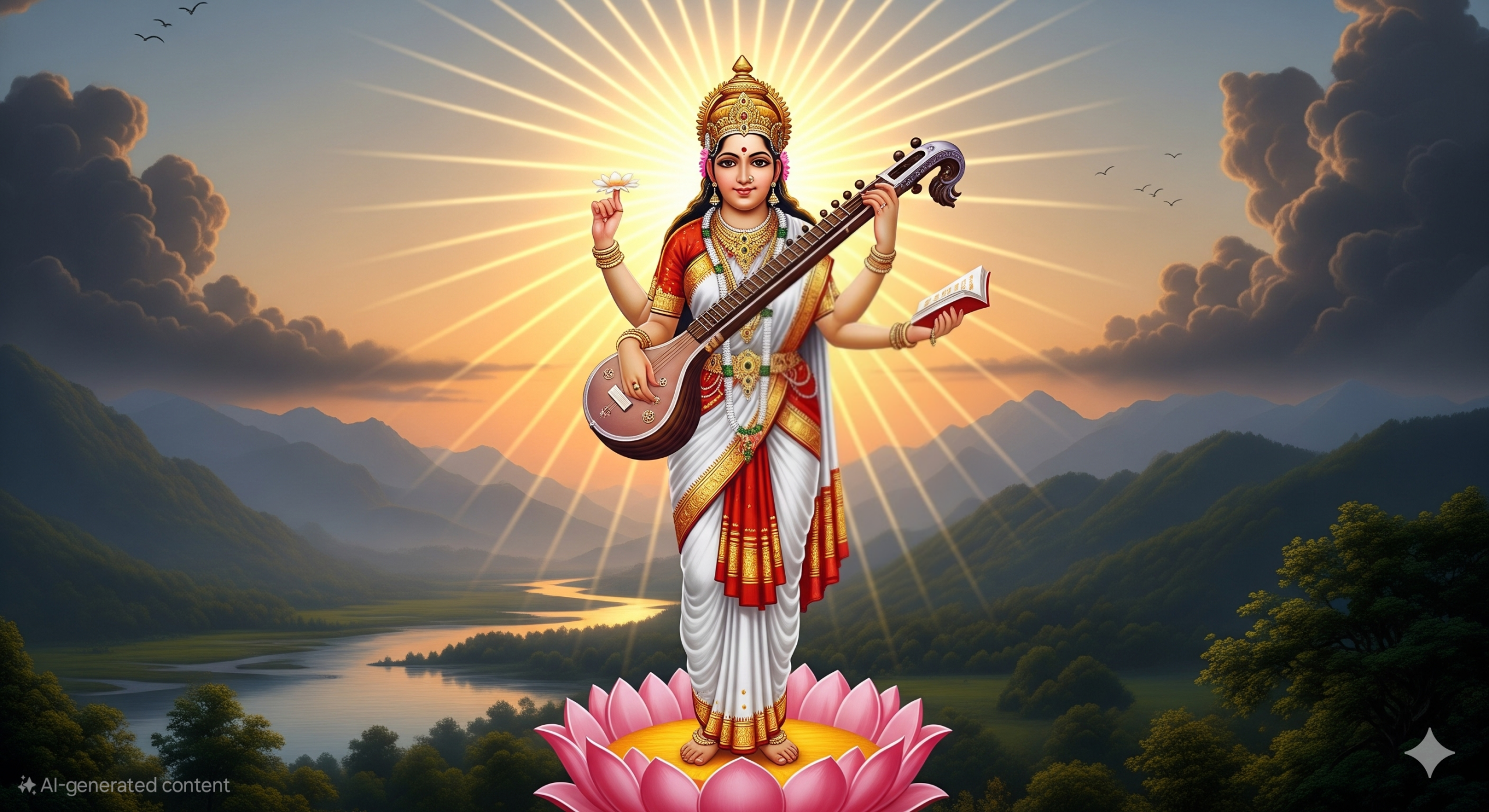
In the Vedic tradition, this guiding principle of knowledge is personified as Goddess Sarasvatī—the inspirer of speech, the nourisher of intellect, and the revealer of truth.
The Sarasvatī Sūktam from the Ṛg Veda (6.61) praises her as both a mighty river and as the goddess of wisdom. Today, we highlight select verses from this hymn that beautifully echo the qualities of a true teacher, qualities that Bhagawan embodied and bestowed upon His devotees and students.
2. Featured Verses
Verse 4
Sanskrit प्रणो देवि सरस्वती वाजेभिर्वाजिनीवती । धीनामवित्र्यवतु ॥ ४ ॥
Translation “O Goddess Sarasvatī, rich in vitality and abundance, may You protect and inspire our thoughts and intellects.”
Reflection Just as Sarasvatī is invoked to safeguard the clarity of our minds, so too do teachers guard our intellect from confusion and ignorance. Bhagawan, in His divine role, constantly uplifted human thought, guiding it toward truth and dharma.
Translation “O Goddess Sarasvatī, may You be our helper in attaining abundance. Bestow blessings upon us, like Pūṣan, the nourisher.”
Reflection The Guru nourishes us not only with knowledge but with strength and values to live rightly. Sarasvatī and Bhagawan together symbolize this nurturing grace, which sustains our spiritual and worldly journeys.
Sanskrit सा नो विश्वा अति द्विषः स्वसृरन्या ऋतावरी । अतन्नहेव सूर्यः ॥ ९ ॥
Transliteration sā no viśvā ati dviṣaḥ svasṛranyā ṛtāvarī | atannaheva sūryaḥ || 9 ||
Translation “May Sarasvatī, the righteous one, our true sister, overcome all hostilities for us, even as the sun dispels the darkness.”
Reflection Teachers remove the darkness of ignorance just as the sun lights up the world. In the same way, Bhagawan’s divine presence dispelled inner conflict and guided seekers toward peace and righteousness.
Sanskrit सरस्वत्यभि नो नेषि वस्यो मा प स्फरीः पयसा मा न आ धक् । जृषस्व नः सख्या वेश्याच मा त्वत् क्षेत्राण्यरणानि गन्म ॥ १४ ॥
Transliteration sarasvatyabhi no neṣi vasyomā pa spharīḥ payasā mā na ā dhak | jṛṣasva naḥ sakhyā veśyāc mā tvat kṣetrāṇyaraṇāni ganma || 14 ||
Translation “O Sarasvatī, lead us to prosperity and do not withhold Your abundance. Be gracious to us as a friend, and may we never stray into barren fields far from Your presence.”
Reflection The highest wealth a teacher gives is wisdom. Sarasvatī here is invoked as the guiding friend, ensuring we remain in fertile lands of knowledge and truth. Bhagawan, through His grace, kept His devotees rooted in the dharmic path, away from the wastelands of worldly delusion.
The Sarasvatī Sūktam contains 14 verses, many of which praise Sarasvatī as a powerful river sustaining life, as well as the goddess who inspires wisdom and higher thought. For this reflection, we have selected verses that especially highlight her as the protector of intellect, nourisher of mind, dispeller of ignorance, and giver of abundance—qualities that resonate with the teacher’s role.
4. Conclusion
Samastah Lokah Sukhino Bhavanthu May all the beings of all the worlds be happy!
Jai Sai Ram!
Please note all content and images generated using AI Tools
Among the many profound declarations in the Vedic corpus, few are as significant and far-reaching as the phrase “Yajño Vai Viṣṇuḥ” — “Yajña indeed is Viṣṇu.”
Bhagawan Sri Sathya Sai Baba, in His discourse “Make Every Moment a Yajna”, draws attention to this very phrase, reminding us that life itself is to be seen as a yajña — a sacred act of offering.
Inspired by this insight, we undertook a study of the Taittirīya Brāhmaṇa to trace the phrase across its occurrences, and what emerges is a beautiful, multidimensional vision of yajña as the sustaining principle of existence, inseparable from Viṣṇu, the all-pervading Divine.
This post brings together all eight occurrences of “Yajño Vai Viṣṇuḥ” in the Taittirīya Brāhmaṇa, with their Sanskrit text, translations and commentaries.
The Taittirīya Brāhmaṇa: Context
The Taittirīya Brāhmaṇa is part of the Kṛṣṇa Yajur Veda, elaborating on the performance and meaning of yajñas (sacrifices). More than a ritual manual, it encodes symbolic truths: every act in a yajña reflects cosmic realities. Within it, the phrase “Yajño vai Viṣṇuḥ” — “Yajña indeed is Viṣṇu” — recurs eight times, underscoring how sacrifice is inseparable from the sustaining presence of Viṣṇu.
Translation “Those whose year-long sacrifice is incomplete lack firm foundation. Therefore, on the Ekādaśinī day, they perform the Vaiṣṇava offering, for Yajña is indeed Viṣṇu. Thus they establish the sacrifice upon firm ground. They also offer to Indra and Agni, for Indra and Agni are the leaders of the gods, and by offering to them, they bring the rite to its proper course.”
Commentary Here Viṣṇu, as yajña, provides stability and foundation — without Him, ritual is incomplete and lacks support.
Translation: “This is Vishnu who moves through all; he is to be invoked with Vaishnava offerings. The sacrifice itself is Vishnu, and through the sacrifice one attains continuity.
Commentary: Vishnu is equated with the yajna itself, showing that ritual action and divine presence are inseparable.
Translation: Tvaṣṭṛ transforms the seed into beneficial forms. Above all, through Vaishnava invocation, the sacrifice is Vishnu. The sacrifice stands firmly and wholly in its entirety.”
Commentary: Tvaṣṭṛ transforms the seed into beneficial forms, symbolizing the manifestation of order from latent potential. By invoking Vishnu, the yajna itself becomes divine, complete, and firmly established, uniting ritual and cosmic principle.
Translation: “Here, the offering is made beautifully to Vishnu. The sacrifice itself is Vishnu, and the sacrifice stands fully established. One offers ‘Svāhā’ to Vishnu for the yajna, and ‘Svāhā’ for its firm establishment.”
Commentary: This verse emphasizes that the act of offering, when performed with devotion, becomes an expression of Vishnu himself. The repeated use of “Svāhā” sanctifies both the offering and the stability of the sacrifice, illustrating that ritual action is inseparable from divine presence. By acknowledging Vishnu as the sacrifice, the verse reinforces that yajna is not merely a physical act but a living, sustaining force that upholds cosmic order.
Translation: “One may offer with a metal vessel, a wooden vessel, or even with water; it is always appropriate. From this arises the upward force. Waters are indeed protectors of the sacrificial fire, dispelling obstacles. ‘To Vishnu,’ it is said, for the yajna itself. Vishnu secures the oblation for the sacrifice, supports it from below, and sustains the generative powers. Therefore, the wombs of living beings receive their sustenance. Above, he places the realm of heaven, the heavenly world, for the collective welfare of all.”
Commentary: This verse highlights the flexibility of offerings—metal, wood, or water—all are valid when offered with devotion, reflecting the universal accessibility of yajna. It emphasizes the protective and sustaining role of Vishnu, who secures the oblation, nurtures life, and upholds cosmic order. The sacrificial act is linked to creation itself, as Vishnu supports the generative powers below and establishes the heavenly realm above, ensuring the welfare of all beings.
Translation: “This is indeed the oblation offered, situated in the intermediary space, firmly supported by the earth. It is called ‘Priya’—that which is dear—and the ghee offering is made with this name. Through this, the world of the virtuous is established. Vishnu protects it. The sacrifice is indeed Vishnu, and through the sacrifice one is safeguarded. Protect the yajna, protect the lord of the yajna, protect me—the sacrificer. By these offerings, blessings are assured for the performer and for others.”
Commentary: This verse emphasizes the sanctity of the oblation, describing it as firmly grounded yet present in the intermediary space, bridging earth and heaven. Naming the ghee offering ‘Priya’ underscores the heartfelt devotion inherent in ritual acts, which aligns them with cosmic order and the world of the virtuous. Vishnu is invoked as the protector of the sacrifice, reinforcing the recurring teaching that the yajna itself is Vishnu. By safeguarding the sacrifice, its lord, and the sacrificer, the verse conveys that every ritual act, however small, carries protective power and grants blessings, uniting human effort with divine presence.
Translation: “Through these offerings, the oblation proceeds and fulfills its purpose. ‘May I not be dissatisfied,’ it is said. ‘Let my world be established in the world-creating act.’ The blessings invoked through these offerings are granted. This is the abode of Vishnu. The sacrifice is indeed Vishnu. This is the imperishable support of the gods. When the yajna exists, it stands in the imperishable realm of the gods. Indra himself does not act without its energy.”
Commentary: This verse emphasizes that every oblation and offering has a purposeful trajectory, culminating in blessings and cosmic order. The act of offering is seen as establishing one’s world while simultaneously sustaining the gods’ realm, highlighting the intertwining of human ritual and divine order. Vishnu is identified as the very essence and support of the sacrifice, reinforcing the core principle that the yajna itself is divine and imperishable, and even powerful deities like Indra depend on its energy to act, showing that ritual and cosmic authority are inseparably linked.
Translation: “‘Svāhā to the Sun, Svāhā to the Sun for me, Svāhā to the Sun in the form of a well-prepared offering,’ it is said. This is Aditi, who elevates the oblation upon establishment. ‘Svāhā to Sarasvatī, Svāhā to Bṛihatī, Svāhā to Sarasvatī in the purifying fire,’ it is said. Speech itself elevates the offering. ‘Svāhā to Pūṣan, Svāhā for the worldly lord, Svāhā to Pūṣan in the offering,’ it is said. Cattle are Pūṣan, and the offering raises them. ‘Svāhā to Tvaṣṭṛ, Svāhā to the paired forms of Tvaṣṭṛ, Svāhā to Tvaṣṭṛ in all forms,’ it is said. Tvaṣṭṛ shapes the cattle into proper forms. Then, through these forms, the offering is elevated. ‘Svāhā to Vishnu, Svāhā to Vishnu for removal, Svāhā to Vishnu for fulfillment,’ it is said. The sacrifice is indeed Vishnu, and through the sacrifice, offerings are elevated. The performer offers a full and complete oblation, dedicated for the intended purpose.”
Commentary: This verse systematically shows how every divine aspect—Aditi, Sarasvatī, Pūṣan, Tvaṣṭṛ, and finally Vishnu—is invoked in the offering, demonstrating the layered sanctity of yajna. Each invocation, whether of cosmic forces, speech, or generative powers, serves to elevate the oblation and align it with divine order. Vishnu is ultimately affirmed as the sacrifice itself, receiving and manifesting every offering in fullness. The verse emphasizes that the complete oblation, when properly offered, unites all forces and reaches Vishnu, highlighting the central Vedic principle that every act in the yajna, however small, is inherently sacred and cosmic in effect.
Reflections
When seen together, the eight occurrences of “Yajño Vai Viṣṇuḥ” span the whole spectrum of human and cosmic needs:
Eight Themes Attributed to Vishnu in Yajna
Vishnu as the Receiver of Offerings (1.4.3.6) Every oblation and ritual act, however small, reaches Vishnu. He is the divine recipient who ensures that offerings achieve continuity, sanctity, and peace.
Vishnu as the Embodiment of the Sacrifice (1.8.1.2) Through the Vaishnava invocation, the yajna itself is Vishnu, standing firm and complete. He transforms potential into beneficial forms, integrating ritual with cosmic order.
Vishnu as the Sanctifier (3.1.6.7) Devotion and utterance, such as saying “Svāhā,” sanctify both the oblation and the stability of the yajna. Vishnu ensures the ritual attains its intended spiritual efficacy.
Vishnu as Sustainer of Life and Cosmic Order (3.2.3.12) By securing the oblation and supporting generative powers, Vishnu sustains both creation and the world of beings, showing that every act contributes to the welfare of the cosmos.
Vishnu as Protector (3.3.6.11) Vishnu safeguards the sacrifice, its lord, and the sacrificer. Through his protection, blessings are granted, and even the simplest offerings maintain their divine potency.
Vishnu as the Imperishable Support of the Gods (3.3.7.7) Vishnu underpins the world of the virtuous and the realm of the gods. Even Indra’s actions depend on the energy of the yajna, demonstrating Vishnu’s role as eternal support.
Vishnu as the Integrator of Cosmic Forces (3.8.11.2) All divine aspects—Aditi, Sarasvatī, Pūṣan, Tvaṣṭṛ—are invoked and unified in the offering, culminating in Vishnu, who receives, elevates, and manifests the totality of ritual and cosmic energies.
Vishnu as the Receiver of Complete and Perfect Offerings (3.8.11.2) Through careful, complete oblation, every act of devotion reaches Vishnu, who manifests the fullness of the sacrifice and ensures the blessings are realized in the world.
Deeper Themes Attributed to Vishnu in Yajna
Sustenance (1.4.3.6) – Vishnu maintains continuity and peace; he ensures that offerings sustain life and cosmic order.
Growth and Progeny (1.8.1.2) – Through Tvaṣṭṛ’s shaping and Vishnu’s presence, the yajna enables growth, productivity, and the generative powers of beings.
Foundation and Stability (3.1.6.7) – Vishnu provides the firm ground for the sacrifice; even the smallest acts are stabilized by his presence.
Completion and Fulfillment (3.2.3.12) – Vishnu ensures that offerings reach their goal, enabling the full realization of yajna’s purpose.
Protection (3.3.6.11) – Vishnu safeguards the sacrificer, the sacrifice, and the yajna itself, granting blessings and security.
Victory (3.3.7.7) – As the imperishable support of the gods, Vishnu upholds divine order, enabling triumph over chaos and sustaining righteous worlds.
Strength and Vitality (3.8.11.2, first part) – Invocations to cosmic forces under Vishnu’s aegis energize life, speech, and action, imparting vitality and power.
Fulfillment of Cosmic Design (3.8.11.2, second part) – Through complete and perfect offerings, Vishnu manifests the totality of the sacrifice, ensuring the universe’s order and the blessings of the ritual are fully realized.
Eight Dimensions of Vishnu in the Yajna
Verse Number
Vishnu’s Role / Theme
Essence of the Verse
1.4.3.6
Sustenance
Vishnu maintains continuity and peace; every offering reaches him, establishing cosmic order.
1.8.1.2
Growth & Progeny
Through Tvaṣṭṛ’s shaping and Vaishnava invocation, the sacrifice promotes growth, productivity, and generative powers.
3.1.6.7
Foundation & Stability
Devotional utterances (“Svāhā”) stabilize the sacrifice; Vishnu gives it firmness and support.
3.2.3.12
Completion & Fulfillment
Offerings, whether metal, wood, or water, reach Vishnu and achieve the full purpose of yajna.
3.3.6.11
Protection
Vishnu safeguards the sacrifice, its lord, and the sacrificer, granting blessings and security.
3.3.7.7
Victory
As imperishable support of the gods, Vishnu upholds cosmic order, enabling triumph and righteous worlds.
3.8.11.2 (part1)
Strength & Vitality
Invocations to Aditi, Sarasvatī, Pūṣan, Tvaṣṭṛ energize life, speech, and action under Vishnu’s aegis.
3.8.11.2 (part2)
Fulfillment of Cosmic Design
Complete oblations manifest Vishnu fully, realizing the universe’s order and the ritual’s blessings.
Practical Application
Living the Yajna in Modern Life
Bhagawan Sri Sathya Sai Baba, in His discourse “Make Every Moment a Yajna,” beautifully explains:
“Man embarks upon an undertaking with a purpose, goal, or an end in view. But, the endeavour is sublimated into a yajna (sacrificial rite which can draw down the Grace of God) only if the purpose, goal or end is the glorification of God, regardless of other considerations. ‘Yajno vai Vishnuh,’ say the Vedas. God is the yajna, for He is the Goal. His Grace is the reward. His creation is used to propitiate Him; the performer is He, the receiver is He. When the ego of the sacrificer does not claim a place, the yajna is rendered Divine.” [saispeaks]
In earlier times, yajna was commonly associated with sacrificial fires, rituals, and offerings into the sacred flame. Today, the essence of yajna extends far beyond ritual. Any task, duty, or work performed with selflessness and surrender is a yajna. Whether it is caring for family, fulfilling professional responsibilities with integrity, serving the community, or engaging in spiritual practices—all of these become yajnas when dedicated to God without ego.
The “Eight Dimensions of Vishnu in the Yajna” table illustrates how Vishnu, the all-pervading Divine, manifests in each facet of life—sustenance, growth, protection, and fulfillment. By seeing our everyday responsibilities through this lens, we realize that:
Our body becomes the altar, our thoughts and actions the offerings, and our heart the sacred fire.
Work itself becomes worship when performed with dedication and without expectation of personal gain.
Success and struggle alike are transformed into offerings, sanctified by the Divine presence.
Bhagawan’s reminder of “Yajno vai Vishnuh” thus calls us to re-envision every act as a sacred sacrifice. In this way, modern life itself becomes a continuous yajna, and every action finds fulfillment in God.
Closing Thoughts
The Taittirīya Brāhmaṇa, through its eightfold affirmation “Yajño Vai Viṣṇuḥ”, reminds us that yajña is not an occasional ritual but the very principle of living. It nourishes, protects, strengthens, and leads to victory and fulfillment.
As a gentle takeaway, Yajña can be understood as any work or task we do, and via Viṣṇuḥ as the offering of that work to the All-pervading Divine. In this light, every action in our life — however small or ordinary — becomes sacred when offered to Viṣṇu. This is the heart of the teaching: to transform life itself into an unbroken yajña. A thought for us all to quietly ponder and practice.
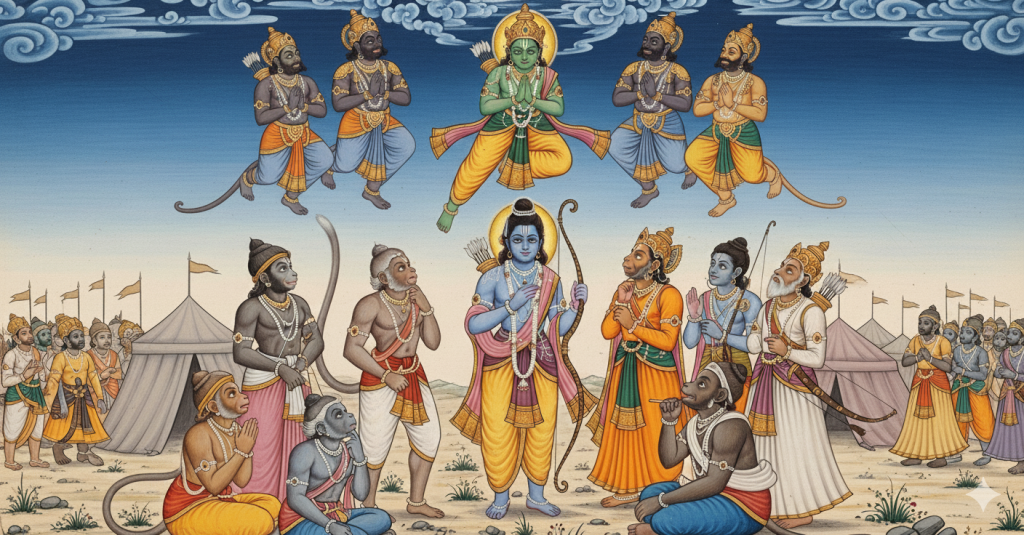
In Yuddha Kāṇḍa Sarga 17 of the Valmiki Rāmāyaṇa, we witness a turning point in the great battle against Rāvaṇa. Vibhīṣaṇa, the younger brother of the demon king, leaves the kingdom of Laṅkā, declaring his loyalty to Rāma. His arrival in the sky above Rāma’s camp immediately sparks a debate among the vānaras — leaders and ministers of Rāma’s army — each bringing a distinct perspective on whether this new ally can be trusted.
This Sarga provides not only a thrilling narrative but also timeless lessons in leadership, discernment, and group decision-making.
The discussion over Vibhīṣaṇa’s arrival is not just a tale from the Rāmāyaṇa, but a masterclass in leadership and decision-making.
Context
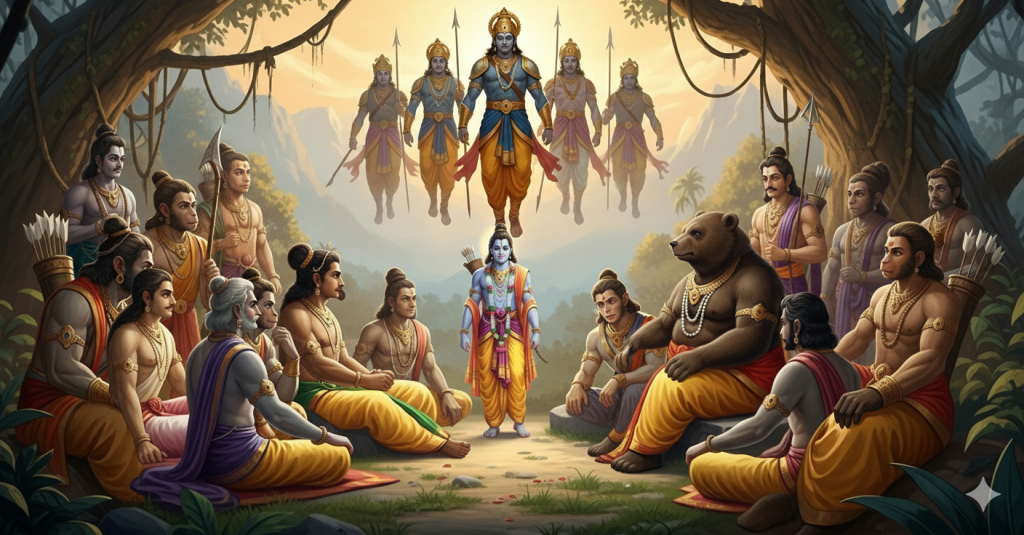
Vibhīṣaṇa, accompanied by four companions, arrived above Rāma’s camp and sought refuge at His feet. Suspended in the sky, he declared his intention to join Rāma’s side. Sugrīva, however, warned that a demon could never be trusted.
To resolve the dilemma, Rāma turned to His council of leaders for their counsel. Angada, Śarabha, Jāmbavān, and Mainda voiced their doubts, questioning the sincerity of Vibhīṣaṇa’s request.
Hanumān alone spoke differently: he argued that Vibhīṣaṇa had recognized both the virtues of Rāma and the flaws of Rāvaṇa, and that his desire to defect was also tied to his hope of rightfully ruling Laṅkā. With this balanced perspective, Hanumān urged Rāma to render the final decision.
In this post we present the heroic arrival of Vibhishana as described in the Valmiki Ramayana.
Translation: “Having spoken the aforesaid harsh words to Rāvaṇa, Vibhīṣhaṇa arrived almost immediately to the place where Rāma was together with Lakṣmaṇa.” Valmiki Ramayana
Commentary: With dramatic turn, we see Vibhīṣhaṇa’s departure from Rāvaṇa’s realm. No delay—he arrives swiftly upon the battlefield, heralding a radical shift: the brother of the enemy now stands among Rāma’s camp.
Verse 6-17-2
Sanskrit (transliteration): tam meru śikhara ākāraṃ dīptaṃ iva śata hṛdaṃ | gagana-stham mahīsthāś te dadṛśur vānarādhipāḥ
Translation: “Those leaders of monkeys standing on the ground saw Vibhīṣhaṇa, resembling the peak of Mount Meru and shining like a thunderbolt in the sky.” Valmiki Ramayana
Commentary: In an almost cinematic moment, Vibhīṣhaṇa hovers brilliantly in the sky—cosmic imagery—a mountain’s summit aflame, a thunderbolt frozen in the heavens. It’s a divine interruption, freezing the attention of all below.
Verse 6-17-3
Sanskrit (transliteration): te ca apy anucaraās tasya catvāro bhīma-vikramaāḥ | te api varmayaudh-upetā bhūṣhaṇottama-bhūṣhitāḥ
Translation: “His four companions of terrific prowess were also there with him. They were wearing weapons and armour and were adorned with excellent ornaments.” Valmiki Ramayana
Commentary: Vibhīṣhaṇa is not solitary—he descends with four regal companions, each a warrior in splendor. It is no stealthy escape but a bold and ceremonial entrance, commanding respect.
Verse 6-17-4
Sanskrit (transliteration): sa ca meghācalaprakāśo vajrāyudh-samaprabhaḥ | varāyudhadharo vīraḥ divyābharaṇa-bhūṣhitaḥ
Translation: “Vibhīṣhaṇa also resembled a mass of cloud, the equal of the God who wields the thunderbolt. He was holding excellent weapons and was adorned with wonderful jewels.” Valmiki Ramayana
Commentary: The metaphor grows more powerful. He is compared to a cloud-mountain and Indra’s thunderbolt. Clad in divine ornaments and weapons, he radiates authority and supernatural presence—no mere wanderer, but a dignified claimant of dharma.
Verse 6-17-5
Sanskrit (transliteration): tam ātmā pañcamaṃ dṛṣṭvā sugrīvo vānarādhipaḥ | vānaraiḥ saha durdharṣhaḥ cintayām āsā buddhimān
Translation: “Sugrīva the valiant of monkeys, who was difficult to be overpowered, having seen Vibhīṣhaṇa, the fifth one along with four others, became thoughtful along with monkeys.” Valmiki Ramayana
Commentary: Even the mighty Sugrīva pauses. This is no routine audience—it is a turning point. Sugrīva’s thoughtful stillness together with the vānaras marks a shift from normalcy to alert consciousness: something extraordinary—and potentially dangerous—is unfolding.
Vibhīṣaṇa’s Plea for Refuge
(Verses 6-17-11 to 6-17-17)
Verse 6-17-11
Sanskrit (Transliteration from the page): sa uvaaca ca mahaapraaGYaH svareNa mahataa mahaan | sugriivam taam ca samprekShya khastha eva vibhiiShaNaH
Translation (from the page): “That great and highly intelligent Vibhīṣhaṇa, halting in the sky itself, saw Sugrīva and those monkeys and spoke to them in a loud voice.” Valmiki Ramayana
Commentary: Vibhīṣhaṇa takes the initiative — speaking loudly so all can hear. His composed presence in the sky conveys authority and clarity before he even speaks his plea.
Translation: “There is a demon called Ravana, the king of demons, having a bad conduct. I am his younger brother, known as Vibhīṣhaṇa.” Valmiki Ramayana
Commentary: Vibhīṣhaṇa introduces himself plainly, acknowledging his lineage yet distancing himself morally — a statement both honest and bold.
Verse 6-17-13
Transliteration: tena siitaa jana sthaanaadd hR^itaa hatvaa jaTaayuSham | ruddhvaa ca vivashaa diinaa raakShasiibhiH surakShitaa
Translation: “It is Ravana who, having killed a bird Jatayu, took away Sita from Janasthana. That unfortunate lady is held captive against her will and she is now amidst the female titans who guard her jealously.” Valmiki Ramayana
Commentary: He speaks factually, recounting Ravana’s crime and Sītā’s suffering. This frames his plea within the moral imperative of justice.
Verse 6-17-14
Transliteration: tam aham hetubhir vaakyair vividhaiH ca nyadarshayam | saadhu niryaatyataam siitaa raamaaya iti punaH punaH
Translation: “I persuaded Ravana again and again by my diverse words and arguments to restore Sita smoothly to Rama.” Valmiki Ramayana
Commentary: Vibhīṣhaṇa positions himself as a repentant brother — one who repeatedly sought peace through reason, not force.
Verse 6-17-15
Transliteration: sa ca na pratijagraaha raavaNaH kaala coditaH | ucyamaano hitam vaakyam vipariita iva auShadham
Translation: “That Ravana, impelled by fate, did not receive my sage advice — as a perverted person does not accept his prescribed medicine.” Valmiki Ramayana
Commentary: The analogy of medicine portrays Vibhīṣhaṇa’s counsel as wise yet ignored — Ravana’s stubbornness cost righteousness and drove Vibhīṣhaṇa to seek refuge elsewhere.
Verse 6-17-16
Transliteration: so aham paruShitas tena daasavac ca avamaanitaH | tyaktvaa putraamH ca daaraamH ca raaghavam sharaNam gataH
Translation: “Reviled by him and humiliated as a slave, I, leaving my sons and my wife, have come to take refuge with Rama.” Valmiki Ramayana
Commentary: Vibhīṣhaṇa’s personal cost becomes clear — he left loved ones and endured insult to uphold dharma. It underlines the sincerity of his surrender.
Translation: “Inform immediately to high-soled Rāma, the protector of all the worlds, that I, Vibhīṣhaṇa, have come here.” Valmiki Ramayana
Commentary: The plea is formal and urgent — he bows to dharma and offers allegiance. Addressing Rāma as the ‘Protector of all worlds’ reveals reverence and humility.
Reflection
This “Heroic Arrival” scene merges the cosmic with the political, the poetic with the strategic. Vibhīṣhaṇa’s descent is at once awe-inspiring and tension-inducing—a divine plea that carries the weight of decisions yet to come. It poses critical questions from the very outset: How should one receive a being from the enemy camp who arrives with such dignity? How do dharma and strategy intersect when cosmic spectacle meets battlefield?
Closing Thoughts
Closing Thoughts
Vibhīṣhaṇa’s sudden appearance in Rāma’s camp marks a turning point in the Yuddha Kāṇḍa. A brother of Rāvaṇa, stepping away from the might of Laṅkā and seeking shelter in Rāma, brings both hope and uncertainty. His arrival sets the stage for one of the most profound debates in the epic—how to balance caution with compassion, and strategy with dharma.
Next week, we will journey into the counsel of Sugrīva, Jāmbavān, Hanumān, and others, as they weigh the motives and truth of Vibhīṣhaṇa’s words—revealing timeless insights into leadership, trust, and divine discernment.
In our previous reflection, we explored the second verse of the first Anuvāka of the Sri Rudram Namakam — “Namaste astu Bhagavan…”. That verse introduced us to Rudra as the all-encompassing Divinity, the Supreme who holds together all creation, pervading and protecting it.
Continuing with this journey through the Namakam, today we turn to the third and fourth verses of the first Anuvāka. These verses are deeply devotional invocations, where the seeker prays to Lord Rudra to reveal His most compassionate, serene, and auspicious aspect. They provide us with a glimpse of how Vedic mantras appeal to the Divine not in fear, but with intimacy and yearning for grace.
Context
Having saluted Rudra as the mighty and all-pervading Lord in the earlier verses, the ṛṣis now seek His gracious aspect. They call upon Him to shine forth His peaceful form, to wield His weapons in protection rather than destruction, and to guide devotees toward life-affirming grace.
Verse 3
Sanskrit या ते रुद्र शिवा तनूरघोराऽपापकाशिनी । तया नस्तनुवा शन्तमया गिरिशन्ताभिचाकशीहि ॥
Transliteration yā te rudra śivā tanūr-aghora apāpakaśhinī । tayā nas tanuvā śantamayā giriśanta abhicākashīhi ॥
Translation O Rudra! That auspicious form of Yours, serene and free from terror, destroying all sins — with that gracious form, O Lord of the mountains, shine forth upon us!
Word-by-Word Meaning
yā te – that (form) of Yours
rudra – O Rudra
śivā tanūḥ – auspicious form / benevolent body
aghora – not terrible, free from fear
apāpakaśhinī – destroyer of sins, remover of evils
Here the devotee recognizes Rudra’s dual nature — fierce and protective on one side, compassionate and healing on the other. The prayer is directed specifically to Rudra’s śivā tanūḥ — His benevolent form, which is:
Aghora — free from fear and dread.
Apāpakaśhinī — destroyer of sins and liberator from the effects of past actions.
Śāntamayā — filled with peace and calm.
The key word here is “abhicākashīhi” — “shine forth upon us.” This is not merely asking for protection but for the active radiance of Divine Grace in one’s life. Just as the sun removes darkness by its very presence, Rudra’s compassionate form removes ignorance and fear, bringing clarity and strength.
This verse is an earnest plea to behold Rudra’s gentle and purifying presence. The devotee asks not to encounter His fearsome form but His śānta-svarūpa—the gracious form that shines with peace and dissolves sin.
The word apāpakāśinī conveys Rudra’s unique power to dispel the very darkness of wrongdoing, not by punishment but by the illuminating presence of His serene nature. Giriśanta, the mountain-dweller, symbolizes both the majestic transcendence of Rudra and the stillness of a mind established in Him. To pray abhicākaśīhi—“shine forth upon us”—is to ask for the direct experience of His grace.
Translation O Lord of the mountains, the arrow that You hold in Your hand to strike—transform that weapon into a gracious, auspicious power. With that, bless us with happiness and long life.
Word-by-Word Meaning
yām iṣhum – that arrow
giriśanta – O Lord of the mountains
haste bibharṣi – which You hold in Your hand
astave – for shooting, for striking
śivām – auspicious, gracious
giritra – O protector of the mountains
tam kurvaṇaḥ – making it so, transforming it
tayā – with that (arrow, now made auspicious)
naḥ mṛḍa – bless us, be gracious to us
jīvase – for life, for our living
Commentary
This verse continues the theme of Rudra’s weapons, often seen as fearsome symbols of destruction. But here the devotee petitions Rudra to transform His arrow into a source of blessing. The arrow, normally associated with injury, becomes an instrument of grace and is here prayed as: make it gracious, O Lord.
This reflects a profound spiritual truth: what seems to be harsh or painful in life can, through Divine Will, turn into a force for growth and protection. Even the trials and challenges we face are arrows in Rudra’s hand — when suffused with His grace, they guide us toward endurance, wisdom, and ultimately liberation.
The prayer culminates in the request: “tayā naḥ mṛḍa jīvase” — Bless us with life through that very power. Thus, the seeker sees Rudra not as a distant or fearsome deity, but as the very sustainer of life, transforming even weapons into instruments of compassion.
This verse does not deny Rudra’s power, nor ask Him to put away His bow. Instead, it asks for a transformation of that power—from destructive to protective, from fearful to a blessing. The petition mā hiṃsīḥ puruṣaṃ jagat (“do not harm man or the world”) is deeply universal, extending beyond the individual devotee to embrace all humanity and the whole of creation.
The verse conveys a profound truth of spiritual life: the same divine energy that terrifies can, when blessed, become a source of preservation and healing.
Practical Application
These verses of the Rudram are not only hymns of praise; they are also guides for living.
Seek the gentle form of life: Just as the devotee longs for Rudra’s serene form, we can consciously seek the gracious and healing aspects of life—in relationships, in nature, and within ourselves.
Transform energy, don’t suppress it: The prayer to make Rudra’s arrows auspicious is a reminder that our own energies—anger, fear, ambition—need not be denied or destroyed. Instead, when surrendered to the Divine, they can be transformed into forces that protect and uplift.
Pray universally: The closing plea “do not harm man or the world” invites us to broaden our prayers beyond personal concerns, holding all beings in our wish for safety and grace.
In this way, the mantras become living practices: they teach us to see, to transform, and to pray universally.
Closing Reflection
Together, verses 3 and 4 of the Namakam show us that Rudra is not merely the fierce destroyer, but the compassionate protector who shines forth with peace and transforms even His arrows into blessings.
They show us that the Divine is not only mighty and fearsome but also infinitely gracious and protective. By invoking His serene form, we invite grace, healing, and auspiciousness into our lives. By trusting His will, we begin to see challenges not as punishments, but as transformative opportunities.
In the radiance of Rudra’s compassionate glance, life itself becomes sacred. Truly, when we call upon Him to “shine forth,” He illumines the path of both worldly well-being and spiritual liberation —discovering in that prayer the possibility of grace shining upon the whole world.
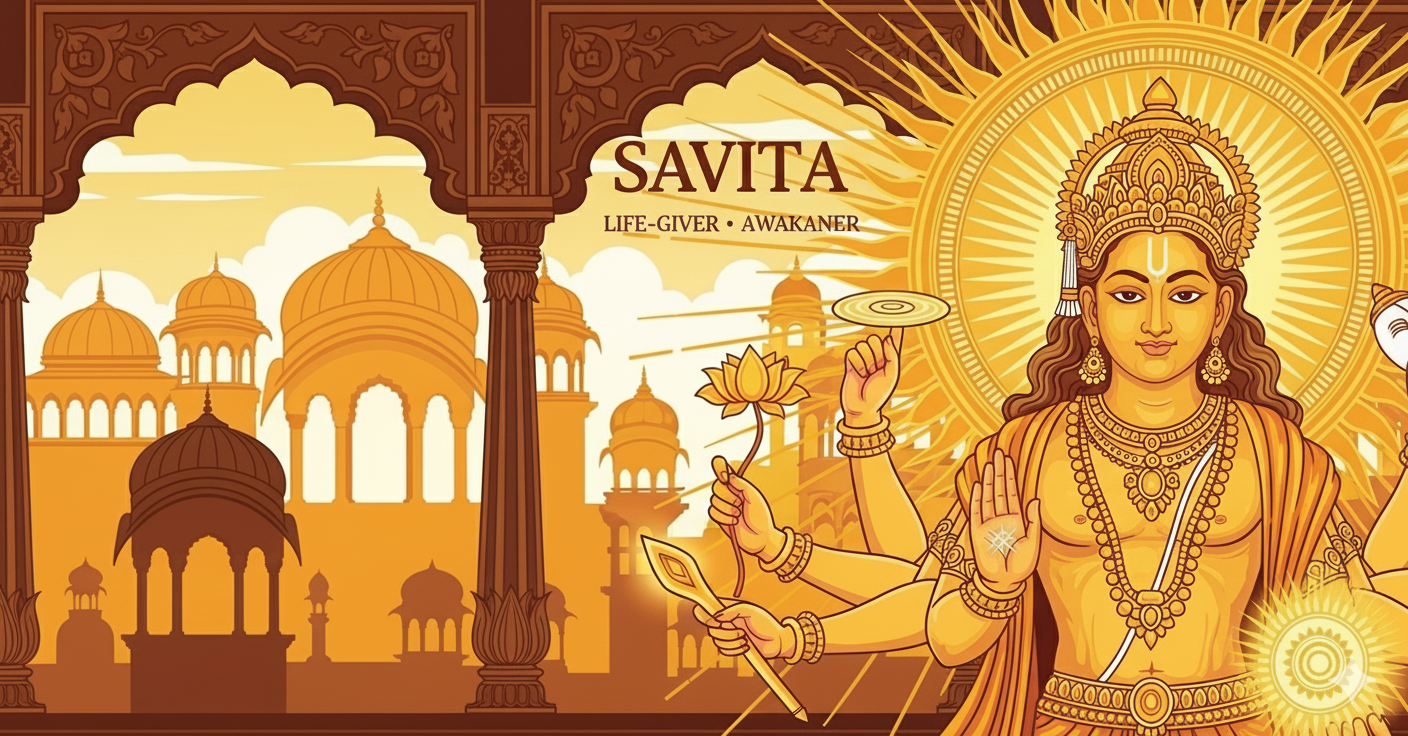
Light has always been a symbol of wisdom, purity, and divinity. In the Vedas, this light is not merely the physical radiance of the Sun but the eternal presence of the Divine that sustains and illumines all of creation. Among the many hymns that glorify the Sun (Surya), the figure of Savita — the life-giver and awakener — stands out as a profound symbol.
The Sun, in this vision, is more than a celestial body. It is the radiant expression of the Divine, the cosmic witness who envelops the worlds with golden rays and shines within us as awareness. It is this dimension of Savita that finds expression in todays post’s verses – both in the Navagraha Suktam and the Surya Upanishad, and which is illuminated further in the teachings of Bhagawan Sri Sathya Sai Baba.
Context
To appreciate the verses we are about to explore, it helps to recall the vision of the rishis. The Sun is both outer and inner: outwardly, it governs time, seasons, and life itself; inwardly, it represents the unfailing light of consciousness that dispels ignorance.
In the Navagraha Suktam, the seer describes this aspect through the imagery of the Sun’s golden rays — an “envelope” that surrounds and protects the worlds. In the Surya Upanishad, the same truth is declared more explicitly: Surya is none other than the Supreme Being, present everywhere and in everything.
Together, these texts form a bridge — moving from the symbolic imagery of light to the direct affirmation of divinity. This bridge becomes even more meaningful when we reflect on how Bhagawan Baba often emphasized the omnipresence of God, guiding us to recognize the Divine not only in the cosmos but in our own hearts.
Verses
Before we step into the verses, let us listen with the same reverence as the ancient rishis — who saw in the Sun not just a source of light, but the very presence of the Divine. The Navagraha Suktam begins by unveiling this vision through a prayer to Surya, the golden-hued one who envelopes and sustains all the worlds.
Om āsatyena rajasā vartamāno niveśayann amṛtaṃ martyaṃ ca | hiraṇyayena savitā rathenā devo yāti bhuvanā vipashyan || Agniṃ dūtaṃ vṛṇīmahe hotāraṃ viśvavedasam | asya yajñasya sukratum || Yeṣām īśe paśupatiḥ paśūnāṃ catuṣpadām ca dvipadām | niṣkrīto ’yaṃ yajñiyaṃ bhāgam etu rāyaspoṣā yajamānasya santu ||
Om adhidevatā pratyadhidevatā sahitāya ādityāya namaḥ ||
Meaning
Surya as Savita The divine Savita (Sun), moving through the worlds with his golden chariot, illumines both the mortal and immortal realms, beholding all beings.
Agni as Messenger We invoke Agni, the divine messenger, the priest who knows all, the one who guides the sacrifice rightly.
Pashupati as Protector Lord Pashupati, the master of all creatures—both four-legged and two-legged—accepts the offering. May the yajamāna (worshipper) be blessed with prosperity and abundance.
Salutations Om, salutations to Āditya (Surya), along with his adhidevata and pratyadhidevata.
Adhidevata & Pratyadhidevata of Surya
Adhidevata (Presiding Deity): Agni Agni is invoked as Surya’s adhidevata because both are luminous, purifying, and the conveyors of divine will. Agni ensures that the prayers and offerings reach the celestial realms.
Pratyadhidevata (Secondary Deity): Pashupati (Rudra/Shiva) Pashupati, Lord of all beings, represents the protective and sustaining power of Surya. He governs both bipeds and quadrupeds, symbolizing life in its entirety.
Explanation
This opening hymn from the Navagraha Suktam invokes Savitṛ (the Sun as divine inspirer):
“आसत्येन रजसा वर्तमानो” – The Sun moves through the heavens, pervading both the immortal (divine) and the mortal (earthly) realms, binding them with his radiant energy.
“हिरण्ययेन सविता रथेन” – He rides his golden chariot, surveying all the worlds, ever-watchful and ever-sustaining.
The verse then calls upon Agni (fire) as the divine messenger, the knower of all, who carries offerings to the gods and ensures that the sacred ritual bears fruit.
The hymn acknowledges Pashupati (Lord of all beings) as the sovereign over all creatures, both four-footed and two-footed.
It closes with the dedication to Āditya (Sun) as the presiding deity, along with the attendant deities (pratyadhidevatas), offering salutations to his all-encompassing radiance.
✨ Reflection: This verse establishes the Sun as both the cosmic witness and the life-giving force. He bridges mortality and immortality, while Agni carries our prayers upward. It reminds us that every living being is sustained by the divine order, and that surrendering our offerings leads to nourishment, prosperity, and harmony.
This verse is an affirmation of Savitā (the Sun as the divine life-giver) as the all-encompassing presence. It declares that the radiance of Savitā is not confined to one direction or moment, but surrounds us entirely: before us, behind us, above, and below.
सविताḥ पुरस्तात् (Savitāḥ purastāt — in front) – The Sun lights the path ahead, guiding our steps, symbolizing foresight, clarity, and direction in life.
सविताḥ पश्चात् (Savitāḥ paścāt — behind) – The Sun supports from behind, reminding us that the divine always stands as our protector and unseen strength, carrying us forward.
सविताḥ ऊर्ध्वम् (Savitāḥ ūrdhvam — above) – The Sun is above, the highest illumination. This represents the aspiration of the soul toward the Supreme, the source of inspiration and higher wisdom.
सविताḥ अधः (Savitāḥ adhaḥ — below) – The Sun is below, sustaining even the earth beneath us. This symbolizes firm grounding, nourishment, and stability, reminding us that divine presence is the very foundation of existence.
Taken together, the mantra is not merely about the astronomical Sun, but about the inner Sun—the ātman. It is a meditative contemplation that wherever one turns, there is only the golden presence of the Divine, pervading all directions.
Reflective Note By chanting this verse, a devotee inwardly acknowledges: “I am always in the embrace of Savitā’s light. There is no place where He is not.” This brings deep reassurance, stillness, and a sense of being surrounded by grace.
Bhagawan Sri Sathya Sai Baba’s Guidance
Bhagawan Baba has emphasized this same truth in His discourses many times. In one such message, He said:
“As long as you have faith in God, you have nothing to fear. May you all enjoy safety and security! Wherever you go, whatever you do, have firm conviction that God is always with you, in you, around you, above you, below you. Do not be carried away by what others say. Have God firmly installed in your heart.” (Source: Discourse, Sathya Sai Speaks)
In another teaching, reaffirming the same truth, He emphasized:
“You trust your friend whom you have met only a few years ago, but not God who is with you, in you, around you, throughout your life.” (Source: Divine Discourse, Shivarathri Feb 1999)
These are not mere words—they are living affirmations that bring the Upanishadic declaration into our personal, everyday experience. Where the Sūrya Upaniṣad states the omnipresence of Savitā, Baba’s words give us a heartfelt reminder that God is our constant companion in all circumstances—empowering us, protecting us, guiding us, and residing within our very hearts.
These words are a living echo of the Upanishadic declaration. Just as the Sūrya Upaniṣad assures us of Savitā’s omnipresence, Baba translates this ancient wisdom into a practical assurance for the devotee: God’s presence surrounds us at all times — protecting, guiding, and uplifting. The radiance of the Divine is not only cosmic but also deeply personal, assuring safety, peace, and fearlessness for every seeker who keeps faith alive.
The Three Declarations United
Navagraha Suktam:Savita illumines all with golden rays — an enveloping presence.
Surya Upanishad:Savita is everywhere — before, behind, above, below.
Bhagawan Baba:God is always with you, in you, around you, above you, below you.
Together, these affirm that the Divine is Omnipresent — not distant, but ever-present as light and love, surrounding and pervading us at every moment.
Reflections & Key Takeaways
Meditating on these verses and recalling Baba’s assurance helps nurture unshakeable faith. It transforms the abstract idea of omnipresence into a tangible inner reality: a light that is ever-present, faithful, and guiding—day and night, in every step we take.
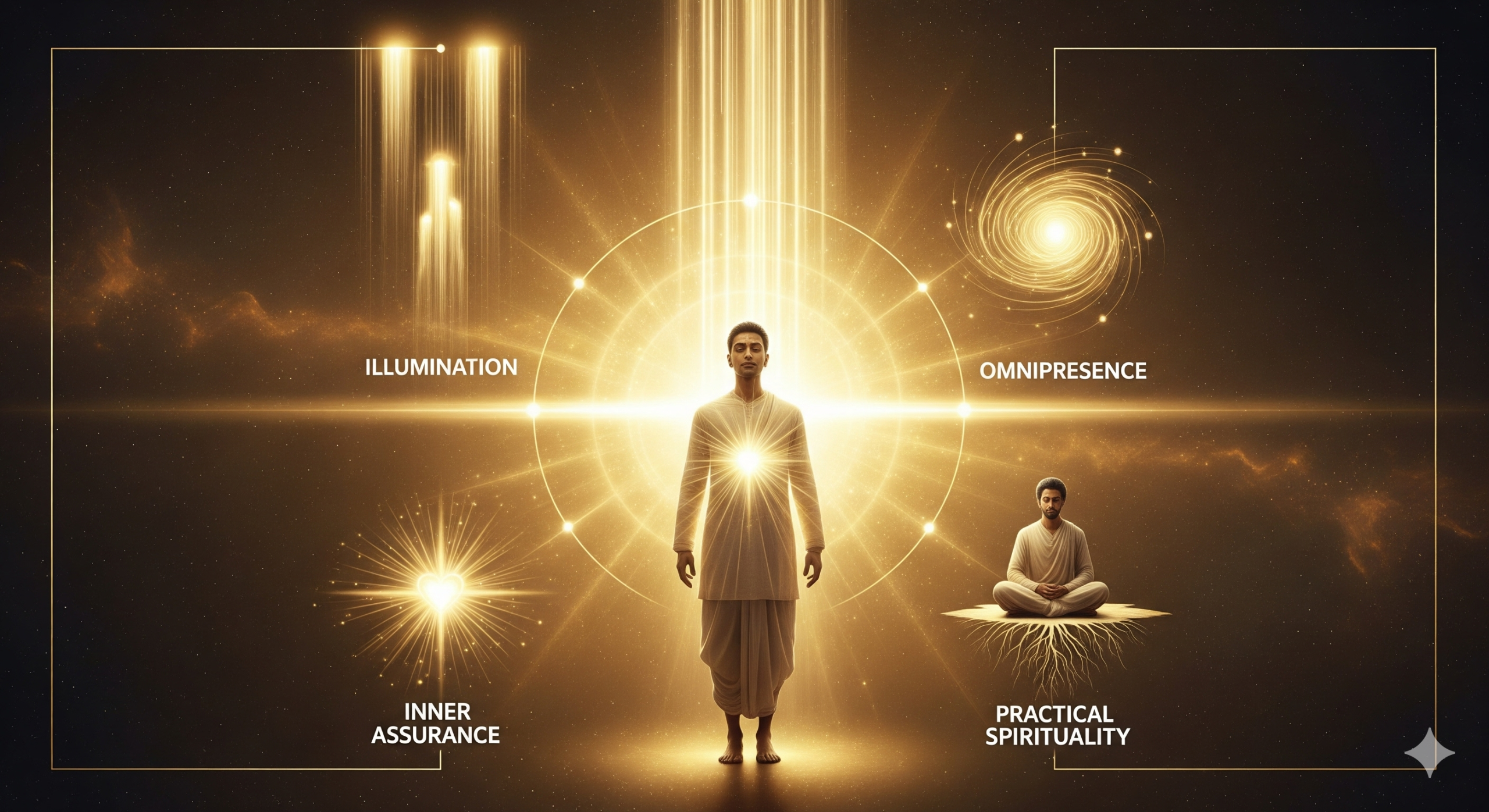
Illumination: Like the golden rays of Savita, God’s grace shines upon all, without distinction.
Omnipresence: The Divine presence is not limited by direction, time, or space — it is all-pervading.
Inner Assurance: With faith, one realizes that God is not only beyond but also within the heart — the truest source of safety and security.
Practical Spirituality: Remembering this omnipresence transforms fear into courage and uncertainty into peace.
Closing Thoughts
On this Sunday dedicated to Surya, let us meditate on Savita — the radiant Sun who illumines our lives.
The Navagraha Suktam, the Surya Upanishad, and Bhagawan Baba’s words together remind us that the same Divine Light that moves across the heavens also shines within us and around us, always.
May we live in that awareness, in light, fearlessness, and faith. – The Golden Presence
Citations & References
Navagraha Suktam – Krishna Yajur Veda – traditionally recited in praise of the nine grahas, with the opening verses dedicated to Surya as Savitā.
Surya Upanishad – From the Atharva Veda, highlighting Surya as the source of illumination, energy, and spiritual awakening.
Samastah Lokah Sukhini Bhavanthu May all beings in all the worlds be happy!
Jai Sai Ram!
Please note all content and images generated using AI Tools
In the cosmic temple, a divine river flows,
Where earth and fire meet, and sacred lotus grows.
Guided by the breath of air, the universe expands,
A silent OM in the ether, held in a divine hand.
Seeing the Divine in Creation
In the sacred worldview of Bharatiya culture, the universe is not a random assembly of matter—it is a living temple, pulsating with the presence of the Divine. Every mountain is a murti, every river a goddess, every breeze a whisper of God. This vision invites us to move from observation to reverence, from consumption to communion.
At the heart of this temple are the five great elements—earth, water, fire, air, and ether—each a manifestation of the Supreme. To worship them is not to worship nature, but to honor God moving through nature.
Bhagawan’s Teaching: Angavathi Worship
Bhagawan Sri Sathya Sai Baba often spoke of the Angavathi form of worship, where the five elements are revered as aspects of Divinity. In one discourse, He explained:
“Angavathi refers to the worship of the five elements—earth, water, fire, air, and ether—considering them as manifestations of the Divine. The earth bears the burden of mighty mountains, vast oceans, dense forests, villages, towns, and cities. Likewise, the remaining four elements are also responsible for the sustenance of creation.” —Discourse link
He further elaborated in another talk:
“All the five elements are aspects of God, His Divinity, and His supreme power. It is for this reason that our ancients worshipped the five elements, revering them as aspects of God Almighty. They worshipped the earth as Mother Goddess, the rivers as various goddesses, and the elements as various deities.” —Discourse link
This reverence is not limited to the external world. Bhagawan reminds us that our own body is composed of these five elements, and that honoring them externally is a way of aligning with their presence within.
The Temple Within: Our Body and the Five Elements
In His discourse “The Sanctity of the Five Elements”, Bhagawan offers a profound teaching that bridges the cosmic and the personal:
“The five elements of which the entire cosmos is built up, are present also in the human being… The human body too is one particular combination of the five elements.”
This transforms Angavathi worship from an external ritual into an intimate act of self-reverence. To honor the elements is to honor the sacred architecture of our own being. The body becomes a temple—not metaphorically, but literally—constructed from divine substance.
Bhagawan further explains that each element is not just a physical force but a limb of the Divine:
“Since the earth is suffused with divine power, it is nothing but an anga or limb of God… All five elements and indeed the whole of Creation is sacred. You are a part of Creation, which is a limb of God.”
This is the heart of Angavathi: to see the five elements as God’s body, and ourselves as part of that cosmic embodiment.
He also offers a subtle Vedantic insight into the attributes and hierarchy of the elements, showing how each one becomes subtler and more pervasive:
Earth possesses all five attributes: sound, touch, form, taste, and smell
Water lacks smell
Fire lacks taste and smell
Air retains only sound and touch
Ether (Akasha) carries only sound
“As the attributes diminish one by one, the subtlety of the entity concerned and its vastness increase.”
This mirrors the Upanishadic sequence of creation, where the Divine unfolds from the formless to the formed. Ether is the subtlest and most expansive, while earth is the densest and most tangible. Yet all are sacred, all are limbs of the One.
Upanishadic Foundations: The Elements as Divine Emanations
The Upanishads affirm this sacred vision. The five elements are not inert—they are emanations of Brahman, the Supreme Reality.
Translation: From Him are born prāṇa, mind, all the sense-organs, space, air, fire, water, and earth, which supports all.
Insight: The five elements are direct emanations of Brahman, forming the very fabric of creation and sustaining all life.
Living the Worship: From Cosmos to Body
Angavathi is not just ritual—it is relationship. Here’s how each element can be honored in daily life:
Element
Deity
Practice
Symbolic Insight
Earth (Prithvi)
Bhudevi
Walking barefoot, gardening
Groundedness, support
Water (Apas)
Gangadevi
Offering water, mindful drinking
Purity, flow
Fire (Agni)
Agnideva
Lighting lamps, inner tapas
Illumination, transformation
Air (Vayu)
Vayudeva
Pranayama, chanting SOHAM
Movement, vitality
Ether (Akasha)
—
Silence, Omkara meditation
Space, subtlety
To worship the elements is to honor the Divine within and without. Our body is made of earth, our blood of water, our digestion of fire, our breath of air, and our mind dances in ether.
Practical Application- Angavathi for a Greener India(Bharat)
We’re growing up in a time where our beautiful Bharat is facing some big challenges – from smog in our cities to plastics in our rivers, and the changing climate affecting our farmers. It’s easy to feel overwhelmed, or think these are just “government problems.” But what if our ancient wisdom, the kind our grandparents talked about, actually gives us the most powerful solutions?
The idea of Angavathi worship isn’t just about ancient rituals; it’s a call to action for us, right now. Imagine if we saw our surroundings – the very elements of India – as sacred, as parts of the Divine.
When we see the Yamuna or Ganga (or any river, even the smaller ones in our own towns) not just as water, but as Gangadevi herself, would we let plastic choke her flow? When we choose reusable bottles instead of single-use plastic, that’s a small act of worship, a way of saying, “I respect you, Divine Water.”
When we walk through a park or a forest, are we just seeing trees, or are we experiencing Bhudevi, Mother Earth, sustaining us? Every time we choose public transport or cycle instead of taking a car, we’re reducing the burden on the air (Vayudeva), keeping it cleaner for everyone in Bengaluru and beyond.
Even the energy we use! From the flicker of a traditional lamp (Agnideva) to the electricity powering our phones – think about its source. Supporting solar energy or being mindful about switching off lights are modern ways to honor the divine fire, using its power wisely and respectfully.
And us! We are made of these elements. When we choose to live consciously, separating our waste, conserving water at home, or joining a local cleanup drive in our neighborhood or near a lake, we aren’t just doing “good deeds.” We are performing Angavathi worship, honoring the very fabric of creation that sustains our lives and our incredible country.
This isn’t about rote spirituality; it’s about making our faith active. It’s about taking pride in our heritage and applying its deepest truths to build a better, cleaner, more respectful Bharat for ourselves and for future generations. Let’s not just observe; let’s participate in preserving the divine temple that is our home.
Closing Thoughts: Worship as Alignment
Angavathi worship is not a ritual—it is alignment. It is the recognition that the same elements that form the mountains and rivers also form our bones and breath. To bow to Bhudevi is to bow to the earth within. To light a lamp is to awaken the fire of awareness.
In this temple called cosmos, every gust of wind, every drop of water, every flicker of flame is a darshan. And every act of reverence is a step toward Atma-sākṣātkāra—Self-realization.
The Devī Atharvaśīrṣa is a radiant jewel of the Atharva Veda. These mantras reveal the Divine Mother not as an external power but as the very source of strength, wisdom, and protection within us. Each verse is a reminder that the Goddess is ever-present—guiding, shielding, and uplifting the seeker.
As we reach the closing section of this sacred text, the teachings emphasize protection from fear, removal of obstacles, and ultimate liberation from the ocean of worldly existence. These verses are not just hymns of praise—they are living truths, offering refuge and empowerment for all who recite and reflect upon them.
This image visually narrates the spiritual journey described in the verses. The first panel shows the awakening of inner strength and wisdom. The center panel depicts the divine shield of protection that helps us overcome fears and obstacles. The final panel illustrates the ultimate liberation and transcendence that comes from this inner connection.
Summary of Earlier Verses (18–19, 21-22)
Two weeks ago, we reflected on the middle section of the Devī Atharva Śīrṣa, where the Goddess was revealed in Her profound cosmic and subtle forms. Those verses (18,19–21,22) described Her as the very essence of the bija mantra, shining like the crescent moon, as the eternal source of all fulfillment. The supreme Brahman meditated upon by the pure-hearted sages, the power behind speech and sound, Devī was revealed as residing in the heart-lotus, radiant as the morning sun, with the noose and goad, offering boons and fearlessness to devotees. She was adored as the supreme Mother, the remover of fear and the great alleviator of suffering—an embodiment of compassion and divine grace.
Verse 18 revealed the bīja of the Goddess — joined with space, fire, and the crescent moon — as the seed that fulfills all purposes.
Verse 19 declared that this one-syllabled Brahman is meditated upon by sages of pure mind, immersed in the ocean of bliss and knowledge.
Verse 21 presented a beautiful image of the Goddess in the heart-lotus: radiant like the morning sun, holding the noose and goad, with hands bestowing fearlessness and boons, three-eyed, clad in red garments, fulfilling the wishes of Her devotees.
Verse 22 concluded this section with a direct salutation: “I bow to You, the great Goddess, destroyer of great fears, who calms the greatest obstacles, and whose very form is supreme compassion.”
This verse (22) forms the bridge, connecting Her supreme transcendental nature with the Phala Śruti, the declaration of blessings that follow from worship and recitation.
Today’s Verses(22-26)
Verse 22
This verse is repeated from the previous time to set the context
Meaning: I bow to You, the great Goddess, destroyer of great fears, who pacifies the most formidable obstacles, whose very form is supreme compassion.
Commentary: This verse serves as a powerful invocation, setting the stage for the entire hymn. It immediately addresses the Goddess as the ultimate refuge. The phrase “destroyer of great fears” (mahābhaya-vināśinīm) doesn’t just refer to a feeling of being scared; it speaks to existential dread—the fear of death, loss, and the unknown. This ancient wisdom reminds us that by connecting with the Divine Feminine, we can confront our deepest anxieties. The term “pacifies the most formidable obstacles” (mahādurgapraśamanīm) relates to the word Durga, which means “fortress” or “difficult to cross.” This speaks to both external challenges and our own internal blockages—mental strongholds, stubborn habits, and emotional walls. The Goddess is invoked here as the force that can dismantle these seemingly insurmountable barriers. Finally, the description of Her form as “supreme compassion” (mahākāruṇyarūpiṇīm) reframes the powerful, sometimes fierce, aspect of the Goddess.
Her destructive power is not born of anger, but of a boundless, unconditional lovethat seeks to remove what harms us, both within and without. This is a profound spiritual lesson: true power is rooted in compassion.
Verse 23
Sanskrit: यस्याः स्वरूपं ब्रह्मादयो न जानन्ति तस्मादुच्यते अज्ञेया । यस्या अन्तो न लभ्यते तस्मादुच्यते अनन्ता । यस्या लक्ष्यं नोपलक्ष्यते तस्मादुच्यते अलक्ष्या । यस्या जननं नोपलभ्यते तस्मादुच्यते अजा । एकैव सर्वत्र वर्तते तस्मादुच्यते एका । एकैव विश्वरूपिणी तस्मादुच्यते नैका । अत एवोच्यते अज्ञेयानन्तालक्ष्याजैका नैकेति ॥ २३ ॥
Meaning: Her true form even Brahmā and the gods cannot know, hence She is called Agyeyā (unknowable). Her end cannot be found, hence She is Anantā (infinite). Her goal cannot be perceived, hence She is Alakṣyā (imperceptible). Her birth cannot be determined, hence She is Ajā (unborn). She alone pervades everywhere, hence She is Ekā (One). Yet She appears as the cosmic form, hence She is Naikā (many).
Therefore, She is described as Agyeyā, Anantā, Alakṣyā, Ajā, Ekā, and Naikā.
Commentary: This verse beautifully uses a series of philosophical pairs to describe the transcendent nature of the Goddess. This isn’t a list of facts to be memorized, but a set of paradoxical truths designed to shatter our limited, dualistic understanding. The Upanishad reminds us that the ultimate reality is beyond our intellectual grasp. The concept of Agyeyā (unknowable) challenges our modern impulse to understand everything rationally. It suggests that profound truths are experienced, not just known. The contrast between Ekā (One) and Naikā (many) is a cornerstone of non-dual philosophy. The Goddess is the singular, unified reality underlying all existence, yet She manifests as the rich, diverse, and sometimes chaotic multiplicity of the cosmos. This teaches us a fundamental spiritual principle: we are all individual expressions of a single divine consciousness. By recognizing the divine in ourselves and in others, we connect to the One (Ekā) in the many (Naikā).
Meaning: She is the Mother of all mantras, the essence of all sound, the embodiment of knowledge. She is beyond even the highest wisdom, the witness of the void itself. Since nothing is higher than Her, She is praised as Durgā.
Commentary: This verse expands on the Goddess’s role in creation and consciousness. The phrase “Mother of all mantras” (mantrāṇāṁ mātṛkā devī) is deeply significant. Mantras are not just sounds; they are potent vibrations that embody a specific aspect of consciousness. The Goddess is the source of all these vibrations, the very matrix of sound from which language, creation, and spiritual power emerge. She is the “essence of all sound” and the “embodiment of knowledge,” reminding us that true wisdom is not just accumulated information but a living, vibrant force. The most profound line is “the witness of the void itself.” This takes the concept of the Goddess beyond form and sound and into the realm of pure, unmanifested potential—the space before creation. She is the consciousness that observes even the absence of everything. This teaches us that the core of our being is not the thoughts, feelings, or external realities we experience, but the silent, unchanging witness that observes them all.
Meaning: I bow to that Goddess Durgā, difficult to approach, destroyer of evil conduct. Fearing worldly existence, I surrender to Her, who carries us across the ocean of saṁsāra.
Commentary: This verse shifts from philosophical description to a personal declaration of devotion. The term “difficult to approach” (durgamāṁ) is a play on the name Durgā, but it is not a negative trait. It signifies that the path to Her is not a casual one; it requires discipline, sincerity, and inner purification. She destroys “evil conduct” (durācāra-vighātinīm), which refers not only to outward actions but, more importantly, to the inner tendencies and thoughts that lead us astray. This is the heart of the transformational process. The devotee expresses a fear of “worldly existence” (saṁsāra)—the endless cycle of birth, death, and suffering driven by ignorance and desire. The final line offers a solution: surrendering to the Goddess. She is the divine boat that “carries us across the ocean of saṁsāra.” This is a powerful metaphor for personal liberation. It implies that we don’t have to navigate theturbulent waters of life alone; by connecting with the divine, we gain the grace and guidance needed to reach the shore of spiritual freedom.
Transliteration: idam atharvaśīrṣaṁ yo ’dhīte sa pañcātharvaśīrṣa-japa-phalam āpnoti । idam atharvaśīrṣam ajñātvā yo ’rcāṁ sthāpayati — śata-lakṣaṁ prajaptvāpi so ’rcā-siddhiṁ na vindati । śatam aṣṭottaraṁ cāsya puraścaryā-vidhiḥ smṛtaḥ ।
Meaning: He who studies this Atharva Śīrṣa obtains the fruit of reciting all the five Atharva Śīrṣas. He who installs an image of the Goddess without knowing this hymn — even if he recites a hundred thousand times — does not attain perfection in worship. Its prescribed puraścaraṇa1is 108 recitations.
Whoever recites it ten times is freed immediately from sins. By the grace of the great Goddess, he crosses the greatest difficulties.
Commentary: This final verse highlights the immense spiritual power and practical benefits of the hymn. The statement that reciting this one hymn is equivalent to all five Atharva Śīrṣas underscores its exceptional status and transformative potential. It teaches a crucial lesson about the difference between rote ritual and conscious devotion: “He who installs an image of the Goddess without knowing this hymn… does not attain perfection in worship.“ This is a profound critique of blind faith and mechanical practice. The verse emphasizes that true worship requires knowledge and understanding of the Divine’s nature as described in the hymn. The knowledge (gnosis) must accompany the devotion (bhakti). The specific instructions for recitation—108 for puraścaraṇa (a preparatory ritual) and 10 times for immediate purification—provide a tangible spiritual practice. The final promise is a powerful one: through the grace of the Goddess, one can overcome even the most formidable obstacles in life, both spiritual and material. It is a promise of divine aid for the one who sincerely engages with this ancient wisdom.
Reflections
While the earlier verses pointed to the mystical vision of Devī — as mantra, as cosmic sound, as the inner light — the Phala Śruti now shifts to the practical fruits of devotion. The Upaniṣad reassures us that invoking the Mother is not merely symbolic; it directly transforms life:fears are removed, difficulties are overcome, knowledge awakens, and liberation becomes possible.
For us today, these verses invite a shift from theory to practice. It is not enough to admire the vision of Devī as cosmic energy; we are encouraged to recite, remember, and live by this Vidyā.
In doing so, we discovercourage in fear, clarity in confusion, and grace in our struggles — the same grace the sages promised thousands of years ago.
Applications in Modern Life
The above verses from the Devi Atharva Shirsha Upanishad offer a profound and timeless roadmap for navigating our modern existence.
Beyond Definition (Verse 23): We live in an age that demands certainty, where we often try to define ourselves and others with labels, metrics, and data. This first verse challenges that by describing the divine as unknowable (Agyeyā) and infinite (Anantā). This wisdom invites us to find peace in the mystery of life, reminding us that our true potential and essence cannot be confined by a resume, a social media profile, or a job title. It’s an invitation to embrace the ever-evolving, boundless nature of our own being.
The Power of Words and Knowledge (Verse 24): This verse highlights that the Goddess is the mother of all mantras and the essence of all knowledge. In our modern context, this points to the profound power of our words and thoughts. What we say and what we think creates our reality. It’s a call to be mindful of the information we consume and the language we use, recognizing that they are not just tools but are imbued with a fundamental creative energy.
Confronting Inner Obstacles (Verse 25): The verse describes the Goddess as the destroyer of evil conduct (durācāra-vighātinīm). This can be interpreted as an inner strength that helps us overcome our own destructive patterns. Our modern “evil conduct” often manifests as negative self-talk, fear-driven procrastination etc. This verse offers the wisdom that we can call upon a higher, inner resolve to overcome these patterns and find the courage to cross the “ocean of saṁsāra,” or the difficult challenges of our daily lives.
Grace and Effort (Verse 26): This final verse offers a beautiful balance of personal effort and higher grace. It states that by understanding and reciting the hymn, we can cross the greatest difficulties. This teaches us that while our actions—our spiritual practice, our good deeds—are important, true liberation and the ability to overcome life’s biggest hurdles come from divine grace. It’s a powerful reminder that we don’t have to carry the burden of our struggles alone.
Closing Thoughts
As the Upaniṣad itself declares:
“In this way, the greatness of the Devī Atharva Śīrṣa has been revealed. This sacred Vidyā bestows liberation upon all and brings auspiciousness.”
These verses from the Devi Atharva Shirsha Upanishad offer a timeless roadmap for living a more fulfilled life. They invite us to let go of our need for complete control and embrace the mystery, to use our words and thoughts mindfully, to face our inner demons with courage, and to ultimately trust that a higher grace will help us through our darkest moments. By reflecting on this ancient wisdom, we can find a path to inner peace and strength in an ever-changing world.
May you carry these verses in your heart, for they remind us that the Divine Mother is both infinite and intimate—beyond comprehension, yet dwelling within you, ever ready to guide you across the ocean of life. Look within. She is the guide. She is the light — The Sacred Strength
Samastah Lokah Sukhino Bhavanthu May all the beings in all the worlds be happy
Jai Sai Ram!
Puraścaraṇa means “a prescribed discipline or practice performed before (or along with) mantra japa (repetition).”
Practical sense: It refers to a set of ritualistic disciplines (like mantra japa, homa, tarpana, mārjana, brāhmaṇa-bhojana) undertaken systematically to energize and fully realize the mantra’s power. It’s like preparing the ground so the mantra can bear its full fruit.
In this context: When the text says “Its prescribed puraścaraṇa is 108 recitations”, it means that to properly invoke the Devi Atharvaśīrṣa, one should ideally perform 108 full recitations of the stotra as a sacred discipline. That number of repetitions is believed to activate the mantra’s potency and bestow the promised benefits (śakti, protection, realization).
In short: Puraścaraṇa = the systematic practice of mantra repetition, with rituals, done in a set number (here, 108 times) to energize the mantra and receive its full blessing.↩︎
Please note all content and images are created using AI Tools