Category: Adhyatmik

Bliss We Are

Bliss We Are

Awakening to our true nature — the joy that we are

Beyond Words, Beyond Thought: Fearless Bliss of Brahman

The Taittirīya Upaniṣad takes us deep into the nature of Brahman—the ultimate reality. In the Brahmānanda Valli, we encounter one of the most profound declarations: speech and mind, our finest instruments of knowledge, cannot fully grasp Brahman. Yet the one who realizes that bliss lives free of fear.

This insight, though ancient, offers timeless guidance for how we live today—reminding us where human faculties end and where inner realization begins.

All this knowledge is concerned with the phenomenal world, which is transient in its character. You cannot secure peace till you gain knowledge of the Eternal. The same truth is declared by scientists when they say that where science ends, spirituality begins.”
Bhagawan Sri Sathya Sai Baba, Discourse on 9 July 1998


The Verse

Sanskrit:
यतो वाचो निवर्तन्ते अप्राप्य मनसा सह ।
आनन्दं ब्रह्मणो विद्वान् न बिभेति कदाचन ॥

Transliteration:
Yato vāco nivartante aprāpya manasā saha |
Ānandaṃ brahmaṇo vidvān na bibheti kadācana ||


Word-by-Word Meaning

  • यतः (yataḥ) — from which (source, origin)
  • वाचः (vācaḥ) — words, speech
  • निवर्तन्ते (nivartante) — turn back, return
  • अप्राप्य (aprāpya) — without attaining
  • मनसा सह (manasā saha) — even along with the mind
  • आनन्दं (ānandam) — bliss, supreme joy
  • ब्रह्मणः (brahmaṇaḥ) — of Brahman
  • विद्वान् (vidvān) — the wise one, knower
  • न बिभेति (na bibheti) — does not fear
  • कदाचन (kadācana) — at any time

Explanation

This verse declares that:

  1. Brahman cannot be reached by speech or mind. Language cannot capture it, and thought cannot grasp it.
  2. Brahman is Bliss. It is not a concept but an experience of fullness.
  3. The knower becomes fearless. Realization of Brahman frees one from fear—fear of loss, uncertainty.

The verse can be divided into two key parts:

Part 1: The Ineffable Nature of Reality

The first two lines describe that which cannot be understood by the intellect.

Yato vāco nivartante aprāpya manasā saha (From which words turn back, without reaching it, along with the mind.)

This part of the verse explains that the ultimate reality, Brahman, is not an object that can be grasped by the senses, described by language, or conceived by the mind. Our thoughts and words are limited tools, designed to interact with the material world. When they try to describe something infinite and timeless like Brahman, they fail and “turn back.” This doesn’t mean Brahman is an abstract void; it means that its true nature is beyond our conventional means of knowing.


Part 2: The Transformative Power of Realization

The second part of the verse reveals the direct result of this understanding.

Ānandaṃ brahmaṇo vidvān na bibheti kadācana (The one who knows the bliss of that Brahman, never fears at any time.)

This is the core of the teaching. The verse clarifies that Brahman’s true nature is Ananda, or pure, unconditional bliss. It is the very essence of existence, and it is our true nature as well. The moment we realize, not just intellectually but through direct experience, that our core being is this blissful and fearless Brahman, all fear vanishes. Fear only arises from a sense of separation, of being small and vulnerable in a vast universe. But when you know that you are one with the eternal, all-pervading source of bliss, what is left to fear? This realization liberates you from all anxiety and insecurity, granting a state of unwavering inner peace.

This ancient wisdom connects powerfully to modern life. We are often crippled by fear—fear of failure, of loss, or of an uncertain future. This verse reminds us that the solution isn’t to fight the world outside, but to turn inward and realize the true nature of the self. By knowing the ultimate source of bliss within, we can live a life free from the bonds of fear.


From Timeless Wisdom to Living Guidance

The Upanishad declares: “Words return, the mind cannot reach; yet the knower of that bliss lives without fear.” This verse paints the map—pointing to a bliss beyond concepts, beyond thought.

But how do we walk that path? How do we move from intellectual understanding to direct experience?

Here, Bhagawan Baba guides us as the living Sadguru. While the Upanishad reminds us of the limits of mind and speech, Bhagawan shows us the practical way to transcend those limits:

  • By dissolving the ego, the false “I”, which veils our innate Ananda.
  • By recognizing that Ananda is not something to be acquired, but our true nature is already present within.
  • By living with awareness, selfless love, and equanimity—transforming everyday life into a practice of realization.

Bhagawan’s Divine Words: Guru Purnima Discourse (2 July 1985)

1. The Inner Guru: Inherent Bliss & the Ego’s Illusion

Bhagawan illumines that the Guru is none other than Brahma-Ananda itselfinherent bliss residing within each heart. All external forms are fleeting; true divinity lies within. Enlightenment entails dissolving the ego—the false(illusion) “I” that fragments the One—and awakening to the timeless, blissful Self.

Ego (I-sense) → Duality → Obscured Bliss → Dissolve ‘I’ → Realize Brahma-Ananda

2. Levels of Bliss: From Human to Transcendent

Building on the Upanishadic scales of Ananda, Bhagawan offers a vivid map—from human delight to celestial, divine, cosmic, and finally, Brahma-Ananda. It’s a journey from conditioned experience to pure, limitless joy.

(Diagram: Stacked levels of Ananda: Human → Gandharva → Deva → Preceptor → Hiranyagarbha → Brahma-Ananda)

3. Speech and Mind Fall Short—Only Being Reaches Truth

Chanting the ancient wisdom, Bhagawan reiterates that ultimate joy cannot be articulated nor conceptualized—no matter how eloquent our words or agile our minds. Only direct realization, through being-ness beyond thought, grants access to that bliss.

(Diagram: Speech & Mind → Limit → Silence → Realization)

4. God Alone Is the Sadguru

Bhagawan’s description of the true Guru resonates deeply with the Upanishadic wisdom: the Sadguru embodies pure consciousness, ultimate wisdom, unwavering equanimity, and transcendental attributes—reminding us that the real guide lies within the Self, the divine Teacher within.

5. Fearlessness Through Inner Liberation

Though Bhagawan doesn’t explicitly cite fearlessness in this discourse, the qualities of equanimity, purity, and transcendence inherently liberate the soul from fear—echoing the Upanishadic promise that realization of bliss grants timeless courage.

6. Living the Wisdom: Four Directives for Spiritual Practice

Bhagawan offers a practical roadmap:

  1. Forsake the company of the wicked.
  2. Embrace the company of the good.
  3. Perform good deeds at all times.
  4. Remember what is permanent and what is impermanent.

(Diagram: Four directives as compass points around “Sanctified Life”)


Reflection & Modern-Day Application

How can this teaching guide us today?

  1. Limits of Language & Thought
    • In life, we often over-rely on “mental chatter” or endless analysis. This verse reminds us: truth is not always found in words or thoughts. Silence, intuition, and presence are powerful.
  2. Anchoring in Bliss (Ānanda)
    • Happiness we chase in the world is fleeting. The Upaniṣad points to a deeper bliss, untouched by circumstances.
  3. Fearlessness in Daily Life
    • Fear—whether of failure, rejection, or the unknown—shrinks us. The knower of inner bliss does not cling, so fear dissolves.
  4. Practical Living
    • Daily meditation: quieting speech & mind to touch that silence.
    • Practicing detachment: seeing joy beyond possessions & status.
    • Facing challenges: remembering that the core Self is untouched.

Key Takeaways
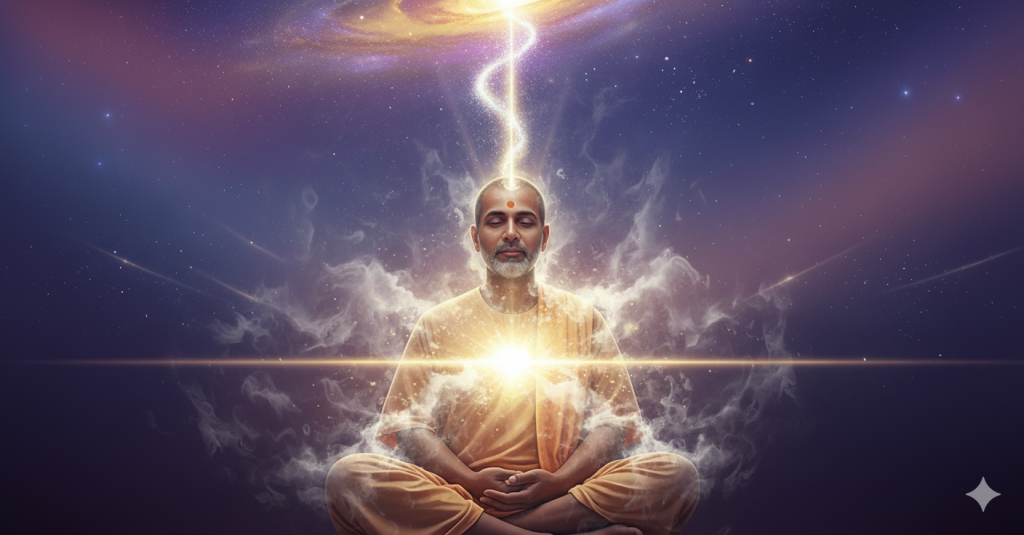
  • The Upanishad declares bliss beyond words and thought—the knower lives fearlessly.
  • Bhagawan reveals how: by dissolving ego, recognizing innate Ananda, and aligning with the Inner Guru.
  • Bliss (Ānanda) is our true nature, waiting to be uncovered.
  • Practical living through meditation, detachment, and Bhagawan’s four directives sanctifies daily life.

Closing Thought

The Taittirīya Upaniṣad gives us the vision; Bhagawan Baba gives us the path. The ancient scripture points to the ineffable bliss beyond mind and word, and Bhagawan Baba shows us how to taste it in our own hearts.

To walk this path is to live without fear, to dwell in love, and to realize that Ananda is not distantit is who we areBliss We Are.


References

  1. Bhagawan Sri Sathya Sai Baba – God Is the Only Sadguru (Guru Purnima Discourse, 2 July 1985, Prasanthi Nilayam)
    — Sri Sathya Sai Speaks, Vol. 18 (1985) links.sairhythms.org
  2. Taittirīya Upaniṣad, Ananda Valli, Anuvāka 9
    “He who knows the bliss of Brahman, whence all words recede, as well as mind (which is unable to reach over), he is not afraid of anything whatsoever.”
    Wisdom Library

Samastha Lokah Sukhino Bhavantu

May all the beings of all the worlds be happy!


Jai Sai Ram!

P.S: All images and content created using AI Tools
Ganapati-Blessings

Ganapati-Blessings

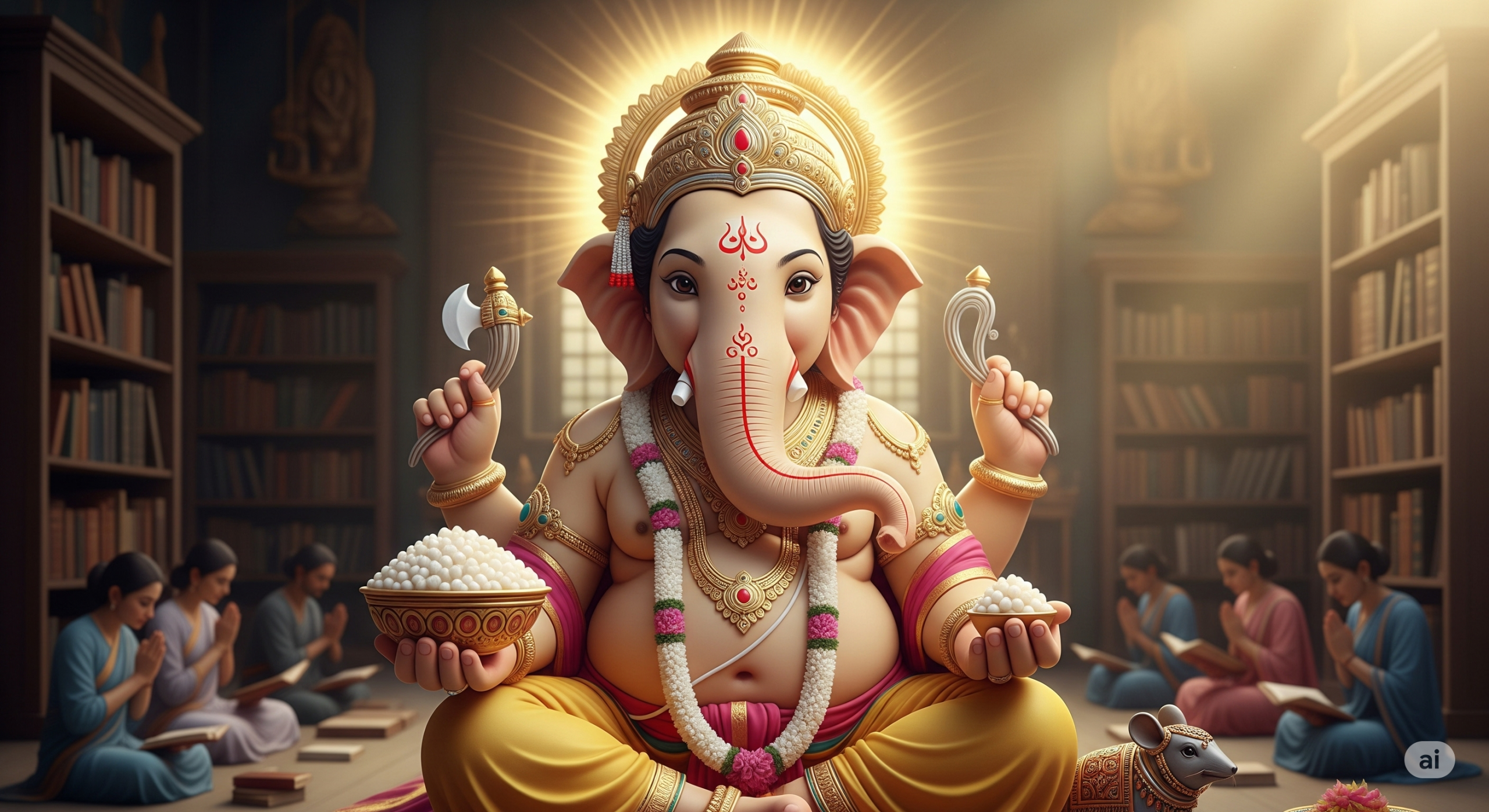
Ganesh Chaturthi Blessings: Wisdom from the Atharva Śīrṣa

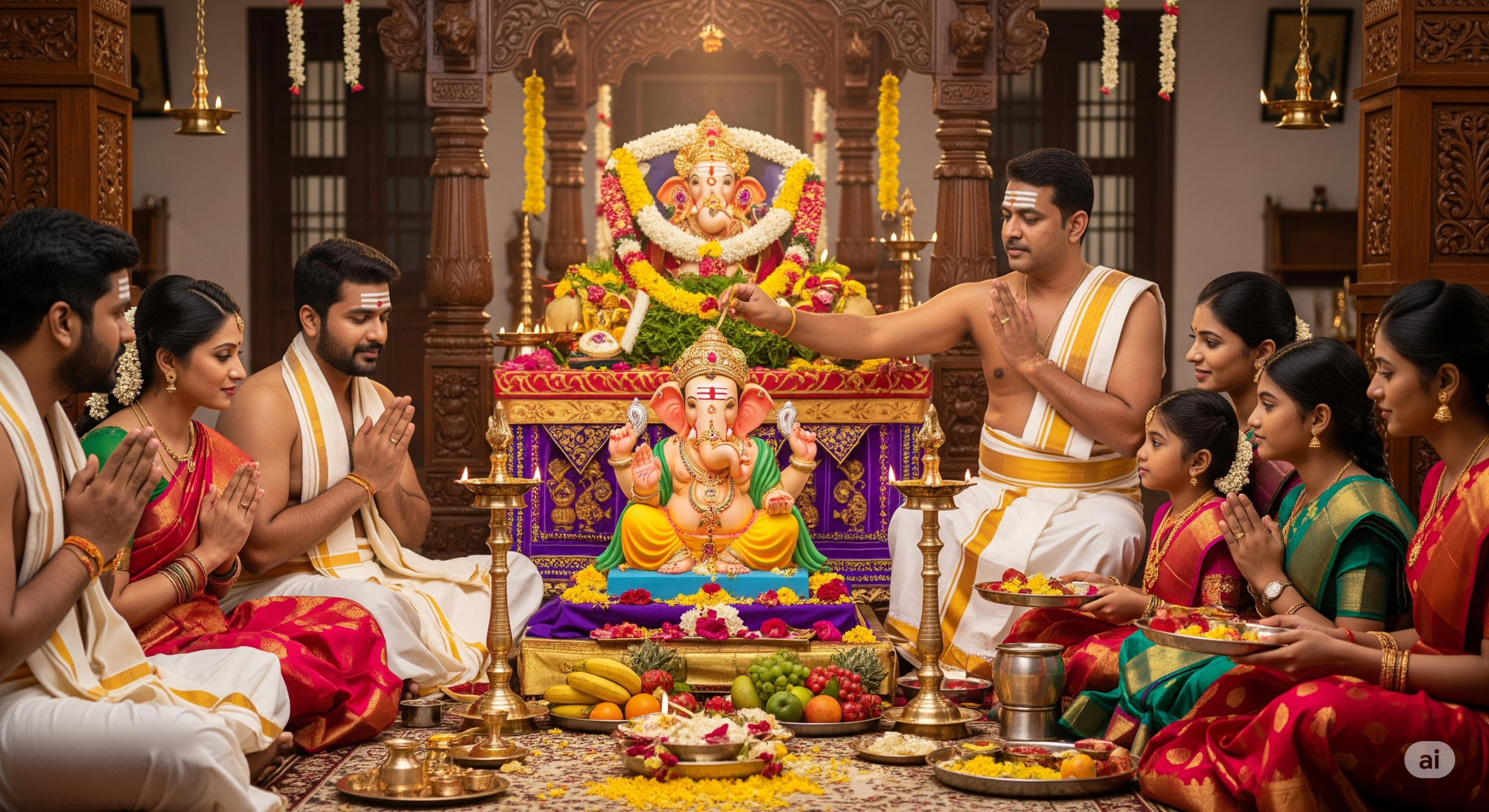
As the sacred day of Ganesh Chaturthi dawns today Wednesday, 27th August 2025, we bow to the remover of obstacles, the patron of wisdom, and the embodiment of auspicious beginnings—Śrī Gaṇapati.

The joyous chants of “Ganpati Bappa Morya!” fill the air and the sweet aroma of modaks wafts from our homes, we welcome Lord Ganesha—the remover of obstacles, the patron of arts, and the beacon of intellect—into our hearts and lives. Ganesh Chaturthi is more than a festival; it is a profound opportunity for renewal, reflection, and spiritual reconnection.

This year, let’s deepen our celebrations by immersing ourselves in the timeless wisdom of the Ganesh Atharvashirsha Upanishad. These ancient verses are not just hymns of praise but are powerful capsules of knowledge that can guide us toward a more meaningful existence.

This post offers four luminous verses from the Śrī Gaṇapatyatharvaśīrṣa Upaniṣad, each a gateway to deeper devotion and spiritual insight. May they guide your celebration from ritual to realization.


Verse 14: The Invocation of Names

Sanskrit: नमो व्रातपतये नमो गणपतये नमः प्रमथपतये। नमस्तेऽस्तु लम्बोदरायैकदन्ताय विघ्ननाशिने शिवसुताय वरदमूर्तये नमः॥

Transliteration: Namo vrātapataye namo gaṇapataye namaḥ pramathapataye। Namaste’stu lambodarāyaika-dantāya vighna-nāśine śiva-sutāya varada-mūrtaye namaḥ॥

Translation: Salutations to the Lord of groups (vrāta), to Gaṇapati, to the leader of divine hosts (pramatha). Obeisance to the pot-bellied, single-tusked remover of obstacles, son of Śiva, embodiment of boons.

Explanation: This verse is a garland of divine epithets—each name revealing a facet of Gaṇapati’s cosmic role. Vrātapati evokes his leadership over spiritual seekers; Pramathapati hints at his command over fierce protectors. The physical attributes—lambodara and eka-danta—are not mere descriptions but symbols of inner fullness and singular focus. The verse culminates in varadamūrti, the form that bestows blessings unconditionally. He is the one who clears the path, not just around us, but within us, allowing our truest desires to manifest.


Verse 15: The Fruit of Study

Sanskrit: एतदथर्वशीर्षं योऽधीते स ब्रह्मभूयाय कल्पते। स सर्वविघ्नैर्न बाध्यते। स सर्वत्र सुखमेधते॥

Transliteration: Etad-atharvaśīrṣaṁ yo’dhīte sa brahmabhūyāya kalpate। Sa sarva-vighnair na bādhyate। Sa sarvatra sukham edhate॥

Translation: Whoever studies this Atharva Śīrṣa becomes fit to attain Brahman. He is not afflicted by obstacles and finds happiness everywhere.

Explanation: This verse affirms the Upaniṣad’s transformative power. The devotee becomes brahmabhūya—eligible for union with the Absolute. Obstacles dissolve, not merely externally but within the mind and heart. The phrase sarvatra sukham edhate suggests a state of pervasive joy, born of spiritual alignment.

Here lies the promise of meditation and sincere study. The Upanishad tells us that by focusing our minds on the divine essence of Ganesha, we transcend the daily struggles and obstacles that cloud our vision. True, lasting happiness becomes accessible to us, no matter where we are.


Verse 23: Worship with Durvā Grass

Sanskrit: यो दूर्वाङ्कुरैर्जपति स वैश्रवणोपमो भवति॥

Transliteration: Yo dūrvāṅkurair japati sa vaiśravaṇopamo bhavati॥

Translation: He who worships with sprigs of durvā grass becomes like Kubera, the lord of wealth.

Explanation: Durvā grass, simple and sacred, becomes a conduit for invoking prosperity. The comparison to Vaiśravaṇa (Kubera) is not just material—it suggests abundance in dharma, wisdom, and generosity. The verse reminds us that devotion need not be elaborate; sincerity sanctifies simplicity.


Verse 24: Worship with Lāja (Popped Rice)

Sanskrit: यो लाजैर्जपति स यशोवान् भवति। स मेधावान् भवति॥

Transliteration: Yo lājair japati sa yaśovān bhavati। Sa medhāvān bhavati॥

Translation: He who worships with parched rice becomes renowned and wise.

Explanation: Lāja, offered with reverence, yields yaśas (fame) and medhā (intellect). These fruits are not for egoic display but for service. Wisdom and recognition, when rooted in devotion, become tools for uplifting others.

These offerings, parched grains and modaks, are symbolic. The grains represent simplicity, humility, and the fruits of the earth. Offering them signifies a pure, grounded devotion that leads to wisdom and recognition.


Reflections and Closing Thoughts

On this Ganesh Chaturthi, let us not only celebrate with modakas and mantras, but also contemplate the deeper truths these verses unveil. Gaṇapati is not merely the deity of beginnings—he is the guardian of our inner journey, the one who clears the path toward self-realization.

Whether you offer durvā or lāja, chant or meditate, may your worship be infused with sincerity and joy. And may the blessings of Śrī Gaṇapati guide you toward wisdom, abundance, and bliss.

These verses teach us that both simple acts of faith and grand offerings of love are beautiful ways to connect with the divine and receive blessings in return.

Wishing you and your loved ones a sacred, joyful, and transformative Ganesh Chaturthi.
Jaya Gaṇeśa!


Samastha Lokah Sukhino Bhavanthu
May all the beings in all the worlds be happy!


Jai Sai Ram!

Seva to Anugraha

Seva to Anugraha

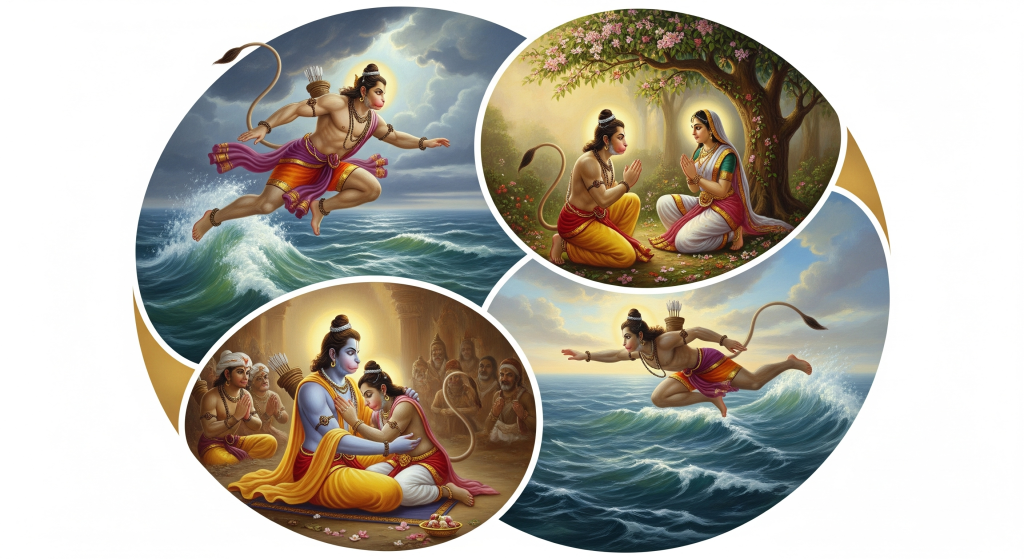
From Darshan to Embrace: Hanuman’s Journey of Devotion

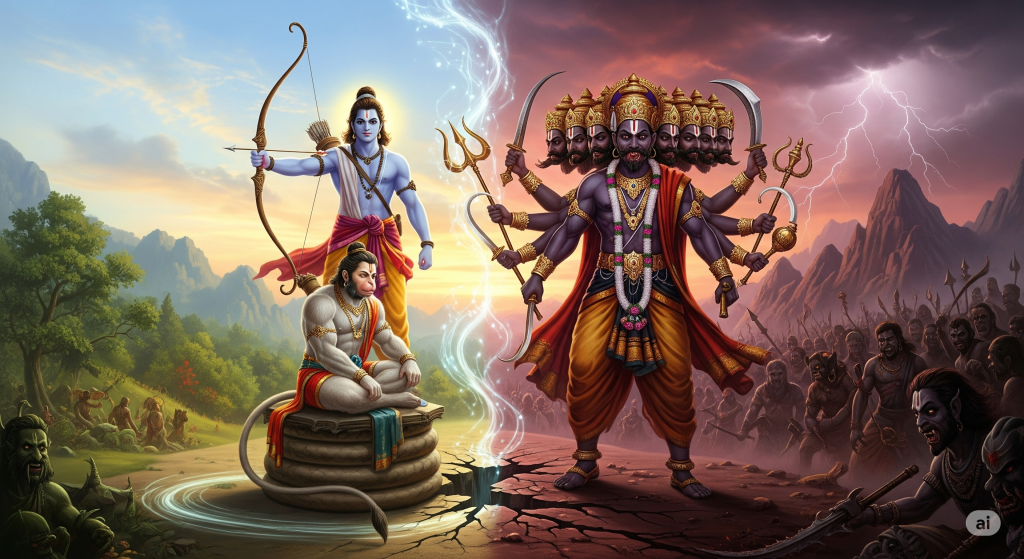
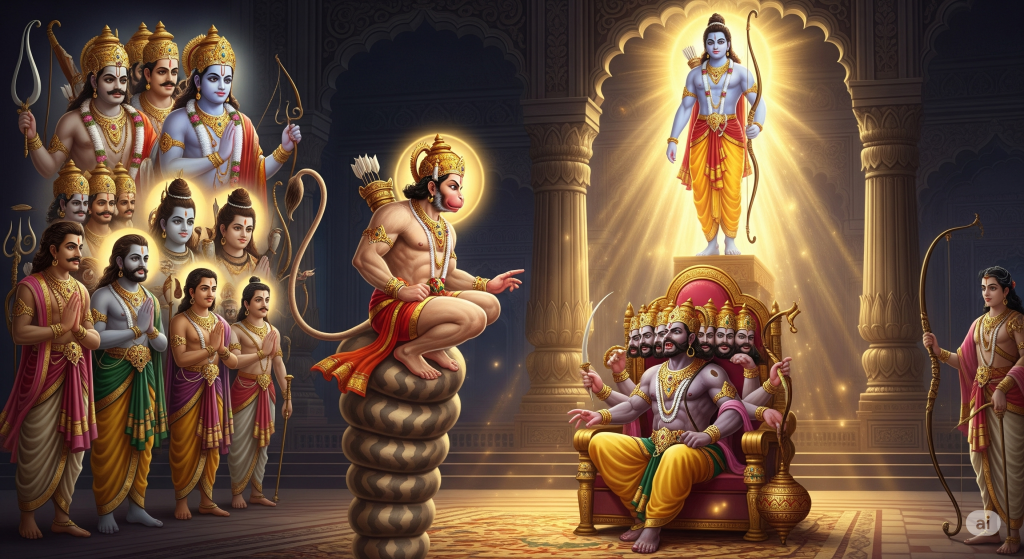
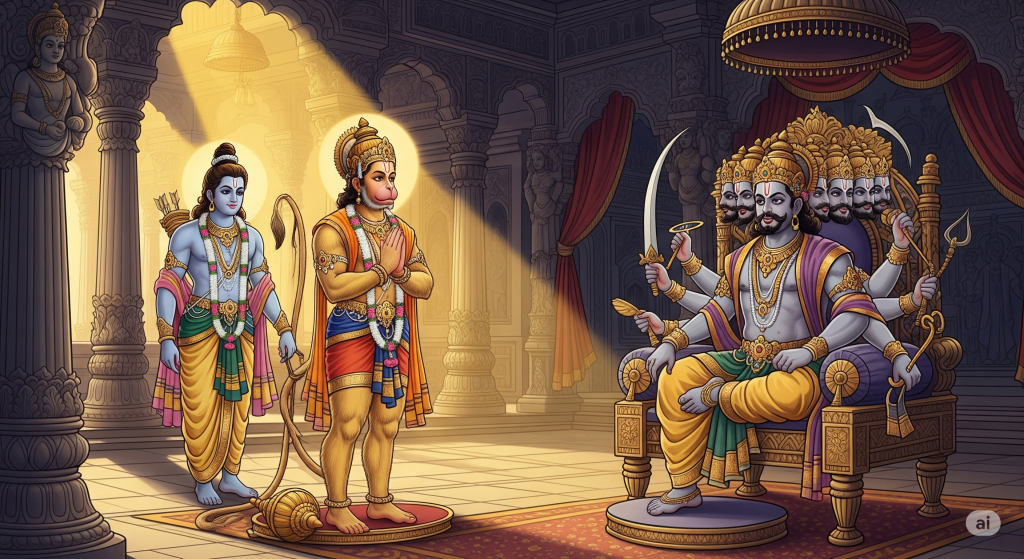
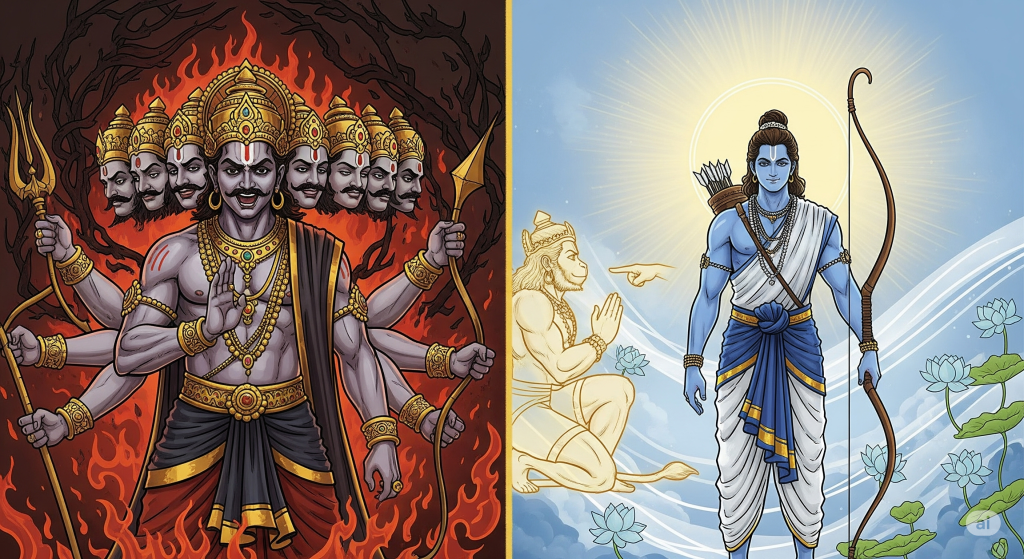
In the sacred rhythm of Ramayana, Hanuman’s journey is not marked by conquest or recognition—but by seva, the quiet offering of selfless love. He does not seek reward, nor does he ask for liberation. His only desire is to serve.

And yet, in that very surrender, the Divine responds—not with accolades, but with anugraha. Seeta’s glance becomes his sanctum. Rama’s embrace becomes his liberation. The servant becomes the beloved.

This is not a tale of achievement. It is a revelation: That when devotion flows without demand, grace arrives without condition.

Introduction

In the quiet sanctum of devotion, Hanuman stands—not as a warrior, not as a scholar, but as a servant. His every breath is an offering, his every action a hymn. He asks for nothing, yet gives everything.

This is not the story of a hero seeking glory. It is the unfolding of seva—pure, unadorned, and unwavering. And in that purity, the Divine responds. Not with reward, but with anugraha—grace that flows like the Ganga, unbidden and boundless.

When Hanuman beholds Seeta, it is not a mere sight—it is darshan, the soul’s recognition of the eternal. When Rama embraces him, it is not a gesture—it is moksha, the liberation born of love.

This is the path from offering to embrace, from effort to grace. This is Seva to Anugraha.


The Sacred Unfolding

This post is a meditative journey into one of the most tender and transformative moments in the Ramayana—Hanuman’s encounter with Seeta and Rama. Through carefully chosen verses, we witness not just events, but spiritual thresholds: where devotion deepens into darshan, and darshan dissolves into grace.

We explore:

  • Hanuman’s approach to Seeta — marked by humility, reverence, and the sacred weight of his message
  • Seeta’s silent recognition — a glance that carries lifetimes of trust and divine affirmation
  • Rama’s embrace of Hanuman — where the servant is not rewarded, but absorbed into love itself

Each verse is a portal. Each reflection, a step deeper into the mystery of anugraha. This is not a study—it is a sacred unfolding.


Darshan and Divine Embrace

In the vast ocean of the Rāmāyaṇa, few moments shine with the purity and power of Hanuman’s journey to Lanka and Rama’s embrace upon his return. These two Sargas—Sundarakāṇḍa Sarga 65 and Yuddha Kāṇḍa Sarga 1—are not merely episodes of reconnaissance and reward. They are spiritual archetypes: the devotee’s fearless leap into darkness for the sake of the Divine, and the Lord’s overflowing love in response to selfless Seva.

Hanuman’s Darshan of Seeta is not a sight—it is a revelation. He beholds the Goddess in exile, radiant in tapasya, unwavering in her surrender. His words to Rama are not a report—they are śrī-vākya, sacred utterance. And Rama’s response is not a royal commendation—it is Divine Union, the embrace that sanctifies all effort.

Together, these chapters offer a blueprint for devotion:
Leap with love.Serve with surrender.Speak with truth.Receive with grace.

Darshan in Lanka: Hanuman’s Sacred Encounter with Mother Seeta

Upon his triumphant return from Lanka, Hanuman was welcomed not with fanfare, but with eager anticipation. Sugreeva, Rama, and the assembled ministers gathered around him—not to hear of battles or burnt palaces, but to receive the most precious news: the well-being of Seeta. Prompted by their heartfelt inquiries, Hanuman bowed reverently in the direction of Seeta and began to recount his sacred Darshan. What unfolded was not a mere report—it was a devotional offering, a first-hand glimpse into the sanctity, sorrow, and spiritual radiance of Seeta in Ashoka Vatika.

The verses that follow, drawn from Sundarakāṇḍa – Sarga 65, capture this moment of reverent narration. Hanuman’s words are not just descriptive—they are imbued with emotion, reverence, and the subtle grace of one who has truly seen.

Sundarakāṇḍa – Sarga 65, Verses 7 to 11, 15 to 19
View full Sarga 65 on ValmikiRamayan.net

Verse 5-65-7

Transliteration: śrutvā tu vacanaṃ teṣām hanūmān māruta ātmajaḥ | praṇamya śirasā devyai sītāyai tām diśam prati || uvāca vākyam vākyajñaḥ sītāyā darśanam yathā

Translation: Hearing their words, Hanuman, son of the wind-god, bowed his head toward the direction of Seeta and spoke, being wise in speech, of the Darshan he had of her.

Commentary: Hanuman’s bow is not ritual—it is reverence toward the Divine Feminine. Even before speaking, he invokes Seeta’s presence, acknowledging her as Maha Lakshmi. His words are not a report—they are a sacred offering, a retelling of Darshan, not mere sight.

Verse 5-65-8

Transliteration: samudram laṅghayitvā aham śata yojanam āyatam | agaccham jānakīm sītām mārgamāṇo didṛkṣayā

Translation: Crossing the vast ocean a hundred yojanas wide, I arrived in search of Seeta, daughter of Janaka, driven by the desire to behold her.

Commentary: Hanuman’s leap is the soul’s flight toward the Divine, propelled by śraddhā and seva. The ocean becomes saṃsāra, and his yearning to see Seeta is the seeker’s longing for Darshan of the Goddess.

Verse 5-65-9

Transliteration: tatra laṅkā iti nagarī rāvaṇasya durātmanaḥ | dakṣiṇasya samudrasya tīre vasati dakṣiṇe

Translation: There lies the city of Lanka, ruled by the wicked Ravana, situated on the southern shore of the ocean.

Commentary: Lanka is not just a fortress—it is the symbol of ego and adharma. Hanuman’s entry into this realm is the penetration of light into darkness, the devotee’s fearless march into illusion to reclaim the Divine.

Verse 5-65-10

Transliteration: tatra dṛṣṭā mayā sītā rāvaṇa antaḥ pure satī | samnyasya tvayi jīvantī rāma rāma mano ratham

Translation: There, in Ravana’s inner chambers, I saw Seeta—chaste and devoted—living only for you, having surrendered herself to you, her mind yoked to Rama alone.

Commentary: This is the moment of Darshan. Hanuman beholds Seeta not as a captive, but as Lakshmi in tapasya, radiant in her surrender. Her body may be confined, but her soul is merged in Rama, her mind a chariot drawn by devotion.

Verse 5-65-11

Transliteration: dṛṣṭā me rākṣasī madhye tarjyamānā muhuḥ muhuḥ | rākṣasībhiḥ virūpābhī rakṣitā pramadā vane

Translation: I saw her among hideous demonesses, repeatedly threatened and guarded in the pleasure garden.

Commentary: Even surrounded by tormentors, Seeta remains untouched in spirit. Her suffering is not defeat—it is austerity, her silence a mantra, her presence a flame of Shakti. Hanuman’s Darshan is of the Goddess in her most sublime resilience.

Verse 5-65-15

Transliteration: ikṣvāku vaṃśa vikhyātim śanaiḥ kīrtayata anagha | sa mayā nara śārdūla viśvāsam upapāditā

Translation: I gently narrated the glory of the Ikṣvāku lineage, O sinless one, and thus instilled trust in her.

Commentary: Hanuman’s speech is śrī-vākya—sacred utterance. By invoking Rama’s dharma and heritage, he rekindles Seeta’s hope. This is bhakti through remembrance, where storytelling becomes a bridge to grace.

Verse 5-65-16–17

Transliteration: tataḥ sambhāṣitā devī sarvam artham ca darśitā | rāma sugrīva sakhyam ca śrutvā prītim upāgatā | niyataḥ samudācāro bhaktiḥ ca asyāḥ tathā tvayi

Translation: Then the divine Seeta spoke with me, revealing everything. Hearing of Rama’s alliance with Sugreeva, she was pleased. Her conduct is disciplined, and her devotion to you remains unwavering.

Commentary: Seeta’s response is Lakshmi’s grace in speech. She doesn’t just speak—she reveals, she blesses. Her joy upon hearing of Rama’s alliance is the Goddess responding to Dharma, and her unwavering devotion is the anchor of the universe’s balance.

Verse 5-65-18

Transliteration: evam mayā mahābhāgā dṛṣṭā janaka nandinī | ugreṇa tapasā yuktā tvat bhaktyā puruṣa ṛṣabha

Translation: Thus I saw the illustrious daughter of Janaka, endowed with intense austerity and deep devotion to you, O best of men.

Commentary: Hanuman’s Darshan is of Lakshmi in her ascetic form—a paradox of divine beauty and fierce penance. Her devotion is not passive—it is active tapas, a blazing fire of love that sanctifies even the soil of Lanka.

Verse 5-65-19

Transliteration: abhijñānam ca me dattam yathā vṛttam tava antike | citra kūṭe mahāprājña vāyasam prati rāghava

Translation: She gave me a token of remembrance—a story of the crow at Chitrakuta—to confirm her identity and love for you, O wise Rama.

Commentary: The crow story is not just a memory—it is prasāda, a sacred token from the Goddess. It affirms her intimacy with Rama, her unbroken connection, and her spiritual sovereignty. Hanuman receives it not as proof, but as blessing.


The Divine Reward for Seva: Rama’s Embrace of Hanuman

After Hanuman completes his sacred mission and narrates Seeta’s condition with reverence and clarity, the atmosphere shifts. Rama, Sugreeva, and the ministers listen not as kings and warriors, but as seekers receiving the fragrance of devotion. Moved by Hanuman’s selfless service, Rama responds—not with royal reward, but with something far greater: anugraha. He speaks words that elevate Hanuman above even the gods, and then, in a moment of pure grace, embraces him.

The verses that follow, drawn from Yuddha Kāṇḍa – Sarga 1, capture this divine response. Rama’s embrace is not symbolic—it is the culmination of seva, the soul’s merging with the Divine through love, loyalty, and surrender.

Yuddha Kāṇḍa – Sarga 1, Verses 1–14
Full Sarga 1 on ValmikiRamayan.net

Verse 6-1-1

Transliteration: śrutvā hanumato vākyam yathāvadbhibhāṣitam | rāmaḥ prītisamāyukto vākyam uttaram abravīt

Translation: Hearing Hanuman’s words, spoken with precision and truth, Rama—filled with joy—spoke in reply.

Commentary: Rama’s joy is not ordinary—it is Divine delight in the perfection of Seva. Hanuman’s speech is not mere reporting; it is truth offered with love, and Rama responds not with command, but with blessing.

Verse 6-1-2

Transliteration: kṛtam hanumatā kāryam sumahadbhuvi durlabham | manasāpi yadanyena na śakyam dharaṇītale

Translation: Hanuman has accomplished a task so great, so rare on earth, that even in thought it could not be achieved by another.

Commentary: This is Rama’s glorification of Seva. Hanuman’s act transcends physical effort—it is unthinkable, a feat of bhakti-infused courage. Rama acknowledges that such service is beyond imagination, even for gods.

Verse 6-1-3

Transliteration: na hi tam paripaśyāmi yastaret mahodadhim | anyatra garuḍādvāyoranyatra ca hanūmataḥ

Translation: I see no one who could cross the great ocean, except Garuda, Vayu, or Hanuman.

Commentary: Rama places Hanuman among divine beings. This is not flattery—it is recognition of Hanuman’s divinity through devotion. Seva has elevated him to the ranks of eternal forces.

Verse 6-1-4

Transliteration: devadānavayakṣāṇām gandharvoragarakṣasām | apradhṛṣyām purīm laṅkām rāvaṇena surakṣitām || praviṣṭaḥ sattvam āśritya jīvan ko nāma niṣkramet

Translation: Who could enter Lanka, protected by Ravana and impenetrable even to gods, demons, and celestial beings—and still return alive, relying only on inner strength?

Commentary: Hanuman’s entry into Lanka is not a conquest—it is a spiritual penetration. He enters the fortress of ego and illusion, relying not on weapons but on śakti (divine energy), dhṛti (resolute fortitude), and bhakti (devotional love).

Verse 6-1-5

Transliteration: ko viśet sudurādharṣām rākṣasaiśca surakṣitām | yo vīryabalasaṃpanno na samaḥ syād hanūmataḥ

Translation: Who could enter that fiercely guarded city, protected by rakshasas, and match Hanuman in strength and valor?

Commentary: Rama declares Hanuman incomparable. This is not about muscle—it is about spiritual might, the strength born of selflessness and surrender.

Verse 6-1-6

Transliteration: bhṛtyakāryam hanumatā sugrīvasya kṛtam mahat | evam vidhāya svabalam sadṛśam vikramasya ca

Translation: Hanuman has fulfilled the servant’s duty to Sugreeva, displaying strength and valor worthy of his own greatness.

Commentary: Hanuman’s loyalty is multi-layered—to Sugreeva, to Rama, and to Dharma. His Seva is not transactional, but transformational, revealing the soul’s alignment with cosmic order.

Verse 6-1-7

Transliteration: yo hi bhṛtyo niyuktaḥ san bhartrā karmaṇi duṣkare | kuryāt tadunurāgeṇa tam āhuḥ puruṣottamam

Translation: He who, appointed by his master to a difficult task, performs it out of love is called the best among men.

Commentary: This is the essence of Seva: not duty alone, but love-infused action. Rama defines Puruṣottama not by birth or power, but by loving service.

Verse 6-1-8

Transliteration: yo niyuktaḥ param kāryam na kuryān nṛpateḥ priyam | bhṛtyo yuktaḥ samarthaśca tam āhur madhyam naram

Translation: He who is appointed to a great task but does not fulfill the king’s wish, though capable, is called mediocre.

Commentary: Rama teaches discernment in Dharma. Capability without commitment is incomplete. True greatness lies in wholehearted execution of sacred duty.

Verse 6-1-9

Transliteration: niyukto nṛpateḥ kāryam na kuryād yaḥ samāhitaḥ | bhṛtyo yuktaḥ samarthaśca tam āhuḥ puruṣādhamam

Translation: He who, though appointed and capable, does not perform the king’s task with focus is called the lowest among men.

Commentary: This verse is a mirror for the ego. Rama warns that neglect of Dharma, even with ability, leads to spiritual downfall. Hanuman, by contrast, is the highest, because he is focused, devoted, and fearless.

Verse 6-1-10

Transliteration: tanniyoge niyuktena kṛtam hanumatā | na cātmā laghatām nītaḥ sugrīvaścāpi toṣitaḥ

Translation: Hanuman, appointed to this task, has fulfilled it without diminishing himself, and Sugreeva too is pleased.

Commentary: Seva does not reduce Hanuman—it reveals his true stature. In fulfilling another’s command, he becomes greater, not lesser. This is the paradox of humility.

Verse 6-1-11

Transliteration: aham ca raghavaṃśaśca lakṣmaṇaśca mahābalaḥ | vaidehyā darśanena adya dharmataḥ parirakṣitāḥ

Translation: Today, I, the Raghu lineage, and mighty Lakshmana are all protected by Dharma through the sight of Vaidehi.

Commentary: Seeta’s Darshan is not just a reunion—it is a restoration of Dharma. Her presence sanctifies the mission, and Hanuman becomes the instrument of cosmic balance.

Verse 6-1-12

Transliteration: idam tu mama dīnasya mano bhūyaḥ prakarṣati | yadīhāsya priyākhyātur na kurmi sadṛśam priyam

Translation: Yet my heart, humble and yearning, is troubled that I cannot offer Hanuman a gift equal to the joy he has given me.

Commentary: Rama’s humility is divine sweetness. Though he is the Lord, he feels indebted to his devotee. This is Bhagavan’s vulnerability, where love outweighs power.

Verse 6-1-13

Transliteration: eṣa sarvasvabhūtas tu pariṣvaṅgo hanumataḥ | mayā kālam imam prāpya dattas tasya mahātmanaḥ

Translation: This embrace of Hanuman, which is my all, I now offer to him, the great soul, at this moment.

Commentary: This is the climax of Seva. Rama’s embrace is not a reward—it is Divine Union. Hanuman becomes one with the Lord, not by ritual, but by pure devotion.

Word-by-Word Translation

SanskritMeaning
eṣaḥthis
sarvasva-bhūtaḥhaving become the entirety / supreme wealth
tuindeed / but
pariṣvaṅgaḥembrace
hanumataḥof Hanuman
mayāby me
kālam imamthis moment / this time
prāpyahaving attained / upon reaching
dattashas been given
tasyato him
mahātmanaḥthe great-souled one / noble-hearted

Rama doesn’t just reward Hanuman—He offers himself.

The embrace is not a gesture, but a declaration: You are my everything.” The phrase sarvasvabhūtaḥ elevates the act to a spiritual pinnacle, where the Divine acknowledges the devotee as its own essence.


Key Takeaways: Wisdom from the Two Sargas

ThemeInsight from Sundarakāṇḍa 65Insight from Yuddha Kāṇḍa 1
Seva as TapasyaHanuman’s leap is not physical—it is the soul’s flight toward the Divine.Rama declares Hanuman’s act as unparalleled, even among gods.
Darshan as RevelationSeeta is seen not as captive, but as Lakshmi in austerity—her silence is mantra.Her Darshan sanctifies Rama, Lakshmana, and the entire Raghu lineage.
Speech as OfferingHanuman’s words are sacred, invoking lineage and Dharma to restore Seeta’s hope.Rama’s reply is filled with love, humility, and spiritual discernment.
Master–Servant DharmaHanuman fulfills Sugreeva’s command with devotion, not ego.Rama defines Puruṣottama as one who serves with love, not just skill.
Recognition of BhaktiHanuman receives Seeta’s token—not as proof, but as prasāda.Rama’s embrace is his “all”—the highest gift to the devotee.

Closing Reflections: When Seva Becomes Anugraha

In Hanuman’s journey, we witness the transformation of effort into grace. His leap across the ocean is the devotee’s plunge into the unknown, guided only by love. His Darshan of Seeta is the soul’s glimpse of the Divine Feminine in her most sublime resilience. And his return to Rama is the culmination of Seva—not with fanfare, but with an embrace.

  1. Rama’s words teach us that greatness is not in power, but in loving service.
  2. Hanuman becomes the embodiment of Puruṣottama, not by conquest, but by surrender.

Hanuman’s story reminds us that the Divine does not measure achievement by scale, but by intention, purity, and love.

As we prepare to explore Vibhīṣaṇa’s surrender next week, let us carry this truth:

The path of devotion is not linear—it is circular. It begins with longing for the Divine, moves through service, and returns to the embrace of the Divine.


Citations

  • Valmiki Ramayana – Sundarakāṇḍa, Sarga 65 Verses 7–11, 15–19 View full Sarga 65 on ValmikiRamayan.net
  • Valmiki Ramayana – Yuddha Kāṇḍa, Sarga 1 Verses 1.1–1.20 (with emphasis on Hanuman’s reception and Rama’s embrace) View full Sarga 1 on ValmikiRamayan.net

Samastha Lokah Sukhino Bhavanthu
May all the beings in all the worlds be happy


Jai Sai Ram!


Stream of Bliss

Stream of Bliss

ānanda-pravāha – A meditative offering inspired by Namakam and Chamakam—where surrender becomes fulfillment, and sound becomes silence.

ānanda-pravāha—“The Stream of Bliss”—is a meditative offering inspired by the sacred hymns Namakam and Chamakam, where the rhythm of surrender blossoms into divine fulfillment.

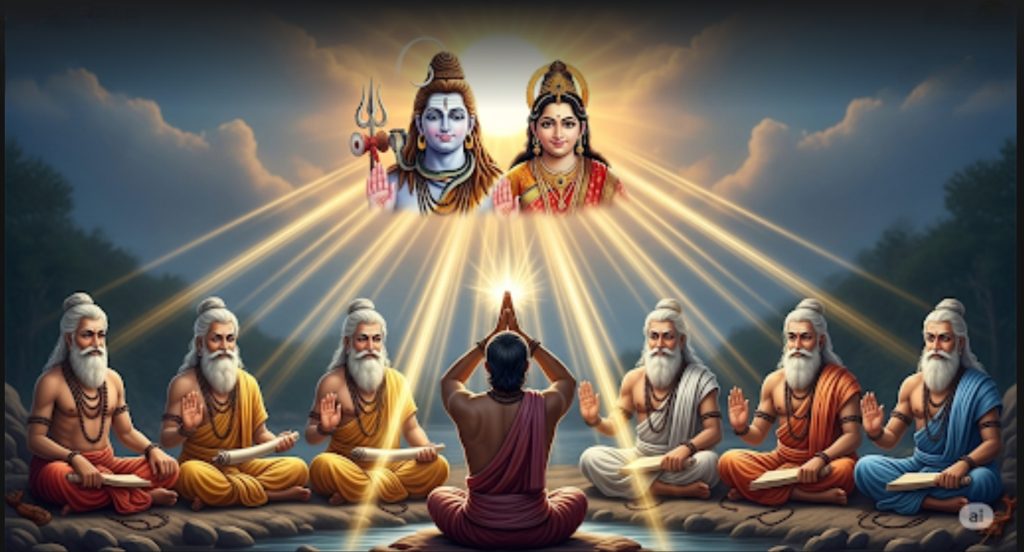
In Namakam, the devotee bows to every form of Śiva, dissolving ego through repeated salutations; in Chamakam, one receives blessings in cascading waves, affirming the abundance that flows from surrender.

This duality reflects the aspect of Śivadissolution and creation, humility and grace.

As the chant deepens, sound itself begins to dissolve into silence—not the absence of vibration, but the presence of stillness, the fullness of Brahman. In this silence, the soul rests in its source, where the final “Om” fades into the quiet language of the Absolute (remember Bhagawan’s darshan in Prashanti, the quiet, the stillness)

Thus, ānanda-pravāha is not merely a chant or a concept—it is a journey from seeking to being, from devotion to union, from sound to silence.

Introduction

In the sacred rhythm of Śrī Rudram, the seeker does not merely chant—he aligns. Each verse is a portal, each name a vibration of the divine. This week, we explore two verses that reveal Śiva as both cosmic protector and intimate source of vitality, wisdom, and grace.


Namakam & Chamakam: A Divine Dialogue

  • Namakam bows to Śiva in his many forms—fierce, benevolent, timeless—offering reverence to the One who dissolves illusion and grants liberation. It is the deep, profound act of surrendering the ego—the recognition that true power lies not in our own will, but in bowing to the cosmic force that governs all.
  • Chamakam responds with yearning, invoking divine blessings for every aspect of embodied life—from breath and intellect to peace and protection. It is a heartfelt prayer for the fulfillment of our purpose, a sacred request to be equipped with the tools needed to live a meaningful, joyful life.

Together, they form a spiritual conversation:

  • Namakam is the “Letting Go”: It’s a humbling recognition that we are not the doer, but a channel for divine will. It teaches us that true freedom comes from surrendering control.
  • Chamakam is the “Receiving”: It’s an active and joyful prayer for everything needed to live a full life. It teaches us that our desires are not selfish, but a path to serve the divine.

This sacred dialogue shows us that true spiritual practice isn’t just about renunciation, but about a balanced lifesurrendering what holds us back so we can receive the blessings that propel us forward.

Together, they form a spiritual conversation: surrender and fulfillment, invocation and grace.


Selected Verses

Namakam – Verse 1.2

Sanskrit Text
नमो अस्तु भगवन् विश्वेश्वराय महादेवाय त्र्यम्बकाय त्रिपुरान्तकाय त्रिकाग्निकालाय कालाग्निरुद्राय नीलकण्ठाय मृत्युञ्जयाय सर्वेश्वराय सदाशिवाय श्रीमन्महादेवाय नमः

Transliteration
namo astu bhagavan viśveśvarāya mahādevāya tryambakāya tripurāntakāya trikāgnikalāya kālāgnirudrāya nīlakaṇṭhāya mṛtyuñjayāya sarveśvarāya sadāśivāya śrīmanmahādevāya namaḥ

Translation
Salutations to the Divine Lord, To the Lord of the Universe, the Great God, The Three-eyed One, the Destroyer of the Three Cities, The One who embodies the three sacred fires and time itself, To Rudra, the Fire of Time, the Blue-Throated One, The Conqueror of Death, the Lord of All, The Ever-Auspicious One, the Glorious Great God—salutations.

Detailed Word-by-Word Table

Word/PhraseMeaning
namo astuMay there be salutations
bhagavanDivine Lord
viśveśvarāyaLord of the universe
mahādevāyaGreat God
tryambakāyaThree-eyed One
tripurāntakāyaDestroyer of the three cities
trikāgnikalāyaEmbodiment of the three sacred fires
kālāgnirudrāyaRudra as the fire of time
nīlakaṇṭhāyaBlue-Throated One
mṛtyuñjayāyaConqueror of death
sarveśvarāyaLord of all
sadāśivāyaEver-auspicious One
śrīmanmahādevāyaGlorious Great God
namaḥSalutations

Though widely included in traditional recitations, the verse “namo astu bhagavan viśveśvarāya…” is not part of the canonical 11 Anuvākas of the Namakam in the Taittirīya Samhitā of the Krishna Yajurveda. Instead, it is a devotional śloka found in various Śiva stotra compilations, often appended as a concluding benediction to the first Anuvāka.

This verse is like a crown jewel—it doesn’t follow the rhythm of the “namaḥ” cascade, but it encapsulates the essence of Rudra’s divinity in one sweeping invocation. Its inclusion in chanting honors the fullness of Śiva in his cosmic, benevolent, and transcendent forms—Viśveśvara, Mahādeva, Tryambaka, Sadāśiva—bridging the liturgical precision of Vedic structure with the devotional fullness of living tradition. While its exact origin is not traceable to the Vedas themselves, it reflects the Bhakti-era poetic style and is preserved in temple liturgies and stotra collections. We present it here under the Namakam section to honor its widespread use and spiritual resonance, even though it stands outside the canonical Rudram verses.


The Transition

This image beautifully embodies the transition from Namakam to Chamakam:

  • Namakam’s reverence—the suspended bead, held in awe
  • Chamakam’s fulfillment—the ripple, the descent, the blessing received

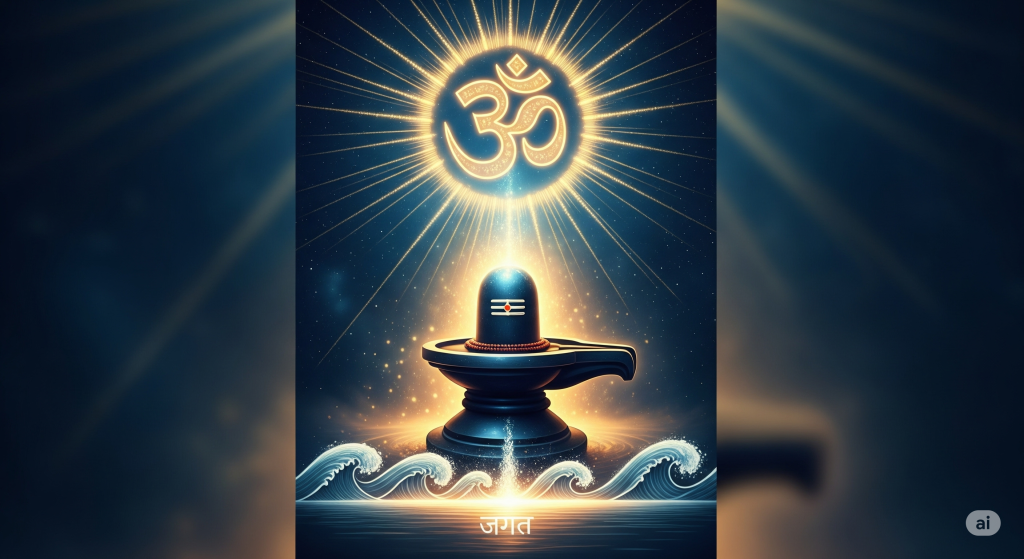
As the sacred bead meets the stillness, a quiet transformation unfolds. The rudrākṣa, symbol of the seeker’s intent, descends into the serene waters of divine consciousness—its touch rippling through the soul’s silence. In that moment, desire becomes devotion: no longer a grasping for worldly gain, but a yearning refined by reverence.

The verses of Chamakam arise not from craving, but from sacred aspiration, where each request is steeped in dharma and surrender. Invocation becomes offering—what was once a call to the divine now becomes a gift of vulnerability, a pouring forth of the heart.

This threshold marks the shift from Namakam’s glorification to Chamakam’s fulfillment, reminding us that even our asking, when offered with love, is a form of worship.


Chamakam – Anuvāka 1

Sanskrit Text:
अग्नाविष्णो सजोषसेमावर्धन्तु वाङ्गिरः । द्युम्नैर्वाजेभिरागतम् । वाजश्च मे प्रसवश्च मे प्रयतिश्च मे प्रसितिश्च मे धीतिश्च मे क्रतुश्च मे । स्वरश्च मे श्लोकश्च मे श्रवश्च मे ज्योतिश्च मे सुवश्च मे । प्राणश्च मे अपानश्च मे व्यानश्च मे असुश्च मे चित्तं च मे आधीतं च मे । वाक्च मे मनश्च मे चक्षुश्च मे श्रोत्रं च मे दक्षश्च मे बलं च मे । ओजश्च मे सहश्च मे आयुश्च मे जराच्च मे आत्मा च मे तनूश्च मे । शर्म च मे वर्म च मे अङ्गानि च मे स्थानि च मे परूषाणि च मे शरीराणि च मे ॥

Transliteration:
agnāviṣṇo sajoṣasemāvardhantu vāṅgiraḥ | dyumnairvājebhirāgatam | vājaś ca me prasavaś ca me prayatiś ca me prasitiś ca me dhītiś ca me kratuś ca me | svaraś ca me ślokaś ca me śravaś ca me jyotiś ca me suvaś ca me | prāṇaś ca me apānaś ca me vyānaś ca me asuś ca me cittaṁ ca me ādhītaṁ ca me | vāk ca me manaś ca me cakṣuś ca me śrotraṁ ca me dakṣaś ca me balaṁ ca me | ojaś ca me sahaś ca me āyuś ca me jarā ca me ātmā ca me tanūś ca me | śarma ca me varma ca me aṅgāni ca me sthāni ca me parūṣāṇi ca me śarīrāṇi ca me ||

Translation:
May Agni and Viṣṇu, united in purpose, bless us through the sacred chants of the Ṛṣis. May they arrive with brilliance and abundance. May I be blessed with: Nourishment, fertility, effort, success, wisdom, resolve, melody, verse, fame, light, heaven, Breath, circulation, vitality, consciousness, learning, speech, mind, sight, hearing, skill, strength, vigor, endurance, long life, graceful aging, soul, body, peace, and protection, limbs, structural placements, joints and articulations, bodies(subtle, causal) and physical form.

Detailed Word-by-Word Table

Word/PhraseMeaning
agnāviṣṇo sajoṣaseAgni and Viṣṇu, united in purpose
imā vardhantu vāṅgiraḥMay these chants be strengthened by the sages
dyumnair vājebhiḥ āgatamMay they arrive with brilliance and abundance
vājaś ca meNourishment, strength
prasavaś ca meFertility, creative impulse
prayatiś ca meSacred effort, offering
prasitiś ca meSuccess, fulfillment
dhītiś ca meWisdom, insight
kratuś ca meWillpower, spiritual resolve
svaraś ca meMelody, musical tone
ślokaś ca meSacred verse, poetic expression
śravaś ca meFame, renown
jyotiś ca meLight, illumination
suvaś ca meHeaven, divine realm
prāṇaś ca meLife breath
apānaś ca meDownward breath (elimination)
vyānaś ca meCirculatory breath (distribution)
asuś ca meVitality, life force
cittaṁ ca meConsciousness, awareness
ādhītaṁ ca meLearning, study
vāk ca meSpeech
manaś ca meMind
cakṣuḥ ca meSight
śrotraṁ ca meHearing
dakṣaḥ ca meSkill, capability
balaṁ ca meStrength
ojaḥ ca meVigor, vitality
sahaḥ ca meEndurance, resilience
āyuḥ ca meLong life
jarā ca meGraceful aging
ātmā ca meSoul, inner self
tanūḥ ca meBody, physical form
śarma ca mePeace, joy
varma ca meProtection, armor
aṅgāni ca meLimbs are mine; physical faculties
sthāni ca meStructural placements are mine; bodily order
parūṣāṇi ca meJoints are mine; points of articulation
śarīrāṇi ca meBodies are mine; complete physical form

Key Takeaways

  • Daily Invocation of Strength: Begin your day with the Namakam verse to invoke clarity, courage, and surrender. Let Śiva’s names remind you that you are supported by cosmic grace.
  • Mindful Integration: Use the Chamakam verse as a meditative checklist—affirming your connection to breath, intellect, vitality, and peace. It’s a holistic wellness mantra.
  • Spiritual Self-Care: These verses are ancient blueprints for balance—physical, mental, and spiritual. Reciting them can center your energy before meetings, creative work, or community service.
  • Living with Intention: The repetition of “ca me” is a reminder: divine support is not abstract—it is personal, present, and accessible. Let each phrase become a conscious affirmation.
  • Sacred Design Thinking: For artists, educators, and seekers—these verses offer symbolic language to infuse your work with depth, beauty, and purpose.

Closing Thoughts

In these verses, we do not merely chant—we align. We do not merely ask—we awaken.

Namakam teaches us to bow with reverence to the cosmic forces that guide and dissolve.
Chamakam teaches us to receive with humility the blessings that sustain and uplift.

In our modern lives, these mantras become more than ritual—they become rhythm.

  • When we feel scattered, Namakam reminds us of the eternal anchor.
  • When we feel depleted, Chamakam offers a vocabulary of renewal.

Let each name of Śiva be a breath of clarity. Let each “ca me” be a heartbeat of divine presence.


Citations & Sacred References


Humble Offering at the Divine Lotus Feet
Jai Sai Ram!


P.S: All images and content created using AI Tools

Sūrya to Ātman

Sūrya to Ātman

A Threefold Path to Your Spiritual Core

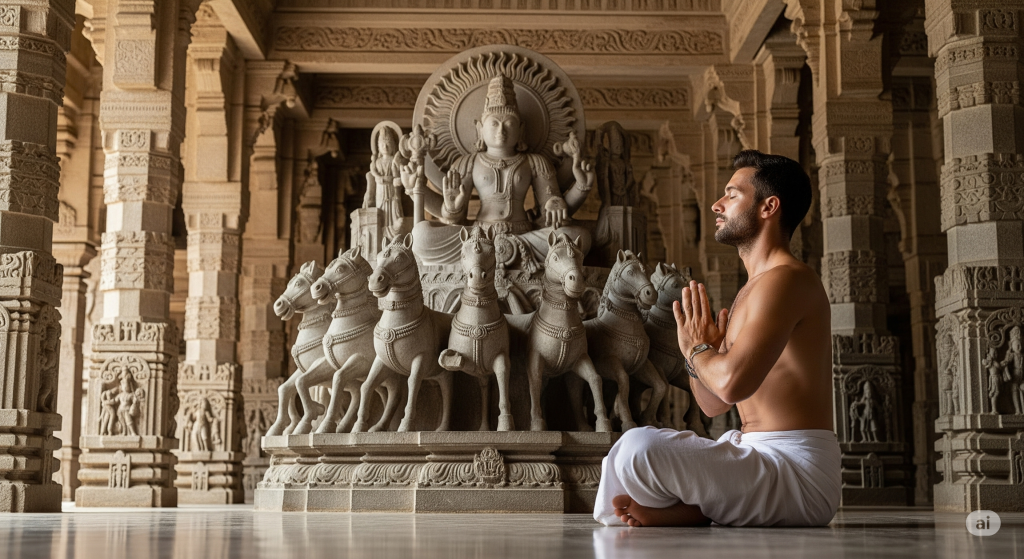
For millennia, the sun has been revered not just as a celestial body, but as the very heart of the cosmos—a tangible manifestation of the divine. Ancient sages understood that the light we see is also a profound inner light that resides within us all. These timeless truths, once the domain of mystics and ascetics, are still accessible to us today through the sacred practice of mantra.

This post will guide you through three powerful mantras dedicated to the sun, revealing their unique spiritual significance and the transformative journey they can offer. You will discover not only a mantra for harnessing the sun’s outer power, but also a deeper, more profound chant from the Upanishad, and a third, transformative mantra that places that very cosmic energy directly within you.

Prepare to journey inward, as we rediscover the ancient wisdom that connects you to the eternal source of all light, consciousness, and purpose.


The Surya Bija Mantra

The first mantra we’ll explore is not a lengthy hymn but a powerful seed sound, known as the Surya Bija Mantra. In Sanskrit, bija means “seed,” and this mantra is believed to hold the concentrated essence of the sun’s core energy. Chanting it is a powerful way to absorb and embody the sun’s vital force.

The mantra is:

ॐ ह्रां ह्रीं ह्रौं सः सूर्याय नमः ॥ (Om Hraam Hreem Hroum Sah Suryaya Namah)

This potent formula is more than just a sequence of sounds; it’s a profound invocation of the sun’s life-giving power. Each syllable is believed to resonate with a specific frequency of solar energy. Consistent practice of this mantra is thought to bestow a number of blessings, including:

  • Vibrant Health and Vitality: Just as the sun nourishes all life on Earth, this mantra is said to energize the body and mind, helping to build a powerful inner vitality.
  • Confidence and Inner Strength: It helps to ignite your inner fire, empowering you with a strong sense of purpose and the courage to face life’s challenges.
  • Clarity and Success: By aligning with the sun’s radiant energy, you can clear away mental fog and illuminate your path forward, leading to greater focus and success in all your endeavors.

This mantra serves as a powerful reminder that the power to shine brightly exists within each of us, waiting to be awakened.


The Surya Ashtakshari Mantra from the Upanishad

This next mantra is a deeper, more philosophical chant, rooted in the ancient wisdom of the Surya Upanishad. It is not a call for energy, but a declaration of the sun’s divine nature and our intrinsic connection to it.

The mantra is:

Oṃ ghṛṇiḥ sūrya āditya oṃ

This mantra is a profound statement of divine reverence. Its words carry immense spiritual weight:

  • Oṃ: The primal sound of creation, representing the ultimate reality.
  • Ghṛṇiḥ: A Vedic term signifying the sun’s radiance, warmth, and compassion. It speaks to the sun’s illuminating and life-giving nature.
  • Sūrya: The visible form of the Sun god, the source of all light and life in our universe.
  • Āditya: An ancient name for the sun, meaning “son of Aditi,” the cosmic mother. This title emphasizes Surya’s divine and eternal origin.

By chanting this mantra, you’re not simply asking for blessings; you are aligning your consciousness with the very source of existence. This practice is believed to purify the mind, dispel negativity, and fill you with a deep, spiritual clarity. It allows you to see the external sun as a reflection of the inner divine light.

How the Words Form the Surya Ashtakshara Mantra

The Surya Upanishad is very specific about the construction of this mantra, stating that it is composed of eight syllables (Ashtakshara). This is a precise formula designed for spiritual resonance.

Sanskrit text

ॐ इत्येकाक्षरं ब्रह्म ।
घृणिरिति द्वे अक्षरे ।
सूर्य इत्यक्षरद्वयम् ।
आदित्य इति त्रीण्यक्षराणि ।
एतस्यैव सूर्यस्याष्टाक्षरो मनुः ।

Transliteration

oṃ ity ekākṣaraṃ brahma |
ghṛṇir iti dve akṣare |
sūrya ity akṣaradvayam |
āditya iti trīṇy akṣarāṇi |
etasyai eva sūryasyāṣṭākṣaro manuḥ |

ॐ इत्येकाक्षरं ब्रह्म ।
“Om” is the single syllable that is Brahman.
घृणिरिति द्वे अक्षरे ।
“Ghṛṇi” is made of two syllables.
सूर्य इत्यक्षरद्वयम् ।
“Sūrya” is of two syllables.
आदित्य इति त्रीण्यक्षराणि ।
“Āditya” consists of three syllables.
एतस्यैव सूर्यस्याष्टाक्षरो मनुः ।
Thus, for this very Sun, the mantra is of eight syllables.

Here is the syllable breakdown:

  • 1st Syllable: Om (ॐ) – The initial syllable.
  • 2nd & 3rd Syllables: Ghri-nih (घृणिः) – This word, meaning “radiance”, “warmth” contributes two syllables.
  • 4th & 5th Syllables: Su-rya (सूर्य) – The name of the Sun god adds two more.
  • 6th, 7th & 8th Syllables: A-di-tya (आदित्य) – This word, meaning “son of Aditi,” provides the final three.

The structure itself is a lesson in spiritual science, showing us that even the very sound and form of a mantra are deliberate, crafted to guide the chanter toward a deeper connection with the cosmos.


The Deeper Connection: The Sūryo Me Cakṣuṣi Mantra

While the mantras we have discussed are for external reverence, this next one is a profound spiritual exercise in internal realization. It is part of the Laghunyasa, a preparatory ritual performed before chanting the powerful Sri Rudram hymn. The term nyasa itself means “placing,” and this mantra is a practice of ritually “placing” the divine within one’s own body.

This mantra is not a prayer but a statement of cosmic identity, unfolding in a beautiful, chain-like realization:

  • Sūryo me cakṣuṣi śritaḥ: “The Sun is placed in my eyes.” This first line declares that our physical sight is not merely a biological function, but a direct manifestation of the divine light of the sun.
  • Cakṣur hṛdaye: “The eyes are placed in the heart.” It deepens the connection by stating that our ability to perceive is not just in our eyes, but is rooted in the spiritual heart (hridaya), the true seat of consciousness.
  • Hṛdayaṃ mayi: “The heart is placed in me.” This is a profound statement of personal identity, confirming that the spiritual core is an integral part of our individual being.
  • Aham amṛte: “I am in immortality.” This shifts the focus from the physical to the metaphysical, asserting that the individual self (aham) is not bound by the mortal world but exists within the eternal.
  • Amṛtaṃ brahmaṇi: “Immortality is in Brahman.” This is the ultimate realization. The immortal self is not a separate entity but is ultimately and completely established in Brahman, the supreme, all-pervading reality.

The entire sequence of this mantra is a journey of spiritual awakening. It guides you from recognizing a physical connection (sun to eyes) to realizing your ultimate, non-dual identity with the divine.


The Synergy of Practice: Uniting Inner and Outer Wisdom

When you bring these three seemingly different types of mantras together, a powerful synergy unfolds.

The Surya Bija Mantra and the Surya Ashtakshara Mantra are practices of looking outward. They are devotional hymns that honor and draw in the sun’s brilliant, life-giving energy from the macrocosm. They are about absorbing and reflecting the light of the divine that shines upon us.

The Sūryo me cakṣuṣi mantra, however, is a practice of looking inward. It is a profound spiritual exercise in internalizing the divine. It allows you to realize that the light you were just honoring is not external to you, but is a fundamental part of your own consciousness, residing in your eyes, your heart, and your very essence.

This combination of practices transforms your spiritual path. You move from simply praising the sun to embodying its light. This is not about seeking a blessing from an external deity; it is about realizing your own divine nature. This powerful synergy fosters a deep sense of unity with the cosmos, granting you not just physical vitality and clarity, but a profound and unshakable connection to the eternal.


Key Takeaways

The three mantras we’ve explored offer a complete spiritual path, moving from outward reverence to profound inward realization.

  • The Surya Bija Mantra (ॐ ह्रां ह्रीं ह्रौं सः सूर्याय नमः): This is a powerful, condensed seed sound for invoking the sun’s vitality. It’s a practice of absorbing the sun’s energy from the external world to gain blessings like health, confidence, and success.
  • The Surya Ashtakshara Mantra (Oṃ ghṛṇiḥ sūrya āditya oṃ): Rooted in the Surya Upanishad, this is a more detailed mantra that honors the sun’s divine radiance. Its chanting is an act of devotion and recognition of the sun as a supreme, cosmic force.
  • The Sūryo Me Cakṣuṣi Mantra: Part of the Laghunyasa ritual, this is a profound statement of self-realization. It is a practice of internalizing the divine light, helping you to realize that the sun’s energy is not just external but is woven into the very fabric of your own consciousness.

The Synergy of Three: The true power lies in their combined practice. By using all three mantras, you create a powerful flow: you first draw in the sun’s energy, then honor its cosmic form, and finally, realize its presence within you. This integrated approach transforms the act of worship into an act of self-realization, bridging the gap between the divine outside and the divine within. Thus we move from Surya to Atman.


Closing Thoughts

In a world filled with endless distractions and demands, finding a moment to connect with a timeless source of power can be truly transformative. The sun is a constant and reliable presence in our sky, a universal symbol of life, light, and consciousness. These ancient mantras are not just old chants; they are powerful tools that remind us of our deep, unbreakable connection to the cosmos. By taking a few moments each day to honor the sun—both in the sky and within yourself—you can cultivate a profound sense of purpose and tap into a wellspring of inner radiance. This simple practice offers a clear path to living a more inspired and purpose-driven life.


Play the AI generated video below to offer Salutations to Lord Surya


Citations and Sources

The information presented in this post is drawn from the following ancient spiritual texts and traditions:

  1. The Surya Upanishad: A key Upanishad dedicated to the praise of Surya, the Sun god. This text is associated with the Atharvaveda and provides the basis for the Oṃ ghṛṇiḥ sūrya āditya oṃ mantra.
  2. The Sri Rudram: A foundational Vedic hymn from the Yajurveda, chanted in praise of Rudra (an aspect of Shiva). The mantra Sūryo me cakṣuṣi śritaḥ is part of a preparatory ritual known as the Laghunyasa, which precedes the main chanting of the Sri Rudram.
  3. General Vedic and Tantric Traditions: The Surya Bija Mantra is a traditional seed sound mantra widely used in various tantric and yogic practices. Its origins are deeply rooted in the broader body of Vedic spiritual knowledge, rather than being attributed to one specific text.

Humble Offering at the Divine Lotus Feet
Jai Sai Ram!


P.S: All content and images generated using AI Tools.

Life’s True Purpose

Life’s True Purpose

From Survival to Fulfillment: Finding Your Life’s True Purpose

Ever feel like you’re just running on a treadmill? You get a good education, land a solid job, chase promotions, and then you look up and wonder, “Is this it?” You’ve mastered the art of earning a living, but you’re still searching for how to truly live a life.

If this sounds like you, you’re not alone. This is a timeless struggle, and thankfully, the answers are just as timeless. They’re found in the profound wisdom of Bhagawan Sri Sathya Sai Baba’s divine discourses and the ancient scriptures he illuminated, showing us the path from mere existence to a purposeful life.


The Two Paths: A Fork in the Road

Bhagawan’s discourse on two kinds of knowledge is like a spiritual GPS. He points out that the education we get today isn’t designed to give us true wisdom. It’s a tool for survival.

“Vidya is of two kinds. One is the Vidya relating to the external situation. The other is the Vidya relating to the internal situation… The kind of education that we are getting today in the schools and colleges cannot be called true Vidya. This will only lead you to occupy some kind of a position and lead your daily life without too much trouble.”

He then gives us the perfect analogy to understand this distinction:

“All types of education are like the rivers while the Brahma Vidya is like the ocean. All the rivers go and merge in the ocean, all types of education lead us to Brahma Vidya.”

In other words, your career path, your technical skills, and your academic degrees are all like rivers. They’re important, they get you from one place to another, but they are all meant to flow into one ultimate destination: the vast ocean of Brahma Vidya, or spiritual knowledge.


The Blueprint: Unlocking Ancient Wisdom

This idea isn’t new; it’s a core teaching of the Upanishads, the ultimate blueprint for a meaningful life. The Mundaka Upanishad lays out the difference between the two paths with stunning clarity.

Lower Knowledge: The Path for a Livelihood (AparaVidya)

This is all the knowledge you get from books, degrees, and worldly pursuits. The Upanishad lists out the Vedas and their auxiliary sciences like phonetics, grammar, and astronomy. In today’s terms, this is your computer science degree, your finance certification, your medical license, and every professional skill you learn. Think of the degrees and certifications we pursue, the professional skills we acquire, and the endless stream of information we consume on a daily basis. From mastering the latest software to understanding complex financial markets, this knowledge equips us to navigate the professional landscape and contribute to society’s material progress. It’s the education that helps us secure jobs, build homes, and provide for our families.This knowledge helps you succeed in the world.

Higher Knowledge: The Path for a Life (ParaVidya)

This is the knowledge that transcends everything else. It is the one thing that, once known, gives you the peace and fulfillment you’ve been searching for. Amidst this pursuit of external knowledge, the yearning for inner peace and deeper understanding persists. In our fast-paced lives, we often seek solace and meaning through practices that align with Para Vidya. This might manifest as engaging in mindfulness and meditation, taking time for self-reflection, or studying spiritual texts to connect with a higher truth. The countless wellness trends and retreats that draw people today are a testament to this inherent human desire for something beyond the material.

The Upanishad calls it “that by which the Imperishable is attained.” It’s the knowledge of your true selfthe part of you that isn’t your job, your social status, or your latest accomplishment.


Authenticity: From the Source

For those who want to connect to the source of this wisdom, here are the original verses and their translations.

The Mundaka Upanishad (1.1.4-5) clearly defines two types of knowledge (Vidya):

Sanskrit Verse:
द्वे विद्ये वेदितव्ये इति ह स्म यद्ब्रह्मविदो वदन्ति परा चैवापरा च ॥ तत्रापरा ऋग्वेदो यजुर्वेदः सामवेदोऽथर्ववेदः शिक्षा कल्पो व्याकरणं निरुक्तं छन्दो ज्योतिषमिति । अथा परा यया तदक्षरमधिगम्यते ॥

Transliteration:
dve vidye veditavye iti ha sma yad brahmavido vadanti parā caivāparā ca. tatrāparā ṛgvedo yajurvedaḥ sāmavedo atharvavedaḥ śikṣā kalpo vyākaraṇaṃ niruktaṃ chando jyotiṣamiti. athā parā yayā tad akṣaramadhigamyate.

Translation:
“Two kinds of knowledge must be known, as declared by those who know Brahman: the higher and the lower. Of these, the lower knowledge is the Rig Veda, the Yajur Veda, the Sama Veda, the Atharva Veda, phonetics, ritual, grammar, etymology, meter, and astronomy. And the higher knowledge is that by which the Imperishable is attained.”

This is further supported by the Katha Upanishad (1.2.8), which stresses that this higher knowledge cannot be obtained through intellect alone but requires a qualified teacher.

Sanskrit Verse:
नैषा तर्केण मतिरापनेया प्रोक्तान्येनैव सुज्ञानाय प्रेष्ठ । यां त्वमापः सत्यधृतिर्बतासि त्वादृङ्नो भूयान्नचिकेतः प्रष्टा ॥

Transliteration:
naiṣā tarkeṇa matirāpaneyā proktānyenaiva sujñānāya preṣṭha. yāṃ tvamāpaḥ satyadhṛtirbatāsi tvādṛṅno bhūyānnaciketaḥ praṣṭā.

Translation:
“This understanding is not to be obtained by reasoning; it is attainable, dear one, when taught by another. You have, Nachiketa, attained it, for you are truly steadfast in truth. May we have an inquirer like you!”


Your Compass on the Quest

The Katha Upanishad adds another critical piece to this puzzle: you can’t walk this path alone. You need a guide. As Bhagawan says, the ability of an individual to lead a seeker to this profound truth is what makes them a guru.

“The ability of an individual to convey the meaning of Atma and Para Brahma to the seekers makes him a guru.”

In our modern world, this guru might not be a traditional sage in a cave. Your guru could be a spiritual teacher, a trusted mentor, or even a book that profoundly changes the way you see the world. The point is, true wisdom is an experience, not just a concept. You need someone who has walked the path to show you the way.


From Information to Transformation

This is where the ancient wisdom becomes your modern-day advantage. The world tells you to focus on the outside—the next promotion, the next big salary, the next title. It’s the late-night study sessions, the endless job applications, the pressure to always be “on.” This pursuit of livelihood is a universal human experience. This is the realm of Apara Vidya.

“What all these people do will be related to the material world.”

This endless push to build a career, climb the ladder, and prove your worth through external achievements can be a very powerful, but ultimately empty, chase if it’s all you have.

Your Wisdom’s Quest is to balance that with Para Vidya. It’s the path of true power: the power of knowing yourself. This is NOT about escaping the world; it’s about finding a way to thrive within it.

So, what does this look like in real life?

  • It’s choosing to sit in silence for ten minutes a day, not to empty your mind, but to listen to your inner voice over the constant noise of notifications.
  • It’s finding joy in creating something with your hands, whether it’s a painting, a song, or a home-cooked meal, as a way to connect with your own spirit.
  • It’s stepping away from a toxic comparison on social media and remembering that your worth isn’t measured in likes or followers.
  • It’s volunteering for a cause you believe in, realizing that true fulfillment comes from service, not just consumption.
  • It’s having the courage to face your own fears and insecurities, understanding that this inner work is a thousand times more valuable than any external success.

Remember, the goal isn’t to abandon your career or your ambitions. It’s to give them meaning. A life filled with purpose is not about doing a job; it’s about being your true self while you do it. The goal is to move beyond mere survival and find genuine fulfillment.

By consciously cultivating Para Vidya, you give the pursuits of Apara Vidya a deeper, richer purpose.


The World Is Your University: Finding Your Guru in Creation

While a human guru can guide you on the path of Brahma Vidya, ancient wisdom teaches us that our education in truth is all around us. The world is not just a place of distraction; it is a profound university, and God’s creation is the most important guru of all.

By embracing a holistic view of life, we realize that wisdom is not confined to textbooks or lecture halls. It’s found by learning to blend harmoniously with nature and observing its silent teachings.

Look to the trees, which teach us the principle of selfless equality, giving shade and fruit to all without distinction. Look to the unyielding mountains, patiently standing through sun, rain, and cold, teaching us to be unattached to the fleeting cares of the body. The birds, perpetually moving and never staying in one place, remind us that the world is impermanent and nothing truly belongs to us.

“All that is contained in the creation – the mountains, the trees, the rivers – are teaching us constantly. The education that nature around us gives us is much more than the education given by a guru or a mother or a father. Therefore, if we can really understand the secret of the creation around us, our minds will not go after the attractions of the material world. There is nothing more wonderful or awe-striking than God’s creation.” –Bhagawan Sri Sathya Sai Baba, summer Showers 1978

The education that nature gives us is much more valuable than any formal learning. By truly understanding the secret of the creation around us, our minds are naturally weaned away from the fleeting attractions of the material world. It is in this grand, living school that we are constantly reminded of what is real and what is not, what is lasting and what is an illusion.


Your Time to Shine

This isn’t just a blog post; it’s an invitation. An invitation to stop running on the treadmill and start walking your true path. The world will always push you to succeed on the outside, but your greatest adventure, your greatest legacy, is to find that inner light.

The light is within you. The knowledge of it is a gift, and as Bhagawan beautifully explains, Brahma Vidya teaches us about our true Self, but it is tapas that leads to a profound union with that truth.

Simply knowing about this inner light, about the boundless potential within, isn’t enough. It requires tapas – the dedicated, consistent effort of spiritual practice. This could be regular meditation, selfless service, mindful self-reflection, or any discipline that purifies your inner being like the active practice of paying attention to the wisdom all around us. It’s the silent reflection gained from sitting in the presence of a mountain, the peace learned from the selfless giving of a tree, and the detachment observed in the birds in the sky. It is the conscious choice to blend harmoniously with creation and let its lessons guide your journey and focus your energy.

It is through this inner “tapas,” this fiery dedication, that we move beyond intellectual understanding and begin to directly experience the truth of our being. It is the active practice that burns away the obstacles, quiets the external noise, and allows the inner light to not just be known, but to shine brightly. It is through this deep inner work that we move beyond simply knowing about our inner light and begin to directly experience its power. It is time to make it shine through your own dedicated practice. It’s time to make your lamp shine.


Citations

  1. Divine Discourse Delivered by Bhagawan Sri Sathya Sai Baba, “God’s Creation Around Us Has A Great Deal To Teach Us,” Summer Showers 1978.
  2. Mundaka Upanishad, Part 1, Chapter 1, Verses 4-5.
  3. Katha Upanishad, Part 1, Chapter 2, Verse 8.

Humble Offering at the Divine Lotus Feet
Jai Sai Ram!


P.S: All content and images generated using AI Tools.

Infinite Light

Infinite Light

Unlocking the Gayathri: The 24 Syllables of Light

Section 1: Introduction

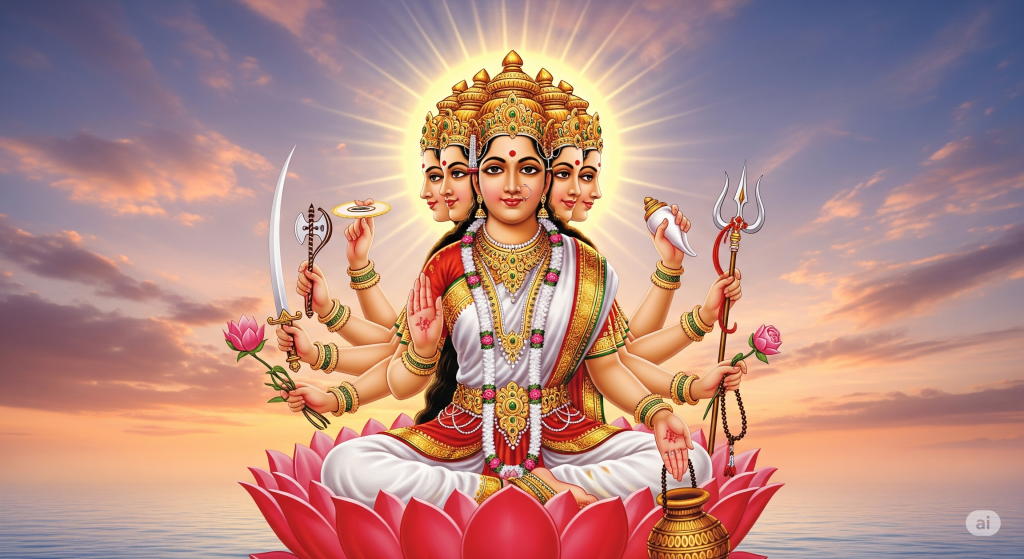
In the vast ocean of Vedic revelation, few mantras shine with the brilliance and precision of the Gayathri. Known as the Veda-mātā—the Mother of the Vedas—this mantra is not merely a sacred utterance, but a sonic embodiment of cosmic order, spiritual aspiration, and inner illumination.

Composed of 24 syllables arranged in the Gayathri chhandas, it is a mantra of light—each syllable a bead of radiance, each word a gateway to higher consciousness. To chant the Gayathri is to align oneself with the rhythm of creation, to awaken the buddhi (intellect), and to invite the divine radiance of Savitṛ into the heart.

This blog post is a self-contained journey into the mantra’s architecture, its chhandas, and the metaphysical significance of its 24 syllables. We will explore how each syllable corresponds to a principle of existence, and how the mantra itself becomes a luminous map of spiritual ascent.

This exploration based on the Devi Bhagavatam (Archive.org – Gayatri in Devi Bhagavatam), invites you to listen deeply, reflect reverently, and chant with clarity.

Section 2: Architectural Overview

The Sonic Structure of Illumination

The Gayathri Mantra is not a random string of syllables—it is a meticulously crafted sonic architecture, encoding layers of cosmology, psychology, and spiritual ascent. Its structure reflects the Vedic vision of reality: tripartite, rhythmic, and radiant.

The Threefold Design

The mantra unfolds in three distinct segments:

  1. Pranava (ॐ)
    • The primordial sound, representing the Absolute Reality (Brahman)
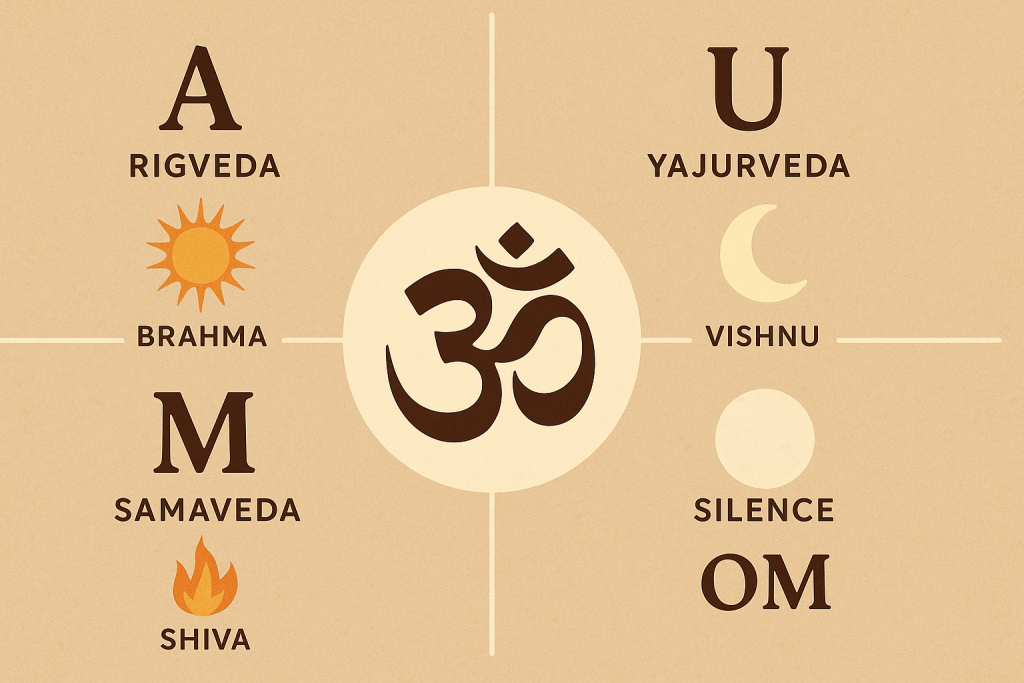
    • Encapsulates the triad: A-U-MWaking, Dreaming, Deep Sleep
    • Acts as the seed and seal of all Vedic mantras
  2. Vyāhṛtis (भूः, भुवः, सुवः)
    • The three cosmic realms:
      • Bhūḥ – Earth / Physical plane
      • Bhuvaḥ – Atmosphere / Mental plane
      • Suvaḥ – Heaven / Spiritual plane
    • These are cosmic coordinates, aligning the chanter with the universal field
  3. Gayathri Verse Proper (Tat Savitur Vareṇyaṃ… )
    • The core 24-syllable verse in Gayathri Chhandas
    • A prayer to Savitṛ, the divine solar force, to awaken the buddhi (intellect)
    • Each syllable is a bead of light, forming a garland of illumination

Mantric Architecture as Metaphysical Blueprint

This tripartite design mirrors the threefold nature of existence:

  • Adhibhautika – Physical (Bhūḥ)
  • Adhidaivika – Divine/Cosmic (Bhuvaḥ)
  • Adhyātmika – Spiritual/Internal (Suvaḥ)

It also reflects the threefold path of realization:

  • Jñāna – Knowledge
  • Karma – Action
  • Upāsanā – Devotion

Thus, the Gayathri is not just a mantra—it is a map of being, a method of awakening, and a mirror of the cosmos.

Section 3: Chhandas – The Metre of Light

Rhythm as Revelation

In Vedic poetry, chhandas refers to the metrical structure—the rhythmic blueprint through which mantras flow. The Gayathri Mantra is composed in the Gayathri Chhandas, one of the most revered metres in the Vedic tradition.

The Chhandogya Upanishad emphasizes the sanctity of the Gayatri metre, stating that it holds together the entire creation by its rhythmic balance (Sacred Texts – Chhandogya Upanishad).

Similarly, the Devi Bhagavatam declares Gayatri as the very embodiment of the Vedas, pervading all metres and sustaining the devas through its syllabic power (Archive.org – Gayatri in Devi Bhagavatam).

Thus, the architecture of the Gayatri Mantra is both poetic and cosmic, reflecting how sound (śabda) and rhythm (chhanda) bridge the human and the divine.

Structure of Gayathri Chhandas

  • Total syllables: 24
  • Divided into 3 pādas (lines)
  • Each pāda contains 8 syllables

This tripartite rhythm is not arbitrary—it reflects the threefold nature of reality and the three realms of existence invoked in the mantra: Bhūḥ, Bhuvaḥ, and Suvaḥ.

Let’s visualize it:

PādaSanskrit TextSyllables
1तत् सवितुर्वरेण्यंtat-sa-vi-tur-va-re-ṇyam
2भर्गो देवस्य धीमहिbhar-go-de-va-sya-dhī-ma-hi
3धियो यो नः प्रचोदयात्dhi-yo-yo-naḥ-pra-cho-da-yāt

Each syllable is counted by its phonetic unit, not by its written form. This precision ensures that the mantra’s vibrational integrity is preserved during chanting.

Gayathri Verse Proper

The heart of the mantra, composed in Gayathri Chhandas—three pādas of eight syllables, totaling 24. This is the luminous invocation to Savitṛ, the divine solar force, to awaken and guide the intellect (buddhi).

तत् सवितुर्वरेण्यं
भर्गो देवस्य धीमहि
धियो यो नः प्रचोदयात् ॥

tat savitur vareṇyaṃ
bhargo devasya dhīmahi
dhiyo yo naḥ pracodayāt ॥

Translation

Let us meditate on the most excellent light of Savitṛ, the divine radiance. May that light inspire and awaken our intellect.

Symbolism of 24

The number 24 is deeply symbolic in Vedic and Tantric cosmology:

  • 24 tattvas in Sāṅkhya philosophy
  • 24 hours in a day—linking mantra to solar rhythm
  • 24 syllables as beads of light in the Gayathri garland

Thus, the Gayathri Chhandas becomes a metaphysical metronome, aligning the chanter with cosmic order and inner clarity.

Gayathri Mantra: Thematic Division by Pāda

PādaSyllablesActual SyllablesThemeInterpretation
1st1–8Tat Sa Vi Tu Va Re Nya MInvocation & IlluminationAwakening divine consciousness; invoking Savitur (the Sun) as the source of light and life.
2nd9–16Bha Go De Va Sya Dhi Ma HiExpansion & RealizationMeditating on the divine qualities (Bhargo Devasya); purifying intellect and deepening awareness.
3rd17–24Yo Yo Nah Pra Cho Da Ya AtIntegration & LiberationPraying for divine guidance (Dhiyo Yo Nah Prachodayāt); aligning intellect with cosmic will.

Notes on Accuracy & Source Alignment

  • The syllables are drawn directly from the Gayathri Mantra as chanted in Vedic tradition:
  • This division is supported by:
    • Taittiriya Aranyaka (2.11.1–8) – defining Gayatri as a meter of 3 pādas × 8 syllables
    • Gayatri Upanishad – interpreting the mantra as a journey from invocation to illumination
    • Commentaries by Swami Sivananda, Pandit Shriram Sharma, and AWGP – elaborating on the spiritual progression encoded in the mantra

Section 4: Gayathri Mantra: 24 Syllables, Rishis & Their Spiritual Gifts

Structured by the three pādas of the Gayatri meter (8 syllables each)

Pāda 1: Invocation & Illumination

Awakening divine consciousness; invoking Savitur as the source of light and life

Tat Savitur Varenyam

This first part of the mantra is associated with the initial eight sages and their contributions.

SyllableSageKey Contributions
TatVamadevaSeer of the fourth Mandala of the Rigveda; known for spiritual wisdom.
SaAtriSeer of the fifth Mandala of the Rigveda; author of the Atri Smriti.
ViVasishthaAuthor of the seventh Mandala of the Rigveda; royal guru of Rama in the Ramayana.
TurShukraPreceptor of the Asuras; possessed the knowledge of reviving the dead (Mṛtyu Sañjīvanī Vidyā).
VaKanvaMentor of Shakuntala in the Mahabharata; known for moral integrity.
ReParasharaFather of Vedavyasa; author of the Viṣṇu Purāṇa and a foundational text on astrology.
NiyamVishwamitraCredited with the creation of the Gayatri Mantra; attained the status of a Brahmarishi.
BharKapilaFounder of the Samkhya school of philosophy.

Pāda 2: Expansion & Realization

Meditating on divine qualities; purifying intellect and deepening awareness

Bhargo Devasya Dhimahi

The second part of the mantra is linked to the next eight sages, known for their significant philosophical and literary works.

SyllableSageKey Contributions
GoShaunakaLeader of sages who listened to spiritual teachings at Naimisharanya.
DeYajnavalkyaA major figure in the Upanishads; known for his dialogues on the nature of the self (Atman).
VaBharadwajaFather of Dronacharya; a Vedic sage credited as a seer of the sixth Mandala of the Rigveda.
SyaJamadagniFather of Parashurama; known for his righteous character.
DheeGautamaAuthor of the Nyaya Sutras, the foundational text of the Nyaya school of logic.
MaMudgalaAssociated with the Mudgala Upanishad; known for his patience.
HiVedavyasaCompiler of the Vedas; author of the epic Mahabharata and the Puranas.
DhiLomashaA sage who narrated various legends to the Pandavas during their exile.

Pāda 3: Integration & Liberation

Praying for divine guidance; aligning intellect with cosmic will

Dhiyo Yo Nah Prachodayat

The final part of the mantra is associated with the last eight sages, many of whom are known for their profound spiritual knowledge and divine roles.

SyllableSageKey Contributions
YoAgastyaConsidered the father of the Tamil language; known for drinking the ocean.
YoKaushikaA master of Vedic knowledge; taught principles of Dharma.
NahVatsyaKnown as a disciple of the sage Shakala who divided the Rigveda.
PraPulastyaA mind-born son of Brahma; grandfather of the Asura king Ravana.
ChoMandukaThe sage associated with the Mandukya Upanishad, a profound text on the syllable Om.
DaDurvasaKnown for his quick temper and powerful curses as well as boons.
YaNaradaA divine sage and master musician; celestial messenger.
TKashyapaOne of the seven great sages (Saptarishi); progenitor of many beings, including gods and demons.

Section 5: Key Takeaways and Application

  • Mantra as Architecture of Consciousness: The Gayatri reveals the power of syllables, padas, and chhandas as blueprints of inner and outer cosmos.
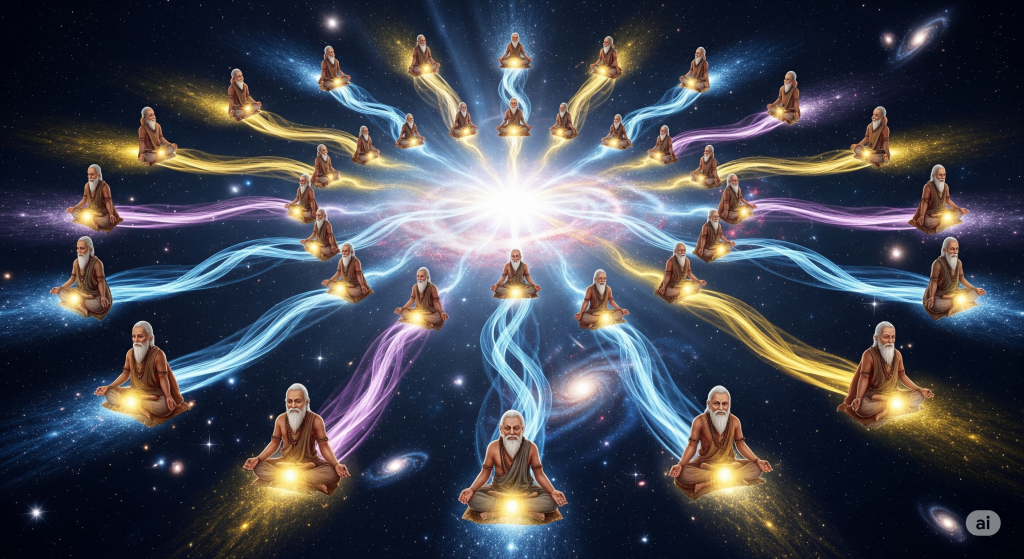
  • Rishi Associations: Each syllable resonates with the tapas, wisdom, and realization of ancient seers, connecting the chanter to an unbroken lineage of spiritual insight.
  • Devata Associations: The syllables embody divine forces, harmonizing the microcosm (individual) with the macrocosm (universe).
  • Practical Application: Regular chanting refines the intellect (dhi), aligns thought with dharma, and awakens clarity, courage, and compassion in daily life.

The reader thus inherits not only a mantra but also an architecture of awakening—a way to harmonize body, mind, and spirit with the eternal rhythm of the cosmos.


Section 6: Closing Reflection

The Gayatri Mantra is not merely a prayer but a living bridge between sound and spirit, seer and seeker, cosmos and consciousness. To chant it with understanding is to participate in the ancient symphony of the sages, invoking the light that guides all beings toward truth.


Citations

Devi Bhagavatam (Archive.org – Gayatri in Devi Bhagavatam).

The information about the associated Rishis (sages), and Devatas (deities) is found in the Devi Bhagavatam, specifically in the 12th Book, Chapter 1.

This link provides a direct translation of the relevant verses where Sage Narayana explains the details of the Gayatri Mantra to Sage Narada, including the complete list of 24 Rishis and their respective Devatas.


Humble Offering at the Divine Lotus Feet
Jai Sai Ram!


PS: All images and content generated using AI Tools

Māsa Shivaratri

Māsa Shivaratri

Māsa Shivaratri: Remembering the Shiva Within

Each month, on the 14th night of the dark fortnight, the moon nearly disappears from the sky. In the spiritual calendar, this night—known as Māsa Shivaratri—is a sacred invitation to turn inward, to quiet the mind, and to contemplate the eternal. While Mahā Shivaratri is widely celebrated once a year, Bhagawan Sri Sathya Sai Baba reminds us that Shivaratri is not an annual event alone—it is a monthly opportunity for spiritual renewal.

“We have not only the Mahashivaratri once a year, but have a Shivaratri every month, dedicated to the worship of Shiva.” — Bhagawan Sri Sathya Sai Baba, 1969 Shivarathri Discourse

The Moon, the Mind, and the Night of Shiva

In His discourse, Bhagawan explains that the moon is the presiding deity of the mind. As the moon wanes during the dark fortnight, so too does the influence of the mind. On the 14th night, only one sixteenth of the moon remains—symbolizing the final vestige of mental distraction. This makes Māsa Shivaratri an ideal time for sādhana, when the mind is most subdued and the heart is most receptive. It is a sacred invitation to turn inward, to dissolve illusion, and to awaken to the formless Truth within. This is Māsa Shivaratri—a monthly spiritual observance that culminates on the 14th night of the dark fortnight, known as Chaturdashi, the night of Shiva.

“The aim of all sadhana is to eliminate the mind. On this night, the moon which is the presiding deity of the mind has only one sixteenth of its power left.” — Bhagawan Sri Sathya Sai Baba, 1969 Shivarathri Discourse

Divine Grace Meets Human Effort

As Māsa Shivaratri invites us into inner stillness, Bhagawan reminds us that spiritual progress is not measured by grandeur, but by sincerity. Even the smallest movement toward liberation—be it a moment of silence, a whispered mantra, or a heartfelt prayer—is met with immense divine grace.

“If you make the slightest effort to move along the Path of your own liberation, the Lord will help you a hundred-fold. That is the hope that MahaShivarathri conveys to you.” — Bhagawan Sri Sathya Sai Baba, 1969 Discourse

This assurance transforms Māsa Shivaratri from a ritual into a monthly renewal of hope. It’s not about perfection—it’s about presence. The Lord does not wait for us to be ready; He responds the moment we begin.

Soham to OM: The Breath of Oneness

In the quiet hours of Māsa Shivaratri, Bhagawan invites us to visualize Shiva not as a distant deity, but as the inner power of all existence. With each breath, we unconsciously affirm Soham — “I am He.” This sacred assertion is not limited to sages or seekers; it is the natural rhythm of life itself.

“Resolve, on this Holy Shivarathri, in the Presence of Shiva Sai, to visualise the Shiva as the inner power of all. With each breath, you are even now, asserting ‘Soham,’ ‘I am He,’ not only you, but, every being that breathes, every being that lives, everything that exists.” — Bhagawan Sri Sathya Sai Baba, 1969 Discourse

Bhagawan explains that as we watch our breath and meditate on this Truth, the sense of separation between Sah (He) and Aham (I) begins to dissolve. Eventually, Soham transforms into OM — the Pranava, the primordial sound, the Swaswaruupa, or true nature of the Self.

This teaching turns Māsa Shivaratri into a breath-based meditation, a monthly reminder to return to our source. It’s not about doing more—it’s about being more aware.

The Linga: Formless Form, Graceful Emergence

One of the most profound moments in Bhagawan’s Shivaratri discourses is the emergence of the Lingam—a sacred symbol of the formless Absolute. The Lingam is not merely an object of worship; it is a cosmic reminder of our true nature.

Bhagawan reveals that the Linga emerges not by magic, but through prayer and Grace. It is not merely a ritual object—it is a glimpse of Divinity, a sign of infinite compassion. Just as OM is the sound symbol of the Divine, the Linga is the form symbol—the most austere, meaningful, and attribute-free representation of God.

“Just as Om is the sound symbol of God, the Linga is the Form symbol or the visible symbol of God, the most meaningful, the simplest and the least endowed with the appendages of attributes.” — Bhagawan Sri Sathya Sai Baba, 1969 Shivarathri Discourse

“That which merges with the goal is Lingam — Leeyathe gamyam ithi lingam.” — Bhagawan Sri Sathya Sai Baba, 1969 Shivarathri Discourse

The Sanskrit etymology deepens this insight:

  • Lingam: That in which the Jagat (changing world) attains Laya (mergence).
  • Leeyathe: To dissolve, to merge.

Thus, the Linga is not just a symbol—it is the point of origin and return, where all forms dissolve into the formless essence.

Why the Night Matters: The Mind and the Moon

As Bhagawan explains that the Moon is the presiding deity of the mind, and just as the Moon wanes during the dark fortnight, so too must the mind be gradually dissolved through sadhana, to become A-manaska. Then only can maya (illusion) be rent asunder and the Reality revealed.

“The aim of all sadhana is to eliminate the mind.” –Bhagawan Sri Sathya Sai Baba, 1969 Shivarathri Discourse

Each night leading up to Shivaratri, a fraction of the Moon disappears—and with it, we are invited to let go of a fraction of our mental clutter. On Chaturdashi, only a sliver remains. It is the most potent time to engage in deep sadhana: puja, japam, dhyana. With vigilant effort, the mind can be quieted, and the veil of maya lifted.

In that silence, Shiva is revealed—not as a form, but as the formless Truth within.

Chidambara Rahasya: The Curtain of Maya

This revelation finds its perfect parallel in the sacred mystery of the Chidambaram Nataraja Temple. In its innermost sanctum, a curtain is lifted for a fleeting moment—not to reveal a deity, but emptiness. No idol, no flame—just space adorned with golden Bilva leaves. And then, the curtain falls again.

This is the Chidambara Rahasya—the secret of Chidambaram. The curtain symbolizes Maya, and its lifting represents the moment of inner revelation, when ignorance is parted and the seeker glimpses the Nishkala Shiva, the formless, attributeless Reality of Shiva.

“In Chidambaram, the curtain lifts for a moment—and we see nothing. But in that nothing, the sages saw everything. This is the Rahasya, the secret: The Divine is not hidden in form, but revealed in formlessness.”

Māsa Shivaratri is our personal Chidambaram. Each month, we are given the chance to lift the curtain of our own mind, to dissolve the ego, and to behold the emptiness that is fullness, the silence that is Truth, the Shivam that is our own Self.

Monthly Worship: A Lifestyle, Not a Ritual

Bhagawan cautions us not to confine our devotion to one night a year. Instead, He encourages us to observe every Māsa Shivaratri with sincerity and simplicity. This can include:

  • Japa of the sacred mantra Om Namah Shivaya
  • Meditation on the inner light or Lingam
  • Upavāsa (fasting) or mauna (silence)
  • Night vigil with bhajans, scriptural reading, or quiet contemplation

“Every moment in our life can be taken to be Shivaratri. We need not wait for Shivaratri on a particular day in a year.” — Bhagawan Sri Sathya Sai Baba, 1969 Shivarathri Discourse

A Discourse to Contemplate

The 1969 Shivaratri discourse is rich with metaphors, insights, and spiritual encouragement. It reminds us that Shiva is not distant or abstract, but the very consciousness that animates all life. He is the stillness behind thought, the light behind the eyes, the silence between breaths.

Bhagawan’s words are not just teachings—they are invitations. Invitations to merge, to surrender, to awaken.

Final Reflection: The Curtain Within

On this Māsa Shivaratri, let us not seek the Divine in distant rituals or elaborate forms. Let us sit quietly, breathe gently, and lift the curtain of our own mind. Just as in Chidambaram, where the veil is drawn back to reveal sacred emptiness, we too can glimpse the formless Truth within—not through sight, but through stillness.

“Soham — I am He.” “OM — the Reality behind this relative reality.”

Each breath affirms our oneness. Each moment of silence draws us closer to the Divine Indweller. And in that sacred pause, what was once ego(illusion/ignorance) becomes Shivam (living divinity).

Tonight, let us dissolve the last fraction of the mind. Let us offer this layer of illusion to the fire of awareness. Let us become still enough to hear the breath of Shiva within.


Discourse Citation
Bhagawan Sri Sathya Sai Baba, Divine Discourse on Mahaashivarathri, Prasanthi Nilayam, February 1969. Available at: https://saispeaks.sathyasai.org/discourse/mahaashivarathri


Humble Pranams at the Divine Lotus Feet
Jai Sai Ram!


PS: All content and images created using AI Tools

Insights from Pranava

Insights from Pranava

The Secret of Om: Insights from Pranava Upanishad

1. Introduction

Among the 108 traditional Upanishads, the Pranava Upanishad of the Atharva Veda holds a luminous place. It unfolds the mystery of Pranava (ॐ, Oṁ) — the primordial sound, the essence of the Vedas, and the very expression of Brahman. In just 13 verses, this Upanishad reveals how all worlds, gods, elements, scriptures, fires, and states of consciousness are contained within this single syllable.

A Refresher on the Upanishads

The Upanishads (literally “sitting near” the teacher) are also known as Vedānta — the crown and conclusion of the Vedas. Traditionally, there are 108 Upanishads, revered for distilling the highest truths of existence. These are spread across the four Vedas as follows:

VedaNumber of UpanishadsExamples
Ṛgveda10Aitareya, Kaushitaki, Ātma, Nārāyaṇa
Sāmaveda16Kena, Chāndogya
Yajurveda (Śukla & Kṛṣṇa)19+32Īśa, Kaṭha, Taittirīya, Bṛhadāraṇyaka
Atharva Veda31Muṇḍaka, Māṇḍūkya, Pranava, Kaivalya

This chart beautifully illustrates how the Yajurveda holds the lion’s share, followed by Atharva Veda, with Sāmaveda and Ṛgveda contributing more selectively.

  • Of these, 10–13 are principal (Mukhya) Upanishads that Śaṅkarācārya and other ācāryas extensively commented upon.
  • The others are considered minor Upanishads, often focused on yoga, renunciation, and devotional practices
  • The Pranava Upanishad is associated with Atharva Veda

2. References from Bhagawan Sri Sathya Sai Baba on Pranava / Om

Bhagawan Baba has again and again highlighted the significance of Pranava:

  • “Om is the sound symbol of God.” (Sri Sathya Sai Speaks, Vol 9 (1969), Shivarathri, Feb)

  • “Om or Pranava is the merging together of three sounds, A, U, and M. When you write GOD, you do not pronounce it ‘jee-oh-dee’, you voice it as GOD. So too, AUM is pronounced Om, Om has a sequel, of a fading M sound which finally tapers into silence, a silence that is felt and experienced” Sri Sathya Sai Speaks, Vol 6 (1966), Birthday – 41, 23 November 1966

These discourses beautifully confirm what the Pranava Upanishad itself proclaims — that Oṁ is the body of Brahman, and meditation on it leads to immortality.

A Journey Through All 13 Verses of the Pranava Upanishad

Before focusing on selected highlights, it is helpful to first walk through the entire progression of the 13 verses. The Pranava Upanishad is concise yet profound — each verse adding a new layer to the revelation of Oṁ.

Summary of the Thirteen Verses

  1. Setting the Context — The secret of Brahmavidyā (knowledge of Brahman) is declared.
  2. The Identity of Oṁ — Oṁ is the Imperishable Brahman; its “body” includes space, time, and existence.
  3. The Convergence of Triads — All cosmic triads (3 deities, 3 worlds, 3 Vedas, 3 fires, 3 syllables) are united in Oṁ
  4. The Body of A — Ṛgveda, Earth, Gārhapatya fire, and Brahmā.
  5. The Body of U — Yajurveda, Mid-space, Dakṣiṇāgni fire, and Viṣṇu.
  6. The Body of M — Sāmaveda, Heaven, Āhavanīya fire, and Śiva (Rudra).
  7. Cosmic Lights — A as the Sun, U as the Moon.
  8. Energies of A–U–M — M as Fire (lightning-like, smokeless); A–U–M as Moon, Sun, and Fire energies.
  9. The Half-syllable — Ardhamātrā is a flame rising above Oṁ, the transcendental Brahman.
  10. The Subtle Flame — A lotus-thread-like light at the nose-tip, piercing the Sun, seen in meditation.
  11. Life-force Radiance — Seventy thousand rays emerging from Oṁ, sustaining life.
  12. Inner Sound (Nāda) — In tranquility, the aspirant hears the sound of a bronze bell — the resonance of Oṁ.
  13. Final Union — Where Oṁ dissolves is Brahman; one who realizes this attains immortality.

Narrative Flow:

  • Verses 1–3 set the context: Oṁ as Brahman, containing all triads.
  • Verses 4–8 detail mappings of A, U, M to Vedas, deities, worlds, fires, and cosmic lights.
  • Verses 9–12 describe higher yogic visions: the half-syllable, subtle flame, rays, and inner sound.
  • Verse 13 concludes with the promise of immortality.

3. Selected Verses from the Pranava Upanishad

Verse 2

Sanskrit:
ॐमित्येकाक्षरं ब्रह्म यदुक्तं ब्रह्मवादिभिः ।
शरीरं तस्य वक्ष्यामि स्थानकालात्मनस्तथा ॥ २ ॥

Transliteration:
oṁ mity ekākṣaraṁ brahma yad uktaṁ brahmavādibhiḥ ।
śarīraṁ tasya vakṣyāmi sthāna-kālātmanas tathā ॥ 2 ॥

Translation:
The knowers of Brahman declare the syllable Oṁ alone as the Imperishable Brahman. I shall now explain its body, its abodes, and its relation to time.

Explanation:
The teaching introduces Oṁ as not just a sound, but Brahman itself — the “body” refers to how cosmic structures map onto its syllables. This verse sets the stage for a deeper exploration of Oṁ as not merely a sound, but the living essence of the cosmos — with form, location, temporal significance, and spiritual depth. It’s like the Upanishad is saying: “Let me show you how the infinite hides in a single syllable.


Verse 4

Sanskrit:
ऋग्वेदो गार्हपत्यं च पृथिवी ब्रह्म एव च ।
अकारस्य शरीरं तु व्याख्यातं ब्रह्मवादिभिः ॥ ४ ॥

Transliteration:
ṛgvedo gārhapatyaṁ ca pṛthivī brahma eva ca ।
akārasya śarīraṁ tu vyākhyātaṁ brahmavādibhiḥ ॥ 4 ॥

Translation:
The Ṛgveda, the Gārhapatya fire, the Earth, and Brahmā are said to form the body of the syllable A.

Explanation:
Each syllable is associated with a Veda, an element, a sacred fire, and a deity. A symbolizes beginnings (creation, earth, Brahmā). It’s like saying: the sound “A” is not just a phoneme — it’s the seed of creation, the ritual, the scripture, and the divine all rolled into one.


Verse 5

Sanskrit:
यजुर्वेदोऽन्तरिक्षं च दक्षिणाग्निस्तथैव च ।
विष्णुश्च भगवान्देव उकारः परिकीर्तितः ॥ ५ ॥

Transliteration:
yajurvedo ’ntarikṣaṁ ca dakṣiṇāgnis tathaiva ca ।
viṣṇuś ca bhagavān devo ukāraḥ parikīrtitaḥ ॥ 5 ॥

Translation:
The Yajurveda, the mid-region, the Dakṣiṇāgni fire, and Lord Viṣṇu constitute the body of the syllable U.

Explanation:
U is linked with preservation, balance, and the middle realm, corresponding to Viṣṇu. So while ‘A’ symbolizes creation and the earthly realm, ‘U’ embodies preservation, the middle world, and the sacred continuity of life and ritual. It’s like the cosmic bridge between the manifest and the transcendent.


Verse 6

Sanskrit:
सामवेदस्तथा द्यौश्चाहवनीयस्तथैव च ।
ईश्वरः परमों देवो मकारः परिकीर्तितः ॥ ६ ॥

Transliteration:
sāmavedas tathā dyaus cāhavanīyas tathaiva ca ।
īśvaraḥ paramo devo makāraḥ parikīrtitaḥ ॥ 6 ॥

Translation:
The Sāmaveda, the heaven, the Āhavanīya fire, and Lord Śiva are designated as the body of the syllable M.

Explanation:
M symbolizes dissolution, heaven, and return to the source, presided over by Śiva. So, ‘M’ represents the culmination — where sound fades into silence, and form dissolves into the formless. In the cosmic dance of creation, preservation, and dissolution, ‘M’ is the graceful bow at the end.

Together, A–U–M isn’t just a sound — it’s a map of existence, a spiritual equation that encodes the entire universe.


Verse 9

Sanskrit:
शिखा च दीपसङ्काशा यत्रास्मिन् परिवर्तते ।
अर्धमात्रा तथा ज्ञेया प्रणवस्योपरी स्थिता ॥ ९ ॥

Transliteration:
śikhā ca dīpasaṅkāśā yatrāsmin parivartate ।
ardhamātrā tathā jñeyā praṇavasyoparī sthitā ॥ 9 ॥

Translation:
The flame, shining like a lamp’s tongue, is the half-mātrā, situated above the syllable Oṁ.

Explanation:
This refers to the subtle sound beyond A–U–M — the silent transcendence (ardhamātrā), the gateway to Turīya. “The flame-like crest that revolves within this (Oṁ) is known as the half-syllable. It is to be understood as existing above the syllable of Praṇava.”

This verse refers to the ardhamātrā — the half-syllable — which isn’t pronounced but felt. It’s the silence after the sound, the stillness after the vibration of A–U–M fades. In yogic and Vedantic traditions, this is the gateway to turīya, the fourth state of consciousness — beyond waking, dreaming, and deep sleep.

The imagery of a flame-like crest evokes a mystical brilliance: something subtle, luminous, and ever-revolving within. It’s like the soul of the mantra — not heard, but realized.


Verse 13

Sanskrit:
यत्रास्मिन्स लीयते शब्दस्तत्परो ब्रह्म गीयते ।
सोऽमृतत्वाय कल्पते सोऽमृतत्वाय कल्पते ॥ १३ ॥

Transliteration:
yatrāsmin sa līyate śabdas tatparo brahma gīyate ।
so ’mṛtatvāya kalpate so ’mṛtatvāya kalpate ॥ 13 ॥

Translation:
Where this sacred sound merges, there is the Supreme Brahman. Whoever abides there attains immortality — verily, immortality.

Explanation:
The Upanishad concludes by declaring Oṁ as the direct means to realize Brahman, granting liberation and immortality. “Wherein the sound merges — that is sung as the Supreme Brahman. It leads to immortality. It leads to immortality.”

  1. The repetition of “so ’mṛtatvāya kalpate” — “it leads to immortality” — is no accident. It’s an emphatic declaration: the journey of sound (śabda) into silence is the journey of the soul into the eternal.
  2. The “tatparaḥ brahma” — the Supreme beyond — is not just the end of the mantra, but the beginning of liberation. It’s the turīya, the fourth state of consciousness, beyond waking, dreaming, and deep sleep.
  3. And the phrase “yatrāsmin sa līyate śabdaḥ” — “wherein the sound dissolves” — points to the ardhamātrā, the half-syllable we explored earlier. It’s not heard, but known. Not spoken, but realized.

This verse is like a whisper from the edge of the infinite — saying: go beyond the sound, and you’ll find the source.


Mapping of A–U–M and Silence in the Pranava Upanishad

SyllableVedaDeityWorld (Loka)Sacred FireSymbol / VisionMeaning
A (अ)ṚgvedaBrahmāEarth (Pṛthivī)GārhapatyaSun’s orbCreation, waking state
U (उ)YajurvedaViṣṇuMid-space (Antarikṣa)DakṣiṇāgniMoonPreservation, dream state
M (म्)SāmavedaŚivaHeaven (Dyuloka)ĀhavanīyaFire, lightningDissolution, deep sleep
Half-mātrā (Ardhamātrā, silence beyond)Beyond VedasTranscendent BrahmanBeyond worldsSubtle flame, lotus-thread light, nāda (inner sound)Turīya — pure consciousness, immortality

Citation: Derived directly from Pranava Upanishad verses 4–6 (assigning A–U–M to Vedas, deities, lokas, fires), verses 7–8 (mapping to Sun, Moon, Fire), and verse 9 (half-mātrā as subtle flame).
Sourced from:

4. Reflections & Key Takeaways

  • The Upanishad shows how all triads — 3 Vedas, 3 deities, 3 worlds, 3 fires — are integrated in Oṁ.
  • A – U – M – silence (ardhamātrā) map to creation, preservation, dissolution, and transcendence.
  • Inner yogic visions of sun, moon, fire, and subtle flame symbolize levels of consciousness.
  • The final teaching: merging into the silence beyond sound is merging into Brahman, attaining immortality.

5. Application in Daily Life

  • Chant Om daily before any prayer or meditation — it harmonizes breath, mind, and body.
  • Contemplate the mappings: A as waking/earth/Brahmā, U as dream/space/Viṣṇu, M as deep sleep/heaven/Śiva, silence as Turīya.
  • Listen for the inner nāda (sound) — Bhagawan Baba encouraged deep attentive chanting to experience inner vibration.
  • Begin every mantra with Om — it charges the mantra with divine potency.

6. Conclusion

The Pranava Upanishad reminds us that Oṁ is not just a sound but the seed of creation, the essence of the Vedas, and the direct symbol of Brahman. Bhagawan Baba’s guidance aligns perfectly: to chant, meditate upon, and live in the awareness of Om. In that practice lies peace, purity, and immortality.


Citations

  1. Pranava Upanishad, Atharva Veda (Sanskrit text). Available at:
  2. Sri Sathya Sai Speaks, Discourses of Bhagawan Sri Sathya Sai Baba:

Humble Pranams at the Divine Lotus Feet
Jai Sai Ram!

PS: All content and images created using AI Tools

Why Rama Chose Hanuman

Why Rama Chose Hanuman

When we think of Hanuman, we often picture him as a mighty vanara who leapt across the ocean or carried mountains in service of Rama. Yet, in the heart of Valmiki’s Ramayana, we find a different dimension of Hanuman — that of a scholar par excellence.

Hanuman was a master of the Vedas and Sastras, with flawless command over grammar, rhetoric, and communication. His intellect was as sharp as his courage, and his devotion as deep as his strength. More than physical power, it was his clarity, humility, and righteousness that set him apart.

When the time came for Rama to choose an emissary to Lanka, the task was not merely physical — it demanded wisdom, diplomacy, and the ability to speak truth with conviction. Rama chose Hanuman because he embodied these very qualities.

“When Hanuman was moving about in the Ashoka forest, all the rakshasas caught hold of Hanuman, tied him up and took him to Ravana. Ravana then asked a series of questions. However, Hanuman did not answer even one of them. The moment he looked at Ravana, Hanuman became very angry. Even there, under those circumstances, Hanuman undertook to tell Ravana what good qualities are and how one should strive to have good qualities. He addressed Ravana and he asked him to realise at least then that what he had done was wrong.”
– Bhagawan Sri Sathya Sai Baba, Summer Showers 1977  

This post explores:
1. Why Sri Rama chose Hanuman and
2. Hanuman’s own timeless words proclaiming the glory of Sri Rama.

With this lens, we turn to Sundarakāṇḍa, Sarga 51, where Hanuman directly addresses Ravana. These verses (38–45) capture a timeless guidance for all of us.

The Glory of Rama – Hanuman’s Words to Ravana

In Sundarakāṇḍa, Sarga 51 (verses 38–45), Hanuman, sitting on his tail at a height greater than Ravana’s throne, delivers a proclamation that shines with both authority and devotion that are timeless declarations of Rama’s divine glory.

Here are the verses (transliteration and meaning condensed for flow):

5.51.38

Transliteration:
satyam rākṣasarājendra śṛṇuṣva vacanaṁ mama || 5-51-38
rāmadāsasya dūtasya vānarasya viśeṣataḥ |

Translation (site-based, refined):
“O king of the rākṣasas, hear my truthful words — the words of Rāma’s servant, his messenger, and in particular of a vānar(a).” valmikiramayan.net

Explanation / meaning:
Hanumān opens with humility and authority together. He explicitly identifies himself as Rāma’s servant and envoy and draws attention to the truthfulness (satya) of what he will say. This establishes the moral standing of his message: it’s not the boast of a warrior but the sober counsel of a loyal messenger whose authority derives from service to dharma. The tone signals: listen not to my form (a vanara) but to the truth behind my words. valmikiramayan.net


5.51.39

Transliteration:
sarvān lokān susaṁhṛtya sabhūtāṁś carācarān || 5-51-39
punareva tathā sraṣṭum śakto rāmo mahāyaśāḥ |

Translation (site-based, refined):
“The renowned Rāma is capable of wholly dissolving all the worlds — animate and inanimate — and creating them again; such is his great glory.” valmikiramayan.net

Explanation / meaning:
This verse lifts the discussion from a local quarrel to cosmic scale. Hanumān reminds Rāvaṇa that Rāma’s potency is not limited to human combat: He is described as able to unmake and remake worlds. The point is both theological and tactical: opposing Rāma is to oppose a power whose scope and authority transcend worldly calculations. For Ravana, this should be a sober reality-check: the stakes are cosmic, not merely political. valmikiramayan.net


5.51.40–42 (grouped on the page)

Transliteration (combined):
devāsuranarendreṣu yakṣarakṣogaṇeṣu ca || 5-51-40
vidyādhareṣu sarveṣu gandharveṣūrageṣu ca |
siddheṣu kinnarendreṣu patatriṣu ca sarvataḥ || 5-51-41
sarvabhūteṣu sarvatra sarvakāleṣu nāsti saḥ |
yo rāmaṁ pratiyudhyeta viṣṇutulya-parākramam || 5-51-42

Translation (site-based, refined):
“Among gods and asuras, kings, yakṣas and rākṣasas, among vidyādharas, gandharvas, nāgas, siddhas, kinnaras and flying tribes — in all beings, everywhere and at all times — there is none who can stand against Rāma; his valour is equal to Viṣṇu’s.” valmikiramayan.net

Explanation / meaning:
This extended passage catalogs the universe’s hosts — celestial, semi-divine, and terrestrial — to stress universal uniqueness: no class of being can match Rāma. By invoking “Viṣṇu-like valour,” Hanumān is effectively identifying Rāma’s active potency with the supreme protector principle. Practically, this tells Rāvaṇa that he faces not just a great mortal but the full weight of the dharma-upholding divine — making resistance both futile and self-destructive. valmikiramayan.net


5.51.43

Transliteration:
sarvalokeśvarasyaivam kṛtvā vipriyam uttamam |
rāmasya rājasimhasya durlabhaṁ tava jīvitam || 5-51-43

Translation (site-based, refined):
“Having grievously wronged Rāma — the lord of all worlds and the lion among kings — your survival will be hard to obtain.” valmikiramayan.net

Explanation / meaning:
This verse turns the philosophical claim into a concrete warning: to injure the guardian of the cosmic order is to invite peril. Hanumān points out that by capturing Sītā and opposing Rāma, Rāvaṇa has committed a grave breach against the world-protector; therefore, continued survival (physical and political) is now improbable. It underlines the moral law: actions against dharma have real, unavoidable consequences. valmikiramayan.net


5.51.44

Transliteration:
devāś ca daityāś ca niśācarendra |
gandharvavidyādhara nāga yakṣāḥ |
rāmasya lokatraya nāyakasya |
sthātum na śaktāḥ samareṣu sarve || 5-51-44

Translation (site-based, refined):
“Not even gods, daityas, leaders of night-roamers, gandharvas, vidyādharas, nāgas or yakṣas — all of them — are able, in battle, to stand before Rāma, the leader of the three worlds.” valmikiramayan.net

Explanation / meaning:
This closing couplet of the counsel returns to the battlefield image: even the greatest martial and supernatural forces cannot withstand the Dharma-rooted might of Rāma. The list includes every major class of beings, demonstrating the utter comprehensiveness of Rāma’s supremacy. It is both a warning (for Ravana) and an affirmation (for listeners/readers): where dharma and divinity coincide, exterior might cannot prevail. valmikiramayan.net


5.51.45

Transliteration:
brahma svayamubhūśca turānano vā |
rudrastriṇetrastripurāntako vā |
indro mahendraḥ suranāyako vā |
trātum na śaktā yudhi rāmavadhyam || 5-51-45

Translation:
“Neither Brahmā himself, nor Turāṇana, nor Rudra, nor Tripurāntaka, nor Indra, nor Mahendra, nor the leaders of the gods — none of them are capable of saving anyone in battle against Rāma, the slayer of evil.”

Explanation / Meaning:
This verse emphatically closes Hanuman’s proclamation, listing even the supreme divine beings and asserting that none can withstand Rāma’s power when he acts to uphold dharma. It is the ultimate affirmation of Rāma’s divinity, valor, and role as protector of the righteous — no worldly or celestial power can oppose him.


Reflections on Hanuman’s Proclamation

Hanuman’s words to Ravana are a timeless guide to understanding Dharma, devotion, and the power of Truth. In these verses, we see Rama portrayed not merely as a warrior, but as the embodiment of righteousness, compassion, and divine authority.

Through Hanuman’s narration, we understand:

  • Dharma and Adharma: Hanuman’s words draw a clear line between Rama’s righteous path and Ravana’s unrighteous one. He personifies the qualities of a devoted servant and a wise leader.
  • Courage and Humility: Hanuman stands alone in Lanka, yet he is fearless. His courage is rooted not in his own strength, but in his devotion to Rama. He maintains a profound sense of humility, always referring to himself as “Rama’s servant” rather than boasting of his own feats.
  • The Power of Devotion: Hanuman’s devotion is his greatest strength. It is what fuels his intellect, courage, and ability to fulfill his mission. His unwavering faith in Rama is what makes him the perfect emissary.
  • Strategic Communication: Hanuman’s speech is a masterclass in diplomacy and psychological warfare. He systematically dismantles Ravana’s arrogance by highlighting Rama’s invincibility and the futility of fighting against him.
  • True strength is rooted in adherence to Dharma.
  • Courage and devotion empower one to act righteously even in the face of formidable opposition.
  • Words spoken with humility and conviction, guided by truth, have immense transformative power.

It is for these reasons that Sri Rama chose Hanuman as His emissary to Lanka.


Key Takeaways

  1. Righteousness (Dharma) Guides Action:
    Rama’s actions are always in alignment with dharma.
  2. Devotion Illuminates and Emboldens:
    Hanuman’s unwavering devotion enabled him to face Ravana fearlessly.
  3. Inner Dharma Surpasses Outer Might:
    No amount of power or ego can triumph over righteousness. Even mighty Ravana was powerless against Rama’s truth.
  4. Leadership Through Integrity:
    Rama’s choice of Hanuman demonstrates that true leadership is entrusted to those with wisdom, courage, and character, not merely physical strength.

Applying These Lessons in Daily Life

  • Anchor Your Actions in Truth: Let honesty and integrity guide decisions at work, home, and community.
  • Cultivate Courage and Devotion: Face challenges with faith — in spiritual practice, personal growth, or social service.
  • Practice Humility and Righteousness: Like Hanuman, serve with humility while standing firmly for what is right.
  • Embody Knowledge with Devotion: Use skills and knowledge for the welfare of others, balancing intellect with heart.

Concluding Reflection

The episode of Hanuman narrating the glory of Sri Rama reminds us that Dharma, Truth, and Devotion are invincible forces. Ravana symbolizes ego, delusion, and misuse of power, whereas Rama symbolizes virtue, divine protection, and righteous leadership.

Bhagawan Sri Sathya Sai Baba says:

“When we give room to jealousy, anger and ego, we become a Ravana. When we follow the path of truth and the path of dharma, we become a Ramachandra. Good and bad are results only of the way we conduct ourselves. Rama and Ravana are not separate people. They are in us and they make us look like one or the other according to our deeds.” 
Summer Showers 1977

By internalizing Bhagawan Baba’s guidance alongside Hanuman’s proclamation, we can transform our daily lives into a living expression of devotion, righteousness, and selfless service, carrying forward the message of Rama and Hanuman in our modern world.


References & Citations

  1. Valmiki Ramayana, Sundarakāṇḍa, Sarga 51, Verses 38–45 – Gita Press Digital Edition

With humble pranams at the Divine Lotus Feet.
Jai Sai Ram

Images

Archives