Vedantic Compass
Introduction: Veda and Dharma — The Eternal Foundations
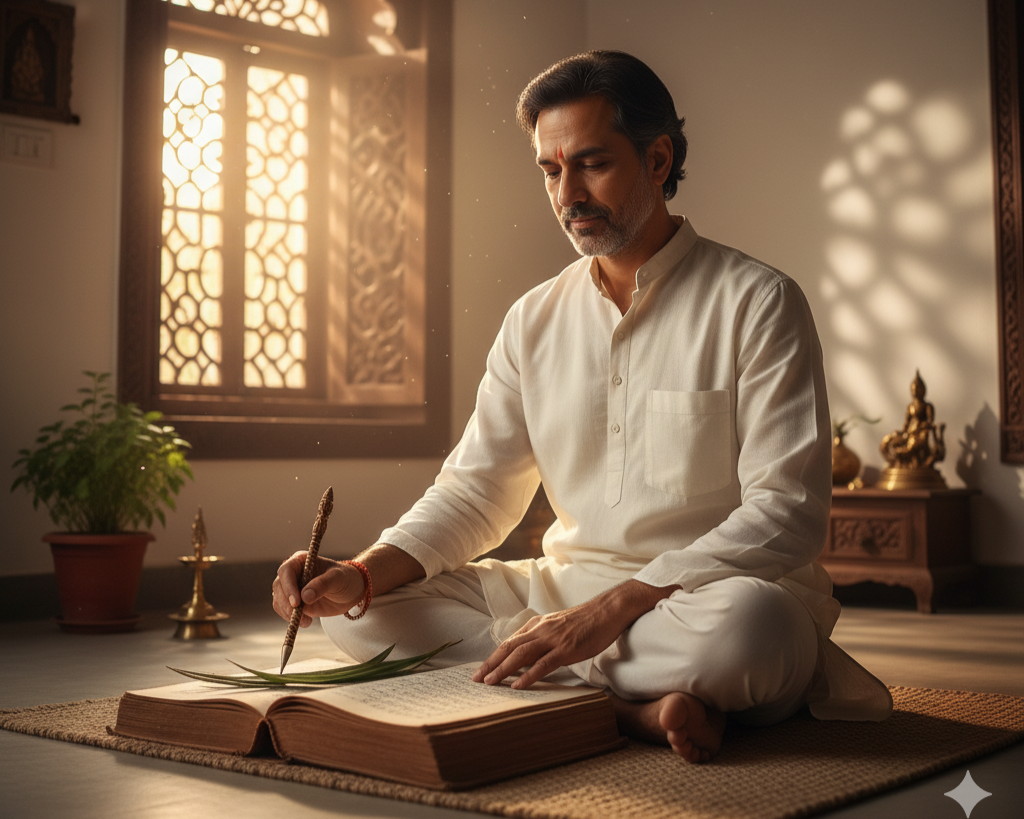
In the vast spiritual landscape of Bharat, the Vedas stand as the primal sound of cosmic order. They are not merely scriptures but the very breath of Sanatana Dharma—timeless, authorless, and all-encompassing. Dharma, often translated as righteousness or duty, is the principle that sustains the universe, society, and the individual. It is the bridge between cosmic law and human conduct.
The phrase Vedokhilo Dharma Moolam—“The Vedas are the root of all Dharma”—encapsulates this sacred relationship. It affirms that all codes of righteous living, all moral frameworks, and all spiritual disciplines must ultimately trace their lineage to the Vedas.
Scriptural Origin and Dharma’s Dimensions
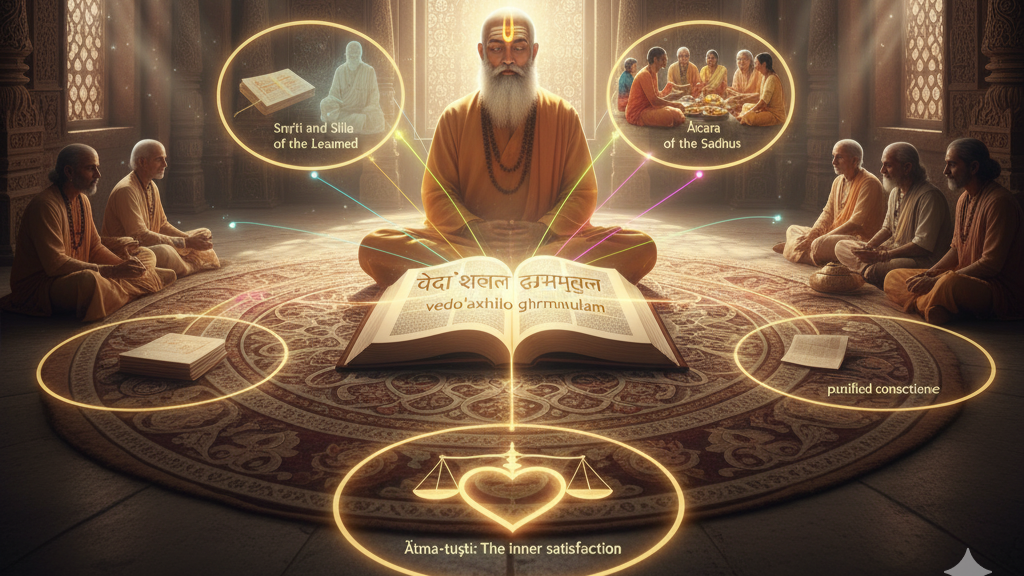
The phrase Vedokhilo Dharma Moolam originates from the Manusmriti 2.6:
The full verse from reads:
Sanskrit:
वेदोऽखिलो धर्ममूलं स्मृतिशीले च तद्विदाम् ।
आचारश्चैव साधूनामात्मनस्तुष्टिरेव च ॥
Transliteration:
vedo’khilo dharmamūlaṃ smṛtiśīle ca tadvidām |
ācāraścaiva sādhūnām ātmanas tuṣṭir eva ca ||
Translation: “The entire Veda is the root-source of Dharma; also the Smṛti and the conduct of those who know the Veda. The practice of good and learned men, and the satisfaction of one’s own conscience, are also sources of Dharma.”
Word-by-Word Breakdown
Here’s our signature table to unpack each word with clarity and reverence:
| Sanskrit Word | Transliteration | Meaning |
|---|---|---|
| वेदः | vedaḥ | The Veda (sacred revealed scripture) |
| अखिलः | akhilaḥ | Entire, complete |
| धर्ममूलम् | dharmamūlam | Root-source of Dharma |
| स्मृतिशीले | smṛtiśīle | Smṛti (recollections) and Śīla (conduct) |
| च | ca | And |
| तद्विदाम् | tadvidām | Of those who know that (i.e., the Veda) |
| आचारः | ācāraḥ | Practice, conduct |
| च एव | ca eva | And indeed |
| साधूनाम् | sādhūnām | Of the virtuous, noble, learned |
| आत्मनः | ātmanah | Of the self |
| तुष्टिः | tuṣṭiḥ | Satisfaction, contentment |
| एव च | eva ca | Indeed also |
Expanded Commentary: The Four Pillars of Dharma
This verse outlines a quadruple foundation for Dharma, each with its own nuance:
- Veda (Vedokhilo Dharma Moolam)
- The Veda is the supreme, eternal authority—apauruṣeya and free from human error.
- It contains injunctions (vidhi) and prohibitions (niṣedha) that guide all aspects of life: ritual, ethics, cosmology, and liberation.
- Smṛti and Śīla of the Learned
- Smṛti texts (like Manusmriti itself) are codified recollections of Vedic wisdom.
- Śīla refers to the conduct of those who have internalized the Vedas—not just scholars, but sages whose lives reflect scriptural truth.
- Ācāra of the Sādhus
- Ācāra is living tradition—the customs and practices of noble souls.
- It reflects Dharma in action, contextualized for time and place. Baba often emphasized this as “practical spirituality.”
- Ātma-tuṣṭi
- The inner satisfaction of the self-realized.
- This is not mere personal preference—it is the intuitive Dharma of one whose conscience is purified by sādhanā and wisdom.
Why This Matters
This verse is not just a list—it’s a hierarchy of discernment. When faced with moral dilemmas or spiritual choices, one must:
- First consult the Veda.
- If unclear, refer to Smṛti and the conduct of Vedic scholars.
- If still uncertain, observe the practice of noble souls.
- And finally, rely on one’s purified conscience.
This layered approach ensures that Dharma is both universal and adaptable, revealed and lived, scriptural and intuitive.
From Śāstra to Śakti: Linking Manusmriti to the Avatar’s Voice

Having explored the layered scriptural foundation of Vedokhilo Dharma Moolam—rooted in the Vedas and elaborated in the Manusmriti—we now turn to the one who came to reawaken these truths in the modern age.
Bhagawan Sri Sathya Sai Baba did not merely echo the wisdom of the ancients—He embodied it. His repeated invocation of this phrase was not a scholarly gesture, but a divine affirmation. He revealed that Dharma is not a human construct, but a cosmic principle, and that the Vedas are its eternal source.
“Vedokhilo Dharma Moolam. The Veda is verily the basis of Dharma. And I have come to restore it.”
More profoundly, Baba declared that his mission was not to interpret Dharma—it was to restore it, protect it, and plant it anew in the hearts of mankind.
In the following section, we explore how Bhagawan Baba unfolded this truth through His many discourses—calling for Veda revival, redefining Dharma for the modern age, and guiding humanity back to its sacred roots.
In the following section, we explore how Bhagawan Baba unfolded this truth through His discourses—calling for Veda revival, redefining Dharma for the modern age, and guiding humanity back to its sacred roots.
The Divine Foundation: Baba’s Explanation of Dharma
In the realm of spiritual wisdom, Bhagawan Baba’s teachings illuminate the profound meaning of the phrase “Vedhokhilo dharma moolam,” or “The Veda is the root of all Dharma.” This is not a static concept but a living principle that connects the divine with our daily lives.
He explains that true Dharma is born from the practice of Truth (Sathya). While many believe truth is simply speaking facts, Baba gives a deeper, more sublime definition. He says, “The creation emerges from truth and merges into truth, Is there a place where truth does not exist? Visualise such pure and unsullied truth.” This truth is not a fleeting concept but the eternal, unchanging essence of Brahman itself. It is the power that sustains the entire world. When our thoughts, words, and actions are in perfect alignment with this divine truth, we are living in Dharma.
Baba simplifies the path to Dharma with the core Vedic teaching: “Sathyam vada, dharmam chara” (Speak the truth, practice righteousness). He explains that when words are in harmony with our thoughts, they become truth; when these words are translated into action, that action becomes Dharma. In this way, every act, every word, and every thought becomes a reflection of divine consciousness. He declares, “Each act of Mine reflects a certain facet of dharma.”
For Baba, Dharma is the very moral fabric of a society. He states that morality, or Dharma, is not something to be forced upon oneself but is our very nature. He asserts, “No society can exist without morality” and reminds us that even birds and animals adhere to a code of conduct. It is only when man abandons this natural code that he suffers.
Ultimately, the source of all Dharma is the Atma, the divine self within each of us. By cultivating unwavering faith and turning our senses inward, we can connect to this Atmic principle. He teaches, “Truth and Righteousness are the two main pillars on which the entire world rests.” When we protect them, they in turn protect us, bringing an eternal state of peace and happiness. This is the ultimate promise of a life lived in accordance with Bhagawan’s vision of Dharma.
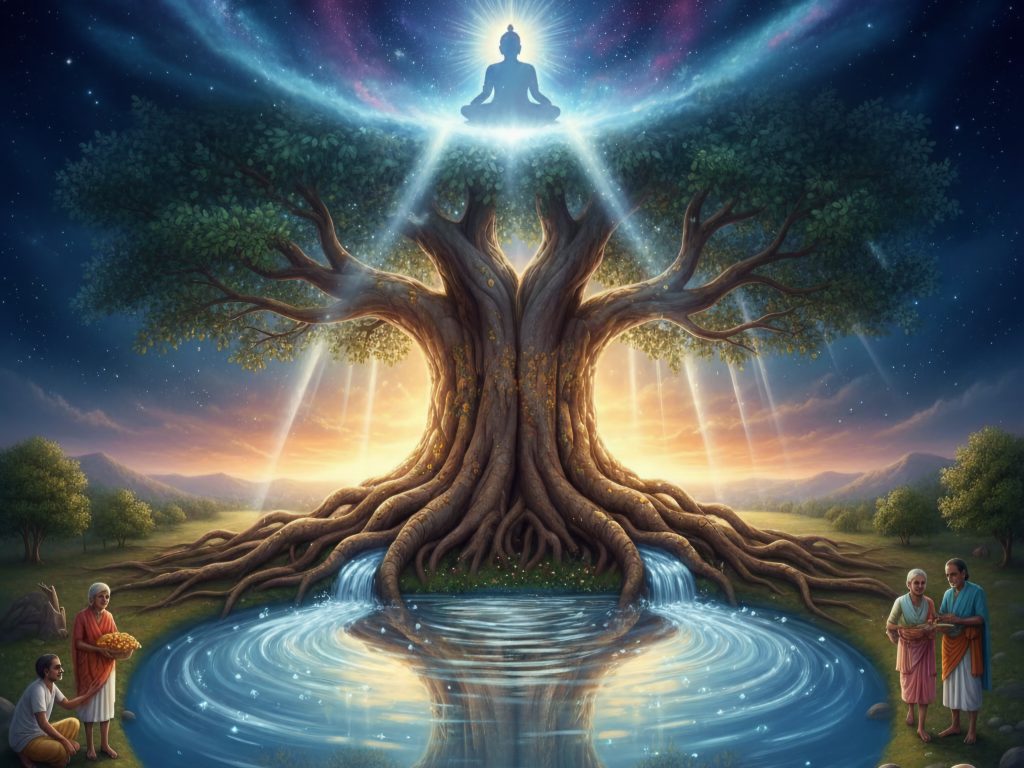
The above image shows a visual metaphor: the Veda is the root (the tree), Dharma is the principle (the flow), and Sathya is the foundation (the pool of water), all illuminated by the divine wisdom of Bhagawan Baba.
Living Baba’s Dharma — A Fourfold Path of Embodiment
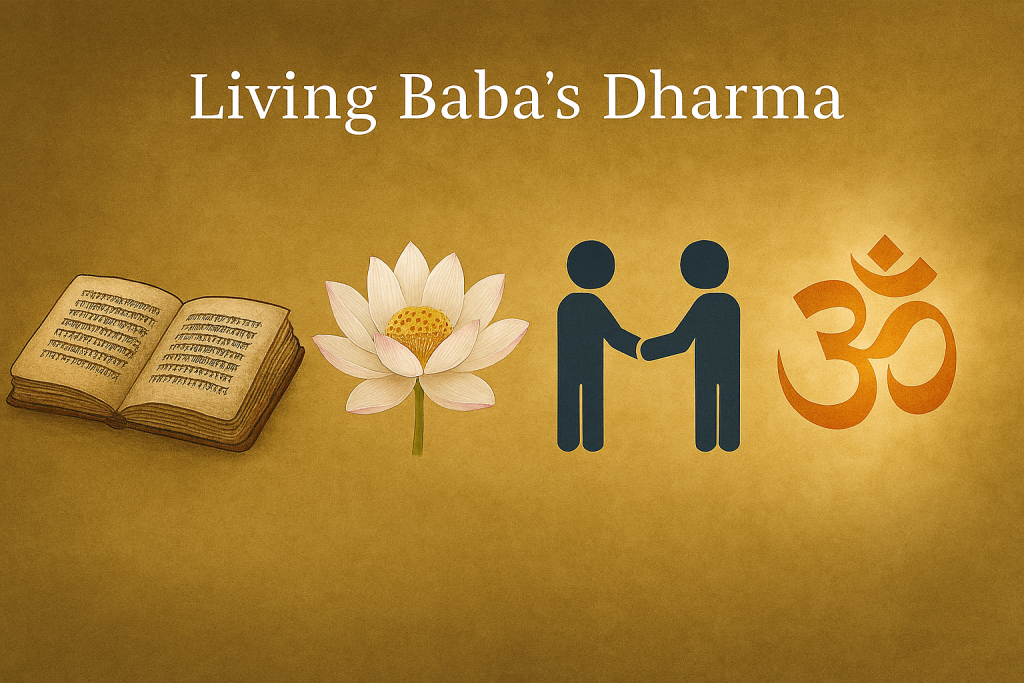
1. Study the Vedas — Not as Texts, but as Living Guidance
Bhagawan Baba emphasized that the Vedas are not meant to be locked away in libraries or recited mechanically. They are living vibrations of cosmic truth, meant to be understood, internalized, and lived.
“The Vedas are the very breath of God. They are not man-made. They are eternal.” — Sathya Sai Speaks
To study the Vedas in Baba’s spirit means:
- Listening with reverence, not just intellect
- Seeking the essence behind the mantras—truth, compassion, unity
- Using Vedic wisdom to guide daily decisions, not just ritual practice
Baba established Veda Pathashalas and encouraged even young children to chant and understand the Vedas, showing that this knowledge is for all—not just scholars.
2. Practice Dharma — Not as Duty Alone, but as Divine Alignment
For Baba, Dharma was not a burden—it was bliss. He taught that Dharma is the natural expression of one’s divine nature. It is not imposed from outside, but arises from within when the heart is pure.
“Dharma is not a set of rules. It is the path laid down by the Lord for the good of all.” — Truth Emerges from Wisdom
To practice Dharma in Baba’s way means:
- Acting with integrity even when no one is watching
- Choosing truth over convenience
- Serving others without expectation
- Aligning one’s life with cosmic order, not personal gain
Baba often said, “Follow the Master, Face the Devil, Fight to the End, Finish the Game.” Dharma is that fight—it is the soul’s commitment to righteousness.
3. Serve Humanity — As an Expression of Vedic Compassion
Service (seva) is the highest form of Dharma in Kali Yuga, according to Baba. He taught that the Vedas culminate in compassion, and that true spirituality is measured by how much one uplifts others.
“Hands that help are holier than lips that pray.” — Sathya Sai Speaks
To serve in Baba’s spirit means:
- Seeing God in every being
- Offering time, energy, and love without ego
- Making one’s life a yajna—a sacred offering to the world
- Uplifting the downtrodden, educating the ignorant, and healing the suffering
Whether through hospitals, schools, or water projects, Baba showed that Vedic Dharma must flow into society as tangible love.
4. Surrender to God — For He Alone Knows Dharma’s Depth
Baba often reminded devotees that only the Divine knows the full scope of Dharma. Human intellect is limited; divine wisdom is infinite.
“Whatever God says is Sathya, and whatever He does is Dharma.” — Truth Emerges from Wisdom
To surrender to Baba means:
- Trusting His guidance even when it challenges our logic
- Accepting His timing, His corrections, and His silence
- Living with humility, knowing that He is the doer
- Letting go of control and allowing Dharma to unfold through His will
This surrender is not passive—it is the most active form of spiritual engagement. It is saying, “Let Thy will be done,” and then living accordingly.
Closing Thoughts
In the end, ‘Vedokhilo dharma moolam’ is more than a phrase—it is a divine blueprint for human transformation. As Bhagawan Baba showed us, its wisdom is not meant to be confined to ancient texts but is to be embodied in every moment of our lives. The fourfold path of study, practice, service, and surrender is not a mere set of instructions, but the very process of rooting our consciousness in the eternal wisdom of the Vedas and blossoming into our divine potential.
By aligning our lives with this timeless Dharma, we not only uplift ourselves but become a force for righteousness in a world in need. This is the ultimate purpose of this ancient truth: to turn every human life into a sacred offering, a living testament to the harmony of cosmic law and divine love.
References
- Sathya Sai Speaks, “Open Your Eyes” The discourse links the protection of Vedic knowledge to the establishment of Dharma.
- Sathya Sai Speaks, “All Mankind” This discourse provides Bhagawan’s definition of Dharma as right action stemming from truth, and the interconnectedness of Truth and Righteousness.
- Sathya Sai Speaks, “Truth Emerges from Wisdom” The discourse highlights the profound link between Sathya (Truth) and Dharma, affirming that Dharma is a direct reflection of Truth. URL:
- Sathya Sai Speaks, Vol. 42 (2009) This volume contains discourses that touch upon the importance of morality and a code of conduct in society, which are central to Bhagawan’s teachings on Dharma.
Samastah Lokah Sukhino Bhavanthu
May all the beings in all the worlds be happy!

Jai Sai Ram!
Please note all images and content created using AI Tools