Vanaras Counsel
Introduction
The arrival of Vibhīṣhaṇa at Rāma’s camp was no small event. Here stood the brother of mighty Rāvaṇa, hovering in the sky, declaring his intent to abandon Laṅkā and seek refuge with Rāma. Such a moment could not be taken lightly. For the vānaras, loyal to Rāma and vigilant against every stratagem of the rakṣasas, the question was pressing: Should this unexpected defector be trusted?
Context
Last week, we traced Vibhīṣhaṇa’s dramatic entrance, ending with his heartfelt appeal for shelter at Rāma’s feet. Yet, his words alone were not enough to settle the matter. Before Rāma himself would speak, the vānaras gathered to deliberate. Sugrīva, as king, raised the first doubts; others like Śarabha, Jāmbavān, and Mainda offered their cautionary views. Finally, it was Hanumān who provided a balanced voice — weighing risk and trust with insight.
This week, we turn to their speeches — words that reveal not just their loyalty, but also their distinct temperaments and wisdom as ministers in Rāma’s service.
Sugrīva’s Counsel

Verse-by-verse commentary (6-17-18 → 6-17-30)
Citations to the source page – Valmiki Ramayana
6-17-18 — (introductory frame)
Sugrīva hears Vibhīṣhaṇa’s proclamation and immediately speaks to Rāma — hurried, emphatic, and protective. This verse simply sets the scene: Sugrīva (the army-chief and king) leaps forward to give counsel without delay.
6-17-19 — (the owl metaphor; danger of surprise attack)
Sugrīva warns that this guest “belongs to the enemy force” and may have come unawares to slay them at the first opportunity — like an owl preying on crows. The image stresses suddenness and predation: an enemy’s defector could be a trojan horse arriving under cover of friendliness.
6-17-20 — (be alert about organization, plans, and secret service)
Sugrīva implores Rāma to be attentive to the mantra (plans), vyūha (battle formations), naya (leadership/strategy) and cāra (espionage/secret service). In short: secure the strategy, deployments and intelligence before accepting anyone new.
6-17-21 — (on rakṣasa nature: shape-shifting and deceit)
He reminds the assembly that rakṣasas can change forms at will, disappear, and are both brave and expert in trickery — hence they are not to be trusted. This is an appeal to a generalization based on past experience with the demon-class.
6-17-22 — (the possibility of a planted agent from Ravana)
Sugrīva suggests the possibility that Vibhīṣaṇa was sent by Ravana (the rakṣasa-lord) with a covert purpose: once accepted, he could work divisively among them. The verse raises the “planted agent” hypothesis — accept at your peril.
6-17-23 — (how an intelligent infiltrator can find and exploit weakness)
He elaborates: a cunning man who enters their camp and gains trust can discover a chink in the armour and, later, strike at the heart of the force. This is a classic warning about insiders: confidence may be weaponized.
6-17-24 — (who to accept and who to reject)
Sugrīva distinguishes troop-sources: contingents supplied by friends, locals, hereditary retainers or paid men are acceptable; contingents furnished by an enemy are not. Practically: source matters — provenance of allies/units should be trusted before incorporation.
6-17-25 — (on rakṣasa disposition and caution)
He continues the line of argument by invoking rakṣasa disposition (their natural temperament) — the emphasis is that one must neither ignore the nature of the guest nor the fact of his lineage; such considerations weigh heavily in high-stakes decisions.
6-17-26 — (the fact of Vibhīṣaṇa’s identity and companions)
Sugrīva points out plainly: this guest is Vibhīṣaṇa, the younger brother of Ravana, and he has come with four rakṣasas. The simple factual statement tightens the earlier suspicion: this is not a lone, neutral seeker but a kinsman of the foe arriving with armed companions.
6-17-27 — (conclusion: treat him as suspect, fit for arrest)
Based on the evidence and the line of reasoning, Sugrīva counsels that Vibhīṣaṇa is fit to be arrested — that Ravana may be sending him — so detain him rather than accept him at once. This is a protective, preventative recommendation.
6-17-28 — (warning about hidden intent and witchcraft of deceit)
He warns that the rakṣasa may be sent “with crooked intent” and remain hidden by magical arts; faith reposed in him could be used against Rāma. The verse underscores the fear of concealed motive and subterfuge.
6-17-29 — (use force: detain swiftly and decisively)
Sugrīva urges decisive, forceful action — bind or detain him speedily with strong measures (daṇḍena), together with the counsellors. The recommendation moves from cautious observation to immediate arrest and restraint.
6-17-30 — (silence after the counsel)
After delivering his rapid, security-first argument, Sugrīva falls silent — the speech has been made; now the king must decide and the council will speak in turn. The silence marks deference and the end of his urgent counsel.
Brief synthesis (how Sugrīva’s advice fits the council)
Sugrīva’s whole speech is a tightly argued case for security first: verify or restrain before you trust.
His logic proceeds from:
- The observed nature and capabilities of rakṣasas (shape-changing, deceit),
- The political possibility of a sent agent,
- The strategic need to protect formations and intelligence, to
- The practical recommendation of immediate detention if doubt remains.
In leadership terms he is the risk-manager: prioritize continuity, secrecy and contingency protection over immediate magnanimity.
Sharabha

Śarabha is one of Sugrīva’s councillors; practical and decisive in counsel.
Śarabha’s Counsel
6-17-43 — (suspicion about timing and motive)
Śarabha begins by pointing out the timing of Vibhīṣhaṇa’s arrival: “At the time when a great battle is about to take place, this rakṣasa approaches you.” His implication is clear — the suddenness is suspicious. If Vibhīṣhaṇa were truly loyal to Rāma, why wait until the eve of war? The doubt is not about his words, but about his motives and timing.
6-17-44 — (warns of espionage; suggests probing)
Śarabha goes further, suggesting that Vibhīṣhaṇa may have been deliberately sent as a spy by Rāvaṇa, to infiltrate Rāma’s camp. He advises a practical measure: do not accept him at face value, but rather send out skilled spies to test the truth of his intentions before taking any decision.
In short: Śarabha’s counsel is one of suspicion and verification. He does not outright reject Vibhīṣhaṇa but urges caution through counter-intelligence.
Jāmbavān
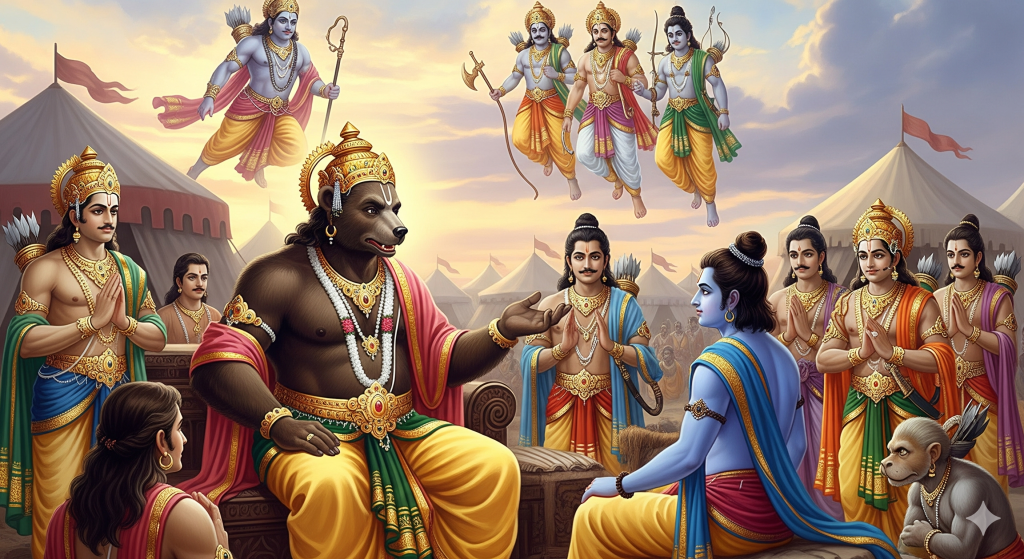
Jāmbavān is the venerable, scripture-learned elder (the wise bear); his voice grounds the council in tradition and prudence.
Jambavan’s counsel
6-17-45 — (deep distrust due to rakṣasa nature)
Jāmbavān, the aged and wise bear-elder, speaks with calm gravity. He declares that Vibhīṣhaṇa should not be trusted simply because he comes seeking refuge. “A rakṣasa is by nature deceitful.” His counsel is to guard against misplaced compassion, for an enemy’s essence may not change overnight.
6-17-46 — (suspicion of calculated timing)
He sharpens his doubt by focusing on circumstance: Vibhīṣhaṇa arrives precisely when the war is imminent. To Jāmbavān, this is not a coincidence but a tactic. He concludes that it is prudent to assume danger and not give him shelter.
In short: Jāmbavān’s counsel stresses essential mistrust — both because of Vibhīṣhaṇa’s rakṣasa identity and the timing of his appearance. Unlike Śarabha, who suggested probing, Jāmbavān recommends outright rejection as the safer course.
Mainda

Mainda is one of the Vānarā commanders known for discernment and reasoned speech.
Mainda’s Counsel
6-17-47 — (doubtful of intention, reminds of rakṣasa guile)
Mainda, son of the Aśvinī gods and a sharp-minded warrior, begins with caution. He stresses that rakṣasas excel in cunning and in disguising their true intent. Accepting one of them blindly would be perilous.
6-17-48 — (question and test rather than accept outright)
Instead of rejecting Vibhīṣhaṇa outright, Mainda suggests a middle path: he should be questioned carefully. By probing his words, testing his consistency, and watching his reactions, one can discern his real purpose. This blends skepticism with investigative pragmatism.
6-17-49 — (reading sincerity from words and demeanor)
Mainda adds that when words and inner intent align, sincerity reveals itself. If Vibhīṣhaṇa’s responses withstand scrutiny and his behavior shows no duplicity, then his refuge might be genuine. Until then, caution is necessary.
In short: Mainda suggests a policy of testing and discernment — neither immediate trust (too risky) nor absolute rejection (possibly wasteful), but a process of probing speech and intent to uncover truth.
Hanumān

Hanumān is Rāma’s chief minister and envoy — learned, devoted, psychologically acute; his counsel blends compassion and practical insight.
Below is Hanumān’s counsel given in verses 6-17-50 → 6-17-68. Below is a table that highlights Hanuman’s advice that’s categorized into intent
| Verse #: | Intent |
|---|---|
| Verses 6-17-50 → 6-17-54 | Opening lines |
| Verses 6-17-55 → 6-17-59 | Wise discernment of character |
| Verses 6-17-60 → 6-17-64 | On questioning and signs |
| Verses 6-17-65 → 6-17-68 | Motives & final appeal |
Hanuman’s counsel
6-17-50
Introductory verse — it frames Hanumān as learned, eloquent and concise. Expect measured, wise counsel rather than heat or haste.
6-17-51
Hanumān opens by honoring Rāma (and the council) — not flattery but establishing respect. This calibrates his forthcoming counsel as sincere, humble, and addressed to a leader of high discernment.
6-17-52
Hanumān explicitly disavows debate-for-debate’s-sake — he positions his speech as practical and duty-driven, signalling that what follows is intended to help decision-making, not to score points.
6-17-53
Hanumān questions the feasibility of the proposed probes (spying/tests). He’s not dismissing caution, but noting a practical limit to the inspectors’ recommendations.
6-17-54
Balanced view: Hanumān acknowledges both sides — you must give tasks to know someone’s capacity, yet it is risky to entrust a newcomer immediately. He is weighing practical trade-offs.
6-17-55
A direct response to the “send a spy” suggestion: Hanumān says that while theoretically sound, it’s impractical here — either because of timing, detection risk, or circumstances.
6-17-56
Hanumān signals he will present his own reasoning about why Vibhīṣhaṇa has come now — preparing the council for an alternative reading of motive and timing.
6-17-57
Hanumān suggests interior motive: Vibhīṣhaṇa recognized Rāma’s superiority and Ravana’s faults — therefore the timing makes sense if the refugee is sincere.
6-17-58
This expands the previous verse: Hanumān reads Vibhīṣhaṇa’s decision as sensible judgment rather than trickery — arriving when hope of just rule exists and when Ravana’s cruelty is clear.
6-17-59
Hanumān now addresses the “question by spies” proposal directly, preparing to explain why that method may fail or backfire.
6-17-60
Hanumān warns that surprise-testing destroys trust. If you trick someone to prove loyalty, you may instead make a genuine friend suspicious and push them away.
6-17-61
Hanumān points out practical limits: only a master judge can read subtle cues quickly; ordinary spy-tests may misread honest hesitation as deceit.
6-17-62
Hanumān reports his own observation: Vibhīṣhaṇa’s words and countenance show no malice — important because he’s present, perceptive, and trustworthy to the council.
6-17-63
Hanumān reasons from behavior: someone plotting betrayal wouldn’t come openly and calmly. Openness and composure argue for sincerity.
6-17-64
Hanumān says inner intent leaks out in demeanor; even if words are practiced, true feelings show. This is an argument for relying on human observation and character-reading.
6-17-65
Hanumān notes that action timed and executed well succeeds — implying that decisive, well-judged acceptance can be effective; dithering or deceptive tests may waste the moment.
6-17-66
Hanumān gives the political reading: Vibhīṣhaṇa has practical motives — he sees Rāma’s advantage and Ravana’s weakness and therefore seeks a rightful position. This reframes the motive from treachery to ambition tied to dharma.
6-17-67
Crucial verdict: Hanumān argues that this motive (seeking legitimate kingship after seeing Ravana’s evil and Rāma’s strength) is sufficient reason to accept Vibhīṣhaṇa — a pragmatic, moral acceptance.
6-17-68
Verse 68 closes Hanumān’s argument: combine observation of intent, the situation (power + wrongdoing), and the candidate’s frankness — the wise should recognize sincerity and act. It’s the culmination of his balanced, experience-based counsel.
Hanumān’s Conclusion
Hanumān combines political realism (Vibhīṣhaṇa has a clear motive: his brother’s wrongdoing and the opportunity to claim the kingdom with Rāma’s support) and psychological insight (his demeanor and words bear the marks of sincerity). Importantly, Hanumān does not presume to decide for Rāma. Instead, he urges that the final judgment rests with the prince, after hearing all counsel. This measured, respectful close is what tips the debate toward dharma rather than suspicion, preparing the stage for Rāma’s decisive words.
In this way, Hanumān skillfully balances caution with compassion, transforming doubt into discernment and guiding the council toward trust — while leaving the ultimate decision to Rāma.
Short summary of the verses from this section : 6-17-11 → 6-17-68

- Vibhīṣaṇa (6-17-11 → 6-17-17): Proclaims his identity, condemns Rāvaṇa’s arrogance, and seeks refuge with Rāma.
- Sugrīva (6-17-18 → 6-17-30): Strongly warns against immediate trust; stresses caution and vigilance, noting it could be a ploy from Rāvaṇa to cause harm.
- Śarabha (6-17-43 → 6-17-44): Suggests sending a spy first to quietly observe.
- Jāmbavān (6-17-45 -> 6-17-46): Distrusts due to Vibhīṣaṇa’s sudden appearance and suspicious timing.
- Mainda (6-17-47 → 6-17-48): Recommends gentle questioning to gauge sincerity.
- Hanumān (6-17-50 → 6-17-68): Advises against trap-thinking, highlights openness in Vibhīṣaṇa’s demeanor, recognizes his valid motive to defect, and concludes by leaving the final decision to Rāma.
Leadership Insights from Vibhīṣaṇa’s Arrival

The debate in this Sarga is not only a spiritual and epic moment but also a masterclass in leadership and decision-making. Each speaker brings a unique perspective that can be applied to modern management and team dynamics.
1. Sugrīva – Caution & Risk Awareness
- Context: As king of the vānaras, Sugrīva immediately suspects deception. He warns Rāma that the rākṣasas are masters of disguise and trickery (verse 6.17.21).
- Lesson: A good leader should never overlook risks. Healthy suspicion protects an organization from threats. However, caution must be balanced with openness, else opportunities may be lost.
2. Śarabha – Balanced Prudence
- Context: Śarabha, one of Sugrīva’s ministers, advises that it is not wise to reject Vibhīṣaṇa outright but equally unwise to accept him blindly (verse 6.17.43).
- Lesson: Prudence is about balance—neither total mistrust nor naïve acceptance. Leaders must weigh pros and cons, gather information, and avoid hasty decisions.
3. Jāmbavān – Wisdom from Experience
- Context: The wise elder Jāmbavān reminds the assembly that decisions should be guided by experience and precedent, not just emotion.
- Lesson: In organizations, senior advisors bring the weight of past experience. Respecting their insights ensures decisions are grounded and less impulsive.
4. Mainda and Dvivida – Analytical Thinking
- Context: The twin vānaras analyze the situation logically, pointing out practical aspects of accepting or rejecting Vibhīṣaṇa.
- Lesson: Analytical leaders break down complex problems, remove emotional bias, and present facts clearly. Teams need such rational voices to balance passion with reason.
5. Hanumān – Strategic Vision & Fair Judgment
- Context: Hanumān provides the most balanced counsel. He assesses Vibhīṣaṇa’s words, demeanor, and situation objectively, concluding that he seems trustworthy (verse 6.17.52).
- Lesson: Great leaders are fair judges of character. They combine empathy with strategy, ensuring that decisions are both compassionate and aligned with long-term goals.
Management Insights from the Vanara Council

A management team that brings together these diverse perspectives—caution (Sugrīva), alert skepticism (Śarabha), balanced pragmatism (Jāmbavān), positive trust in ability (Mainda), and Hanumān’s discerning compassion—forms a strong collective. Each voice highlights a crucial aspect of leadership: risk-awareness, critical scrutiny, experience-based judgment, constructive optimism, and fair strategic insight. When such complementary qualities come together, decisions become not only well-rounded but also resilient and humane in the face of uncertainty.
Closing Thoughts

The arrival of Vibhīṣaṇa and the subsequent debate among the vānaras show how collective wisdom emerges from diversity of thought. Each minister voiced a unique perspective, yet together they shaped a decision that was both cautious and courageous.
For us today, this reminds us that effective leadership is not about unanimity, but about listening, discerning, and integrating different viewpoints. When a team can balance caution with trust, skepticism with pragmatism, it creates a foundation for decisions that stand the test of time.
References
All verses are adapted from the Valmiki Rāmāyaṇa online resource.
Samastah Lokah Sukhino Bhavanthu
May all the beings in all the worlds be happy!

Jai Sai Ram!
Please note that all images and content are generated using AI Tools.