The Bubble Nebula – A Star Blowing a Giant Bubble in Space
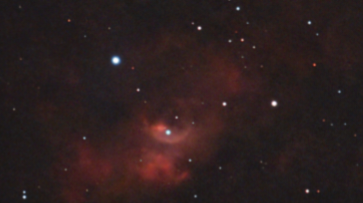
Photographing the night sky from Bengaluru, I captured this faint reddish cloud in the constellation Cassiopeia: NGC 7635, famously known as the Bubble Nebula.
Click any image to open full view in a new tab.
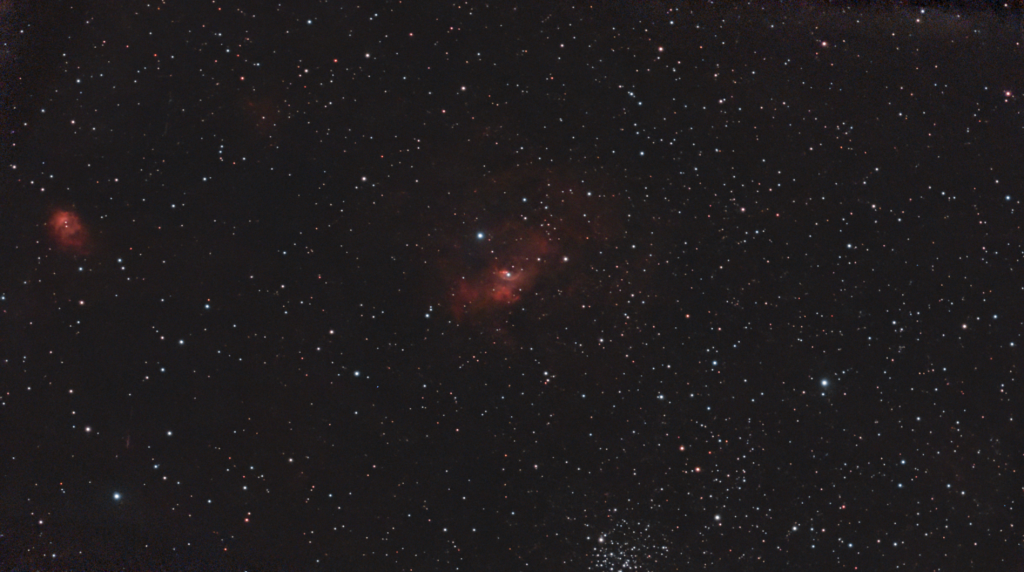
While it looks like a peaceful cosmic cloud, it is actually the visible evidence of a huge astronomical process—a massive star reshaping space itself.
Anatomy of the Cosmic Bubble
- Object: NGC 7635 (Bubble Nebula) | Constellation: Cassiopeia
- Distance: ~7,100 light-years | Bubble Size: ~7 light-years
- Central Star: BD+60°2522 (45x Sun’s mass)
- Wind Speed: >4 million mph (~6.4 million km/h)
- Nearby Field Targets: Messier 52 (Open Cluster), NGC 7538 (Northern Lagoon)
- Location: Bengaluru, India
Look closely at the bright central region of the image:
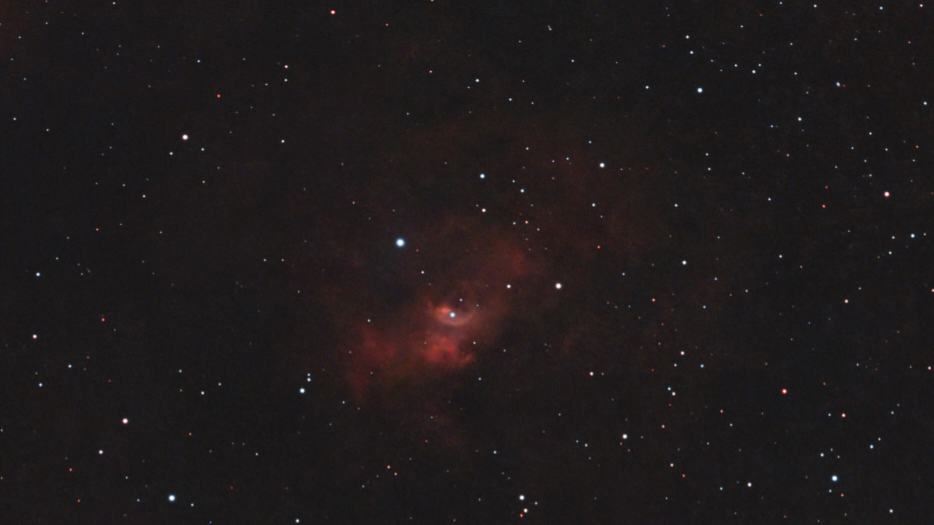
The Shell Composition: The distinct spherical shell is composed of glowing red, ionized hydrogen gas and interstellar dust. It isn’t a solid surface, but a razor-thin shockwave boundary glowing under intense ultraviolet radiation.
The Snowplough Mechanism: At the center lies BD+60°2522, an O-type star roughly 45 times more massive than our Sun. It blasts a ferocious stellar wind at over 4 million mph (~6.4 million km/h). As this wind pushes outward, it slams into the cold interstellar cloud, sweeping surrounding gas into a spherical bubble shell.
Why it’s Asymmetric: The bubble isn’t perfectly round, and the star is visibly off-center. On one side, the wind encounters a wall of dense molecular gas that resists the push and slows expansion. On the opposite side, it pushes into a lower-density region, allowing the shell to balloon outward much farther.
Size: The bubble is ~7 light-years across (66 trillion km)—about 1.5 times the distance from our Sun to our nearest star system, Alpha Centauri.
Distance: ~7,100 light-years away. The light captured in this image left the nebula 7,100 years ago during the dawn of human civilization.
Reading the Close-up Shot
Astrophotography turns a faint patch of light into a living story of stellar power, deep time, and massive scale.
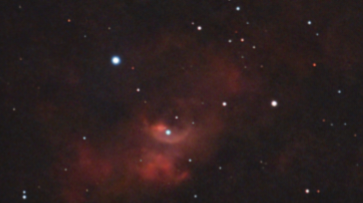
The Bright Star (BD+60°2522): The bright star nestled inside the arc—this is the engine driving the entire structure. This 4-million-year-old star will eventually end its short life in a supernova in about 10 to 20 million years.
The Dense Gas Barrier (Lower-Left Arc): Notice how bright and tight the shell is on the lower-left. The stellar wind is crashing directly into a wall of dense cold gas, halting its expansion and making that edge glow intensely.
Free Expansion (Upper-Right Shell): On the opposite side, the gas is thinner, allowing the wind to push out farther into a smooth, faint bubble boundary.
The Red Glow: The surrounding ambient interstellar hydrogen gas, glowing red under the central star’s fierce ultraviolet radiation.
Distinction: Bubble Shell vs. Red Glow
It helps to separate the two main structures in the shot:
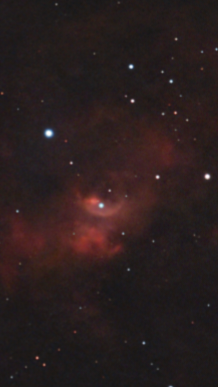
- The Inner Bubble: The small, bright curved boundary shaped directly by the stellar wind (~7 light-years across).
- The Outer Red Glow: The much larger surrounding emission nebula—ambient gas energized and set ablaze by the star’s radiation.
Wide-Angle Perspective: A 3D View of Cassiopeia
Step back into the full wide-field frame, and the neighborhood comes alive with three distinct deep-sky objects sharing the same patch of night sky:
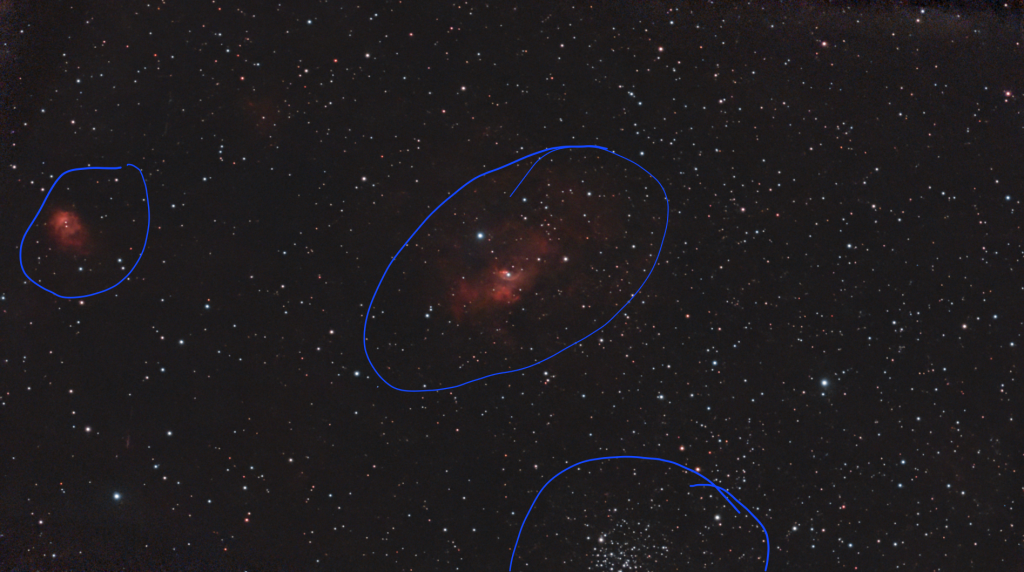
- Messier 52 (Bottom Edge): The dense, glittering cluster of stars along the bottom frame is M52, a rich open star cluster containing thousands of young stars.
- NGC 7538 (Far Left): The active star-forming red cloud on the left margin is NGC 7538, often called the Northern Lagoon Nebula for its striking structural resemblance to the famous southern Lagoon.
- The 3D Illusion: While all three objects fit together inside this single frame, they are actually separated by vast depths of interstellar space along our line of sight:
- Messier 52: ~5,000 light-years away (closest to us)
- Bubble Nebula (NGC 7635): ~7,100 light-years away (sitting in the mid-ground)
- Northern Lagoon (NGC 7538): ~9,100 light-years away (deep in the background)
In the 2D photograph, M52 and the Bubble Nebula appear side-by-side—separated by just 0.5 degrees (roughly the width of a full moon)—yet M52 sits more than 2,000 light-years closer to Earth!