Floral Glimpses
A simple floral offering — a rose in full bloom, a pink hibiscus, and the fragrant promise of jasmine buds.



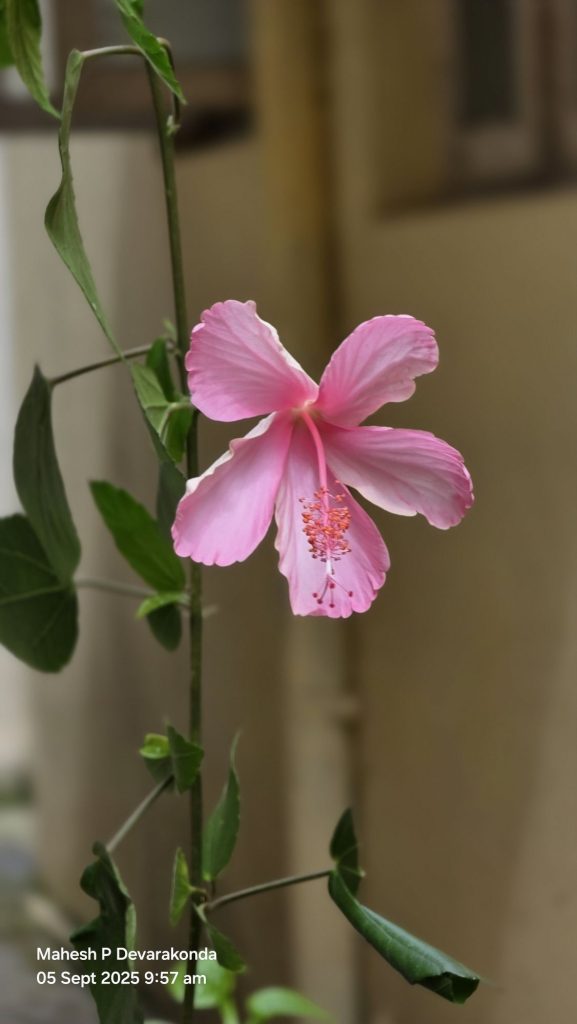
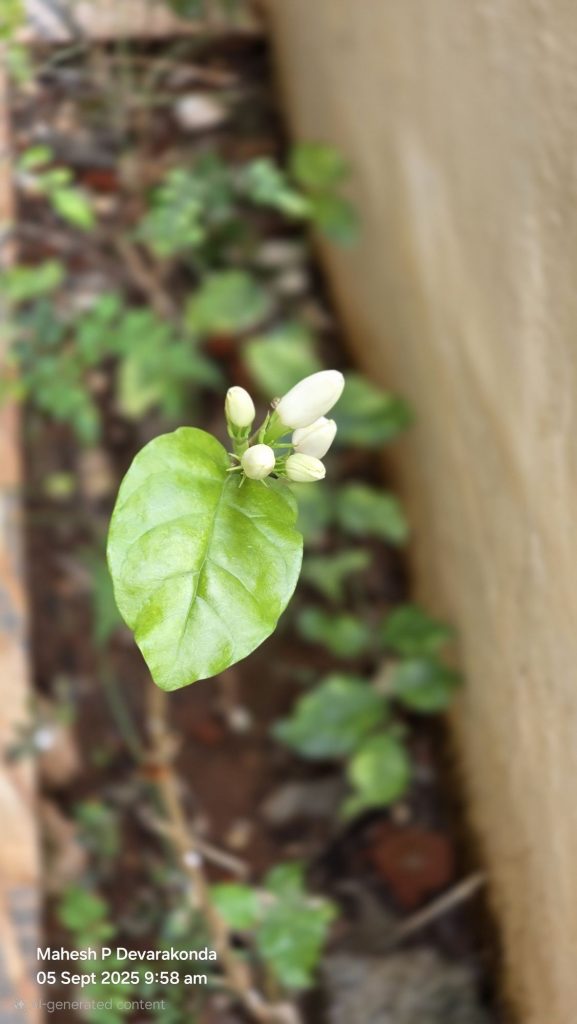

May these humble blossoms carry our prayers in fragrance and grace.
A simple floral offering — a rose in full bloom, a pink hibiscus, and the fragrant promise of jasmine buds.
May these humble blossoms carry our prayers in fragrance and grace.

On this sacred occasion of Teachers’ Day, we first offer our humble salutations to Bhagawan Sri Sathya Sai Baba, the eternal teacher, who through His boundless grace has illumined our intellects and shown us the path of seva and dharmic living. His life and message stand as a timeless guide, inspiring us to learn, live, and share knowledge with love and selflessness.
Teachers’ Day is celebrated on 5 September across India to honor the birth anniversary of Dr. Sarvepalli Radhakrishnan (1888–1975)—a revered philosopher, teacher, and the nation’s second President. When his students approached him seeking to celebrate his birthday, he humbly proposed instead that the day be observed as Teachers’ Day, to honor the pivotal role educators play in society. This practice began in 1962, and since then, educational institutions nationwide have marked the day with expressions of gratitude—through cultural programs, heartfelt tributes, and acts of appreciation. Source: Unacademy.
On this day, we remember with gratitude all those who guide us in the journey of knowledge.
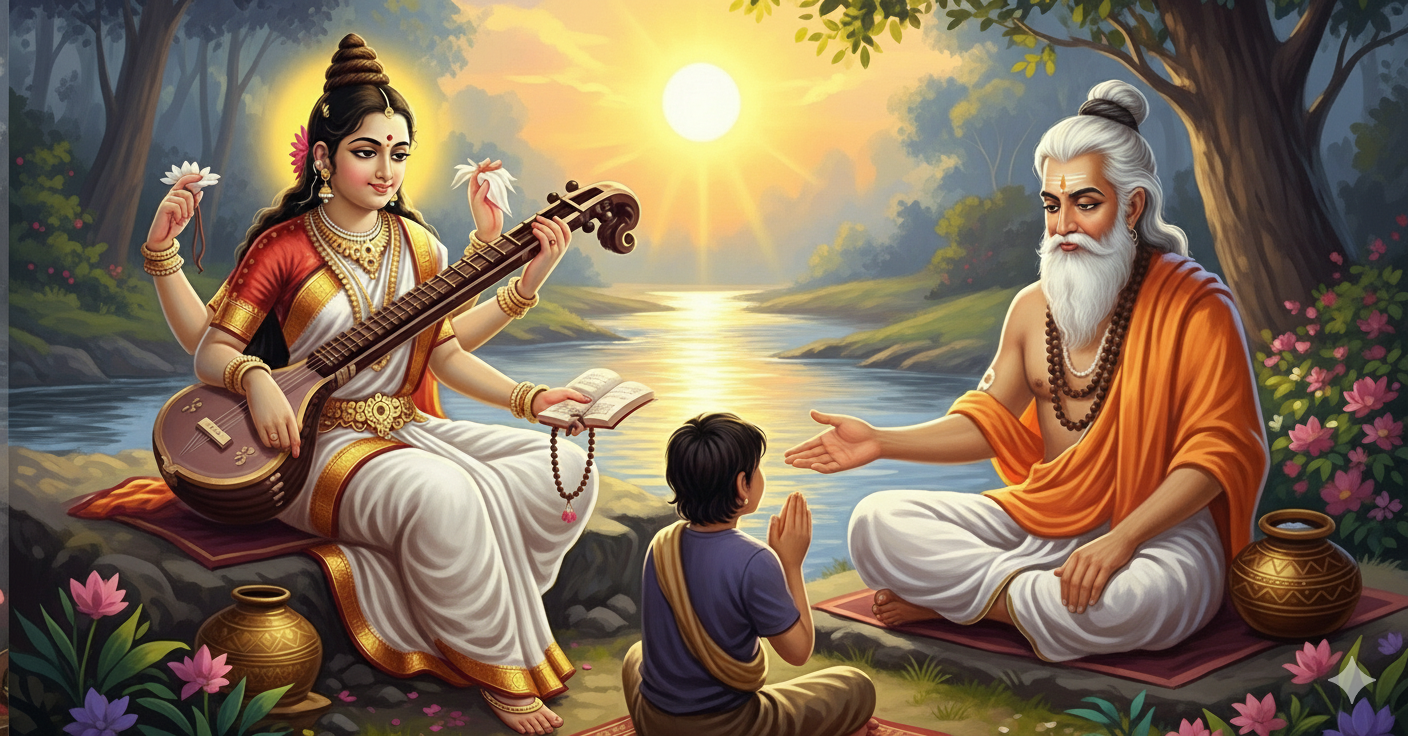
In the Vedic tradition, this guiding principle of knowledge is personified as Goddess Sarasvatī—the inspirer of speech, the nourisher of intellect, and the revealer of truth.
The Sarasvatī Sūktam from the Ṛg Veda (6.61) praises her as both a mighty river and as the goddess of wisdom. Today, we highlight select verses from this hymn that beautifully echo the qualities of a true teacher, qualities that Bhagawan embodied and bestowed upon His devotees and students.

Sanskrit
प्रणो देवि सरस्वती वाजेभिर्वाजिनीवती ।
धीनामवित्र्यवतु ॥ ४ ॥
Transliteration
praṇo devī sarasvatī vājebhirvājinīvatī |
dhīnāmavitryavatu || 4 ||
Translation
“O Goddess Sarasvatī, rich in vitality and abundance, may You protect and inspire our thoughts and intellects.”

Reflection
Just as Sarasvatī is invoked to safeguard the clarity of our minds, so too do teachers guard our intellect from confusion and ignorance. Bhagawan, in His divine role, constantly uplifted human thought, guiding it toward truth and dharma.
Source: Rig Veda 6.61 – Sri Aurobindo Edition
Sanskrit
त्वं देवि सरस्वत्यवा वाजेषु वाजिनि ।
रदा पूषेव नः सनिम् ॥ ६ ॥
Transliteration
tvaṃ devī sarasvatyavā vājeṣu vājinī |
radā pūṣeva naḥ sanim || 6 ||
Translation
“O Goddess Sarasvatī, may You be our helper in attaining abundance. Bestow blessings upon us, like Pūṣan, the nourisher.”

Reflection
The Guru nourishes us not only with knowledge but with strength and values to live rightly. Sarasvatī and Bhagawan together symbolize this nurturing grace, which sustains our spiritual and worldly journeys.
Source: Rig Veda 6.61 – Sri Aurobindo Edition
Sanskrit
सा नो विश्वा अति द्विषः स्वसृरन्या ऋतावरी ।
अतन्नहेव सूर्यः ॥ ९ ॥
Transliteration
sā no viśvā ati dviṣaḥ svasṛranyā ṛtāvarī |
atannaheva sūryaḥ || 9 ||
Translation
“May Sarasvatī, the righteous one, our true sister, overcome all hostilities for us, even as the sun dispels the darkness.”

Reflection
Teachers remove the darkness of ignorance just as the sun lights up the world. In the same way, Bhagawan’s divine presence dispelled inner conflict and guided seekers toward peace and righteousness.
Source: Rig Veda 6.61 – Sri Aurobindo Edition
Sanskrit
सरस्वत्यभि नो नेषि वस्यो मा प स्फरीः पयसा मा न आ धक् ।
जृषस्व नः सख्या वेश्याच मा त्वत् क्षेत्राण्यरणानि गन्म ॥ १४ ॥
Transliteration
sarasvatyabhi no neṣi vasyomā pa spharīḥ payasā mā na ā dhak |
jṛṣasva naḥ sakhyā veśyāc mā tvat kṣetrāṇyaraṇāni ganma || 14 ||
Translation
“O Sarasvatī, lead us to prosperity and do not withhold Your abundance. Be gracious to us as a friend, and may we never stray into barren fields far from Your presence.”

Reflection
The highest wealth a teacher gives is wisdom. Sarasvatī here is invoked as the guiding friend, ensuring we remain in fertile lands of knowledge and truth. Bhagawan, through His grace, kept His devotees rooted in the dharmic path, away from the wastelands of worldly delusion.
Source: Rig Veda 6.61 – Sri Aurobindo Edition
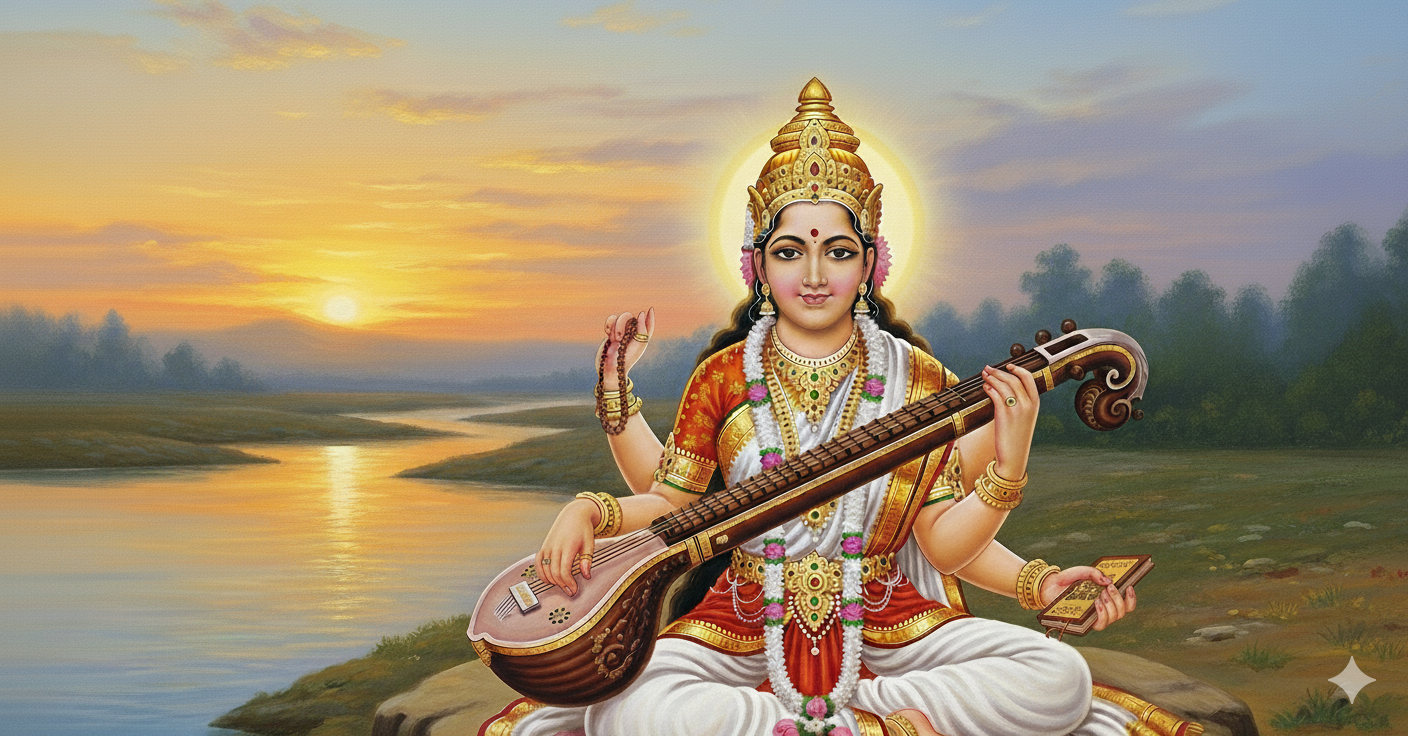
The Sarasvatī Sūktam contains 14 verses, many of which praise Sarasvatī as a powerful river sustaining life, as well as the goddess who inspires wisdom and higher thought. For this reflection, we have selected verses that especially highlight her as the protector of intellect, nourisher of mind, dispeller of ignorance, and giver of abundance—qualities that resonate with the teacher’s role.

Samastah Lokah Sukhino Bhavanthu
May all the beings of all the worlds be happy!


Jai Sai Ram!
Please note all content and images generated using AI Tools
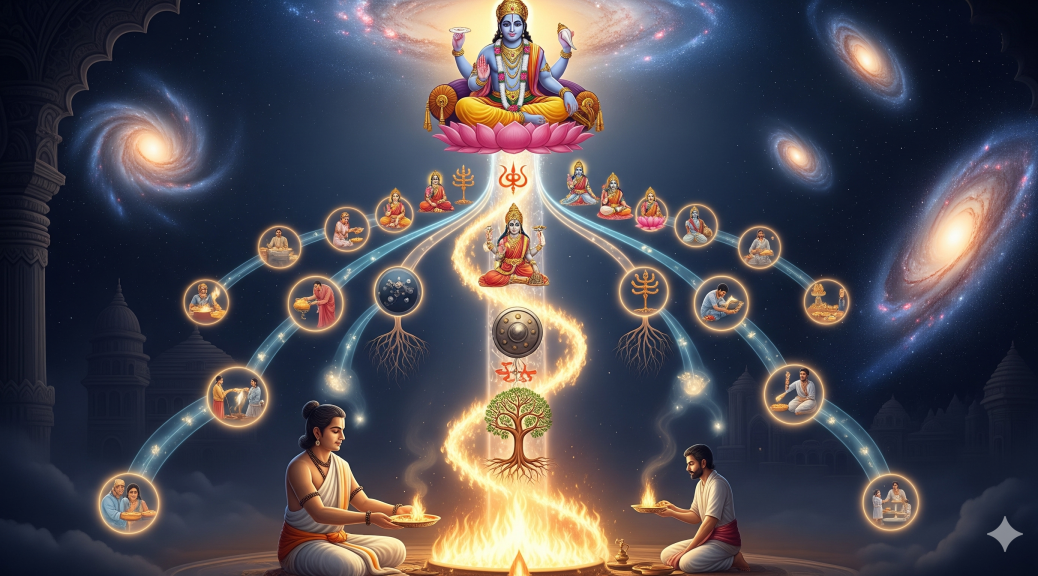
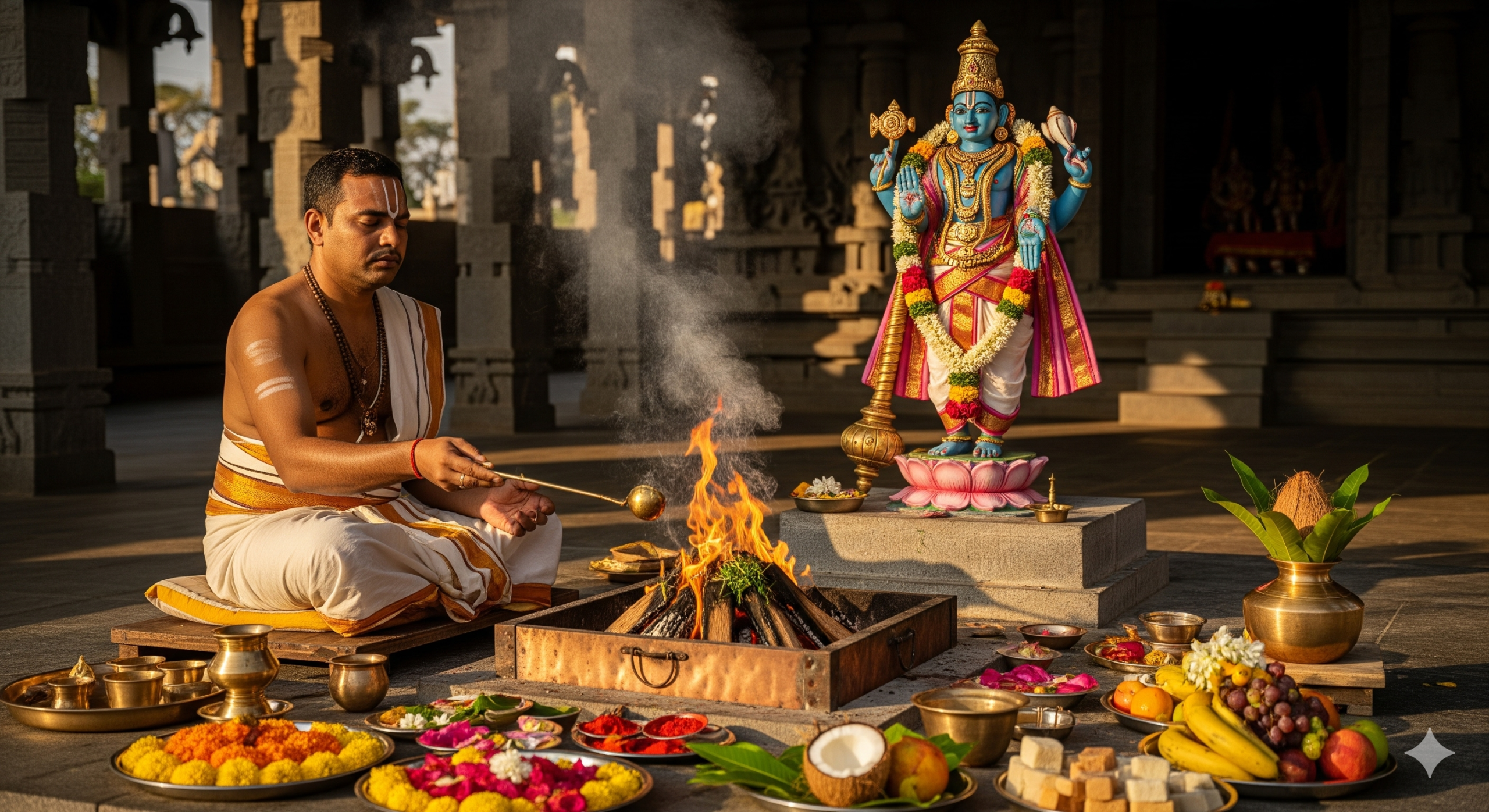
Among the many profound declarations in the Vedic corpus, few are as significant and far-reaching as the phrase “Yajño Vai Viṣṇuḥ” — “Yajña indeed is Viṣṇu.”
Bhagawan Sri Sathya Sai Baba, in His discourse “Make Every Moment a Yajna”, draws attention to this very phrase, reminding us that life itself is to be seen as a yajña — a sacred act of offering.
Inspired by this insight, we undertook a study of the Taittirīya Brāhmaṇa to trace the phrase across its occurrences, and what emerges is a beautiful, multidimensional vision of yajña as the sustaining principle of existence, inseparable from Viṣṇu, the all-pervading Divine.
This post brings together all eight occurrences of “Yajño Vai Viṣṇuḥ” in the Taittirīya Brāhmaṇa, with their Sanskrit text, translations and commentaries.

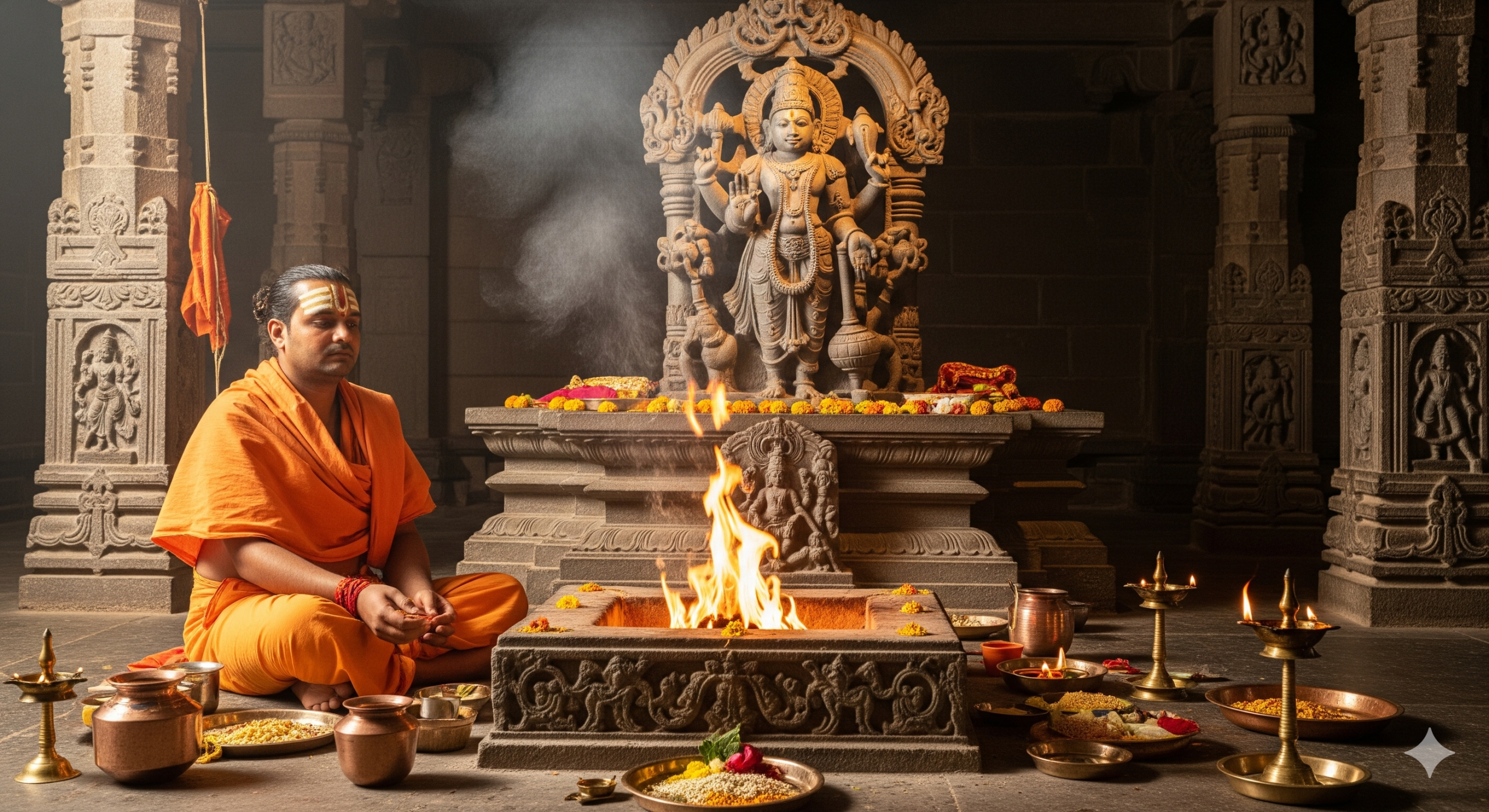
The Taittirīya Brāhmaṇa is part of the Kṛṣṇa Yajur Veda, elaborating on the performance and meaning of yajñas (sacrifices). More than a ritual manual, it encodes symbolic truths: every act in a yajña reflects cosmic realities. Within it, the phrase “Yajño vai Viṣṇuḥ” — “Yajña indeed is Viṣṇu” — recurs eight times, underscoring how sacrifice is inseparable from the sustaining presence of Viṣṇu.
Sanskrit
अप्र॑तिष्ठां॒ वा ए॒ते ग॑च्छन्ति । येषाꣳ॑ संवथ्स॒रेऽना॒प्तेऽथ॑ । ए॒का॒द॒शिन्या॒प्यते᳚ । वै॒ष्ण॒वं वा॑म॒नमाल॑भन्ते । य॒ज्ञो वै विष्णुः॑ । य॒ज्ञमे॒वाल॑भन्ते॒ प्रति॑ष्ठित्यै । ऐ॒न्द्रा॒ग्नमाल॑भन्ते । इ॒न्द्रा॒ग्नी वै दे॒वाना॒मया॑तयामानौ । ये ए॒व दे॒वते॒ अया॑तयाम्नी । ते ए॒वाल॑भन्ते ॥ १। २। ५। १॥
Translation
“Those whose year-long sacrifice is incomplete lack firm foundation. Therefore, on the Ekādaśinī day, they perform the Vaiṣṇava offering, for Yajña is indeed Viṣṇu. Thus they establish the sacrifice upon firm ground. They also offer to Indra and Agni, for Indra and Agni are the leaders of the gods, and by offering to them, they bring the rite to its proper course.”
Commentary
Here Viṣṇu, as yajña, provides stability and foundation — without Him, ritual is incomplete and lacks support.

….. इ॒दं विष्णु॒र्विच॑क्रम॒ इति॑ वैष्ण॒व्यर्चाऽह॑व॒नीया᳚द्ध्व॒ꣳ॒सय॒न्नुद्द्र॑वेत् । य॒ज्ञो वै विष्णुः॑ । य॒ज्ञेनै॒व य॒ज्ञꣳ संत॑नोति । … ॥ १। ४। ३। ६॥
Translation:
“This is Vishnu who moves through all; he is to be invoked with Vaishnava offerings. The sacrifice itself is Vishnu, and through the sacrifice one attains continuity.
Commentary:
Vishnu is equated with the yajna itself, showing that ritual action and divine presence are inseparable.

…रेत॑ ए॒व हि॒तं त्वष्टा॑ रू॒पाणि॒ विक॑रोति । उ॒परि॑ष्टाद्वैष्ण॒वेन॑ । य॒ज्ञो वै विष्णुः॑ । य॒ज्ञ ए॒वान्त॒तः प्रति॑तिष्ठति ॥ १। ८। १। २
Translation:
Tvaṣṭṛ transforms the seed into beneficial forms. Above all, through Vaishnava invocation, the sacrifice is Vishnu. The sacrifice stands firmly and wholly in its entirety.”
Commentary:
Tvaṣṭṛ transforms the seed into beneficial forms, symbolizing the manifestation of order from latent potential. By invoking Vishnu, the yajna itself becomes divine, complete, and firmly established, uniting ritual and cosmic principle.

अथै॒तं विष्ण॑वे च॒रुं निर्व॑पति । य॒ज्ञो वै विष्णुः॑ । य॒ज्ञ ए॒वान्त॒तः प्रति॑तिष्ठति । सोऽत्र॑ जुहोति । विष्ण॑वे॒ स्वाहा॑ य॒ज्ञाय॒ स्वाहा᳚ । प्र॒ति॒ष्ठायै॒ स्वाहेति॑ ॥ ३। १। ६। ७॥
Translation:
“Here, the offering is made beautifully to Vishnu. The sacrifice itself is Vishnu, and the sacrifice stands fully established. One offers ‘Svāhā’ to Vishnu for the yajna, and ‘Svāhā’ for its firm establishment.”
Commentary:
This verse emphasizes that the act of offering, when performed with devotion, becomes an expression of Vishnu himself. The repeated use of “Svāhā” sanctifies both the offering and the stability of the sacrifice, illustrating that ritual action is inseparable from divine presence. By acknowledging Vishnu as the sacrifice, the verse reinforces that yajna is not merely a physical act but a living, sustaining force that upholds cosmic order.

अ॒य॒स्पा॒त्रेण॑ वा दारुपा॒त्रेण॒ वाऽपि॑दधाति । तद्धि सदे॑वम् । उ॒द॒न्वद्भ॑वति । आपो॒ वै र॑क्षो॒घ्नीः । रक्ष॑सा॒मप॑हत्यै । अद॑स्तमसि॒ विष्ण॑वे॒ त्वेत्या॑ह । य॒ज्ञो वै विष्णुः॑ । य॒ज्ञायै॒वैन॒दद॑स्तं करोति । विष्णो॑ ह॒व्यꣳ र॑क्ष॒स्वेत्या॑ह॒ गुप्त्यै᳚ । अन॑धः सादयति । गर्भा॑णां॒ धृत्या॒ अप्र॑पादाय । तस्मा॒द्गर्भाः᳚ प्र॒जाना॒मप्र॑पादुकाः । उ॒परी॑व॒ निद॑धाति । उ॒परी॑व॒ हि सु॑व॒र्गो लो॒कः । सु॒व॒र्गस्य॑ लो॒कस्य॒ सम॑ष्ट्यै ॥ ३। २। ३। १२॥
Translation:
“One may offer with a metal vessel, a wooden vessel, or even with water; it is always appropriate. From this arises the upward force. Waters are indeed protectors of the sacrificial fire, dispelling obstacles. ‘To Vishnu,’ it is said, for the yajna itself. Vishnu secures the oblation for the sacrifice, supports it from below, and sustains the generative powers. Therefore, the wombs of living beings receive their sustenance. Above, he places the realm of heaven, the heavenly world, for the collective welfare of all.”
Commentary:
This verse highlights the flexibility of offerings—metal, wood, or water—all are valid when offered with devotion, reflecting the universal accessibility of yajna. It emphasizes the protective and sustaining role of Vishnu, who secures the oblation, nurtures life, and upholds cosmic order. The sacrificial act is linked to creation itself, as Vishnu supports the generative powers below and establishes the heavenly realm above, ensuring the welfare of all beings.
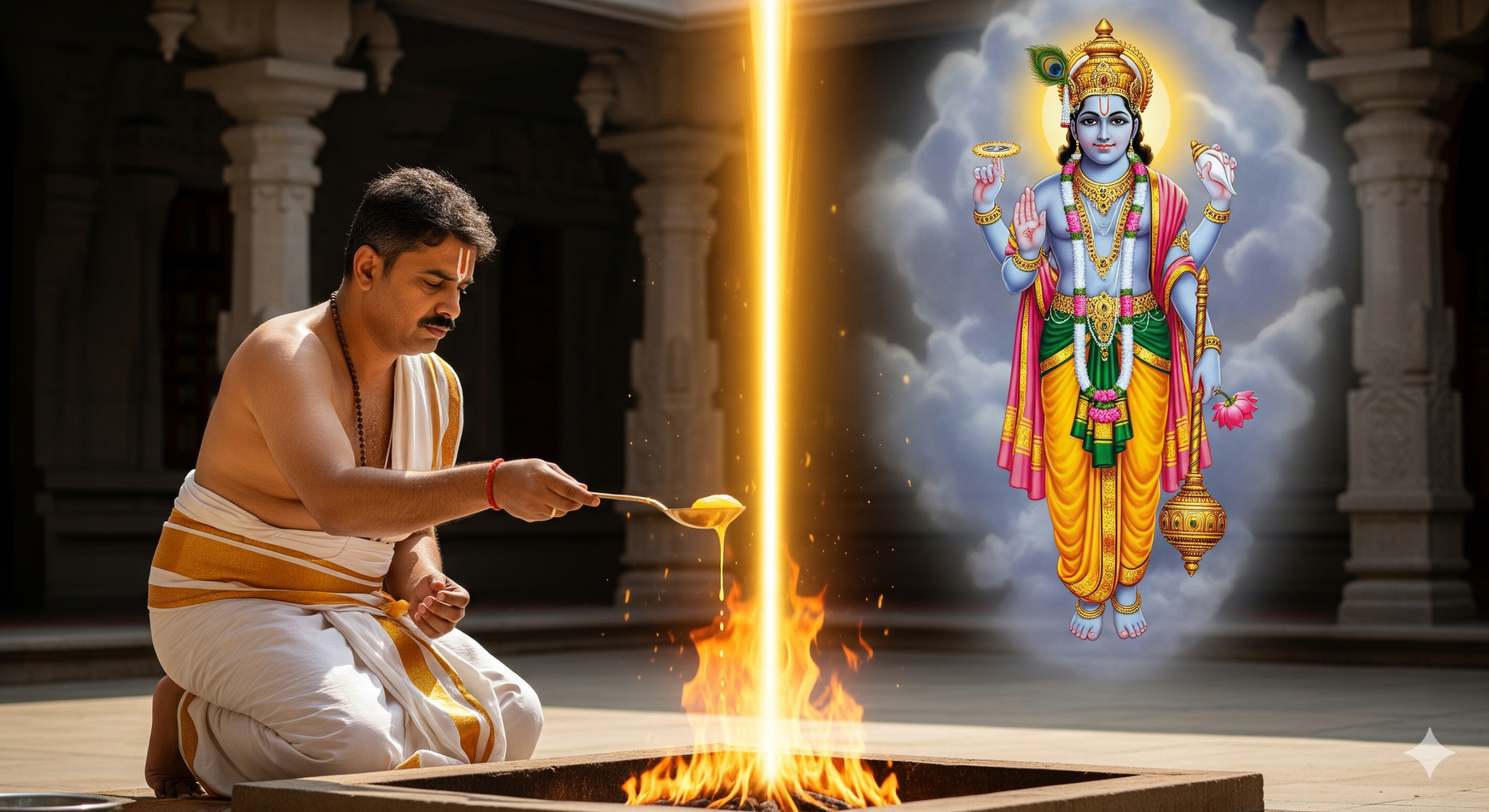
अ॒सौ वै जु॒हूः । अ॒न्तरि॑क्षमुप॒भृत् । पृ॒थि॒वी ध्रु॒वा । तासा॑मे॒तदे॒व प्रि॒यं नाम॑ । यद्घृ॒ताचीति॑ । यद्घृ॒ताचीत्याह॑ । प्रि॒येणै॒वैना॒ नाम्ना॑ सादयति । ए॒ता अ॑सदन्थ्सुकृ॒तस्य॑ लो॒क इत्या॑ह । स॒त्यं वै सु॑कृ॒तस्य॑ लो॒कः । स॒त्य ए॒वैनाः᳚ सुकृ॒तस्य॑ लो॒के सा॑दयति । ता वि॑ष्णो पा॒हीत्या॑ह । य॒ज्ञो वै विष्णुः॑ । य॒ज्ञस्य॒ धृत्यै᳚ । पा॒हि य॒ज्ञं पा॒हि य॒ज्ञप॑तिं पा॒हि मां य॑ज्ञ॒निय॒मित्या॑ह । य॒ज्ञाय॒ यज॑मानाया॒त्मने᳚ । तेभ्य॑ ए॒वाशिष॒माशा॒स्तेऽना᳚र्त्यै ॥ ३। ३। ६। ११॥
Translation:
“This is indeed the oblation offered, situated in the intermediary space, firmly supported by the earth. It is called ‘Priya’—that which is dear—and the ghee offering is made with this name. Through this, the world of the virtuous is established. Vishnu protects it. The sacrifice is indeed Vishnu, and through the sacrifice one is safeguarded. Protect the yajna, protect the lord of the yajna, protect me—the sacrificer. By these offerings, blessings are assured for the performer and for others.”
Commentary:
This verse emphasizes the sanctity of the oblation, describing it as firmly grounded yet present in the intermediary space, bridging earth and heaven. Naming the ghee offering ‘Priya’ underscores the heartfelt devotion inherent in ritual acts, which aligns them with cosmic order and the world of the virtuous. Vishnu is invoked as the protector of the sacrifice, reinforcing the recurring teaching that the yajna itself is Vishnu. By safeguarding the sacrifice, its lord, and the sacrificer, the verse conveys that every ritual act, however small, carries protective power and grants blessings, uniting human effort with divine presence.
ताभ्या॑मे॒व प्र॑ति॒प्रोच्या॒त्याक्रा॑मति । विजि॑हाथां॒ मा मा॒ संता᳚प्त॒मित्या॒हाहिꣳ॑सायै । लो॒कं मे॑ लोककृतौ कृणुत॒मित्या॑ह ।आ॒शिष॑मे॒वैतामाशा᳚स्ते । विष्णोः॒ स्थान॑म॒सीत्या॑ह । य॒ज्ञो वै विष्णुः॑ । ए॒तत्खलु॒ वै दे॒वाना॒मप॑राजितमा॒यत॑नम् । यद्य॒ज्ञः । दे॒वाना॑मे॒वाप॑राजित आ॒यत॑ने तिष्ठति । इ॒त इन्द्रो॑ अकृणोद्वी॒र्या॑णीत्या॑ह ॥ ३। ३। ७। ७॥
Translation:
“Through these offerings, the oblation proceeds and fulfills its purpose. ‘May I not be dissatisfied,’ it is said. ‘Let my world be established in the world-creating act.’ The blessings invoked through these offerings are granted. This is the abode of Vishnu. The sacrifice is indeed Vishnu. This is the imperishable support of the gods. When the yajna exists, it stands in the imperishable realm of the gods. Indra himself does not act without its energy.”
Commentary:
This verse emphasizes that every oblation and offering has a purposeful trajectory, culminating in blessings and cosmic order. The act of offering is seen as establishing one’s world while simultaneously sustaining the gods’ realm, highlighting the intertwining of human ritual and divine order. Vishnu is identified as the very essence and support of the sacrifice, reinforcing the core principle that the yajna itself is divine and imperishable, and even powerful deities like Indra depend on its energy to act, showing that ritual and cosmic authority are inseparably linked.

अदि॑त्यै॒ स्वाहाऽदि॑त्यै म॒ह्यै᳚ स्वाहाऽदि॑त्यै सुमृडी॒कायै॒ स्वाहेत्या॑ह । इ॒यं वा अदि॑तिः । अ॒स्या ए॒वैनं॑ प्रति॒ष्ठायोद्य॑च्छते । सर॑स्वत्यै॒ स्वाहा॒ सर॑स्वत्यै बृह॒त्यै᳚ स्वाहा॒ सर॑स्वत्यै पाव॒कायै॒ स्वाहेत्या॑ह । वाग्वै सर॑स्वती । वा॒चैवैन॒मुद्य॑च्छते । पू॒ष्णे स्वाहा॑ पू॒ष्णे प्र॑प॒थ्या॑य॒ स्वाहा॑ पू॒ष्णे न॒रन्धि॑षाय॒ स्वाहेत्या॑ह । प॒शवो॒ वै पू॒षा । प॒शुभि॑रे॒वैन॒मुद्य॑च्छते । त्वष्ट्रे॒ स्वाहा॒ त्वष्ट्रे॑ तु॒रीपा॑य॒ स्वाहा॒ त्वष्ट्रे॑ पुरु॒रूपा॑य॒ स्वाहेत्या॑ह। त्वष्टा॒ वै प॑शू॒नां मि॑थु॒नानाꣳ॑ रूप॒कृत् । रू॒पमे॒व प॒शुषु॑ दधाति । अथो॑ रू॒पैरे॒वैन॒मुद्य॑च्छते । विष्ण॑वे॒ स्वाहा॒ विष्ण॑वे निखुर्य॒पाय॒ स्वाहा॒ विष्ण॑वे निभूय॒पाय॒ स्वाहेत्या॑ह । य॒ज्ञो वै विष्णुः॑ । य॒ज्ञायै॒वैन॒मुद्य॑च्छते । पू॒र्णा॒हु॒तिमु॑त्त॒मां जु॑होति । प्रत्युत्त॑ब्ध्यै सय॒त्वाय॑ ॥ ३। ८। ११। २॥
Translation:
“‘Svāhā to the Sun, Svāhā to the Sun for me, Svāhā to the Sun in the form of a well-prepared offering,’ it is said. This is Aditi, who elevates the oblation upon establishment. ‘Svāhā to Sarasvatī, Svāhā to Bṛihatī, Svāhā to Sarasvatī in the purifying fire,’ it is said. Speech itself elevates the offering. ‘Svāhā to Pūṣan, Svāhā for the worldly lord, Svāhā to Pūṣan in the offering,’ it is said. Cattle are Pūṣan, and the offering raises them. ‘Svāhā to Tvaṣṭṛ, Svāhā to the paired forms of Tvaṣṭṛ, Svāhā to Tvaṣṭṛ in all forms,’ it is said. Tvaṣṭṛ shapes the cattle into proper forms. Then, through these forms, the offering is elevated. ‘Svāhā to Vishnu, Svāhā to Vishnu for removal, Svāhā to Vishnu for fulfillment,’ it is said. The sacrifice is indeed Vishnu, and through the sacrifice, offerings are elevated. The performer offers a full and complete oblation, dedicated for the intended purpose.”
Commentary:
This verse systematically shows how every divine aspect—Aditi, Sarasvatī, Pūṣan, Tvaṣṭṛ, and finally Vishnu—is invoked in the offering, demonstrating the layered sanctity of yajna. Each invocation, whether of cosmic forces, speech, or generative powers, serves to elevate the oblation and align it with divine order. Vishnu is ultimately affirmed as the sacrifice itself, receiving and manifesting every offering in fullness. The verse emphasizes that the complete oblation, when properly offered, unites all forces and reaches Vishnu, highlighting the central Vedic principle that every act in the yajna, however small, is inherently sacred and cosmic in effect.

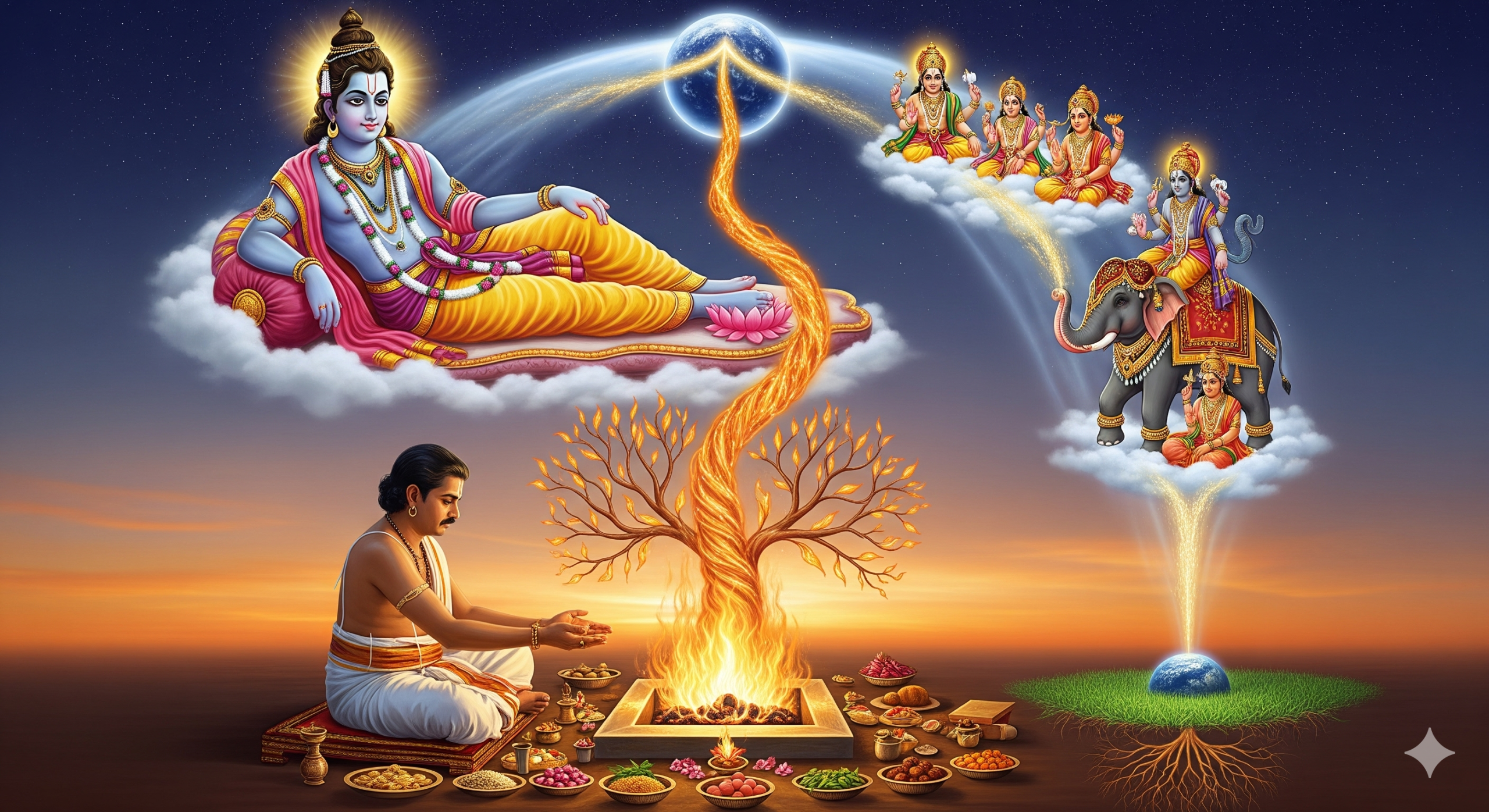
When seen together, the eight occurrences of “Yajño Vai Viṣṇuḥ” span the whole spectrum of human and cosmic needs:
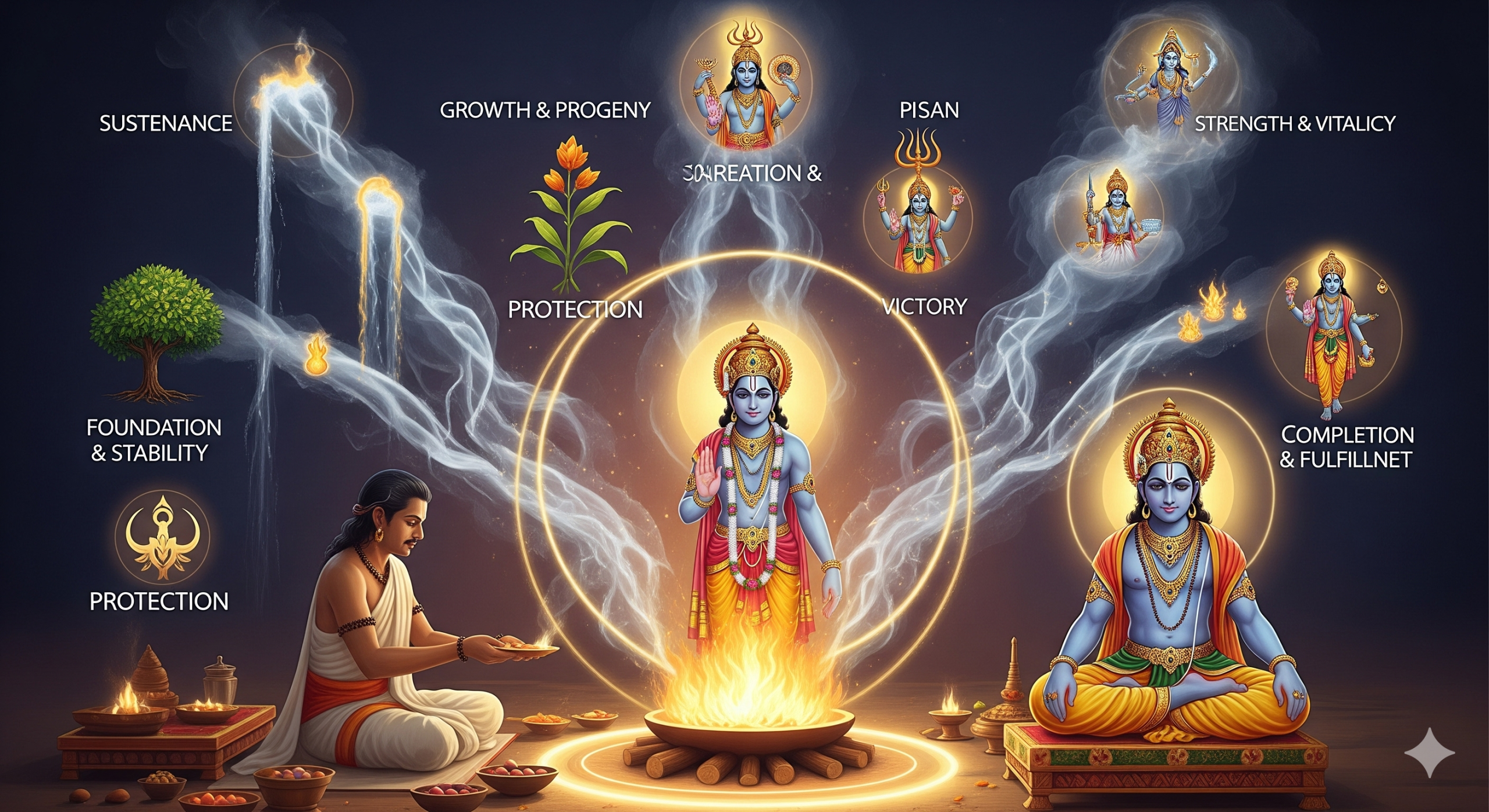
| Verse Number | Vishnu’s Role / Theme | Essence of the Verse |
|---|---|---|
| 1.4.3.6 | Sustenance | Vishnu maintains continuity and peace; every offering reaches him, establishing cosmic order. |
| 1.8.1.2 | Growth & Progeny | Through Tvaṣṭṛ’s shaping and Vaishnava invocation, the sacrifice promotes growth, productivity, and generative powers. |
| 3.1.6.7 | Foundation & Stability | Devotional utterances (“Svāhā”) stabilize the sacrifice; Vishnu gives it firmness and support. |
| 3.2.3.12 | Completion & Fulfillment | Offerings, whether metal, wood, or water, reach Vishnu and achieve the full purpose of yajna. |
| 3.3.6.11 | Protection | Vishnu safeguards the sacrifice, its lord, and the sacrificer, granting blessings and security. |
| 3.3.7.7 | Victory | As imperishable support of the gods, Vishnu upholds cosmic order, enabling triumph and righteous worlds. |
| 3.8.11.2 (part1) | Strength & Vitality | Invocations to Aditi, Sarasvatī, Pūṣan, Tvaṣṭṛ energize life, speech, and action under Vishnu’s aegis. |
| 3.8.11.2 (part2) | Fulfillment of Cosmic Design | Complete oblations manifest Vishnu fully, realizing the universe’s order and the ritual’s blessings. |

Living the Yajna in Modern Life
Bhagawan Sri Sathya Sai Baba, in His discourse “Make Every Moment a Yajna,” beautifully explains:
“Man embarks upon an undertaking with a purpose, goal, or an end in view. But, the endeavour is sublimated into a yajna (sacrificial rite which can draw down the Grace of God) only if the purpose, goal or end is the glorification of God, regardless of other considerations. ‘Yajno vai Vishnuh,’ say the Vedas. God is the yajna, for He is the Goal. His Grace is the reward. His creation is used to propitiate Him; the performer is He, the receiver is He. When the ego of the sacrificer does not claim a place, the yajna is rendered Divine.” [saispeaks]
In earlier times, yajna was commonly associated with sacrificial fires, rituals, and offerings into the sacred flame. Today, the essence of yajna extends far beyond ritual. Any task, duty, or work performed with selflessness and surrender is a yajna. Whether it is caring for family, fulfilling professional responsibilities with integrity, serving the community, or engaging in spiritual practices—all of these become yajnas when dedicated to God without ego.
The “Eight Dimensions of Vishnu in the Yajna” table illustrates how Vishnu, the all-pervading Divine, manifests in each facet of life—sustenance, growth, protection, and fulfillment. By seeing our everyday responsibilities through this lens, we realize that:
Bhagawan’s reminder of “Yajno vai Vishnuh” thus calls us to re-envision every act as a sacred sacrifice. In this way, modern life itself becomes a continuous yajna, and every action finds fulfillment in God.

The Taittirīya Brāhmaṇa, through its eightfold affirmation “Yajño Vai Viṣṇuḥ”, reminds us that yajña is not an occasional ritual but the very principle of living. It nourishes, protects, strengthens, and leads to victory and fulfillment.
As a gentle takeaway, Yajña can be understood as any work or task we do, and via Viṣṇuḥ as the offering of that work to the All-pervading Divine. In this light, every action in our life — however small or ordinary — becomes sacred when offered to Viṣṇu. This is the heart of the teaching: to transform life itself into an unbroken yajña. A thought for us all to quietly ponder and practice.
Samastah Lokah Sukhino Bhavanthu
May all the beings of all the worlds be happy!
Jai Sai Ram!
Please note all images and content created using AI Tools

In our modern, fast-paced world, we are often overwhelmed by distractions and external pressures. We yearn for a sense of purpose and a deeper connection to something meaningful. Ancient wisdom traditions, passed down through generations, offer a profound roadmap for this journey—a way to find true peace and empowerment by looking inward.
The Mudgala Purana, a sacred Hindu scripture, is one such timeless guide. It reveals that the key to mastering our external world lies in conquering our inner self.
In the pursuit of spiritual knowledge, few texts are as direct and transformative. The Mudgala Purana is one of the two key Upapuranas (minor Puranas), along with the Ganesha Purana, that are central to the worship of Ganesha as the Supreme Brahman—the ultimate, all-encompassing reality.
This aspect and worship of Ganesha as the Supreme Brahman, is also expressed in the verses of the Ganesh Atharva Shirsha Upanishad, as described below:
| Sanskrit | Transliteration | English Translation |
|---|---|---|
| त्वमेव प्रत्यक्षं ब्रह्मासि । त्वमेव केवलं कर्ताऽसि । त्वमेव केवलं धर्ताऽसि । त्वमेव केवलं हर्ताऽसि । | Tvam-eva pratyakṣam Brahmāsi. Tvam-eva kevalam kartā-asi. Tvam-eva kevalam dhartā-asi. Tvam-eva kevalam hartā-asi. | You alone are the visible Brahman. You alone are the creator. You alone are the sustainer. You alone are the destroyer. |
Similar to the Atharva Shirsha Upanishad mantra’s, The Mudgala Purana provides a profound philosophical journey that uses the divine form of Ganesha to explain the unfolding of creation and the path to spiritual liberation.
While many see Ganesha simply as the beloved remover of obstacles, these texts unveil a deeper truth: that the divine consciousness, the very essence of the universe, is embodied in the form of the elephant-headed god.
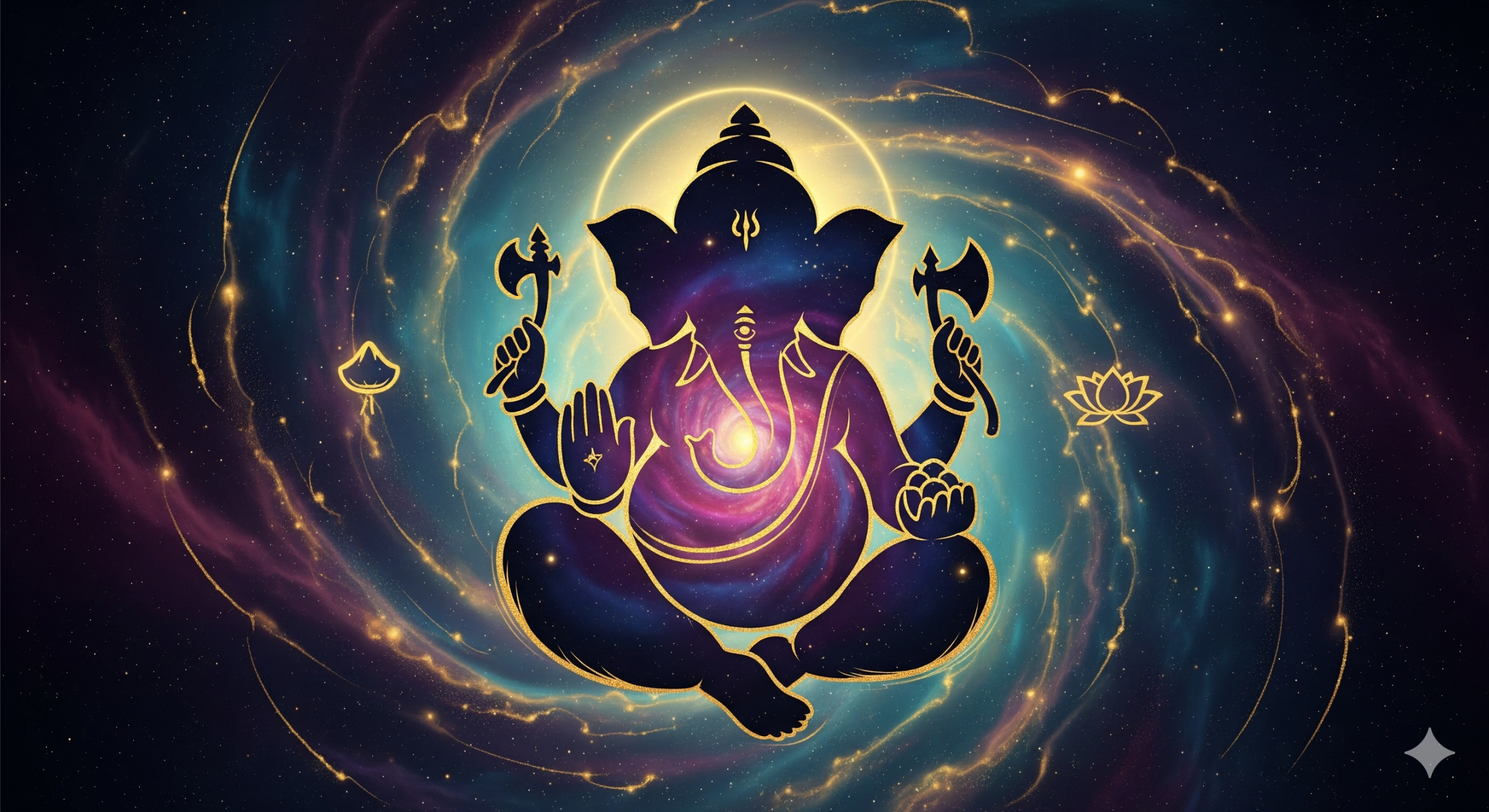
The Purana’s core wisdom is revealed through the mythological and philosophical dimensions of Ganesha. The text is not a dry theological treatise but a vibrant map of our spiritual journey.
The most powerful teaching is found in the concept of Ganesha’s eight incarnations. Each of these forms is a divine manifestation that descends to conquer a specific demon. Yet, the true power of these stories lies in their metaphorical meaning: the demons are not external foes but personifications of our inner vices. Arrogance, greed, delusion, and ego are the very forces that create obstacles in our lives. By meditating on Ganesha’s triumphs over these demons, we are given a clear, actionable guide for conquering our own internal challenges.
Beyond these incarnations, the Purana is a vast compendium of wisdom. It details the cosmology of Ganesha, his relationship with other deities, and the proper rituals for his worship. The text elevates sound itself, asserting that the primordial sound Omkara is a form of Ganesha. This all-encompassing view encourages us to find the divine not just in temples but in the very fabric of existence, in every sound, in every thought.

The heart of the Mudgala Purana lies in its vivid descriptions of Ganesha’s eight incarnations. These are not merely mythical stories; they are powerful allegories for the human struggle against spiritual ignorance. Each incarnation, or avatar, manifests to defeat a specific demon who represents a common human vice.
By meditating on these stories, we learn to identify and confront our own inner demons. The Purana teaches us that true spiritual progress is not about fighting external forces but about conquering the negative emotions and attachments that hold us back from our highest potential.

While the eight incarnations provide a clear path for self-improvement, the Mudgala Purana contains much more. It offers a complete spiritual framework, including:

The timeless wisdom of the Mudgala Purana offers profound lessons we can apply to our daily lives:
By engaging with the wisdom of the Mudgala Purana, we can find a deeper purpose, navigate the challenges of life with greater clarity, and embark on a transformative journey from our ego-driven existence to one of spiritual enlightenment.

The Mudgala Purana is, at its heart, a guide to self-realization. It teaches us that the path to spiritual enlightenment is not about seeking a god in a distant heaven, but about recognizing the divine spark that already resides within us.
By understanding that Ganesha is the creator, the sustainer, and the destroyer, we realize that we are part of an endless cosmic dance. Our purpose, then, is to transcend our ego and our attachments—the very demons Ganesha battles—and merge with that ultimate consciousness. This ancient wisdom provides a powerful framework for living a purposeful life, a life where every action, thought, and word becomes an act of a divine being.
Samastah Lokah Sukhino Bhavanthu
May all the beings in all the worlds be happy!
Jai Sai Ram!
Please note all content and imagesg generated using AI Tools
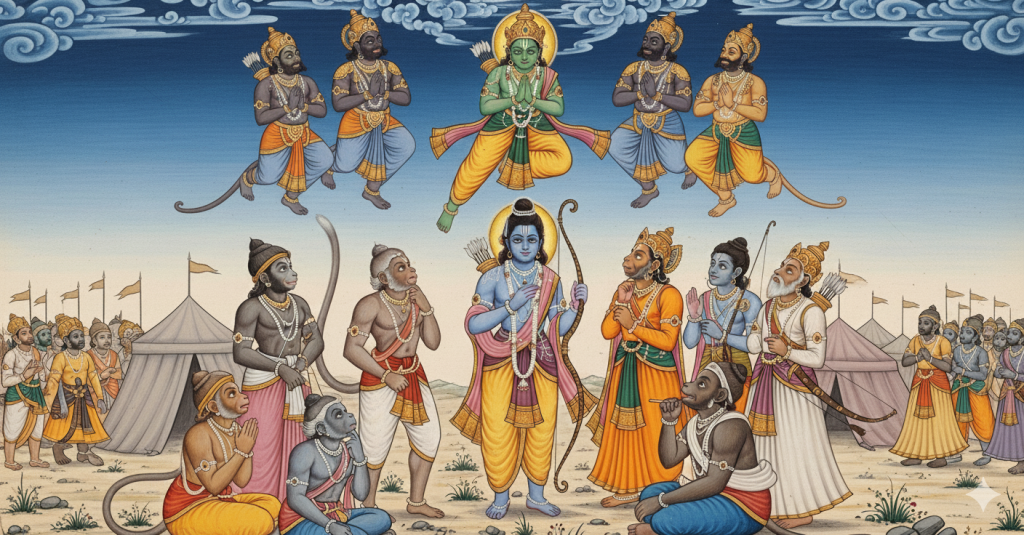
In Yuddha Kāṇḍa Sarga 17 of the Valmiki Rāmāyaṇa, we witness a turning point in the great battle against Rāvaṇa. Vibhīṣaṇa, the younger brother of the demon king, leaves the kingdom of Laṅkā, declaring his loyalty to Rāma. His arrival in the sky above Rāma’s camp immediately sparks a debate among the vānaras — leaders and ministers of Rāma’s army — each bringing a distinct perspective on whether this new ally can be trusted.
This Sarga provides not only a thrilling narrative but also timeless lessons in leadership, discernment, and group decision-making.
The discussion over Vibhīṣaṇa’s arrival is not just a tale from the Rāmāyaṇa, but a masterclass in leadership and decision-making.
Vibhīṣaṇa, accompanied by four companions, arrived above Rāma’s camp and sought refuge at His feet. Suspended in the sky, he declared his intention to join Rāma’s side. Sugrīva, however, warned that a demon could never be trusted.
To resolve the dilemma, Rāma turned to His council of leaders for their counsel. Angada, Śarabha, Jāmbavān, and Mainda voiced their doubts, questioning the sincerity of Vibhīṣaṇa’s request.
Hanumān alone spoke differently: he argued that Vibhīṣaṇa had recognized both the virtues of Rāma and the flaws of Rāvaṇa, and that his desire to defect was also tied to his hope of rightfully ruling Laṅkā. With this balanced perspective, Hanumān urged Rāma to render the final decision.
In this post we present the heroic arrival of Vibhishana as described in the Valmiki Ramayana.

(Yuddha Kāṇḍa, Sarga 17: Verses 1–5)
Sanskrit (transliteration):
iti uktvā paruṣam vākyaṃ rāvaṇaṃ rāvaṇānujaḥ |
ājagāma muhūrteṇa yatra rāmaḥ salakṣmaṇaḥ
Translation:
“Having spoken the aforesaid harsh words to Rāvaṇa, Vibhīṣhaṇa arrived almost immediately to the place where Rāma was together with Lakṣmaṇa.” Valmiki Ramayana
Commentary:
With dramatic turn, we see Vibhīṣhaṇa’s departure from Rāvaṇa’s realm. No delay—he arrives swiftly upon the battlefield, heralding a radical shift: the brother of the enemy now stands among Rāma’s camp.
Sanskrit (transliteration):
tam meru śikhara ākāraṃ dīptaṃ iva śata hṛdaṃ |
gagana-stham mahīsthāś te dadṛśur vānarādhipāḥ
Translation:
“Those leaders of monkeys standing on the ground saw Vibhīṣhaṇa, resembling the peak of Mount Meru and shining like a thunderbolt in the sky.” Valmiki Ramayana
Commentary:
In an almost cinematic moment, Vibhīṣhaṇa hovers brilliantly in the sky—cosmic imagery—a mountain’s summit aflame, a thunderbolt frozen in the heavens. It’s a divine interruption, freezing the attention of all below.
Sanskrit (transliteration):
te ca apy anucaraās tasya catvāro bhīma-vikramaāḥ |
te api varmayaudh-upetā bhūṣhaṇottama-bhūṣhitāḥ
Translation:
“His four companions of terrific prowess were also there with him. They were wearing weapons and armour and were adorned with excellent ornaments.” Valmiki Ramayana
Commentary:
Vibhīṣhaṇa is not solitary—he descends with four regal companions, each a warrior in splendor. It is no stealthy escape but a bold and ceremonial entrance, commanding respect.
Sanskrit (transliteration):
sa ca meghācalaprakāśo vajrāyudh-samaprabhaḥ |
varāyudhadharo vīraḥ divyābharaṇa-bhūṣhitaḥ
Translation:
“Vibhīṣhaṇa also resembled a mass of cloud, the equal of the God who wields the thunderbolt. He was holding excellent weapons and was adorned with wonderful jewels.” Valmiki Ramayana
Commentary:
The metaphor grows more powerful. He is compared to a cloud-mountain and Indra’s thunderbolt. Clad in divine ornaments and weapons, he radiates authority and supernatural presence—no mere wanderer, but a dignified claimant of dharma.
Sanskrit (transliteration):
tam ātmā pañcamaṃ dṛṣṭvā sugrīvo vānarādhipaḥ |
vānaraiḥ saha durdharṣhaḥ cintayām āsā buddhimān
Translation:
“Sugrīva the valiant of monkeys, who was difficult to be overpowered, having seen Vibhīṣhaṇa, the fifth one along with four others, became thoughtful along with monkeys.” Valmiki Ramayana
Commentary:
Even the mighty Sugrīva pauses. This is no routine audience—it is a turning point. Sugrīva’s thoughtful stillness together with the vānaras marks a shift from normalcy to alert consciousness: something extraordinary—and potentially dangerous—is unfolding.

(Verses 6-17-11 to 6-17-17)
Sanskrit (Transliteration from the page):
sa uvaaca ca mahaapraaGYaH svareNa mahataa mahaan |
sugriivam taam ca samprekShya khastha eva vibhiiShaNaH
Translation (from the page):
“That great and highly intelligent Vibhīṣhaṇa, halting in the sky itself, saw Sugrīva and those monkeys and spoke to them in a loud voice.” Valmiki Ramayana
Commentary:
Vibhīṣhaṇa takes the initiative — speaking loudly so all can hear. His composed presence in the sky conveys authority and clarity before he even speaks his plea.
Transliteration:
raavaNo naama durvR^itto raakShaso raakShasa iishvaraH |
tasya aham anujo bhraataa vibhiiShaNa iti shrutaH
Translation:
“There is a demon called Ravana, the king of demons, having a bad conduct. I am his younger brother, known as Vibhīṣhaṇa.” Valmiki Ramayana
Commentary:
Vibhīṣhaṇa introduces himself plainly, acknowledging his lineage yet distancing himself morally — a statement both honest and bold.
Transliteration:
tena siitaa jana sthaanaadd hR^itaa hatvaa jaTaayuSham |
ruddhvaa ca vivashaa diinaa raakShasiibhiH surakShitaa
Translation:
“It is Ravana who, having killed a bird Jatayu, took away Sita from Janasthana. That unfortunate lady is held captive against her will and she is now amidst the female titans who guard her jealously.” Valmiki Ramayana
Commentary:
He speaks factually, recounting Ravana’s crime and Sītā’s suffering. This frames his plea within the moral imperative of justice.
Transliteration:
tam aham hetubhir vaakyair vividhaiH ca nyadarshayam |
saadhu niryaatyataam siitaa raamaaya iti punaH punaH
Translation:
“I persuaded Ravana again and again by my diverse words and arguments to restore Sita smoothly to Rama.” Valmiki Ramayana
Commentary:
Vibhīṣhaṇa positions himself as a repentant brother — one who repeatedly sought peace through reason, not force.
Transliteration:
sa ca na pratijagraaha raavaNaH kaala coditaH |
ucyamaano hitam vaakyam vipariita iva auShadham
Translation:
“That Ravana, impelled by fate, did not receive my sage advice — as a perverted person does not accept his prescribed medicine.” Valmiki Ramayana
Commentary:
The analogy of medicine portrays Vibhīṣhaṇa’s counsel as wise yet ignored — Ravana’s stubbornness cost righteousness and drove Vibhīṣhaṇa to seek refuge elsewhere.
Transliteration:
so aham paruShitas tena daasavac ca avamaanitaH |
tyaktvaa putraamH ca daaraamH ca raaghavam sharaNam gataH
Translation:
“Reviled by him and humiliated as a slave, I, leaving my sons and my wife, have come to take refuge with Rama.” Valmiki Ramayana
Commentary:
Vibhīṣhaṇa’s personal cost becomes clear — he left loved ones and endured insult to uphold dharma. It underlines the sincerity of his surrender.
Transliteration:
nivedeayata maam kshipram raaghavaaya mahaatmane |
sarva loka sharaNyaaya vibhiiShaNam upasthitam
Translation:
“Inform immediately to high-soled Rāma, the protector of all the worlds, that I, Vibhīṣhaṇa, have come here.” Valmiki Ramayana
Commentary:
The plea is formal and urgent — he bows to dharma and offers allegiance. Addressing Rāma as the ‘Protector of all worlds’ reveals reverence and humility.
This “Heroic Arrival” scene merges the cosmic with the political, the poetic with the strategic. Vibhīṣhaṇa’s descent is at once awe-inspiring and tension-inducing—a divine plea that carries the weight of decisions yet to come. It poses critical questions from the very outset: How should one receive a being from the enemy camp who arrives with such dignity? How do dharma and strategy intersect when cosmic spectacle meets battlefield?
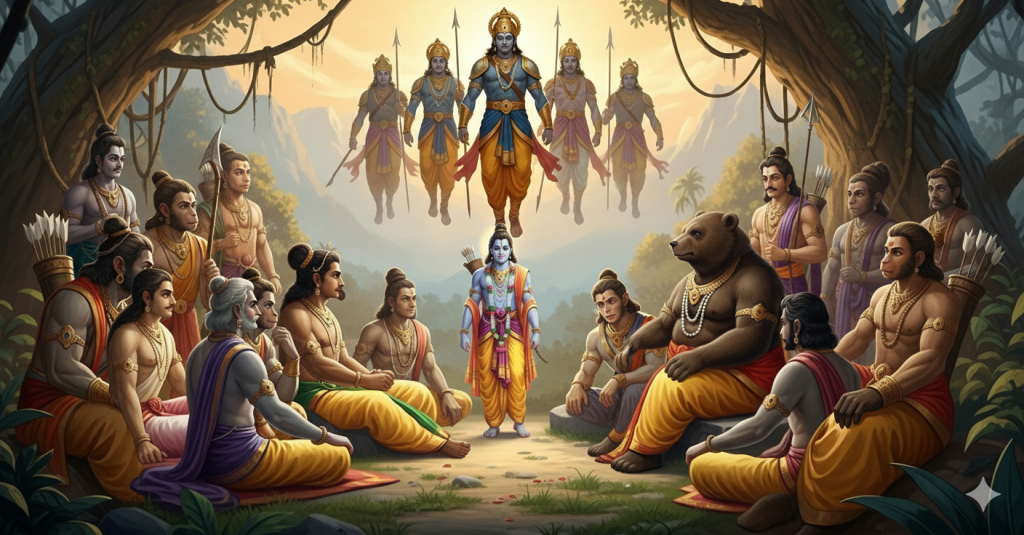
Vibhīṣhaṇa’s sudden appearance in Rāma’s camp marks a turning point in the Yuddha Kāṇḍa. A brother of Rāvaṇa, stepping away from the might of Laṅkā and seeking shelter in Rāma, brings both hope and uncertainty. His arrival sets the stage for one of the most profound debates in the epic—how to balance caution with compassion, and strategy with dharma.
Next week, we will journey into the counsel of Sugrīva, Jāmbavān, Hanumān, and others, as they weigh the motives and truth of Vibhīṣhaṇa’s words—revealing timeless insights into leadership, trust, and divine discernment.
All verses and translations are from: Valmiki Ramayana – Yuddha Kāṇḍa, Sarga 17
Samastah Lokah Sukhino Bhavanthu
May All the Beings in All the Worlds be Happy!
Jai Sai Ram!
Please note all content and images generated using AI Tools

In our previous reflection, we explored the second verse of the first Anuvāka of the Sri Rudram Namakam — “Namaste astu Bhagavan…”. That verse introduced us to Rudra as the all-encompassing Divinity, the Supreme who holds together all creation, pervading and protecting it.
Continuing with this journey through the Namakam, today we turn to the third and fourth verses of the first Anuvāka. These verses are deeply devotional invocations, where the seeker prays to Lord Rudra to reveal His most compassionate, serene, and auspicious aspect. They provide us with a glimpse of how Vedic mantras appeal to the Divine not in fear, but with intimacy and yearning for grace.
Having saluted Rudra as the mighty and all-pervading Lord in the earlier verses, the ṛṣis now seek His gracious aspect. They call upon Him to shine forth His peaceful form, to wield His weapons in protection rather than destruction, and to guide devotees toward life-affirming grace.

Sanskrit
या ते रुद्र शिवा तनूरघोराऽपापकाशिनी ।
तया नस्तनुवा शन्तमया गिरिशन्ताभिचाकशीहि ॥
Transliteration
yā te rudra śivā tanūr-aghora apāpakaśhinī ।
tayā nas tanuvā śantamayā giriśanta abhicākashīhi ॥
Translation
O Rudra! That auspicious form of Yours, serene and free from terror, destroying all sins — with that gracious form, O Lord of the mountains, shine forth upon us!
Here the devotee recognizes Rudra’s dual nature — fierce and protective on one side, compassionate and healing on the other. The prayer is directed specifically to Rudra’s śivā tanūḥ — His benevolent form, which is:
The key word here is “abhicākashīhi” — “shine forth upon us.” This is not merely asking for protection but for the active radiance of Divine Grace in one’s life. Just as the sun removes darkness by its very presence, Rudra’s compassionate form removes ignorance and fear, bringing clarity and strength.
This verse is an earnest plea to behold Rudra’s gentle and purifying presence. The devotee asks not to encounter His fearsome form but His śānta-svarūpa—the gracious form that shines with peace and dissolves sin.
The word apāpakāśinī conveys Rudra’s unique power to dispel the very darkness of wrongdoing, not by punishment but by the illuminating presence of His serene nature. Giriśanta, the mountain-dweller, symbolizes both the majestic transcendence of Rudra and the stillness of a mind established in Him. To pray abhicākaśīhi—“shine forth upon us”—is to ask for the direct experience of His grace.

Sanskrit
यामिषुं गिरिशन्त हस्ते बिभर्ष्यस्तवे ।
शिवां गिरित्र तम कुर्वणो तया नो मृड जीवसे ॥
Transliteration
yām iṣhuṃ giriśanta haste bibharṣhy astave ।
śivāṃ giri-tra tama kurvaṇo tayā no mṛḍa jīvase ॥
Translation
O Lord of the mountains, the arrow that You hold in Your hand to strike—transform that weapon into a gracious, auspicious power. With that, bless us with happiness and long life.
This verse continues the theme of Rudra’s weapons, often seen as fearsome symbols of destruction. But here the devotee petitions Rudra to transform His arrow into a source of blessing. The arrow, normally associated with injury, becomes an instrument of grace and is here prayed as: make it gracious, O Lord.
This reflects a profound spiritual truth: what seems to be harsh or painful in life can, through Divine Will, turn into a force for growth and protection. Even the trials and challenges we face are arrows in Rudra’s hand — when suffused with His grace, they guide us toward endurance, wisdom, and ultimately liberation.
The prayer culminates in the request: “tayā naḥ mṛḍa jīvase” — Bless us with life through that very power. Thus, the seeker sees Rudra not as a distant or fearsome deity, but as the very sustainer of life, transforming even weapons into instruments of compassion.
This verse does not deny Rudra’s power, nor ask Him to put away His bow. Instead, it asks for a transformation of that power—from destructive to protective, from fearful to a blessing. The petition mā hiṃsīḥ puruṣaṃ jagat (“do not harm man or the world”) is deeply universal, extending beyond the individual devotee to embrace all humanity and the whole of creation.
The verse conveys a profound truth of spiritual life: the same divine energy that terrifies can, when blessed, become a source of preservation and healing.

These verses of the Rudram are not only hymns of praise; they are also guides for living.
In this way, the mantras become living practices: they teach us to see, to transform, and to pray universally.

Together, verses 3 and 4 of the Namakam show us that Rudra is not merely the fierce destroyer, but the compassionate protector who shines forth with peace and transforms even His arrows into blessings.
They show us that the Divine is not only mighty and fearsome but also infinitely gracious and protective. By invoking His serene form, we invite grace, healing, and auspiciousness into our lives. By trusting His will, we begin to see challenges not as punishments, but as transformative opportunities.
In the radiance of Rudra’s compassionate glance, life itself becomes sacred. Truly, when we call upon Him to “shine forth,” He illumines the path of both worldly well-being and spiritual liberation —discovering in that prayer the possibility of grace shining upon the whole world.
Source for Sanskrit Text & Transliteration:
Samastah Lokah Sukhino Bhavanthu
May all the beings in all the worlds be happy
Jai Sai Ram!
Please note all content and images are generated using AI
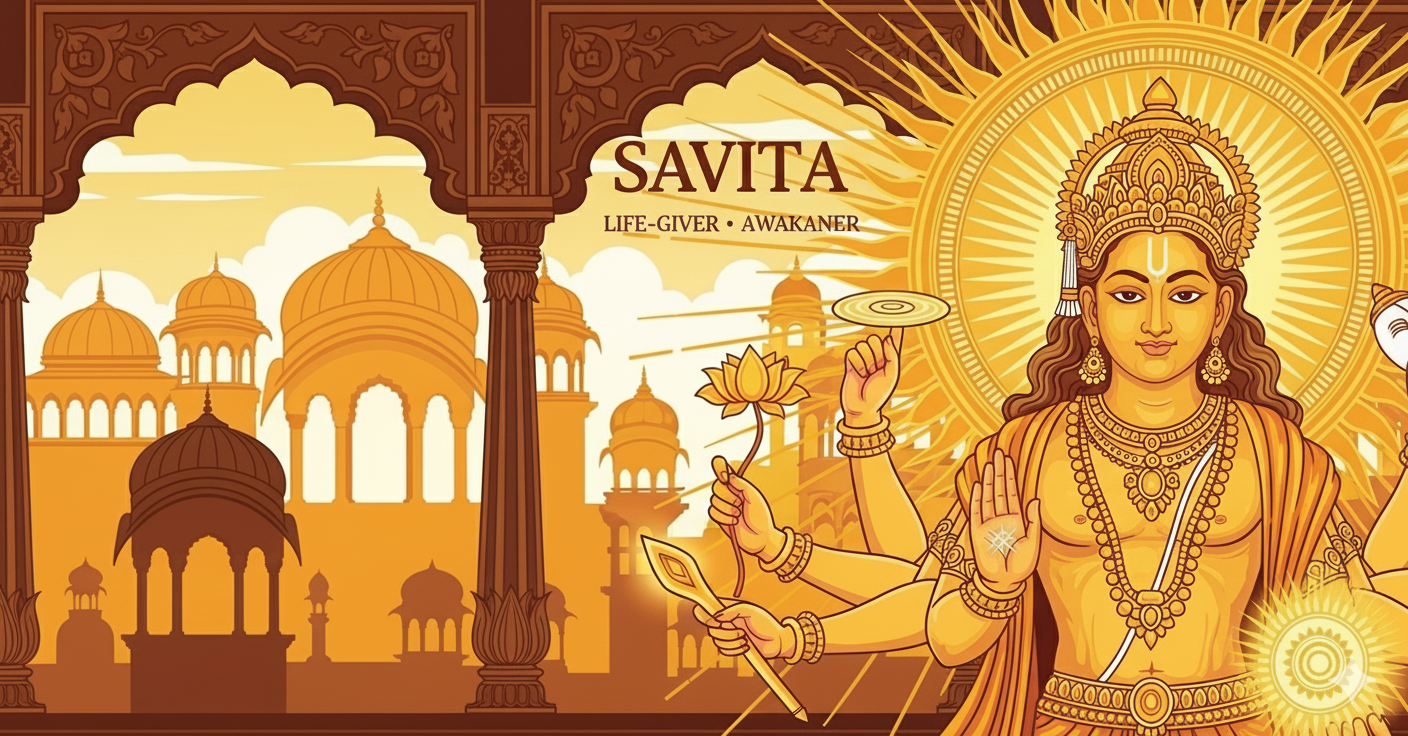
Light has always been a symbol of wisdom, purity, and divinity. In the Vedas, this light is not merely the physical radiance of the Sun but the eternal presence of the Divine that sustains and illumines all of creation. Among the many hymns that glorify the Sun (Surya), the figure of Savita — the life-giver and awakener — stands out as a profound symbol.
The Sun, in this vision, is more than a celestial body. It is the radiant expression of the Divine, the cosmic witness who envelops the worlds with golden rays and shines within us as awareness. It is this dimension of Savita that finds expression in todays post’s verses – both in the Navagraha Suktam and the Surya Upanishad, and which is illuminated further in the teachings of Bhagawan Sri Sathya Sai Baba.
To appreciate the verses we are about to explore, it helps to recall the vision of the rishis. The Sun is both outer and inner: outwardly, it governs time, seasons, and life itself; inwardly, it represents the unfailing light of consciousness that dispels ignorance.
In the Navagraha Suktam, the seer describes this aspect through the imagery of the Sun’s golden rays — an “envelope” that surrounds and protects the worlds. In the Surya Upanishad, the same truth is declared more explicitly: Surya is none other than the Supreme Being, present everywhere and in everything.
Together, these texts form a bridge — moving from the symbolic imagery of light to the direct affirmation of divinity. This bridge becomes even more meaningful when we reflect on how Bhagawan Baba often emphasized the omnipresence of God, guiding us to recognize the Divine not only in the cosmos but in our own hearts.
Before we step into the verses, let us listen with the same reverence as the ancient rishis — who saw in the Sun not just a source of light, but the very presence of the Divine. The Navagraha Suktam begins by unveiling this vision through a prayer to Surya, the golden-hued one who envelopes and sustains all the worlds.

ॐ आसत्येन रजसा वर्तमानो निवेशयन्नमृतं मर्त्यं च ।
हिरण्ययेन सविता रथेनाऽऽदेवो याति भुवना विपश्यन् ॥
अग्निं दूतं वृणीमहे होतारं विश्ववेदसम् ।
अस्य यज्ञस्य सुक्रतुम् ॥
येषाम् ईशे पशुपतिः पशूनां चतुष्पदाम् च द्विपदाम् ।
निष्क्रीतोऽयं यज्ञियं भागमेतु रायस्पोषा यजमानस्य सन्तु ॥

ॐ अधिदेवता प्रत्यधिदेवता सहिताय आदित्याय नमः ॥
Om āsatyena rajasā vartamāno niveśayann amṛtaṃ martyaṃ ca |
hiraṇyayena savitā rathenā devo yāti bhuvanā vipashyan ||
Agniṃ dūtaṃ vṛṇīmahe hotāraṃ viśvavedasam |
asya yajñasya sukratum ||
Yeṣām īśe paśupatiḥ paśūnāṃ catuṣpadām ca dvipadām |
niṣkrīto ’yaṃ yajñiyaṃ bhāgam etu rāyaspoṣā yajamānasya santu ||
Om adhidevatā pratyadhidevatā sahitāya ādityāya namaḥ ||
This opening hymn from the Navagraha Suktam invokes Savitṛ (the Sun as divine inspirer):
✨ Reflection: This verse establishes the Sun as both the cosmic witness and the life-giving force. He bridges mortality and immortality, while Agni carries our prayers upward. It reminds us that every living being is sustained by the divine order, and that surrendering our offerings leads to nourishment, prosperity, and harmony.
Sanskrit Text
सविताḥ पुरस्तात् ।
सविताḥ पश्चात् ।
सविताḥ ऊर्ध्वम् ।
सविताḥ अधः ।
Transliteration
savitaḥ purastāt ।
savitaḥ paścāt ।
savitaḥ ūrdhvam ।
savitaḥ adhaḥ ।

This verse is an affirmation of Savitā (the Sun as the divine life-giver) as the all-encompassing presence. It declares that the radiance of Savitā is not confined to one direction or moment, but surrounds us entirely: before us, behind us, above, and below.
Taken together, the mantra is not merely about the astronomical Sun, but about the inner Sun—the ātman. It is a meditative contemplation that wherever one turns, there is only the golden presence of the Divine, pervading all directions.
Reflective Note
By chanting this verse, a devotee inwardly acknowledges: “I am always in the embrace of Savitā’s light. There is no place where He is not.” This brings deep reassurance, stillness, and a sense of being surrounded by grace.
Bhagawan Baba has emphasized this same truth in His discourses many times. In one such message, He said:
“As long as you have faith in God, you have nothing to fear. May you all enjoy safety and security! Wherever you go, whatever you do, have firm conviction that God is always with you, in you, around you, above you, below you. Do not be carried away by what others say. Have God firmly installed in your heart.”
(Source: Discourse, Sathya Sai Speaks)
In another teaching, reaffirming the same truth, He emphasized:
“You trust your friend whom you have met only a few years ago, but not God who is with you, in you, around you, throughout your life.” (Source: Divine Discourse, Shivarathri Feb 1999)

These are not mere words—they are living affirmations that bring the Upanishadic declaration into our personal, everyday experience. Where the Sūrya Upaniṣad states the omnipresence of Savitā, Baba’s words give us a heartfelt reminder that God is our constant companion in all circumstances—empowering us, protecting us, guiding us, and residing within our very hearts.
These words are a living echo of the Upanishadic declaration. Just as the Sūrya Upaniṣad assures us of Savitā’s omnipresence, Baba translates this ancient wisdom into a practical assurance for the devotee: God’s presence surrounds us at all times — protecting, guiding, and uplifting. The radiance of the Divine is not only cosmic but also deeply personal, assuring safety, peace, and fearlessness for every seeker who keeps faith alive.

Together, these affirm that the Divine is Omnipresent — not distant, but ever-present as light and love, surrounding and pervading us at every moment.
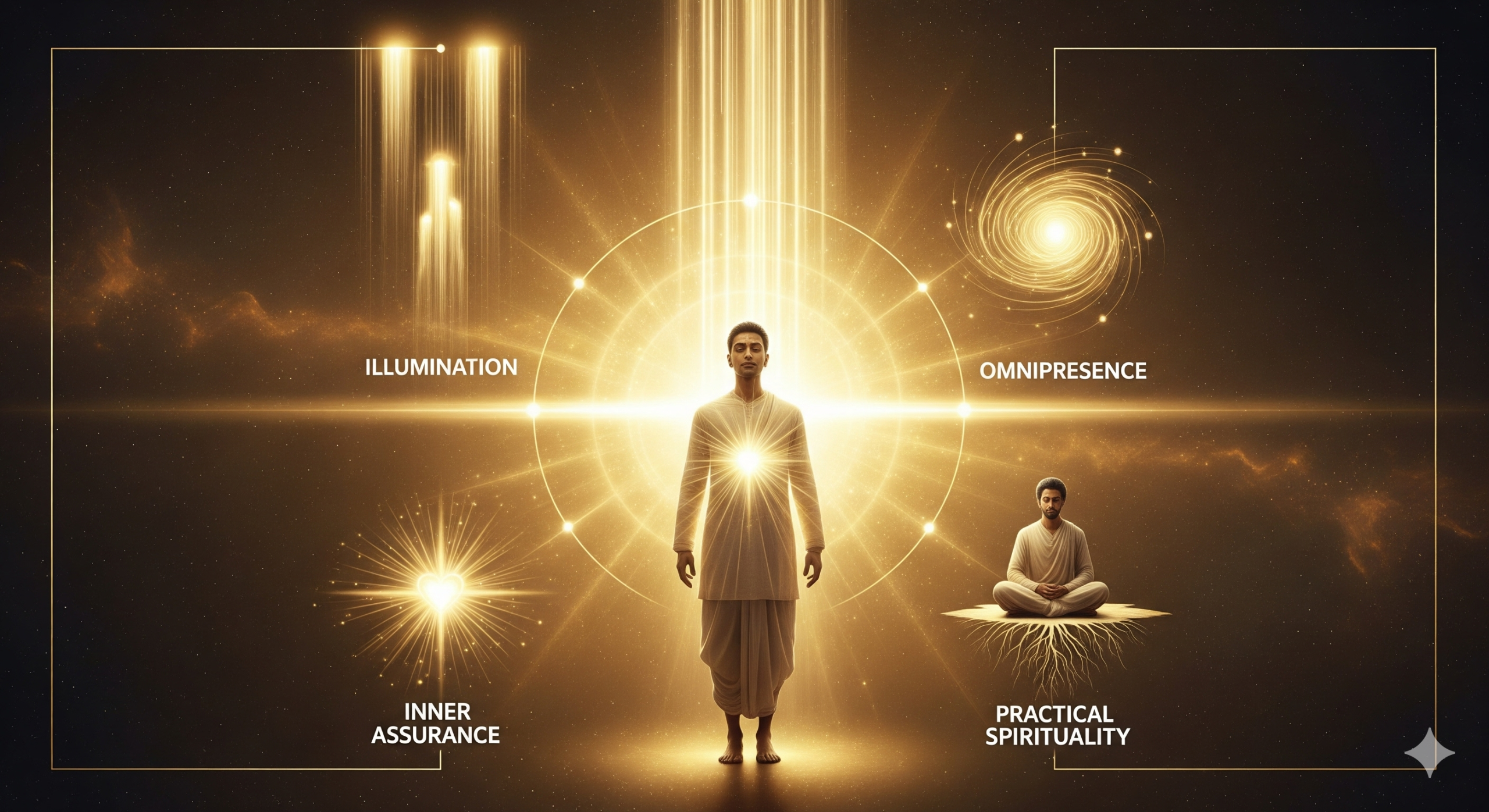
Meditating on these verses and recalling Baba’s assurance helps nurture unshakeable faith. It transforms the abstract idea of omnipresence into a tangible inner reality: a light that is ever-present, faithful, and guiding—day and night, in every step we take.

On this Sunday dedicated to Surya, let us meditate on Savita — the radiant Sun who illumines our lives.
The Navagraha Suktam, the Surya Upanishad, and Bhagawan Baba’s words together remind us that the same Divine Light that moves across the heavens also shines within us and around us, always.
May we live in that awareness, in light, fearlessness, and faith. – The Golden Presence
Samastah Lokah Sukhini Bhavanthu
May all beings in all the worlds be happy!
Jai Sai Ram!
Please note all content and images generated using AI Tools

In the cosmic temple, a divine river flows,
Where earth and fire meet, and sacred lotus grows.
Guided by the breath of air, the universe expands,
A silent OM in the ether, held in a divine hand.
In the sacred worldview of Bharatiya culture, the universe is not a random assembly of matter—it is a living temple, pulsating with the presence of the Divine. Every mountain is a murti, every river a goddess, every breeze a whisper of God. This vision invites us to move from observation to reverence, from consumption to communion.
At the heart of this temple are the five great elements—earth, water, fire, air, and ether—each a manifestation of the Supreme. To worship them is not to worship nature, but to honor God moving through nature.

Bhagawan Sri Sathya Sai Baba often spoke of the Angavathi form of worship, where the five elements are revered as aspects of Divinity. In one discourse, He explained:
“Angavathi refers to the worship of the five elements—earth, water, fire, air, and ether—considering them as manifestations of the Divine. The earth bears the burden of mighty mountains, vast oceans, dense forests, villages, towns, and cities. Likewise, the remaining four elements are also responsible for the sustenance of creation.” —Discourse link
He further elaborated in another talk:
“All the five elements are aspects of God, His Divinity, and His supreme power. It is for this reason that our ancients worshipped the five elements, revering them as aspects of God Almighty. They worshipped the earth as Mother Goddess, the rivers as various goddesses, and the elements as various deities.” —Discourse link

This reverence is not limited to the external world. Bhagawan reminds us that our own body is composed of these five elements, and that honoring them externally is a way of aligning with their presence within.

In His discourse “The Sanctity of the Five Elements”, Bhagawan offers a profound teaching that bridges the cosmic and the personal:
“The five elements of which the entire cosmos is built up, are present also in the human being… The human body too is one particular combination of the five elements.”
This transforms Angavathi worship from an external ritual into an intimate act of self-reverence. To honor the elements is to honor the sacred architecture of our own being. The body becomes a temple—not metaphorically, but literally—constructed from divine substance.
Bhagawan further explains that each element is not just a physical force but a limb of the Divine:
“Since the earth is suffused with divine power, it is nothing but an anga or limb of God… All five elements and indeed the whole of Creation is sacred. You are a part of Creation, which is a limb of God.”
This is the heart of Angavathi: to see the five elements as God’s body, and ourselves as part of that cosmic embodiment.

He also offers a subtle Vedantic insight into the attributes and hierarchy of the elements, showing how each one becomes subtler and more pervasive:
“As the attributes diminish one by one, the subtlety of the entity concerned and its vastness increase.”
This mirrors the Upanishadic sequence of creation, where the Divine unfolds from the formless to the formed. Ether is the subtlest and most expansive, while earth is the densest and most tangible. Yet all are sacred, all are limbs of the One.
The Upanishads affirm this sacred vision. The five elements are not inert—they are emanations of Brahman, the Supreme Reality.

Sanskrit: तस्माद्वा एतस्मादात्मन आकाशः सम्भूतः । आकाशाद्वायुः । वायोरग्निः । अग्नेरापः । अद्भ्यः पृथिवी ।
Transliteration: tasmād vā etasmād ātmana ākāśaḥ sambhūtaḥ | ākāśād vāyuḥ | vāyor agniḥ | agner āpaḥ | adbhyaḥ pṛthivī |
Translation: From that Self (Ātman) arose space; from space, air; from air, fire; from fire, water; and from water, earth.
Insight: Creation flows from subtle to gross, from the formless to form. Ether is the womb of vibration; earth is the cradle of manifestation.

Sanskrit: एतस्माज्जायते प्राणो मनः सर्वेन्द्रियाणि च । खं वायुर्ज्योतिरापः पृथिवी विश्वस्य धारिणी ॥
Transliteration: etasmājjāyate prāṇo manaḥ sarvendriyāṇi ca | khaṃ vāyurjyotirāpaḥ pṛthivī viśvasya dhāriṇī ||
Translation: From Him are born prāṇa, mind, all the sense-organs, space, air, fire, water, and earth, which supports all.
Insight: The five elements are direct emanations of Brahman, forming the very fabric of creation and sustaining all life.
Angavathi is not just ritual—it is relationship. Here’s how each element can be honored in daily life:
| Element | Deity | Practice | Symbolic Insight |
|---|---|---|---|
| Earth (Prithvi) | Bhudevi | Walking barefoot, gardening | Groundedness, support |
| Water (Apas) | Gangadevi | Offering water, mindful drinking | Purity, flow |
| Fire (Agni) | Agnideva | Lighting lamps, inner tapas | Illumination, transformation |
| Air (Vayu) | Vayudeva | Pranayama, chanting SOHAM | Movement, vitality |
| Ether (Akasha) | — | Silence, Omkara meditation | Space, subtlety |
To worship the elements is to honor the Divine within and without. Our body is made of earth, our blood of water, our digestion of fire, our breath of air, and our mind dances in ether.

We’re growing up in a time where our beautiful Bharat is facing some big challenges – from smog in our cities to plastics in our rivers, and the changing climate affecting our farmers. It’s easy to feel overwhelmed, or think these are just “government problems.” But what if our ancient wisdom, the kind our grandparents talked about, actually gives us the most powerful solutions?
The idea of Angavathi worship isn’t just about ancient rituals; it’s a call to action for us, right now. Imagine if we saw our surroundings – the very elements of India – as sacred, as parts of the Divine.
This isn’t about rote spirituality; it’s about making our faith active. It’s about taking pride in our heritage and applying its deepest truths to build a better, cleaner, more respectful Bharat for ourselves and for future generations. Let’s not just observe; let’s participate in preserving the divine temple that is our home.

Angavathi worship is not a ritual—it is alignment. It is the recognition that the same elements that form the mountains and rivers also form our bones and breath. To bow to Bhudevi is to bow to the earth within. To light a lamp is to awaken the fire of awareness.
In this temple called cosmos, every gust of wind, every drop of water, every flicker of flame is a darshan. And every act of reverence is a step toward Atma-sākṣātkāra—Self-realization.
Samastah Lokah Sukhino Bhavanthu
May all the beings of all the worlds be happy

Jai Sai Ram!
Please note all images and content created using AI Tools

The Devī Atharvaśīrṣa is a radiant jewel of the Atharva Veda. These mantras reveal the Divine Mother not as an external power but as the very source of strength, wisdom, and protection within us. Each verse is a reminder that the Goddess is ever-present—guiding, shielding, and uplifting the seeker.
As we reach the closing section of this sacred text, the teachings emphasize protection from fear, removal of obstacles, and ultimate liberation from the ocean of worldly existence. These verses are not just hymns of praise—they are living truths, offering refuge and empowerment for all who recite and reflect upon them.

This image visually narrates the spiritual journey described in the verses. The first panel shows the awakening of inner strength and wisdom. The center panel depicts the divine shield of protection that helps us overcome fears and obstacles. The final panel illustrates the ultimate liberation and transcendence that comes from this inner connection.
Two weeks ago, we reflected on the middle section of the Devī Atharva Śīrṣa, where the Goddess was revealed in Her profound cosmic and subtle forms. Those verses (18,19–21,22) described Her as the very essence of the bija mantra, shining like the crescent moon, as the eternal source of all fulfillment. The supreme Brahman meditated upon by the pure-hearted sages, the power behind speech and sound, Devī was revealed as residing in the heart-lotus, radiant as the morning sun, with the noose and goad, offering boons and fearlessness to devotees. She was adored as the supreme Mother, the remover of fear and the great alleviator of suffering—an embodiment of compassion and divine grace.
This verse (22) forms the bridge, connecting Her supreme transcendental nature with the Phala Śruti, the declaration of blessings that follow from worship and recitation.

This verse is repeated from the previous time to set the context
Sanskrit:
नमामि त्वां महादेवीं महाभयविनाशिनीम् ।
महादुर्गप्रशमनीं महाकारुण्यरूपिणीम् ॥ २२ ॥
Transliteration:
namāmi tvāṁ mahādevīṁ mahābhaya-vināśinīm ।
mahādurgapraśamanīṁ mahākāruṇyarūpiṇīm ॥ 22 ॥
Meaning:
I bow to You, the great Goddess, destroyer of great fears, who pacifies the most formidable obstacles, whose very form is supreme compassion.
Commentary: This verse serves as a powerful invocation, setting the stage for the entire hymn. It immediately addresses the Goddess as the ultimate refuge. The phrase “destroyer of great fears” (mahābhaya-vināśinīm) doesn’t just refer to a feeling of being scared; it speaks to existential dread—the fear of death, loss, and the unknown. This ancient wisdom reminds us that by connecting with the Divine Feminine, we can confront our deepest anxieties. The term “pacifies the most formidable obstacles” (mahādurgapraśamanīm) relates to the word Durga, which means “fortress” or “difficult to cross.” This speaks to both external challenges and our own internal blockages—mental strongholds, stubborn habits, and emotional walls. The Goddess is invoked here as the force that can dismantle these seemingly insurmountable barriers. Finally, the description of Her form as “supreme compassion” (mahākāruṇyarūpiṇīm) reframes the powerful, sometimes fierce, aspect of the Goddess.
Her destructive power is not born of anger, but of a boundless, unconditional love that seeks to remove what harms us, both within and without. This is a profound spiritual lesson: true power is rooted in compassion.

Sanskrit:
यस्याः स्वरूपं ब्रह्मादयो न जानन्ति तस्मादुच्यते अज्ञेया ।
यस्या अन्तो न लभ्यते तस्मादुच्यते अनन्ता ।
यस्या लक्ष्यं नोपलक्ष्यते तस्मादुच्यते अलक्ष्या ।
यस्या जननं नोपलभ्यते तस्मादुच्यते अजा ।
एकैव सर्वत्र वर्तते तस्मादुच्यते एका ।
एकैव विश्वरूपिणी तस्मादुच्यते नैका ।
अत एवोच्यते अज्ञेयानन्तालक्ष्याजैका नैकेति ॥ २३ ॥
Transliteration:
yasyāḥ svarūpaṁ brahmādayo na jānanti tasmād ucyate ajñeyā ।
yasyā anto na labhyate tasmād ucyate anantā ।
yasyā lakṣyaṁ nopalakṣyate tasmād ucyate alakṣyā ।
yasyā jananaṁ nopalabhyate tasmād ucyate ajā ।
ekaiva sarvatra vartate tasmād ucyate ekā ।
ekaiva viśvarūpiṇī tasmād ucyate naikā ।
ata evocyate ajñeyā-anantā-alakṣyā-ajekā-naiketi ॥ 23 ॥
Meaning:
Her true form even Brahmā and the gods cannot know, hence She is called Agyeyā (unknowable).
Her end cannot be found, hence She is Anantā (infinite).
Her goal cannot be perceived, hence She is Alakṣyā (imperceptible).
Her birth cannot be determined, hence She is Ajā (unborn).
She alone pervades everywhere, hence She is Ekā (One).
Yet She appears as the cosmic form, hence She is Naikā (many).
Therefore, She is described as Agyeyā, Anantā, Alakṣyā, Ajā, Ekā, and Naikā.
Commentary: This verse beautifully uses a series of philosophical pairs to describe the transcendent nature of the Goddess. This isn’t a list of facts to be memorized, but a set of paradoxical truths designed to shatter our limited, dualistic understanding. The Upanishad reminds us that the ultimate reality is beyond our intellectual grasp. The concept of Agyeyā (unknowable) challenges our modern impulse to understand everything rationally. It suggests that profound truths are experienced, not just known. The contrast between Ekā (One) and Naikā (many) is a cornerstone of non-dual philosophy. The Goddess is the singular, unified reality underlying all existence, yet She manifests as the rich, diverse, and sometimes chaotic multiplicity of the cosmos. This teaches us a fundamental spiritual principle: we are all individual expressions of a single divine consciousness. By recognizing the divine in ourselves and in others, we connect to the One (Ekā) in the many (Naikā).

Sanskrit:
मन्त्राणां मातृका देवी शब्दानां ज्ञानरूपिणी ।
ज्ञानानां चिन्मयातीता शून्यानां शून्यसाक्षिणी ।
यस्याः परतरं नास्ति सैषा दुर्गा प्रकीर्तिता ॥ २४ ॥
Transliteration:
mantrāṇāṁ mātṛkā devī śabdānāṁ jñānarūpiṇī ।
jñānānāṁ cinmayātītā śūnyānāṁ śūnyasākṣiṇī ।
yasyāḥ parataraṁ nāsti saiṣā durgā prakīrtitā ॥ 24 ॥
Meaning:
She is the Mother of all mantras, the essence of all sound, the embodiment of knowledge.
She is beyond even the highest wisdom, the witness of the void itself.
Since nothing is higher than Her, She is praised as Durgā.
Commentary: This verse expands on the Goddess’s role in creation and consciousness. The phrase “Mother of all mantras” (mantrāṇāṁ mātṛkā devī) is deeply significant. Mantras are not just sounds; they are potent vibrations that embody a specific aspect of consciousness. The Goddess is the source of all these vibrations, the very matrix of sound from which language, creation, and spiritual power emerge. She is the “essence of all sound” and the “embodiment of knowledge,” reminding us that true wisdom is not just accumulated information but a living, vibrant force. The most profound line is “the witness of the void itself.” This takes the concept of the Goddess beyond form and sound and into the realm of pure, unmanifested potential—the space before creation. She is the consciousness that observes even the absence of everything. This teaches us that the core of our being is not the thoughts, feelings, or external realities we experience, but the silent, unchanging witness that observes them all.

Sanskrit:
तां दुर्गां दुर्गमां देवीं दुराचारविघातिनीम् ।
नमामि भवभीतोऽहं संसारार्णवतारिणीम् ॥ २५ ॥
Transliteration:
tāṁ durgāṁ durgamāṁ devīṁ durācāra-vighātinīm ।
namāmi bhava-bhīto ’haṁ saṁsārārṇava-tāriṇīm ॥ 25 ॥
Meaning:
I bow to that Goddess Durgā, difficult to approach, destroyer of evil conduct.
Fearing worldly existence, I surrender to Her, who carries us across the ocean of saṁsāra.
Commentary: This verse shifts from philosophical description to a personal declaration of devotion. The term “difficult to approach” (durgamāṁ) is a play on the name Durgā, but it is not a negative trait. It signifies that the path to Her is not a casual one; it requires discipline, sincerity, and inner purification. She destroys “evil conduct” (durācāra-vighātinīm), which refers not only to outward actions but, more importantly, to the inner tendencies and thoughts that lead us astray. This is the heart of the transformational process. The devotee expresses a fear of “worldly existence” (saṁsāra)—the endless cycle of birth, death, and suffering driven by ignorance and desire. The final line offers a solution: surrendering to the Goddess. She is the divine boat that “carries us across the ocean of saṁsāra.” This is a powerful metaphor for personal liberation. It implies that we don’t have to navigate the turbulent waters of life alone; by connecting with the divine, we gain the grace and guidance needed to reach the shore of spiritual freedom.

Sanskrit:
इदमथर्वशीर्षं योऽधीते स पञ्चाथर्वशीर्षजप-फलमाप्नोति ।
इदमथर्वशीर्षमज्ञात्वा योऽर्चां स्थापयति —
शतलक्षं प्रजप्त्वापि सोऽर्चासिद्धिं न विन्दति ।
शतमष्टोत्तरं चास्य पुरश्चर्याविधिः स्मृतः ।
दशवारं पठेद् यस्तु सद्यः पापैः प्रमुच्यते ।
महादुर्गाणि तरति महादेव्याः प्रसादतः ॥ २६ ॥
Transliteration:
idam atharvaśīrṣaṁ yo ’dhīte sa pañcātharvaśīrṣa-japa-phalam āpnoti ।
idam atharvaśīrṣam ajñātvā yo ’rcāṁ sthāpayati —
śata-lakṣaṁ prajaptvāpi so ’rcā-siddhiṁ na vindati ।
śatam aṣṭottaraṁ cāsya puraścaryā-vidhiḥ smṛtaḥ ।
daśa-vāraṁ paṭhed yastu sadyaḥ pāpaiḥ pramucyate ।
mahādurgāṇi tarati mahādevyāḥ prasādataḥ ॥ 26 ॥
Meaning:
He who studies this Atharva Śīrṣa obtains the fruit of reciting all the five Atharva Śīrṣas.
He who installs an image of the Goddess without knowing this hymn — even if he recites a hundred thousand times — does not attain perfection in worship.
Its prescribed puraścaraṇa 1is 108 recitations.
Whoever recites it ten times is freed immediately from sins.
By the grace of the great Goddess, he crosses the greatest difficulties.
Commentary: This final verse highlights the immense spiritual power and practical benefits of the hymn. The statement that reciting this one hymn is equivalent to all five Atharva Śīrṣas underscores its exceptional status and transformative potential. It teaches a crucial lesson about the difference between rote ritual and conscious devotion: “He who installs an image of the Goddess without knowing this hymn… does not attain perfection in worship.“ This is a profound critique of blind faith and mechanical practice. The verse emphasizes that true worship requires knowledge and understanding of the Divine’s nature as described in the hymn. The knowledge (gnosis) must accompany the devotion (bhakti). The specific instructions for recitation—108 for puraścaraṇa (a preparatory ritual) and 10 times for immediate purification—provide a tangible spiritual practice. The final promise is a powerful one: through the grace of the Goddess, one can overcome even the most formidable obstacles in life, both spiritual and material. It is a promise of divine aid for the one who sincerely engages with this ancient wisdom.

While the earlier verses pointed to the mystical vision of Devī — as mantra, as cosmic sound, as the inner light — the Phala Śruti now shifts to the practical fruits of devotion. The Upaniṣad reassures us that invoking the Mother is not merely symbolic; it directly transforms life: fears are removed, difficulties are overcome, knowledge awakens, and liberation becomes possible.
For us today, these verses invite a shift from theory to practice. It is not enough to admire the vision of Devī as cosmic energy; we are encouraged to recite, remember, and live by this Vidyā.
In doing so, we discover courage in fear, clarity in confusion, and grace in our struggles — the same grace the sages promised thousands of years ago.

The above verses from the Devi Atharva Shirsha Upanishad offer a profound and timeless roadmap for navigating our modern existence.

As the Upaniṣad itself declares:
“In this way, the greatness of the Devī Atharva Śīrṣa has been revealed. This sacred Vidyā bestows liberation upon all and brings auspiciousness.”
These verses from the Devi Atharva Shirsha Upanishad offer a timeless roadmap for living a more fulfilled life. They invite us to let go of our need for complete control and embrace the mystery, to use our words and thoughts mindfully, to face our inner demons with courage, and to ultimately trust that a higher grace will help us through our darkest moments. By reflecting on this ancient wisdom, we can find a path to inner peace and strength in an ever-changing world.

May you carry these verses in your heart, for they remind us that the Divine Mother is both infinite and intimate—beyond comprehension, yet dwelling within you, ever ready to guide you across the ocean of life. Look within. She is the guide. She is the light — The Sacred Strength
Samastah Lokah Sukhino Bhavanthu
May all the beings in all the worlds be happy
Jai Sai Ram!
Please note all content and images are created using AI Tools

Beyond Words, Beyond Thought: Fearless Bliss of Brahman
The Taittirīya Upaniṣad takes us deep into the nature of Brahman—the ultimate reality. In the Brahmānanda Valli, we encounter one of the most profound declarations: speech and mind, our finest instruments of knowledge, cannot fully grasp Brahman. Yet the one who realizes that bliss lives free of fear.
This insight, though ancient, offers timeless guidance for how we live today—reminding us where human faculties end and where inner realization begins.
“All this knowledge is concerned with the phenomenal world, which is transient in its character. You cannot secure peace till you gain knowledge of the Eternal. The same truth is declared by scientists when they say that where science ends, spirituality begins.”
— Bhagawan Sri Sathya Sai Baba, Discourse on 9 July 1998
Sanskrit:
यतो वाचो निवर्तन्ते अप्राप्य मनसा सह ।
आनन्दं ब्रह्मणो विद्वान् न बिभेति कदाचन ॥
Transliteration:
Yato vāco nivartante aprāpya manasā saha |
Ānandaṃ brahmaṇo vidvān na bibheti kadācana ||

This verse declares that:
The verse can be divided into two key parts:
The first two lines describe that which cannot be understood by the intellect.
Yato vāco nivartante aprāpya manasā saha(From which words turn back, without reaching it, along with the mind.)
This part of the verse explains that the ultimate reality, Brahman, is not an object that can be grasped by the senses, described by language, or conceived by the mind. Our thoughts and words are limited tools, designed to interact with the material world. When they try to describe something infinite and timeless like Brahman, they fail and “turn back.” This doesn’t mean Brahman is an abstract void; it means that its true nature is beyond our conventional means of knowing.
The second part of the verse reveals the direct result of this understanding.
Ānandaṃ brahmaṇo vidvān na bibheti kadācana(The one who knows the bliss of that Brahman, never fears at any time.)
This is the core of the teaching. The verse clarifies that Brahman’s true nature is Ananda, or pure, unconditional bliss. It is the very essence of existence, and it is our true nature as well. The moment we realize, not just intellectually but through direct experience, that our core being is this blissful and fearless Brahman, all fear vanishes. Fear only arises from a sense of separation, of being small and vulnerable in a vast universe. But when you know that you are one with the eternal, all-pervading source of bliss, what is left to fear? This realization liberates you from all anxiety and insecurity, granting a state of unwavering inner peace.
This ancient wisdom connects powerfully to modern life. We are often crippled by fear—fear of failure, of loss, or of an uncertain future. This verse reminds us that the solution isn’t to fight the world outside, but to turn inward and realize the true nature of the self. By knowing the ultimate source of bliss within, we can live a life free from the bonds of fear.
The Upanishad declares: “Words return, the mind cannot reach; yet the knower of that bliss lives without fear.” This verse paints the map—pointing to a bliss beyond concepts, beyond thought.
But how do we walk that path? How do we move from intellectual understanding to direct experience?

Here, Bhagawan Baba guides us as the living Sadguru. While the Upanishad reminds us of the limits of mind and speech, Bhagawan shows us the practical way to transcend those limits:
Bhagawan illumines that the Guru is none other than Brahma-Ananda itself—inherent bliss residing within each heart. All external forms are fleeting; true divinity lies within. Enlightenment entails dissolving the ego—the false(illusion) “I” that fragments the One—and awakening to the timeless, blissful Self.
Ego (I-sense) → Duality → Obscured Bliss → Dissolve ‘I’ → Realize Brahma-Ananda
Building on the Upanishadic scales of Ananda, Bhagawan offers a vivid map—from human delight to celestial, divine, cosmic, and finally, Brahma-Ananda. It’s a journey from conditioned experience to pure, limitless joy.

(Diagram: Stacked levels of Ananda: Human → Gandharva → Deva → Preceptor → Hiranyagarbha → Brahma-Ananda)
Chanting the ancient wisdom, Bhagawan reiterates that ultimate joy cannot be articulated nor conceptualized—no matter how eloquent our words or agile our minds. Only direct realization, through being-ness beyond thought, grants access to that bliss.

(Diagram: Speech & Mind → Limit → Silence → Realization)
Bhagawan’s description of the true Guru resonates deeply with the Upanishadic wisdom: the Sadguru embodies pure consciousness, ultimate wisdom, unwavering equanimity, and transcendental attributes—reminding us that the real guide lies within the Self, the divine Teacher within.

Though Bhagawan doesn’t explicitly cite fearlessness in this discourse, the qualities of equanimity, purity, and transcendence inherently liberate the soul from fear—echoing the Upanishadic promise that realization of bliss grants timeless courage.
Bhagawan offers a practical roadmap:

(Diagram: Four directives as compass points around “Sanctified Life”)

How can this teaching guide us today?

The Taittirīya Upaniṣad gives us the vision; Bhagawan Baba gives us the path. The ancient scripture points to the ineffable bliss beyond mind and word, and Bhagawan Baba shows us how to taste it in our own hearts.

To walk this path is to live without fear, to dwell in love, and to realize that Ananda is not distant—it is who we are – Bliss We Are.

Samastha Lokah Sukhino Bhavantu
May all the beings of all the worlds be happy!
Jai Sai Ram!
P.S: All images and content created using AI Tools