Healing Voice
Introduction
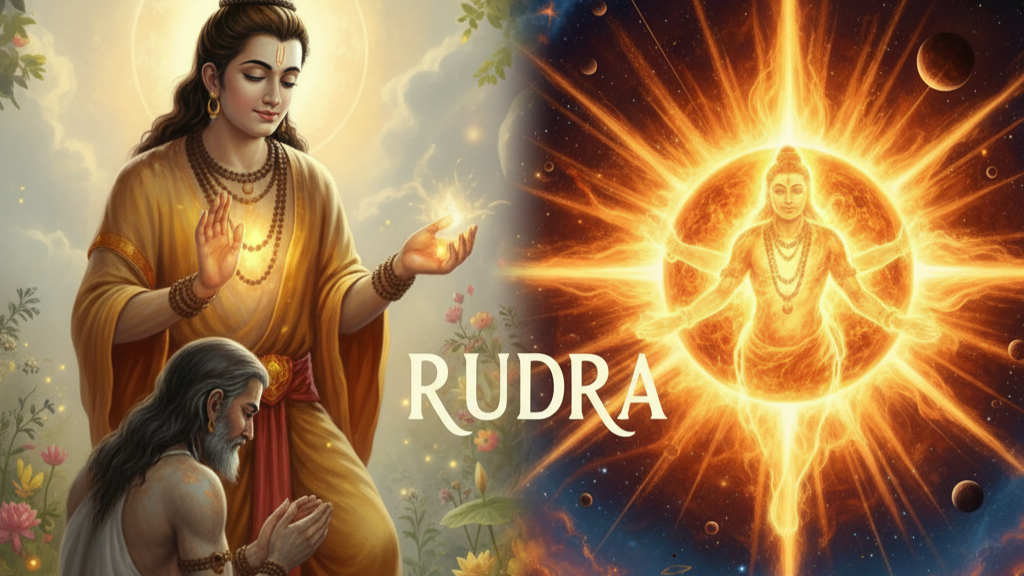
In our last reflection on the first Anuvāka of the Śrī Rudram, we paused with verses 3 and 4. Those mantras reminded us that Rudra’s immense power can also be a source of shelter and protection when approached with reverence.
Continuing this journey, verses 6 and 7 take us deeper — portraying Rudra as both the supreme healer and the one who intercedes for devotees, and as the solar, auspicious power shining in all directions. Together, they balance intimacy and awe: Rudra is near and compassionate, yet cosmic and vast.
Context
These verses shift the focus from a protective plea to a recognition of Rudra’s healing and cosmic presence. Verse 6 depicts Rudra as the divine physician who removes both visible and invisible dangers. Verse 7 then expands our awareness to the sunlike Rudra and his countless hosts spread across all directions.
Verse 6

Sanskrit
अध्यावोचदधिवक्ता प्रथमो दैव्यो भिषक् ।
अहिंश्च सर्वाञ्जम्भयन्त्सर्वाश्च यातुधान्यः ॥ ६ ॥
Transliteration
adhyāvocat adhivaktā prathamo daivyo bhīṣak |
ahiṃś ca sarvāñ jambhayant sarvāś ca yātudhānyaḥ || 6 ||
Translation
“May He, the Guiding voice, the foremost divine Physician, speak on our behalf — He who destroys dangers and subdues all hostile beings, seen and unseen.”
Commentary
This verse is striking because Rudra is called adhivaktā (the presence that speaks for us) and bhīṣak (healer, physician). He is not only a mighty force but also the one who intercedes for the devotee and restores balance. The threats named — serpents, beasts, yātudhānas — can be understood both literally (dangers faced by people in ancient life) and symbolically (inner poisons such as fear, anger, envy). Rudra, then, is invoked as the divine energy that dispels both external harm and internal obstacles.
Verse 7

Sanskrit
असौ यस्ताम्रो अरुण उत बभ्रुः सुमङ्गलः ।
ये चेमारुद्रा अभितो दिक्षु श्रिताः सहस्रशोऽवैषाहेड ईमहे ॥ ७ ॥
Transliteration
asau ya stāmraḥ aruṇa uta babhruḥ sumaṅgalaḥ|
ye cemā rudrā abhito dikṣu śritāḥ sahasraśo ’vaiṣā heḍa īmahe || 7 ||
Translation
“That Rudra, coppery, reddish, and golden-tawny, ever auspicious — and those Rudras who dwell in all directions in thousands — we propitiate, seeking the pacification of their wrath.”
Commentary
Here Rudra is pictured in the colours of sunrise — tāmra (coppery), aruṇa (rosy), babhru (golden-tawny). This imagery links Rudra to the life-giving sun, symbolizing renewal and auspiciousness. Yet the verse also acknowledges the countless Rudras spread across the directions, whose energies must be respected and pacified. It conveys the dual truth: Rudra’s presence is both cosmic in scale and benevolent in intent when approached with devotion.
Reflection

Together, verses 6 and 7 offer two complementary visions. Rudra is the healer who stands with us, protecting and interceding — reminding us to place our trust in divine grace. At the same time, Rudra is the cosmic, sunlike force whose vast energies surround and sustain creation. The verses teach us to live in balance: to honour Rudra with reverence, but also to rest in the confidence that His power can bring healing, renewal, and auspiciousness.
Practical Application

These mantras invite simple, accessible practice for daily life. Verse 6 inspires us to turn to Rudra as protector and healer in times of difficulty. Verse 7, with its dawn imagery, calls us to begin each day with gratitude and an awareness of auspicious renewal.
- Verse 6: Recite once during a quiet moment to invite Rudra’s protection, healing and to listen His guiding voice within.
- Verse 7: At sunrise, repeat the verse silently while watching the changing colours of the sky.
Closing Thoughts

Samastah Lokah Sukhino Bhavanthu
May all the beings in all the worlds be happy!

Jai Sai Ram!
Please note all images and content created using AI Tools.
Faced some technical challenges while generating todays images, apologize for the inconsistency