Sūrya to Ātman
A Threefold Path to Your Spiritual Core

For millennia, the sun has been revered not just as a celestial body, but as the very heart of the cosmos—a tangible manifestation of the divine. Ancient sages understood that the light we see is also a profound inner light that resides within us all. These timeless truths, once the domain of mystics and ascetics, are still accessible to us today through the sacred practice of mantra.
This post will guide you through three powerful mantras dedicated to the sun, revealing their unique spiritual significance and the transformative journey they can offer. You will discover not only a mantra for harnessing the sun’s outer power, but also a deeper, more profound chant from the Upanishad, and a third, transformative mantra that places that very cosmic energy directly within you.
Prepare to journey inward, as we rediscover the ancient wisdom that connects you to the eternal source of all light, consciousness, and purpose.
The Surya Bija Mantra

The first mantra we’ll explore is not a lengthy hymn but a powerful seed sound, known as the Surya Bija Mantra. In Sanskrit, bija means “seed,” and this mantra is believed to hold the concentrated essence of the sun’s core energy. Chanting it is a powerful way to absorb and embody the sun’s vital force.
The mantra is:
ॐ ह्रां ह्रीं ह्रौं सः सूर्याय नमः ॥ (Om Hraam Hreem Hroum Sah Suryaya Namah)
This potent formula is more than just a sequence of sounds; it’s a profound invocation of the sun’s life-giving power. Each syllable is believed to resonate with a specific frequency of solar energy. Consistent practice of this mantra is thought to bestow a number of blessings, including:
- Vibrant Health and Vitality: Just as the sun nourishes all life on Earth, this mantra is said to energize the body and mind, helping to build a powerful inner vitality.
- Confidence and Inner Strength: It helps to ignite your inner fire, empowering you with a strong sense of purpose and the courage to face life’s challenges.
- Clarity and Success: By aligning with the sun’s radiant energy, you can clear away mental fog and illuminate your path forward, leading to greater focus and success in all your endeavors.
This mantra serves as a powerful reminder that the power to shine brightly exists within each of us, waiting to be awakened.
The Surya Ashtakshari Mantra from the Upanishad

This next mantra is a deeper, more philosophical chant, rooted in the ancient wisdom of the Surya Upanishad. It is not a call for energy, but a declaration of the sun’s divine nature and our intrinsic connection to it.
The mantra is:
Oṃ ghṛṇiḥ sūrya āditya oṃ
This mantra is a profound statement of divine reverence. Its words carry immense spiritual weight:
- Oṃ: The primal sound of creation, representing the ultimate reality.
- Ghṛṇiḥ: A Vedic term signifying the sun’s radiance, warmth, and compassion. It speaks to the sun’s illuminating and life-giving nature.
- Sūrya: The visible form of the Sun god, the source of all light and life in our universe.
- Āditya: An ancient name for the sun, meaning “son of Aditi,” the cosmic mother. This title emphasizes Surya’s divine and eternal origin.
By chanting this mantra, you’re not simply asking for blessings; you are aligning your consciousness with the very source of existence. This practice is believed to purify the mind, dispel negativity, and fill you with a deep, spiritual clarity. It allows you to see the external sun as a reflection of the inner divine light.
How the Words Form the Surya Ashtakshara Mantra
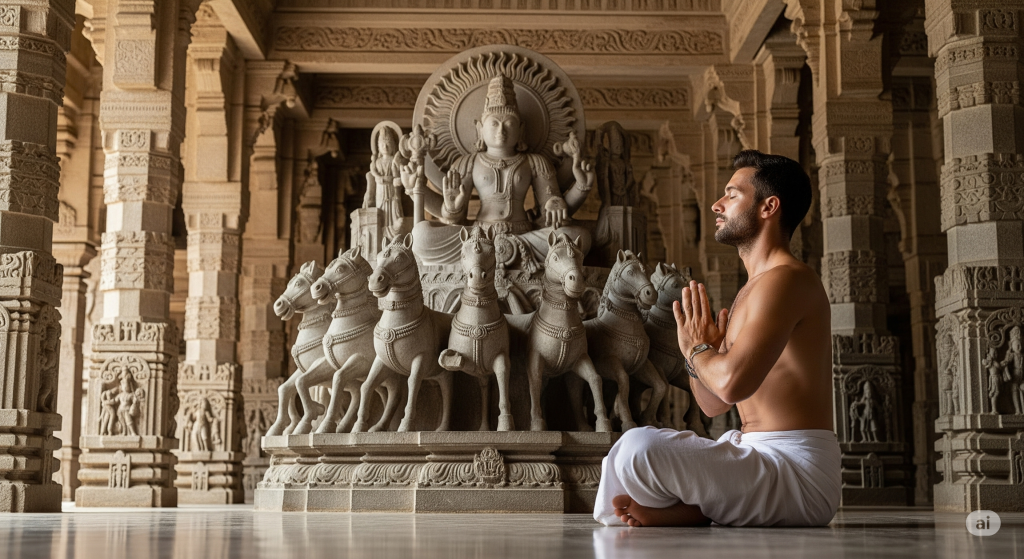
The Surya Upanishad is very specific about the construction of this mantra, stating that it is composed of eight syllables (Ashtakshara). This is a precise formula designed for spiritual resonance.
Sanskrit text
ॐ इत्येकाक्षरं ब्रह्म ।
घृणिरिति द्वे अक्षरे ।
सूर्य इत्यक्षरद्वयम् ।
आदित्य इति त्रीण्यक्षराणि ।
एतस्यैव सूर्यस्याष्टाक्षरो मनुः ।
Transliteration
oṃ ity ekākṣaraṃ brahma |
ghṛṇir iti dve akṣare |
sūrya ity akṣaradvayam |
āditya iti trīṇy akṣarāṇi |
etasyai eva sūryasyāṣṭākṣaro manuḥ |
ॐ इत्येकाक्षरं ब्रह्म ।
“Om” is the single syllable that is Brahman.
घृणिरिति द्वे अक्षरे ।
“Ghṛṇi” is made of two syllables.
सूर्य इत्यक्षरद्वयम् ।
“Sūrya” is of two syllables.
आदित्य इति त्रीण्यक्षराणि ।
“Āditya” consists of three syllables.
एतस्यैव सूर्यस्याष्टाक्षरो मनुः ।
Thus, for this very Sun, the mantra is of eight syllables.
Here is the syllable breakdown:
- 1st Syllable: Om (ॐ) – The initial syllable.
- 2nd & 3rd Syllables: Ghri-nih (घृणिः) – This word, meaning “radiance”, “warmth” contributes two syllables.
- 4th & 5th Syllables: Su-rya (सूर्य) – The name of the Sun god adds two more.
- 6th, 7th & 8th Syllables: A-di-tya (आदित्य) – This word, meaning “son of Aditi,” provides the final three.
The structure itself is a lesson in spiritual science, showing us that even the very sound and form of a mantra are deliberate, crafted to guide the chanter toward a deeper connection with the cosmos.
The Deeper Connection: The Sūryo Me Cakṣuṣi Mantra
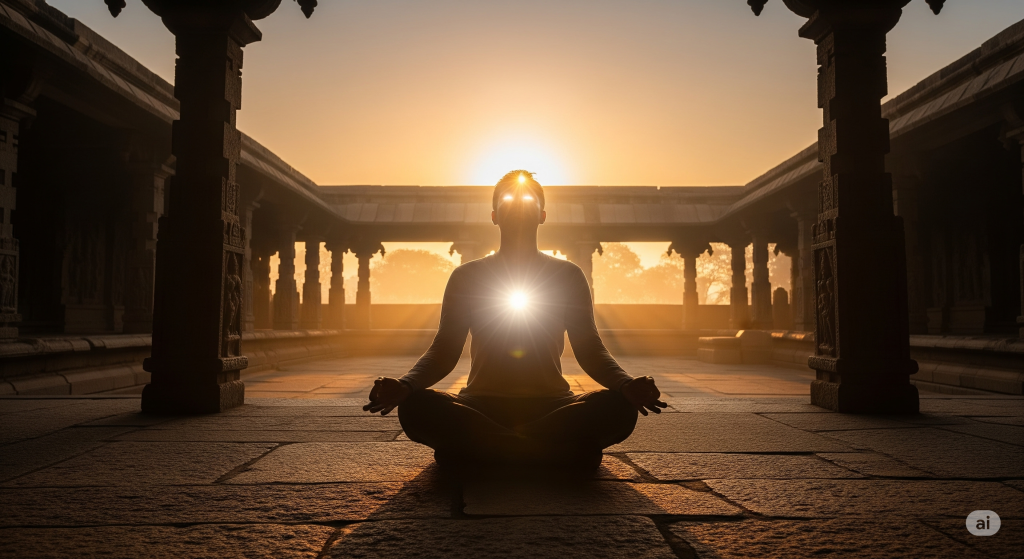
While the mantras we have discussed are for external reverence, this next one is a profound spiritual exercise in internal realization. It is part of the Laghunyasa, a preparatory ritual performed before chanting the powerful Sri Rudram hymn. The term nyasa itself means “placing,” and this mantra is a practice of ritually “placing” the divine within one’s own body.
This mantra is not a prayer but a statement of cosmic identity, unfolding in a beautiful, chain-like realization:
- Sūryo me cakṣuṣi śritaḥ: “The Sun is placed in my eyes.” This first line declares that our physical sight is not merely a biological function, but a direct manifestation of the divine light of the sun.
- Cakṣur hṛdaye: “The eyes are placed in the heart.” It deepens the connection by stating that our ability to perceive is not just in our eyes, but is rooted in the spiritual heart (hridaya), the true seat of consciousness.
- Hṛdayaṃ mayi: “The heart is placed in me.” This is a profound statement of personal identity, confirming that the spiritual core is an integral part of our individual being.
- Aham amṛte: “I am in immortality.” This shifts the focus from the physical to the metaphysical, asserting that the individual self (aham) is not bound by the mortal world but exists within the eternal.
- Amṛtaṃ brahmaṇi: “Immortality is in Brahman.” This is the ultimate realization. The immortal self is not a separate entity but is ultimately and completely established in Brahman, the supreme, all-pervading reality.
The entire sequence of this mantra is a journey of spiritual awakening. It guides you from recognizing a physical connection (sun to eyes) to realizing your ultimate, non-dual identity with the divine.
The Synergy of Practice: Uniting Inner and Outer Wisdom

When you bring these three seemingly different types of mantras together, a powerful synergy unfolds.
The Surya Bija Mantra and the Surya Ashtakshara Mantra are practices of looking outward. They are devotional hymns that honor and draw in the sun’s brilliant, life-giving energy from the macrocosm. They are about absorbing and reflecting the light of the divine that shines upon us.
The Sūryo me cakṣuṣi mantra, however, is a practice of looking inward. It is a profound spiritual exercise in internalizing the divine. It allows you to realize that the light you were just honoring is not external to you, but is a fundamental part of your own consciousness, residing in your eyes, your heart, and your very essence.
This combination of practices transforms your spiritual path. You move from simply praising the sun to embodying its light. This is not about seeking a blessing from an external deity; it is about realizing your own divine nature. This powerful synergy fosters a deep sense of unity with the cosmos, granting you not just physical vitality and clarity, but a profound and unshakable connection to the eternal.
Key Takeaways

The three mantras we’ve explored offer a complete spiritual path, moving from outward reverence to profound inward realization.
- The Surya Bija Mantra (ॐ ह्रां ह्रीं ह्रौं सः सूर्याय नमः): This is a powerful, condensed seed sound for invoking the sun’s vitality. It’s a practice of absorbing the sun’s energy from the external world to gain blessings like health, confidence, and success.
- The Surya Ashtakshara Mantra (Oṃ ghṛṇiḥ sūrya āditya oṃ): Rooted in the Surya Upanishad, this is a more detailed mantra that honors the sun’s divine radiance. Its chanting is an act of devotion and recognition of the sun as a supreme, cosmic force.
- The Sūryo Me Cakṣuṣi Mantra: Part of the Laghunyasa ritual, this is a profound statement of self-realization. It is a practice of internalizing the divine light, helping you to realize that the sun’s energy is not just external but is woven into the very fabric of your own consciousness.
The Synergy of Three: The true power lies in their combined practice. By using all three mantras, you create a powerful flow: you first draw in the sun’s energy, then honor its cosmic form, and finally, realize its presence within you. This integrated approach transforms the act of worship into an act of self-realization, bridging the gap between the divine outside and the divine within. Thus we move from Surya to Atman.
Closing Thoughts

In a world filled with endless distractions and demands, finding a moment to connect with a timeless source of power can be truly transformative. The sun is a constant and reliable presence in our sky, a universal symbol of life, light, and consciousness. These ancient mantras are not just old chants; they are powerful tools that remind us of our deep, unbreakable connection to the cosmos. By taking a few moments each day to honor the sun—both in the sky and within yourself—you can cultivate a profound sense of purpose and tap into a wellspring of inner radiance. This simple practice offers a clear path to living a more inspired and purpose-driven life.
Play the AI generated video below to offer Salutations to Lord Surya
Citations and Sources
The information presented in this post is drawn from the following ancient spiritual texts and traditions:
- The Surya Upanishad: A key Upanishad dedicated to the praise of Surya, the Sun god. This text is associated with the Atharvaveda and provides the basis for the Oṃ ghṛṇiḥ sūrya āditya oṃ mantra.
- Online Source: Full text and translation of the Surya Upanishad
- The Sri Rudram: A foundational Vedic hymn from the Yajurveda, chanted in praise of Rudra (an aspect of Shiva). The mantra Sūryo me cakṣuṣi śritaḥ is part of a preparatory ritual known as the Laghunyasa, which precedes the main chanting of the Sri Rudram.
- Online Source: English translation of the Laghunyasa and the Sri Rudram
- General Vedic and Tantric Traditions: The Surya Bija Mantra is a traditional seed sound mantra widely used in various tantric and yogic practices. Its origins are deeply rooted in the broader body of Vedic spiritual knowledge, rather than being attributed to one specific text.
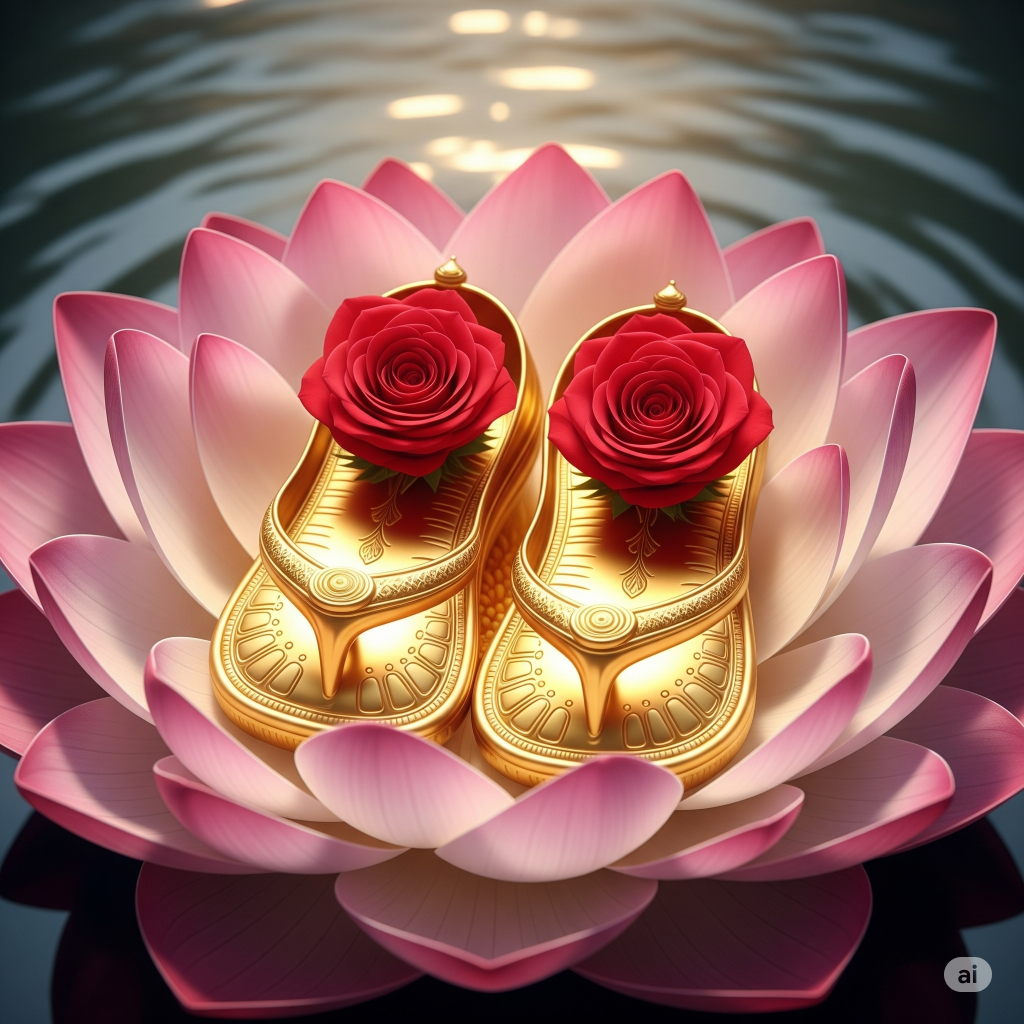
Humble Offering at the Divine Lotus Feet
Jai Sai Ram!
P.S: All content and images generated using AI Tools.