Infinite Light
Unlocking the Gayathri: The 24 Syllables of Light
Section 1: Introduction
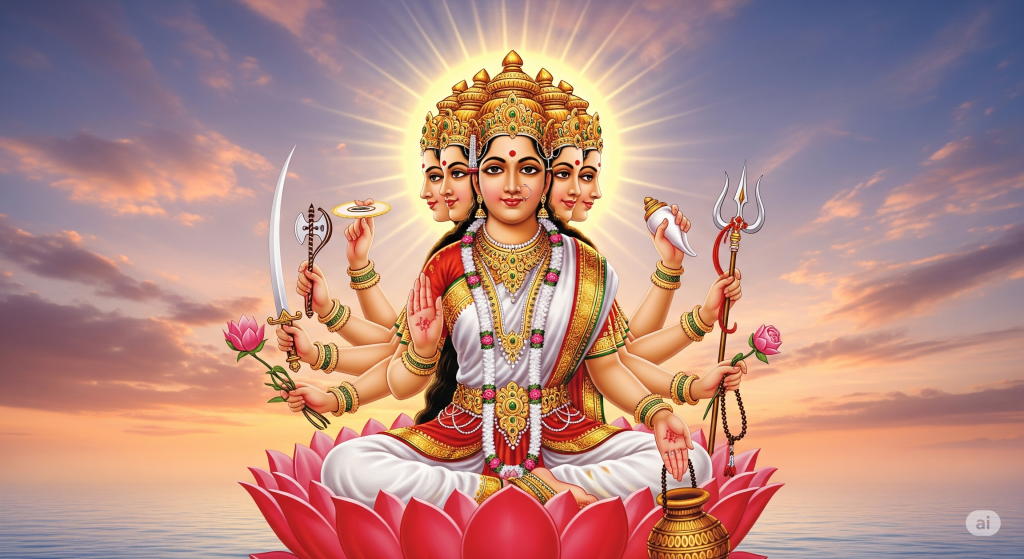
In the vast ocean of Vedic revelation, few mantras shine with the brilliance and precision of the Gayathri. Known as the Veda-mātā—the Mother of the Vedas—this mantra is not merely a sacred utterance, but a sonic embodiment of cosmic order, spiritual aspiration, and inner illumination.
Composed of 24 syllables arranged in the Gayathri chhandas, it is a mantra of light—each syllable a bead of radiance, each word a gateway to higher consciousness. To chant the Gayathri is to align oneself with the rhythm of creation, to awaken the buddhi (intellect), and to invite the divine radiance of Savitṛ into the heart.
This blog post is a self-contained journey into the mantra’s architecture, its chhandas, and the metaphysical significance of its 24 syllables. We will explore how each syllable corresponds to a principle of existence, and how the mantra itself becomes a luminous map of spiritual ascent.
This exploration based on the Devi Bhagavatam (Archive.org – Gayatri in Devi Bhagavatam), invites you to listen deeply, reflect reverently, and chant with clarity.
Section 2: Architectural Overview
The Sonic Structure of Illumination
The Gayathri Mantra is not a random string of syllables—it is a meticulously crafted sonic architecture, encoding layers of cosmology, psychology, and spiritual ascent. Its structure reflects the Vedic vision of reality: tripartite, rhythmic, and radiant.
The Threefold Design
The mantra unfolds in three distinct segments:
- Pranava (ॐ)
- The primordial sound, representing the Absolute Reality (Brahman)
- Encapsulates the triad: A-U-M → Waking, Dreaming, Deep Sleep
- Acts as the seed and seal of all Vedic mantras
- Vyāhṛtis (भूः, भुवः, सुवः)
- The three cosmic realms:
- Bhūḥ – Earth / Physical plane
- Bhuvaḥ – Atmosphere / Mental plane
- Suvaḥ – Heaven / Spiritual plane
- These are cosmic coordinates, aligning the chanter with the universal field
- The three cosmic realms:
- Gayathri Verse Proper (Tat Savitur Vareṇyaṃ… )
- The core 24-syllable verse in Gayathri Chhandas
- A prayer to Savitṛ, the divine solar force, to awaken the buddhi (intellect)
- Each syllable is a bead of light, forming a garland of illumination
Mantric Architecture as Metaphysical Blueprint
This tripartite design mirrors the threefold nature of existence:
- Adhibhautika – Physical (Bhūḥ)
- Adhidaivika – Divine/Cosmic (Bhuvaḥ)
- Adhyātmika – Spiritual/Internal (Suvaḥ)
It also reflects the threefold path of realization:
- Jñāna – Knowledge
- Karma – Action
- Upāsanā – Devotion
Thus, the Gayathri is not just a mantra—it is a map of being, a method of awakening, and a mirror of the cosmos.
Section 3: Chhandas – The Metre of Light
Rhythm as Revelation
In Vedic poetry, chhandas refers to the metrical structure—the rhythmic blueprint through which mantras flow. The Gayathri Mantra is composed in the Gayathri Chhandas, one of the most revered metres in the Vedic tradition.
The Chhandogya Upanishad emphasizes the sanctity of the Gayatri metre, stating that it holds together the entire creation by its rhythmic balance (Sacred Texts – Chhandogya Upanishad).
Similarly, the Devi Bhagavatam declares Gayatri as the very embodiment of the Vedas, pervading all metres and sustaining the devas through its syllabic power (Archive.org – Gayatri in Devi Bhagavatam).
Thus, the architecture of the Gayatri Mantra is both poetic and cosmic, reflecting how sound (śabda) and rhythm (chhanda) bridge the human and the divine.
Structure of Gayathri Chhandas
- Total syllables: 24
- Divided into 3 pādas (lines)
- Each pāda contains 8 syllables
This tripartite rhythm is not arbitrary—it reflects the threefold nature of reality and the three realms of existence invoked in the mantra: Bhūḥ, Bhuvaḥ, and Suvaḥ.
Let’s visualize it:
| Pāda | Sanskrit Text | Syllables |
|---|---|---|
| 1 | तत् सवितुर्वरेण्यं | tat-sa-vi-tur-va-re-ṇyam |
| 2 | भर्गो देवस्य धीमहि | bhar-go-de-va-sya-dhī-ma-hi |
| 3 | धियो यो नः प्रचोदयात् | dhi-yo-yo-naḥ-pra-cho-da-yāt |
Each syllable is counted by its phonetic unit, not by its written form. This precision ensures that the mantra’s vibrational integrity is preserved during chanting.
Gayathri Verse Proper
The heart of the mantra, composed in Gayathri Chhandas—three pādas of eight syllables, totaling 24. This is the luminous invocation to Savitṛ, the divine solar force, to awaken and guide the intellect (buddhi).
तत् सवितुर्वरेण्यं
भर्गो देवस्य धीमहि
धियो यो नः प्रचोदयात् ॥
tat savitur vareṇyaṃ
bhargo devasya dhīmahi
dhiyo yo naḥ pracodayāt ॥
Translation
Let us meditate on the most excellent light of Savitṛ, the divine radiance. May that light inspire and awaken our intellect.
Symbolism of 24
The number 24 is deeply symbolic in Vedic and Tantric cosmology:
- 24 tattvas in Sāṅkhya philosophy
- 24 hours in a day—linking mantra to solar rhythm
- 24 syllables as beads of light in the Gayathri garland
Thus, the Gayathri Chhandas becomes a metaphysical metronome, aligning the chanter with cosmic order and inner clarity.
Gayathri Mantra: Thematic Division by Pāda
| Pāda | Syllables | Actual Syllables | Theme | Interpretation |
|---|---|---|---|---|
| 1st | 1–8 | Tat Sa Vi Tu Va Re Nya M | Invocation & Illumination | Awakening divine consciousness; invoking Savitur (the Sun) as the source of light and life. |
| 2nd | 9–16 | Bha Go De Va Sya Dhi Ma Hi | Expansion & Realization | Meditating on the divine qualities (Bhargo Devasya); purifying intellect and deepening awareness. |
| 3rd | 17–24 | Yo Yo Nah Pra Cho Da Ya At | Integration & Liberation | Praying for divine guidance (Dhiyo Yo Nah Prachodayāt); aligning intellect with cosmic will. |
Notes on Accuracy & Source Alignment
- The syllables are drawn directly from the Gayathri Mantra as chanted in Vedic tradition:
- This division is supported by:
- Taittiriya Aranyaka (2.11.1–8) – defining Gayatri as a meter of 3 pādas × 8 syllables
- Gayatri Upanishad – interpreting the mantra as a journey from invocation to illumination
- Commentaries by Swami Sivananda, Pandit Shriram Sharma, and AWGP – elaborating on the spiritual progression encoded in the mantra
Section 4: Gayathri Mantra: 24 Syllables, Rishis & Their Spiritual Gifts
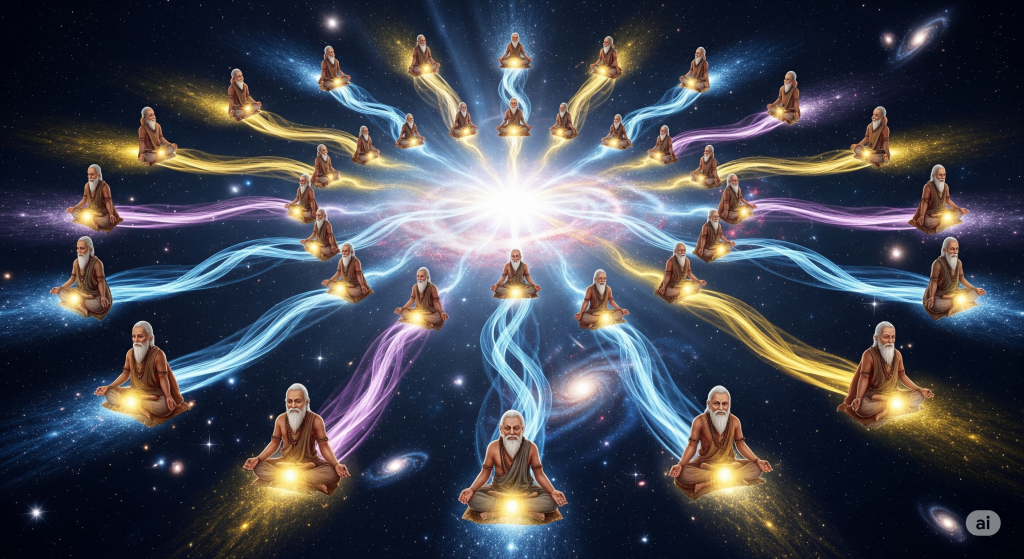
Structured by the three pādas of the Gayatri meter (8 syllables each)
Pāda 1: Invocation & Illumination
Awakening divine consciousness; invoking Savitur as the source of light and life
Tat Savitur Varenyam
This first part of the mantra is associated with the initial eight sages and their contributions.
| Syllable | Sage | Key Contributions |
| Tat | Vamadeva | Seer of the fourth Mandala of the Rigveda; known for spiritual wisdom. |
| Sa | Atri | Seer of the fifth Mandala of the Rigveda; author of the Atri Smriti. |
| Vi | Vasishtha | Author of the seventh Mandala of the Rigveda; royal guru of Rama in the Ramayana. |
| Tur | Shukra | Preceptor of the Asuras; possessed the knowledge of reviving the dead (Mṛtyu Sañjīvanī Vidyā). |
| Va | Kanva | Mentor of Shakuntala in the Mahabharata; known for moral integrity. |
| Re | Parashara | Father of Vedavyasa; author of the Viṣṇu Purāṇa and a foundational text on astrology. |
| Niyam | Vishwamitra | Credited with the creation of the Gayatri Mantra; attained the status of a Brahmarishi. |
| Bhar | Kapila | Founder of the Samkhya school of philosophy. |
Pāda 2: Expansion & Realization
Meditating on divine qualities; purifying intellect and deepening awareness
Bhargo Devasya Dhimahi
The second part of the mantra is linked to the next eight sages, known for their significant philosophical and literary works.
| Syllable | Sage | Key Contributions |
| Go | Shaunaka | Leader of sages who listened to spiritual teachings at Naimisharanya. |
| De | Yajnavalkya | A major figure in the Upanishads; known for his dialogues on the nature of the self (Atman). |
| Va | Bharadwaja | Father of Dronacharya; a Vedic sage credited as a seer of the sixth Mandala of the Rigveda. |
| Sya | Jamadagni | Father of Parashurama; known for his righteous character. |
| Dhee | Gautama | Author of the Nyaya Sutras, the foundational text of the Nyaya school of logic. |
| Ma | Mudgala | Associated with the Mudgala Upanishad; known for his patience. |
| Hi | Vedavyasa | Compiler of the Vedas; author of the epic Mahabharata and the Puranas. |
| Dhi | Lomasha | A sage who narrated various legends to the Pandavas during their exile. |
Pāda 3: Integration & Liberation
Praying for divine guidance; aligning intellect with cosmic will
Dhiyo Yo Nah Prachodayat
The final part of the mantra is associated with the last eight sages, many of whom are known for their profound spiritual knowledge and divine roles.
| Syllable | Sage | Key Contributions |
| Yo | Agastya | Considered the father of the Tamil language; known for drinking the ocean. |
| Yo | Kaushika | A master of Vedic knowledge; taught principles of Dharma. |
| Nah | Vatsya | Known as a disciple of the sage Shakala who divided the Rigveda. |
| Pra | Pulastya | A mind-born son of Brahma; grandfather of the Asura king Ravana. |
| Cho | Manduka | The sage associated with the Mandukya Upanishad, a profound text on the syllable Om. |
| Da | Durvasa | Known for his quick temper and powerful curses as well as boons. |
| Ya | Narada | A divine sage and master musician; celestial messenger. |
| T | Kashyapa | One of the seven great sages (Saptarishi); progenitor of many beings, including gods and demons. |
Section 5: Key Takeaways and Application
- Mantra as Architecture of Consciousness: The Gayatri reveals the power of syllables, padas, and chhandas as blueprints of inner and outer cosmos.
- Rishi Associations: Each syllable resonates with the tapas, wisdom, and realization of ancient seers, connecting the chanter to an unbroken lineage of spiritual insight.
- Devata Associations: The syllables embody divine forces, harmonizing the microcosm (individual) with the macrocosm (universe).
- Practical Application: Regular chanting refines the intellect (dhi), aligns thought with dharma, and awakens clarity, courage, and compassion in daily life.
The reader thus inherits not only a mantra but also an architecture of awakening—a way to harmonize body, mind, and spirit with the eternal rhythm of the cosmos.
Section 6: Closing Reflection
The Gayatri Mantra is not merely a prayer but a living bridge between sound and spirit, seer and seeker, cosmos and consciousness. To chant it with understanding is to participate in the ancient symphony of the sages, invoking the light that guides all beings toward truth.
Citations
Devi Bhagavatam (Archive.org – Gayatri in Devi Bhagavatam).
The information about the associated Rishis (sages), and Devatas (deities) is found in the Devi Bhagavatam, specifically in the 12th Book, Chapter 1.
- Reference Link: Śrīmad Devi Bhāgavatam | Book 12 Chapter 1
This link provides a direct translation of the relevant verses where Sage Narayana explains the details of the Gayatri Mantra to Sage Narada, including the complete list of 24 Rishis and their respective Devatas.
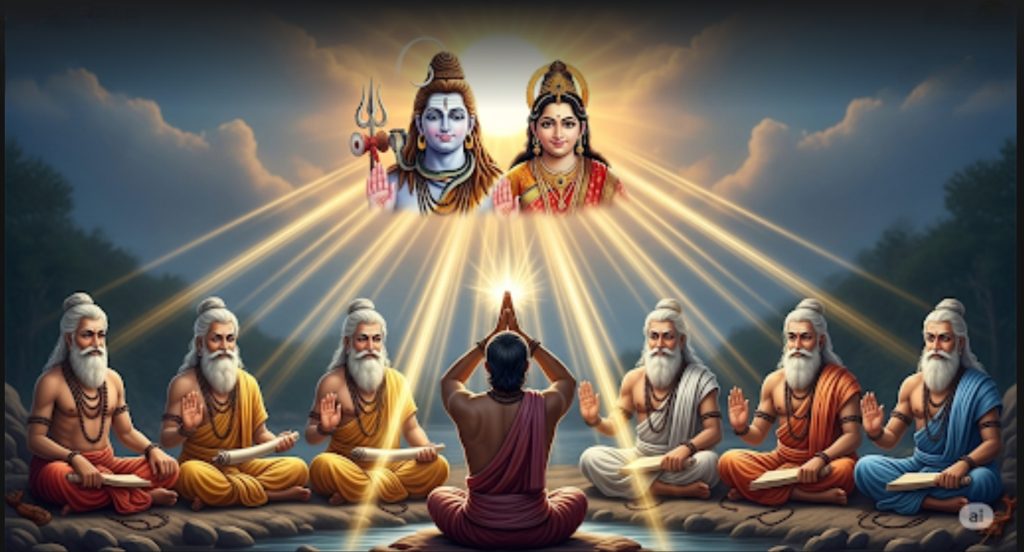
Humble Offering at the Divine Lotus Feet
Jai Sai Ram!
PS: All images and content generated using AI Tools