Insights from Pranava
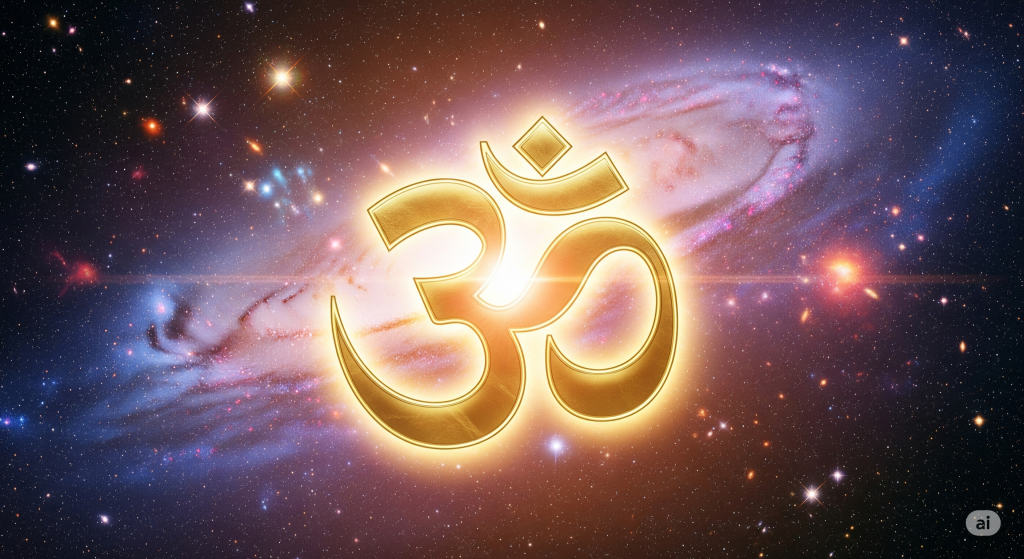
The Secret of Om: Insights from Pranava Upanishad
1. Introduction
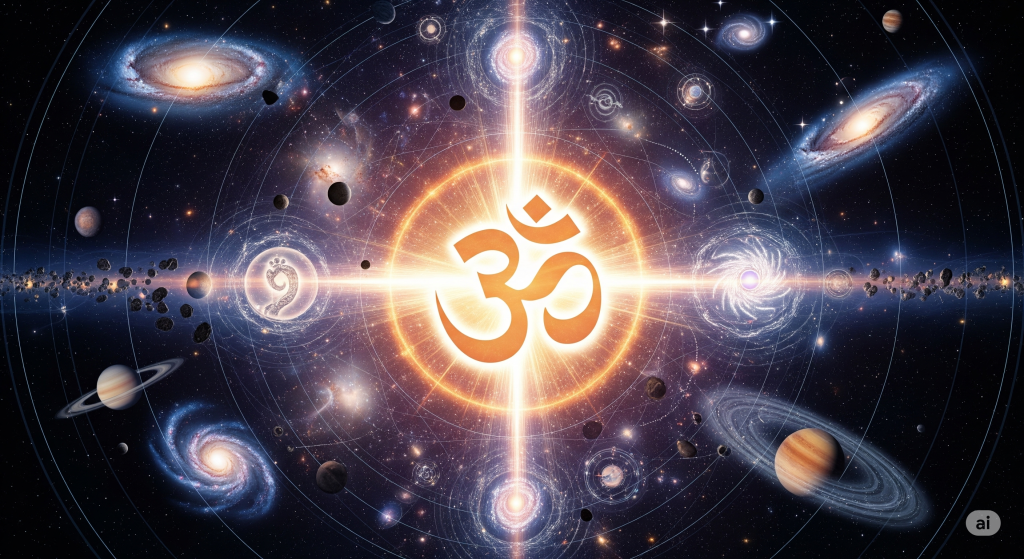
Among the 108 traditional Upanishads, the Pranava Upanishad of the Atharva Veda holds a luminous place. It unfolds the mystery of Pranava (ॐ, Oṁ) — the primordial sound, the essence of the Vedas, and the very expression of Brahman. In just 13 verses, this Upanishad reveals how all worlds, gods, elements, scriptures, fires, and states of consciousness are contained within this single syllable.
A Refresher on the Upanishads
The Upanishads (literally “sitting near” the teacher) are also known as Vedānta — the crown and conclusion of the Vedas. Traditionally, there are 108 Upanishads, revered for distilling the highest truths of existence. These are spread across the four Vedas as follows:
| Veda | Number of Upanishads | Examples |
|---|---|---|
| Ṛgveda | 10 | Aitareya, Kaushitaki, Ātma, Nārāyaṇa |
| Sāmaveda | 16 | Kena, Chāndogya |
| Yajurveda (Śukla & Kṛṣṇa) | 19+32 | Īśa, Kaṭha, Taittirīya, Bṛhadāraṇyaka |
| Atharva Veda | 31 | Muṇḍaka, Māṇḍūkya, Pranava, Kaivalya |
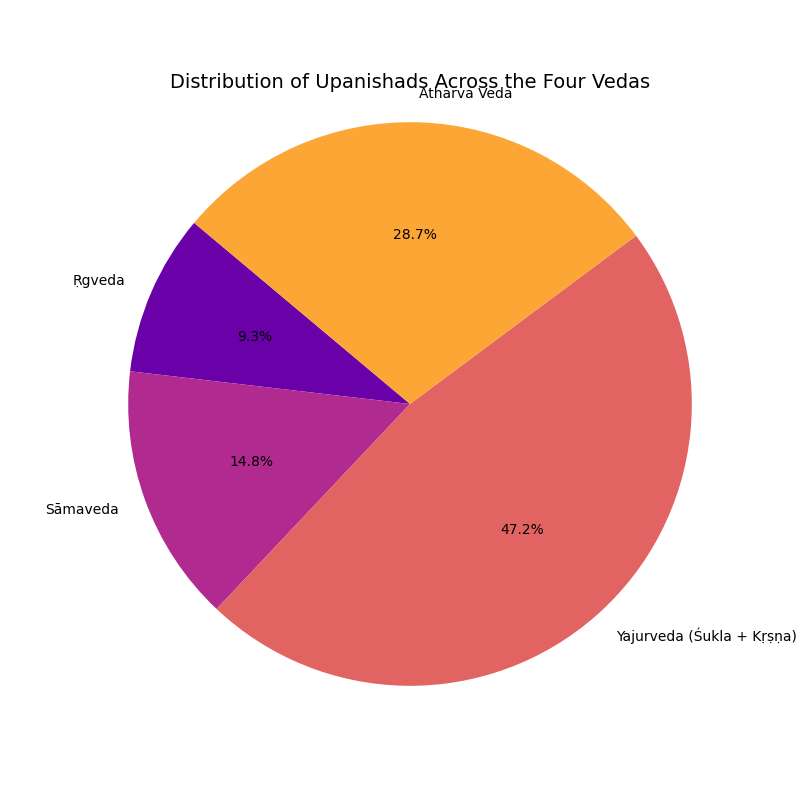
This chart beautifully illustrates how the Yajurveda holds the lion’s share, followed by Atharva Veda, with Sāmaveda and Ṛgveda contributing more selectively.
- Of these, 10–13 are principal (Mukhya) Upanishads that Śaṅkarācārya and other ācāryas extensively commented upon.
- The others are considered minor Upanishads, often focused on yoga, renunciation, and devotional practices
- The Pranava Upanishad is associated with Atharva Veda
2. References from Bhagawan Sri Sathya Sai Baba on Pranava / Om
Bhagawan Baba has again and again highlighted the significance of Pranava:
- “Om is the sound symbol of God.” (Sri Sathya Sai Speaks, Vol 9 (1969), Shivarathri, Feb)
- “Om or Pranava is the merging together of three sounds, A, U, and M. When you write GOD, you do not pronounce it ‘jee-oh-dee’, you voice it as GOD. So too, AUM is pronounced Om, Om has a sequel, of a fading M sound which finally tapers into silence, a silence that is felt and experienced” Sri Sathya Sai Speaks, Vol 6 (1966), Birthday – 41, 23 November 1966
These discourses beautifully confirm what the Pranava Upanishad itself proclaims — that Oṁ is the body of Brahman, and meditation on it leads to immortality.
A Journey Through All 13 Verses of the Pranava Upanishad
Before focusing on selected highlights, it is helpful to first walk through the entire progression of the 13 verses. The Pranava Upanishad is concise yet profound — each verse adding a new layer to the revelation of Oṁ.
Summary of the Thirteen Verses
- Setting the Context — The secret of Brahmavidyā (knowledge of Brahman) is declared.
- The Identity of Oṁ — Oṁ is the Imperishable Brahman; its “body” includes space, time, and existence.
- The Convergence of Triads — All cosmic triads (3 deities, 3 worlds, 3 Vedas, 3 fires, 3 syllables) are united in Oṁ
- The Body of A — Ṛgveda, Earth, Gārhapatya fire, and Brahmā.
- The Body of U — Yajurveda, Mid-space, Dakṣiṇāgni fire, and Viṣṇu.
- The Body of M — Sāmaveda, Heaven, Āhavanīya fire, and Śiva (Rudra).
- Cosmic Lights — A as the Sun, U as the Moon.
- Energies of A–U–M — M as Fire (lightning-like, smokeless); A–U–M as Moon, Sun, and Fire energies.
- The Half-syllable — Ardhamātrā is a flame rising above Oṁ, the transcendental Brahman.
- The Subtle Flame — A lotus-thread-like light at the nose-tip, piercing the Sun, seen in meditation.
- Life-force Radiance — Seventy thousand rays emerging from Oṁ, sustaining life.
- Inner Sound (Nāda) — In tranquility, the aspirant hears the sound of a bronze bell — the resonance of Oṁ.
- Final Union — Where Oṁ dissolves is Brahman; one who realizes this attains immortality.
Narrative Flow:
- Verses 1–3 set the context: Oṁ as Brahman, containing all triads.
- Verses 4–8 detail mappings of A, U, M to Vedas, deities, worlds, fires, and cosmic lights.
- Verses 9–12 describe higher yogic visions: the half-syllable, subtle flame, rays, and inner sound.
- Verse 13 concludes with the promise of immortality.
3. Selected Verses from the Pranava Upanishad
Verse 2
Sanskrit:
ॐमित्येकाक्षरं ब्रह्म यदुक्तं ब्रह्मवादिभिः ।
शरीरं तस्य वक्ष्यामि स्थानकालात्मनस्तथा ॥ २ ॥
Transliteration:
oṁ mity ekākṣaraṁ brahma yad uktaṁ brahmavādibhiḥ ।
śarīraṁ tasya vakṣyāmi sthāna-kālātmanas tathā ॥ 2 ॥
Translation:
The knowers of Brahman declare the syllable Oṁ alone as the Imperishable Brahman. I shall now explain its body, its abodes, and its relation to time.
Explanation:
The teaching introduces Oṁ as not just a sound, but Brahman itself — the “body” refers to how cosmic structures map onto its syllables. This verse sets the stage for a deeper exploration of Oṁ as not merely a sound, but the living essence of the cosmos — with form, location, temporal significance, and spiritual depth. It’s like the Upanishad is saying: “Let me show you how the infinite hides in a single syllable.
Verse 4
Sanskrit:
ऋग्वेदो गार्हपत्यं च पृथिवी ब्रह्म एव च ।
अकारस्य शरीरं तु व्याख्यातं ब्रह्मवादिभिः ॥ ४ ॥
Transliteration:
ṛgvedo gārhapatyaṁ ca pṛthivī brahma eva ca ।
akārasya śarīraṁ tu vyākhyātaṁ brahmavādibhiḥ ॥ 4 ॥
Translation:
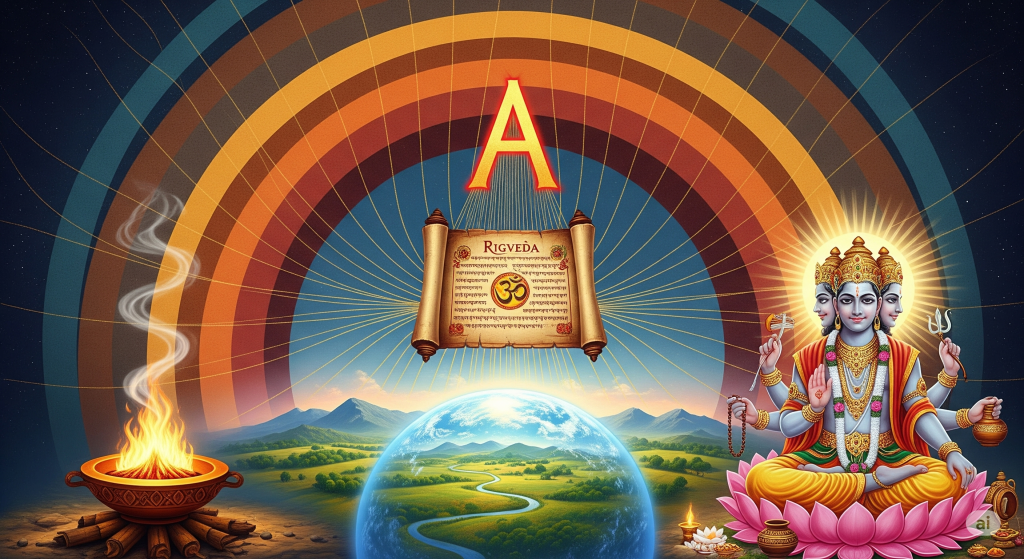
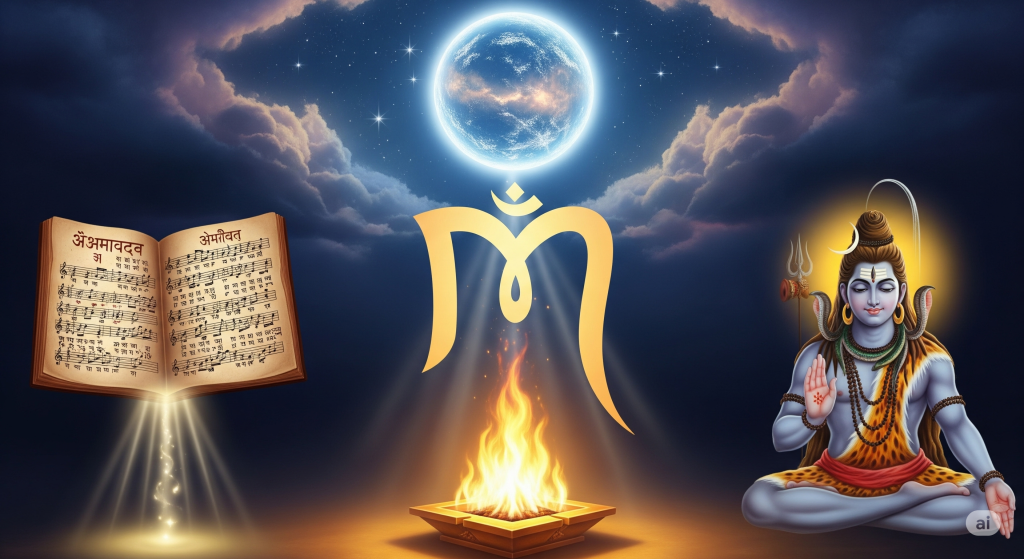
The Ṛgveda, the Gārhapatya fire, the Earth, and Brahmā are said to form the body of the syllable A.
Explanation:
Each syllable is associated with a Veda, an element, a sacred fire, and a deity. A symbolizes beginnings (creation, earth, Brahmā). It’s like saying: the sound “A” is not just a phoneme — it’s the seed of creation, the ritual, the scripture, and the divine all rolled into one.
Verse 5
Sanskrit:
यजुर्वेदोऽन्तरिक्षं च दक्षिणाग्निस्तथैव च ।
विष्णुश्च भगवान्देव उकारः परिकीर्तितः ॥ ५ ॥
Transliteration:
yajurvedo ’ntarikṣaṁ ca dakṣiṇāgnis tathaiva ca ।
viṣṇuś ca bhagavān devo ukāraḥ parikīrtitaḥ ॥ 5 ॥
Translation:
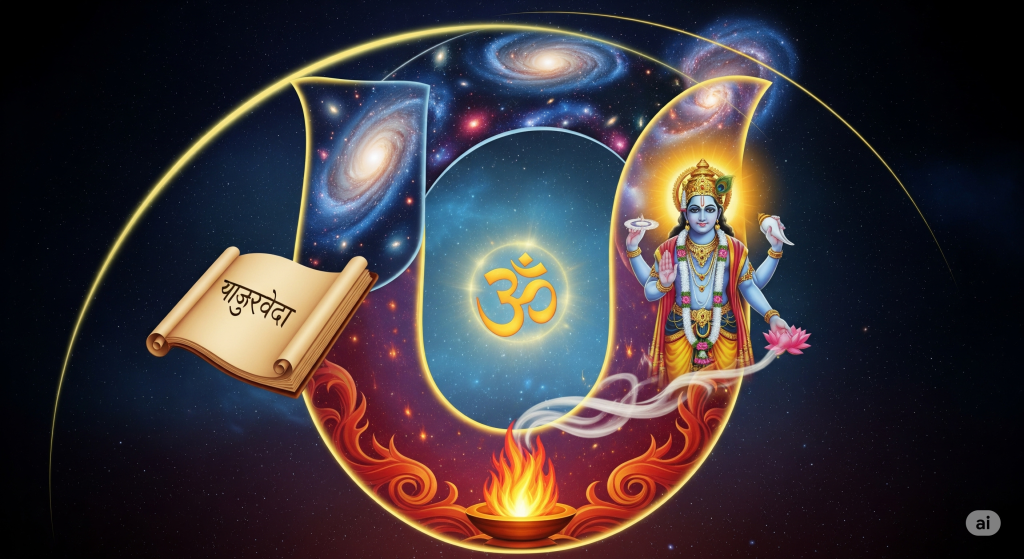
The Yajurveda, the mid-region, the Dakṣiṇāgni fire, and Lord Viṣṇu constitute the body of the syllable U.
Explanation:
U is linked with preservation, balance, and the middle realm, corresponding to Viṣṇu. So while ‘A’ symbolizes creation and the earthly realm, ‘U’ embodies preservation, the middle world, and the sacred continuity of life and ritual. It’s like the cosmic bridge between the manifest and the transcendent.
Verse 6
Sanskrit:
सामवेदस्तथा द्यौश्चाहवनीयस्तथैव च ।
ईश्वरः परमों देवो मकारः परिकीर्तितः ॥ ६ ॥
Transliteration:
sāmavedas tathā dyaus cāhavanīyas tathaiva ca ।
īśvaraḥ paramo devo makāraḥ parikīrtitaḥ ॥ 6 ॥
Translation:
The Sāmaveda, the heaven, the Āhavanīya fire, and Lord Śiva are designated as the body of the syllable M.
Explanation:
M symbolizes dissolution, heaven, and return to the source, presided over by Śiva. So, ‘M’ represents the culmination — where sound fades into silence, and form dissolves into the formless. In the cosmic dance of creation, preservation, and dissolution, ‘M’ is the graceful bow at the end.
Together, A–U–M isn’t just a sound — it’s a map of existence, a spiritual equation that encodes the entire universe.
Verse 9
Sanskrit:
शिखा च दीपसङ्काशा यत्रास्मिन् परिवर्तते ।
अर्धमात्रा तथा ज्ञेया प्रणवस्योपरी स्थिता ॥ ९ ॥
Transliteration:
śikhā ca dīpasaṅkāśā yatrāsmin parivartate ।
ardhamātrā tathā jñeyā praṇavasyoparī sthitā ॥ 9 ॥
Translation:
The flame, shining like a lamp’s tongue, is the half-mātrā, situated above the syllable Oṁ.
Explanation:
This refers to the subtle sound beyond A–U–M — the silent transcendence (ardhamātrā), the gateway to Turīya. “The flame-like crest that revolves within this (Oṁ) is known as the half-syllable. It is to be understood as existing above the syllable of Praṇava.”
This verse refers to the ardhamātrā — the half-syllable — which isn’t pronounced but felt. It’s the silence after the sound, the stillness after the vibration of A–U–M fades. In yogic and Vedantic traditions, this is the gateway to turīya, the fourth state of consciousness — beyond waking, dreaming, and deep sleep.
The imagery of a flame-like crest evokes a mystical brilliance: something subtle, luminous, and ever-revolving within. It’s like the soul of the mantra — not heard, but realized.
Verse 13
Sanskrit:
यत्रास्मिन्स लीयते शब्दस्तत्परो ब्रह्म गीयते ।
सोऽमृतत्वाय कल्पते सोऽमृतत्वाय कल्पते ॥ १३ ॥
Transliteration:
yatrāsmin sa līyate śabdas tatparo brahma gīyate ।
so ’mṛtatvāya kalpate so ’mṛtatvāya kalpate ॥ 13 ॥
Translation:
Where this sacred sound merges, there is the Supreme Brahman. Whoever abides there attains immortality — verily, immortality.
Explanation:
The Upanishad concludes by declaring Oṁ as the direct means to realize Brahman, granting liberation and immortality. “Wherein the sound merges — that is sung as the Supreme Brahman. It leads to immortality. It leads to immortality.”
- The repetition of “so ’mṛtatvāya kalpate” — “it leads to immortality” — is no accident. It’s an emphatic declaration: the journey of sound (śabda) into silence is the journey of the soul into the eternal.
- The “tatparaḥ brahma” — the Supreme beyond — is not just the end of the mantra, but the beginning of liberation. It’s the turīya, the fourth state of consciousness, beyond waking, dreaming, and deep sleep.
- And the phrase “yatrāsmin sa līyate śabdaḥ” — “wherein the sound dissolves” — points to the ardhamātrā, the half-syllable we explored earlier. It’s not heard, but known. Not spoken, but realized.
This verse is like a whisper from the edge of the infinite — saying: go beyond the sound, and you’ll find the source.
Mapping of A–U–M and Silence in the Pranava Upanishad
| Syllable | Veda | Deity | World (Loka) | Sacred Fire | Symbol / Vision | Meaning |
|---|---|---|---|---|---|---|
| A (अ) | Ṛgveda | Brahmā | Earth (Pṛthivī) | Gārhapatya | Sun’s orb | Creation, waking state |
| U (उ) | Yajurveda | Viṣṇu | Mid-space (Antarikṣa) | Dakṣiṇāgni | Moon | Preservation, dream state |
| M (म्) | Sāmaveda | Śiva | Heaven (Dyuloka) | Āhavanīya | Fire, lightning | Dissolution, deep sleep |
| Half-mātrā (Ardhamātrā, silence beyond) | Beyond Vedas | Transcendent Brahman | Beyond worlds | — | Subtle flame, lotus-thread light, nāda (inner sound) | Turīya — pure consciousness, immortality |
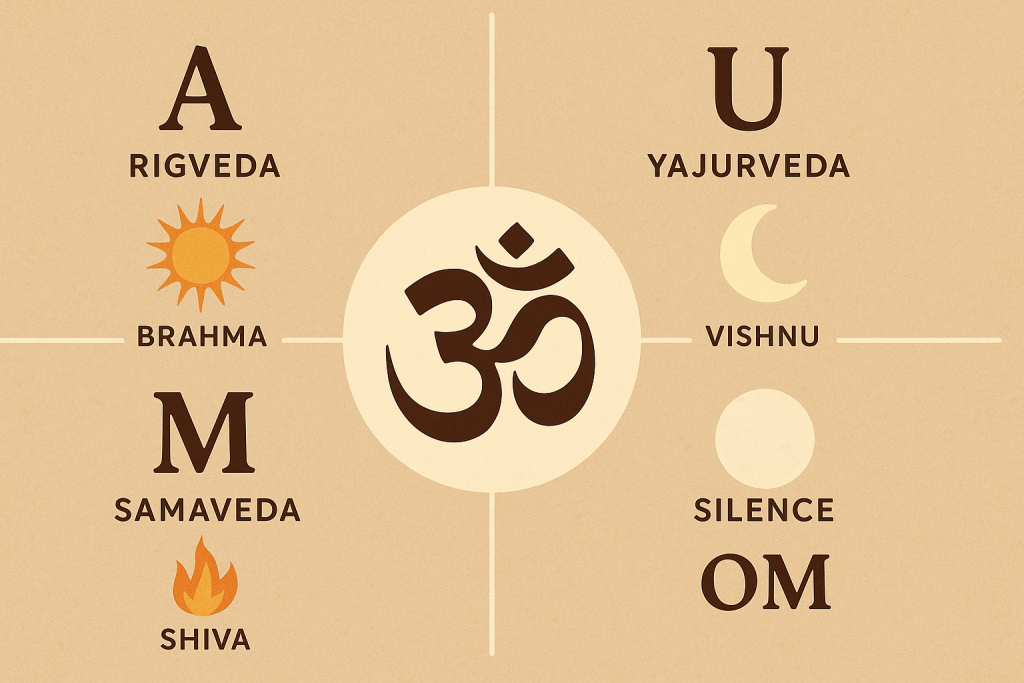
Citation: Derived directly from Pranava Upanishad verses 4–6 (assigning A–U–M to Vedas, deities, lokas, fires), verses 7–8 (mapping to Sun, Moon, Fire), and verse 9 (half-mātrā as subtle flame).
Sourced from:
- Wikisource (Sanskrit): https://sa.wikisource.org/wiki/प्रणवोपनिषद्
- Upanishads.org.in: https://upanishads.org.in/upanishads/61/pranavopanishat
4. Reflections & Key Takeaways
- The Upanishad shows how all triads — 3 Vedas, 3 deities, 3 worlds, 3 fires — are integrated in Oṁ.
- A – U – M – silence (ardhamātrā) map to creation, preservation, dissolution, and transcendence.
- Inner yogic visions of sun, moon, fire, and subtle flame symbolize levels of consciousness.
- The final teaching: merging into the silence beyond sound is merging into Brahman, attaining immortality.
5. Application in Daily Life
- Chant Om daily before any prayer or meditation — it harmonizes breath, mind, and body.
- Contemplate the mappings: A as waking/earth/Brahmā, U as dream/space/Viṣṇu, M as deep sleep/heaven/Śiva, silence as Turīya.
- Listen for the inner nāda (sound) — Bhagawan Baba encouraged deep attentive chanting to experience inner vibration.
- Begin every mantra with Om — it charges the mantra with divine potency.

6. Conclusion
The Pranava Upanishad reminds us that Oṁ is not just a sound but the seed of creation, the essence of the Vedas, and the direct symbol of Brahman. Bhagawan Baba’s guidance aligns perfectly: to chant, meditate upon, and live in the awareness of Om. In that practice lies peace, purity, and immortality.
Citations
- Pranava Upanishad, Atharva Veda (Sanskrit text). Available at:
- Wikisource (Sanskrit): https://sa.wikisource.org/wiki/प्रणवोपनिषद्
- Upanishads.org.in: https://upanishads.org.in/upanishads/61/pranavopanishat
- Sri Sathya Sai Speaks, Discourses of Bhagawan Sri Sathya Sai Baba:
- https://links.sairhythms.org/8P74 Birthday Discourse (Pranava the Praana)
- https://links.sairhythms.org/FV29 Shivaratri Discourse
Humble Pranams at the Divine Lotus Feet
Jai Sai Ram!
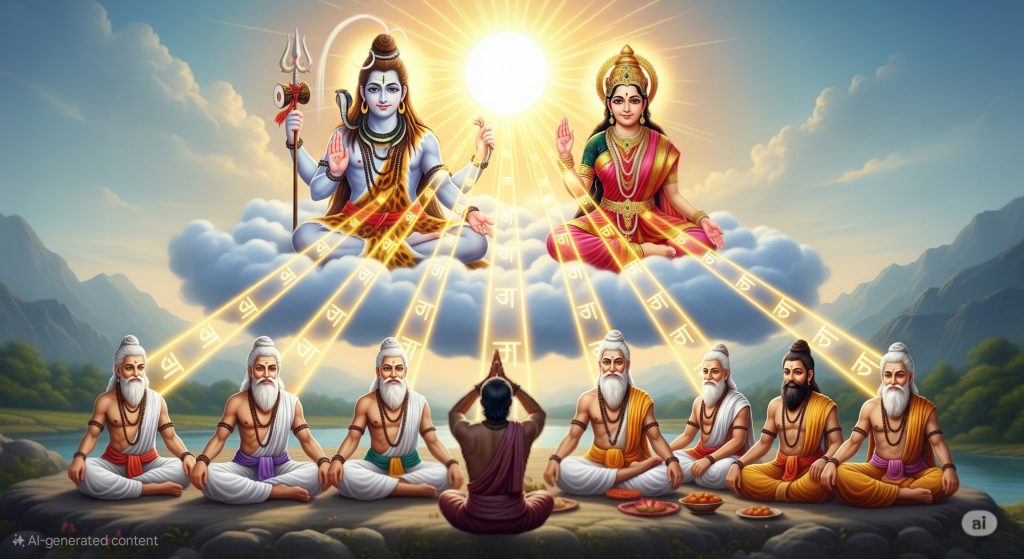
PS: All content and images created using AI Tools