Why Rama Chose Hanuman
When we think of Hanuman, we often picture him as a mighty vanara who leapt across the ocean or carried mountains in service of Rama. Yet, in the heart of Valmiki’s Ramayana, we find a different dimension of Hanuman — that of a scholar par excellence.
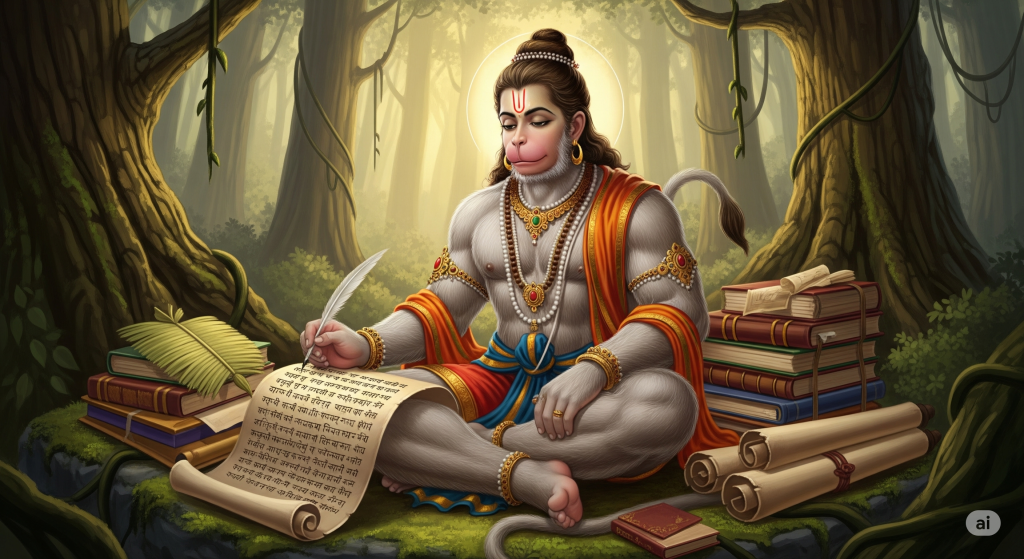
Hanuman was a master of the Vedas and Sastras, with flawless command over grammar, rhetoric, and communication. His intellect was as sharp as his courage, and his devotion as deep as his strength. More than physical power, it was his clarity, humility, and righteousness that set him apart.
When the time came for Rama to choose an emissary to Lanka, the task was not merely physical — it demanded wisdom, diplomacy, and the ability to speak truth with conviction. Rama chose Hanuman because he embodied these very qualities.
“When Hanuman was moving about in the Ashoka forest, all the rakshasas caught hold of Hanuman, tied him up and took him to Ravana. Ravana then asked a series of questions. However, Hanuman did not answer even one of them. The moment he looked at Ravana, Hanuman became very angry. Even there, under those circumstances, Hanuman undertook to tell Ravana what good qualities are and how one should strive to have good qualities. He addressed Ravana and he asked him to realise at least then that what he had done was wrong.”
– Bhagawan Sri Sathya Sai Baba, Summer Showers 1977
This post explores:
1. Why Sri Rama chose Hanuman and
2. Hanuman’s own timeless words proclaiming the glory of Sri Rama.
With this lens, we turn to Sundarakāṇḍa, Sarga 51, where Hanuman directly addresses Ravana. These verses (38–45) capture a timeless guidance for all of us.
The Glory of Rama – Hanuman’s Words to Ravana
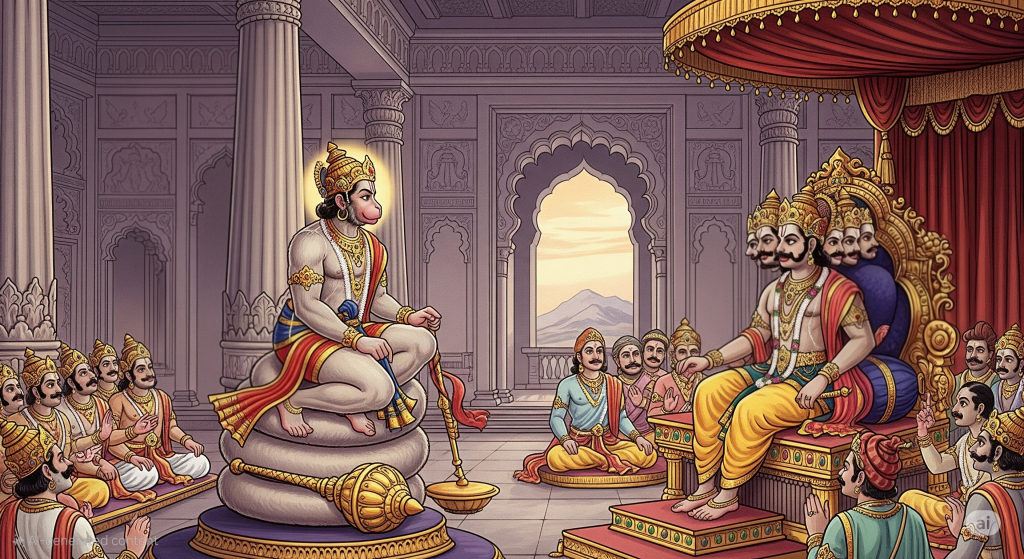
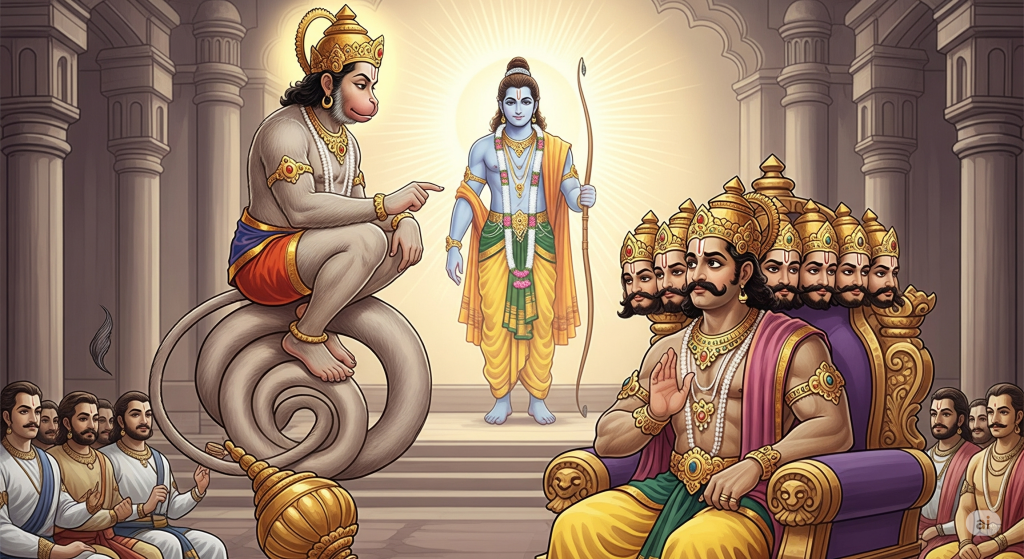
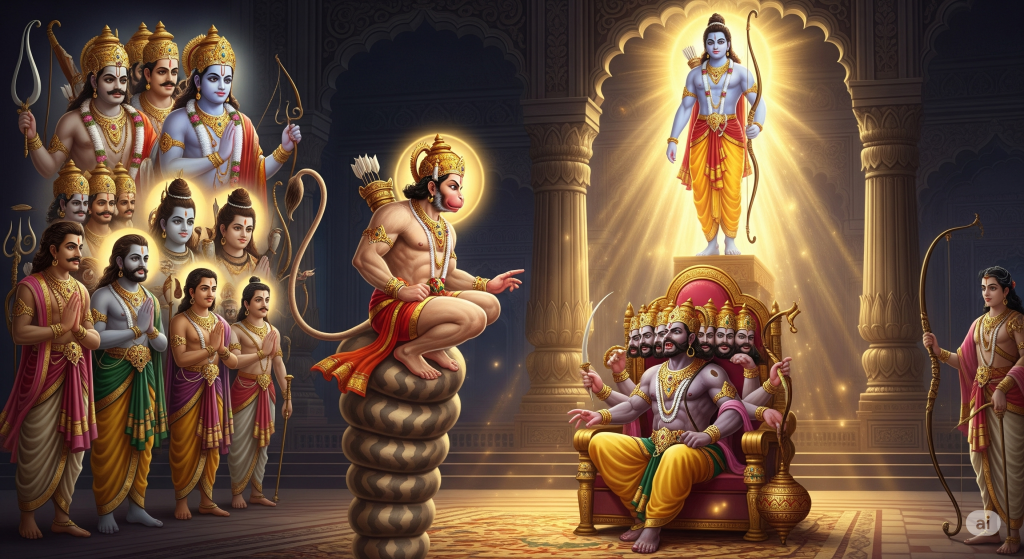
In Sundarakāṇḍa, Sarga 51 (verses 38–45), Hanuman, sitting on his tail at a height greater than Ravana’s throne, delivers a proclamation that shines with both authority and devotion that are timeless declarations of Rama’s divine glory.
Here are the verses (transliteration and meaning condensed for flow):
5.51.38
Transliteration:satyam rākṣasarājendra śṛṇuṣva vacanaṁ mama || 5-51-38rāmadāsasya dūtasya vānarasya viśeṣataḥ |
Translation (site-based, refined):
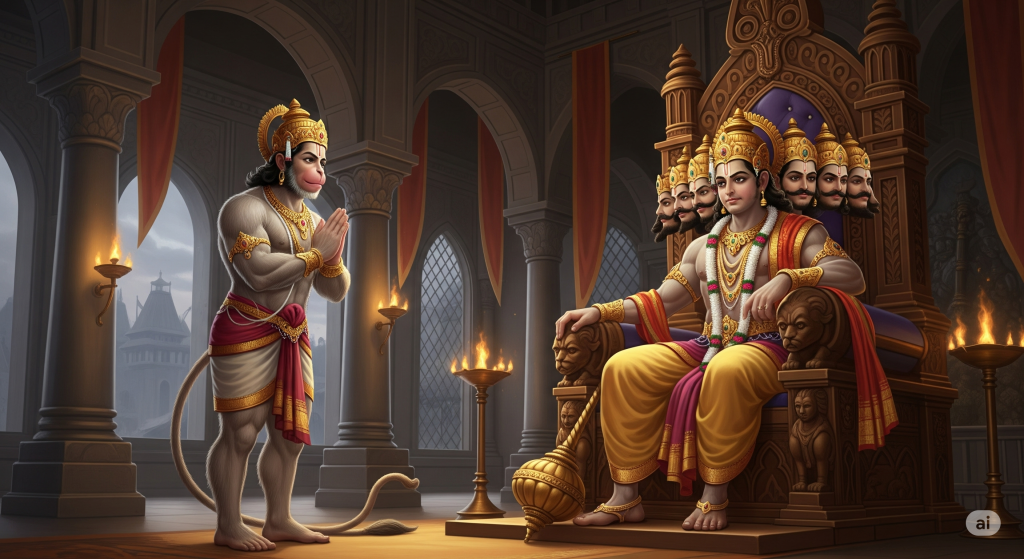
“O king of the rākṣasas, hear my truthful words — the words of Rāma’s servant, his messenger, and in particular of a vānar(a).” valmikiramayan.net
Explanation / meaning:
Hanumān opens with humility and authority together. He explicitly identifies himself as Rāma’s servant and envoy and draws attention to the truthfulness (satya) of what he will say. This establishes the moral standing of his message: it’s not the boast of a warrior but the sober counsel of a loyal messenger whose authority derives from service to dharma. The tone signals: listen not to my form (a vanara) but to the truth behind my words. valmikiramayan.net
5.51.39
Transliteration:sarvān lokān susaṁhṛtya sabhūtāṁś carācarān || 5-51-39punareva tathā sraṣṭum śakto rāmo mahāyaśāḥ |
Translation (site-based, refined):
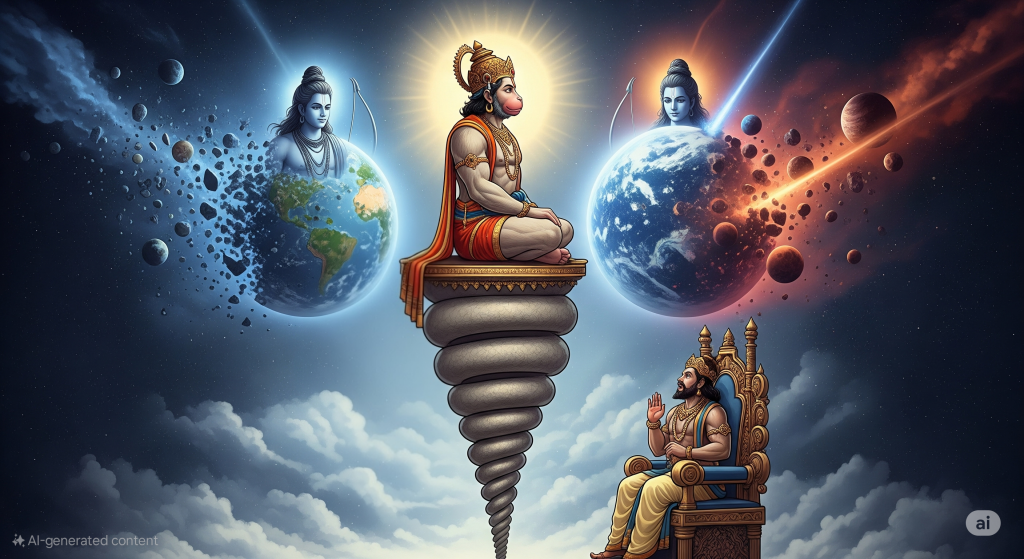
“The renowned Rāma is capable of wholly dissolving all the worlds — animate and inanimate — and creating them again; such is his great glory.” valmikiramayan.net
Explanation / meaning:
This verse lifts the discussion from a local quarrel to cosmic scale. Hanumān reminds Rāvaṇa that Rāma’s potency is not limited to human combat: He is described as able to unmake and remake worlds. The point is both theological and tactical: opposing Rāma is to oppose a power whose scope and authority transcend worldly calculations. For Ravana, this should be a sober reality-check: the stakes are cosmic, not merely political. valmikiramayan.net
5.51.40–42 (grouped on the page)
Transliteration (combined):devāsuranarendreṣu yakṣarakṣogaṇeṣu ca || 5-51-40vidyādhareṣu sarveṣu gandharveṣūrageṣu ca |siddheṣu kinnarendreṣu patatriṣu ca sarvataḥ || 5-51-41sarvabhūteṣu sarvatra sarvakāleṣu nāsti saḥ |yo rāmaṁ pratiyudhyeta viṣṇutulya-parākramam || 5-51-42
Translation (site-based, refined):
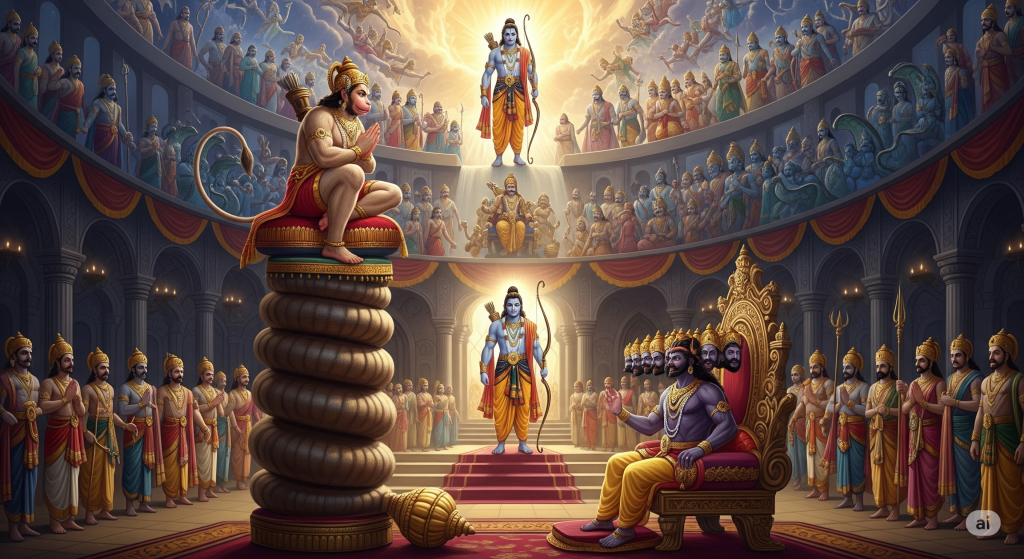
“Among gods and asuras, kings, yakṣas and rākṣasas, among vidyādharas, gandharvas, nāgas, siddhas, kinnaras and flying tribes — in all beings, everywhere and at all times — there is none who can stand against Rāma; his valour is equal to Viṣṇu’s.” valmikiramayan.net
Explanation / meaning:
This extended passage catalogs the universe’s hosts — celestial, semi-divine, and terrestrial — to stress universal uniqueness: no class of being can match Rāma. By invoking “Viṣṇu-like valour,” Hanumān is effectively identifying Rāma’s active potency with the supreme protector principle. Practically, this tells Rāvaṇa that he faces not just a great mortal but the full weight of the dharma-upholding divine — making resistance both futile and self-destructive. valmikiramayan.net
5.51.43
Transliteration:sarvalokeśvarasyaivam kṛtvā vipriyam uttamam |rāmasya rājasimhasya durlabhaṁ tava jīvitam || 5-51-43
Translation (site-based, refined):
“Having grievously wronged Rāma — the lord of all worlds and the lion among kings — your survival will be hard to obtain.” valmikiramayan.net
Explanation / meaning:
This verse turns the philosophical claim into a concrete warning: to injure the guardian of the cosmic order is to invite peril. Hanumān points out that by capturing Sītā and opposing Rāma, Rāvaṇa has committed a grave breach against the world-protector; therefore, continued survival (physical and political) is now improbable. It underlines the moral law: actions against dharma have real, unavoidable consequences. valmikiramayan.net
5.51.44
Transliteration:devāś ca daityāś ca niśācarendra |gandharvavidyādhara nāga yakṣāḥ |rāmasya lokatraya nāyakasya |sthātum na śaktāḥ samareṣu sarve || 5-51-44
Translation (site-based, refined):
“Not even gods, daityas, leaders of night-roamers, gandharvas, vidyādharas, nāgas or yakṣas — all of them — are able, in battle, to stand before Rāma, the leader of the three worlds.” valmikiramayan.net
Explanation / meaning:
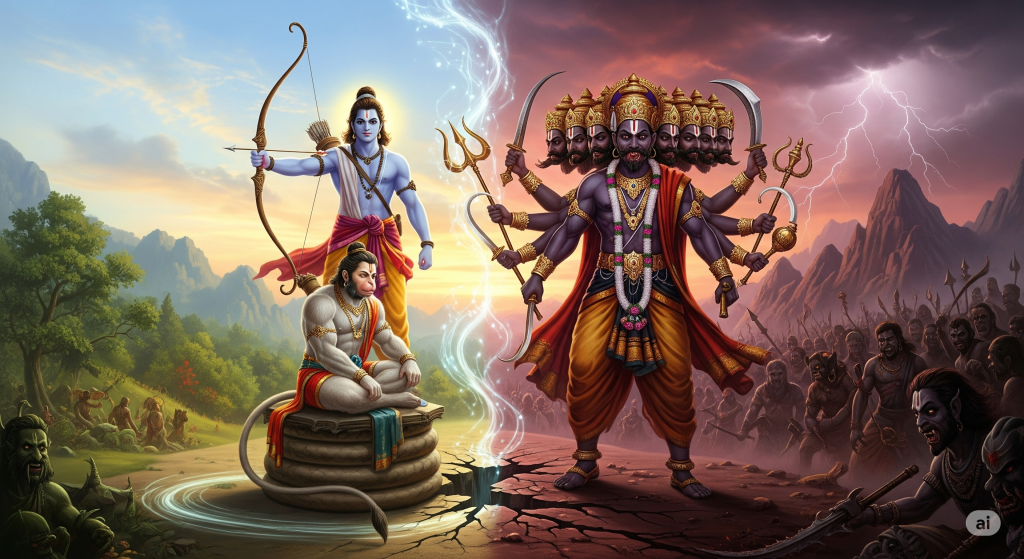
This closing couplet of the counsel returns to the battlefield image: even the greatest martial and supernatural forces cannot withstand the Dharma-rooted might of Rāma. The list includes every major class of beings, demonstrating the utter comprehensiveness of Rāma’s supremacy. It is both a warning (for Ravana) and an affirmation (for listeners/readers): where dharma and divinity coincide, exterior might cannot prevail. valmikiramayan.net
5.51.45
Transliteration:brahma svayamubhūśca turānano vā |rudrastriṇetrastripurāntako vā |indro mahendraḥ suranāyako vā |trātum na śaktā yudhi rāmavadhyam || 5-51-45
Translation:
“Neither Brahmā himself, nor Turāṇana, nor Rudra, nor Tripurāntaka, nor Indra, nor Mahendra, nor the leaders of the gods — none of them are capable of saving anyone in battle against Rāma, the slayer of evil.”
Explanation / Meaning:
This verse emphatically closes Hanuman’s proclamation, listing even the supreme divine beings and asserting that none can withstand Rāma’s power when he acts to uphold dharma. It is the ultimate affirmation of Rāma’s divinity, valor, and role as protector of the righteous — no worldly or celestial power can oppose him.
Reflections on Hanuman’s Proclamation
Hanuman’s words to Ravana are a timeless guide to understanding Dharma, devotion, and the power of Truth. In these verses, we see Rama portrayed not merely as a warrior, but as the embodiment of righteousness, compassion, and divine authority.
Through Hanuman’s narration, we understand:
- Dharma and Adharma: Hanuman’s words draw a clear line between Rama’s righteous path and Ravana’s unrighteous one. He personifies the qualities of a devoted servant and a wise leader.
- Courage and Humility: Hanuman stands alone in Lanka, yet he is fearless. His courage is rooted not in his own strength, but in his devotion to Rama. He maintains a profound sense of humility, always referring to himself as “Rama’s servant” rather than boasting of his own feats.
- The Power of Devotion: Hanuman’s devotion is his greatest strength. It is what fuels his intellect, courage, and ability to fulfill his mission. His unwavering faith in Rama is what makes him the perfect emissary.
- Strategic Communication: Hanuman’s speech is a masterclass in diplomacy and psychological warfare. He systematically dismantles Ravana’s arrogance by highlighting Rama’s invincibility and the futility of fighting against him.
- True strength is rooted in adherence to Dharma.
- Courage and devotion empower one to act righteously even in the face of formidable opposition.
- Words spoken with humility and conviction, guided by truth, have immense transformative power.
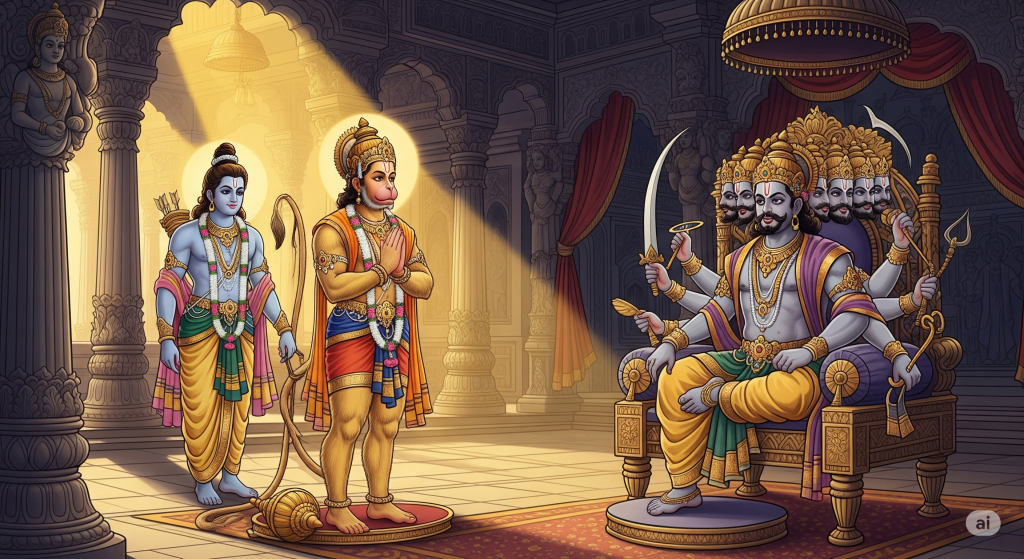
It is for these reasons that Sri Rama chose Hanuman as His emissary to Lanka.
Key Takeaways
- Righteousness (Dharma) Guides Action:
Rama’s actions are always in alignment with dharma. - Devotion Illuminates and Emboldens:
Hanuman’s unwavering devotion enabled him to face Ravana fearlessly. - Inner Dharma Surpasses Outer Might:
No amount of power or ego can triumph over righteousness. Even mighty Ravana was powerless against Rama’s truth. - Leadership Through Integrity:
Rama’s choice of Hanuman demonstrates that true leadership is entrusted to those with wisdom, courage, and character, not merely physical strength.
Applying These Lessons in Daily Life

- Anchor Your Actions in Truth: Let honesty and integrity guide decisions at work, home, and community.
- Cultivate Courage and Devotion: Face challenges with faith — in spiritual practice, personal growth, or social service.
- Practice Humility and Righteousness: Like Hanuman, serve with humility while standing firmly for what is right.
- Embody Knowledge with Devotion: Use skills and knowledge for the welfare of others, balancing intellect with heart.
Concluding Reflection
The episode of Hanuman narrating the glory of Sri Rama reminds us that Dharma, Truth, and Devotion are invincible forces. Ravana symbolizes ego, delusion, and misuse of power, whereas Rama symbolizes virtue, divine protection, and righteous leadership.
Bhagawan Sri Sathya Sai Baba says:
“When we give room to jealousy, anger and ego, we become a Ravana. When we follow the path of truth and the path of dharma, we become a Ramachandra. Good and bad are results only of the way we conduct ourselves. Rama and Ravana are not separate people. They are in us and they make us look like one or the other according to our deeds.”
– Summer Showers 1977
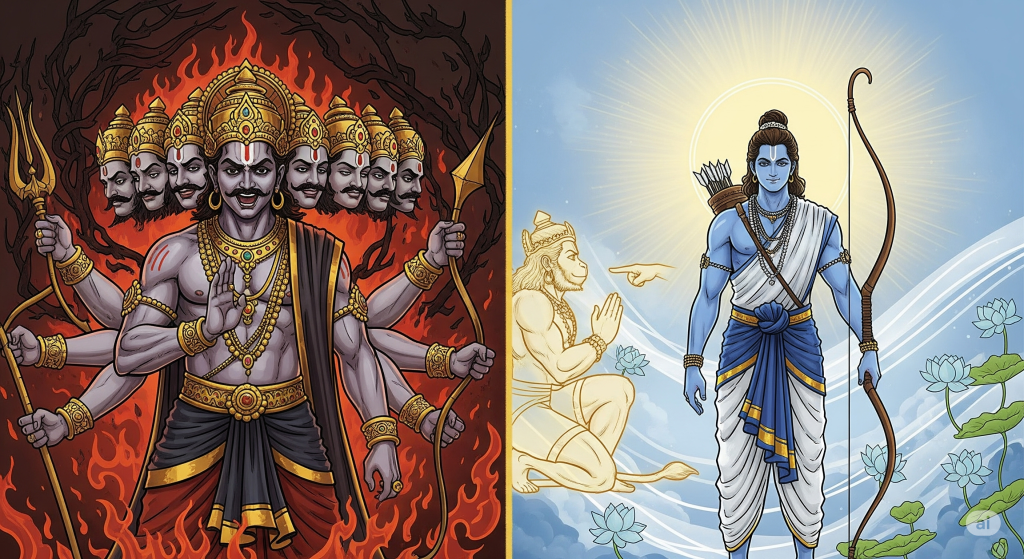
By internalizing Bhagawan Baba’s guidance alongside Hanuman’s proclamation, we can transform our daily lives into a living expression of devotion, righteousness, and selfless service, carrying forward the message of Rama and Hanuman in our modern world.
References & Citations
- Valmiki Ramayana, Sundarakāṇḍa, Sarga 51, Verses 38–45 – Gita Press Digital Edition
With humble pranams at the Divine Lotus Feet.
Jai Sai Ram