Vedic Cosmos
Stars and Astronomy in the Vedic Vision

Introduction:
In Vedic times, the heavens were not merely studied for practical reasons of navigation or calendrical keeping; they were revered as a living presence, an eternal expression of the divine. The ṛṣis looked to the night sky not with curiosity alone but with awe, reverence, and devotion. The stars, planets, and constellations were woven into the fabric of yajña and dharma. To them, the cosmos was not an inert expanse but a sacred order — Ṛta — that bound together gods, nature, and mankind.
The Vedas reveal astronomy as a part of the spiritual experience of existence. The same fire that blazes in the yajña-kund glows in the stars above; the same hymns that invoke Agni and Indra also call upon the Nakṣatras. Thus, when the seers gazed upon the heavens, they did not see distant, cold bodies of light, but radiant deities, showering grace upon humankind.
Nāsadīya Sūkta – Hymn of Creation (Ṛg Veda 10.129)
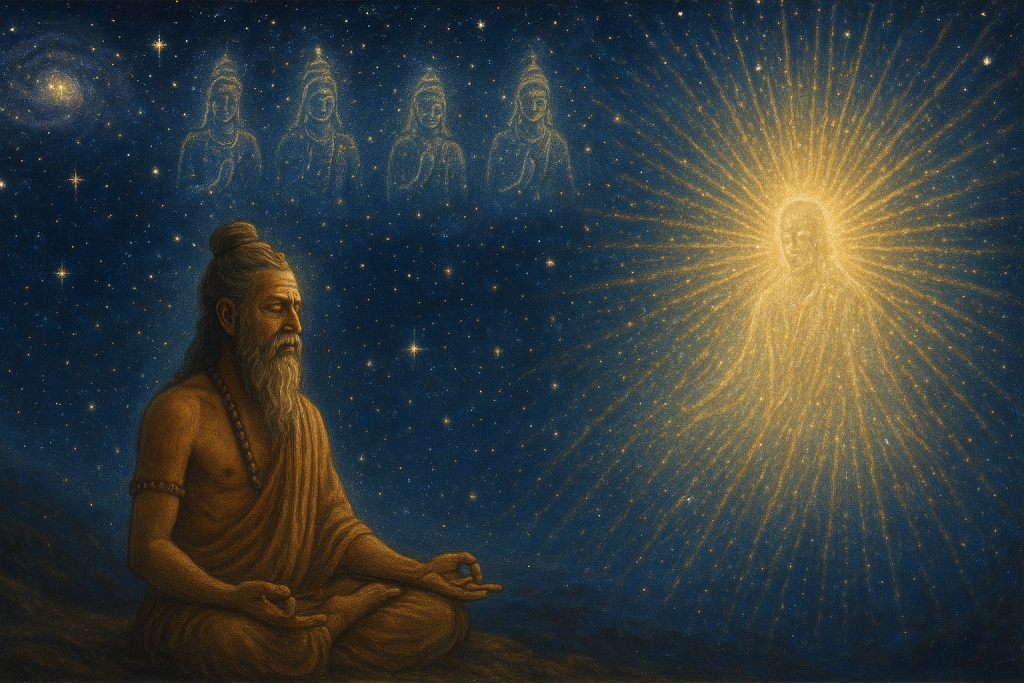
This Rg Veda hymn(10.129), also known as the “Hymn of Creation” or “Hymn of Non-existence,” stands out in the Vedic tradition for its radical philosophical inquiry. Composed in the late Vedic period, it moves beyond mythological narratives to ask fundamental questions about the ultimate reality. It posits a time before existence and non-existence, before the gods, and before any discernible form. The hymn’s power lies in its deep humility, acknowledging that the mystery of creation may be unknowable, even to the gods themselves. It is a contemplative, rather than declarative, text, marking a powerful shift towards philosophical speculation.
Here are the first four verses in transliteration and translation:
Verse 1
नासदासीन्नो सदासीत्तदानीं नासीद्रजो नो व्योमा परो यत् |
किमावरीवः कुह कस्य शर्मन्नम्भः किमासीद्गहनं गभीरम् ॥ १॥
Transliteration:
nāsad āsīn no sad āsīt tadānīṃ nāsīd rajo no vyomā paro yat
kim āvarīvaḥ kuha kasya śarman ambhaḥ kim āsīd gahanaṃ gabhīram
Translation: Then, there was neither non-existence nor existence. There was no realm of air, no sky beyond it. What covered it? Where was it? In whose protection? Was there water, deep and unfathomable?
Commentary: This verse dissolves all dualities—being and non-being, space and sky. It evokes a primordial stillness, where even the concept of “covering” or “protection” is questioned. The mention of water hints at the Vedic motif of undifferentiated waters, yet even that is uncertain. A cosmic koan in poetic form.
Verse 2
न मृत्युरासीदमृतं न तर्हि न रात्र्या अह्न आसीत्प्रकेतः |
आनीदवातं स्वधया तदेकं तस्माद्धान्यन्न परः किञ्चनास ॥२॥
Transliteration:
na mṛtyur āsīd amṛtaṃ na tarhi na rātryā ahna āsīt praketaḥ
ānīd avātaṃ svadhayā tad ekaṃ tasmād dhānyan na paraḥ kiñcanāsa
Translation: There was no death then, nor immortality. No sign of night or day. That One breathed, windless, by its own impulse. Apart from That, nothing else existed.
Commentary: Time and polarity vanish—no death, no immortality, no day or night. “It breathed without air” is a stunning image of self-sustained consciousness. “Svadhayā” suggests divine autonomy. This is not creation from emptiness, but emergence from fullness.
Verse 3
तम आसीत्तमसा गूहळमग्रे प्रकेतं सलिलं सर्वाऽइदम् |
तुच्छ्येनाभ्वपिहितं यदासीत्तपसस्तन्महिनाजायतैकम् ॥३॥
Transliteration:
tama āsīt tamasā gūḷham agre apraketaṃ salilaṃ sarvam ā idam
tucchyena ābhv api hitaṃ yad āsīt tapasas tan mahinā jāyataikam
Translation: Darkness was hidden in darkness at first. All this was undifferentiated water. That which was void and formless was covered by the void. Through the power of tapas, That One came into being.
Commentary: A paradox of concealment: darkness wrapped in darkness. The world is fluid, unformed, veiled by voidness. But then comes the turning point—through tapas (creative heat, austerity), the One emerges. This is the Vedic Big Bang of consciousness.
Verse 4
कामस्तदग्रे समवर्तताधि मनसो रेतः प्रथमं यदासीत् |
सतो बन्धुमसति निरविन्दन्हृदि प्रतीष्या कवयो मनीषा ॥४॥
Transliteration:
kāmas tad agre samavartatādhi manaso retaḥ prathamaṃ yad āsīt
sato bandhumasati niravindan hṛdi pratīṣyā kavayo manīṣā
Translation: Desire arose in the beginning—that was the first seed of mind. Sages, searching in their hearts with wisdom, Found the bond of the existent in the non-existent.
Commentary: “Kāma” is not lust, but the primal will to manifest. It’s the first stir of mind, the seed of creation. The “kavayo manīṣā”—wise seers—intuit the link between sat and asat, form and formlessness. This is the birth of cosmic yearning.
From Kāma to “Eko’ham Bahu Syām” The fourth verse is remarkable. It speaks of kāma—desire—as the first stirring within the One, the subtle impulse toward manifestation. This is not passion in a human sense, but the cosmic will that bridges asat (non-being) and sat (being).
While the Ṛg Veda itself remains open and exploratory, later seers of the Upaniṣadic age drew upon this vision to articulate a profound truth: that the One wished to become many.
This is seen clearly in the Chāndogya Upaniṣad, where the primordial Being (Sat) thinks to itself, “bahu syām prajāyeya” (“May I become many, may I grow forth”) (6.2.3) [1].
Similarly, the Taittirīya Upaniṣad echoes this idea in the Brahmānandavallī, verse 6, stating that the Brahman, the Absolute, desired to become manifold [2].
From Creation to Cosmos: The Stars as Divine Beings
If the Nāsadīya Sūkta reveals the mystery of existence, the night sky reveals its sacred order. To the Vedic seers, the heavens were not an accidental scattering of lights. They were a yajña-vedi, a cosmic altar, where every star had its place and its purpose.
The sky was filled with deities: Agni blazed as the sun, Soma shone as the moon, and the Nakṣatras (lunar mansions) were honored as celestial presences. Each Nakṣatra was invoked in yajñas, each associated with a deity—from Agni to Indra, from Varuṇa to the Ādityas. To name a star was not to catalog it but to honor it, to recognize the deity whose energy flowed through its light.
Thus, the ancients did not merely “map” the sky; they sanctified it. The night was not empty darkness but a sacred tapestry of gods. Just as the five elements—Agni, Vāyu, Varuṇa, Pṛthvī, and Ākāśa—were revered as divine, so too were the stars. The heavens themselves were alive, a realm of deities showering their grace upon mankind.
Mapping the Celestial Deities: From Vedic to Western Names

While the Vedic seers saw the stars as living deities, modern astronomy has cataloged them with a different purpose—to create a universal map of the cosmos. This does not diminish the ancient wisdom; rather, it provides a bridge to connect their sacred vision with our modern understanding. The Nakṣatras, or lunar mansions, are the cornerstone of Vedic astronomy. There are 27 (or sometimes 28) of these, and each is a specific sector of the sky with a prominent star at its heart.
Below, we map some of the major Nakṣatras to their well-known Western astronomical names. This is not a one-to-one translation but a correspondence, linking the celestial deity to its physical location in the night sky.
| Vedic Nakṣatra | Western Star/Constellation |
| Ashwini | The star cluster Beta and Gamma Arietis in the constellation Aries. |
| Krittika | The Pleiades star cluster in the constellation Taurus. |
| Rohini | Aldebaran, the brightest star in the constellation Taurus. |
| Mrigashira | Lambda Orionis, the head of the constellation Orion. |
| Punarvasu | Castor and Pollux, the two brightest stars in the constellation Gemini. |
| Pushya | Delta Cancri in the constellation Cancer. |
| Ashlesha | Epsilon Hydrae in the constellation Hydra. |
| Magha | Regulus, the brightest star in the constellation Leo. |
This mapping reveals that the same luminous points in the sky that the Rig Veda referred to as divine beings are the very same celestial bodies we observe today. The difference lies not in the stars themselves, but in the lens through which we view them—as a cosmic dance of deities rather than just a collection of gas and dust.
Prominent Individual Stars: Vedic and Western Equivalents
Beyond the Nakshatras, several prominent stars also held significant importance in both Vedic and Western traditions. Here is a mapping of some well-known Western stars to their commonly associated Vedic names:
| Western Star Name | Constellation | Vedic Name / Association |
| Sirius | Canis Major | Mrigavyadha or Lubdhaka |
| Canopus | Carina | Agastya |
| Vega | Lyra | Abhijit (part of a Nakshatra) |
| Capella | Auriga | Brahma Hridaya |
| Castor & Pollux | Gemini | Aditi and Diti |
| Elnath | Taurus | Agni |
This simple mapping reveals a shared human connection to the heavens that transcends cultural and temporal boundaries.
The Sapta Rishi Mandala: The Seven Sages and Dhruva

One of the most revered and easily recognizable constellations in the Northern Hemisphere is the Big Dipper, which holds a special and sacred place in Vedic astronomy. It is known as the Sapta Rishi Mandala, or “The Circle of the Seven Sages.” These seven stars are believed to be the cosmic forms of the seven great sages (Maharishis) who received and transmitted the sacred knowledge of the Vedas.
Each star in this constellation is a divine presence, honored for its wisdom and spiritual power. Here is the mapping of the seven stars and their corresponding rishis:
- Dubhe (Alpha Ursae Majoris) – Marichi
- Merak (Beta Ursae Majoris) – Vashistha (often accompanied by the faint star Alcor, known as Arundhati, Vashistha’s wife, a binary companion visible to the naked eye)
- Phecda (Gamma Ursae Majoris) – Angiras
- Megrez (Delta Ursae Majoris) – Atri
- Alioth (Epsilon Ursae Majoris) – Pulastya
- Mizar (Zeta Ursae Majoris) – Pulaha
- Alkaid (Eta Ursae Majoris) – Kratu
This constellation served as a vital directional guide for ancient seers, with the two stars at the bowl’s outer edge (Dubhe and Merak) always pointing towards Dhruva (Polaris), the North Star. Dhruva is a symbol of steadfastness, eternal truth, and unwavering resolve in Vedic tradition, representing a fixed point around which the cosmos revolves.
Here is an image depicting the Sapta Rishi Mandala (Big Dipper) and Dhruva highlighting the connection between these celestial guides.


Reflections and Closing Thoughts

The journey from the Nāsadīya Sūkta’s questions on cosmic origins to the systematic mapping of stars reveals a timeless human quest for meaning. The Vedic seers didn’t simply observe the heavens; they engaged in a sacred relationship with them. They saw the night sky not as a distant, indifferent void, but as a direct expression of the divine, a celestial blueprint for life on Earth.
In our modern world, filled with scientific explanations and light pollution that obscures the stars, we can still learn from this ancient wisdom. The stars remind us that we are part of a grander, sacred order. They invite us to find our own “Dhruva,” a fixed point of purpose and truth that can guide us through life’s uncertainties. They encourage us to seek wisdom, just as the Sapta Rishis are said to embody.
By looking up at the night sky with a renewed sense of wonder and reverence, we can reconnect with a profound tradition that binds us to our past, to the universe, and to a higher purpose. The cosmos is not just a subject for study; it is a canvas for contemplation, inviting us to reflect on our place within its infinite, sacred tapestry.
References
[1] Chāndogya Upaniṣad, Chapter 6, Section 2, Verse 3. Retrieved from WisdomLib.
[2] Taittirīya Upaniṣad, Brahmānandavallī, Verse 6. Retrieved from Shlokam.org.
Samastah Lokah Sukhino Bhavanthu
May all the beings in all the worlds be happy!

Jai Sai Ram!

Please note all images and content generated using AI Tools
The star chart image is a screenshot from Stellarium app.