Awaiting the Blaze: Capturing Corona Borealis Before the Nova
On the evening of June 17, 2024, armed with my Samsung S 24 Note Ultra, I embarked on a unique stargazing journey from the heart of Bangalore, India. My mission was not just to admire the night sky, but to capture a moment that would soon etch itself into the annals of astronomical history.
My gaze was fixed on the constellation Corona Borealis, also known as the Northern Crown. This semi-circular constellation (shown below), reminiscent of a regal crown, has been a part of numerous mythologies and now, it is set to be part of a rare celestial event.

The star of the show is T Coronae Borealis, popularly known as the Blaze Star. This star has a recurring nova and is expected to dramatically increase in brightness, a phenomenon known as going nova, sometime between now and September 2024.

Although the Blaze Star, currently at a magnitude of 10.4, is not visible to the naked eye, I used the Sky Safari app to pinpoint its location within the constellation (see above). I captured a few photos of the complete Corona Borealis constellation, with the invisible Blaze Star waiting in the wings for its grand spectacle.
These images, captured with the impressive camera of the Samsung S 24 Note Ultra, will serve as a ‘before’ snapshot of this celestial event. A silent testament to the calm before the storm.

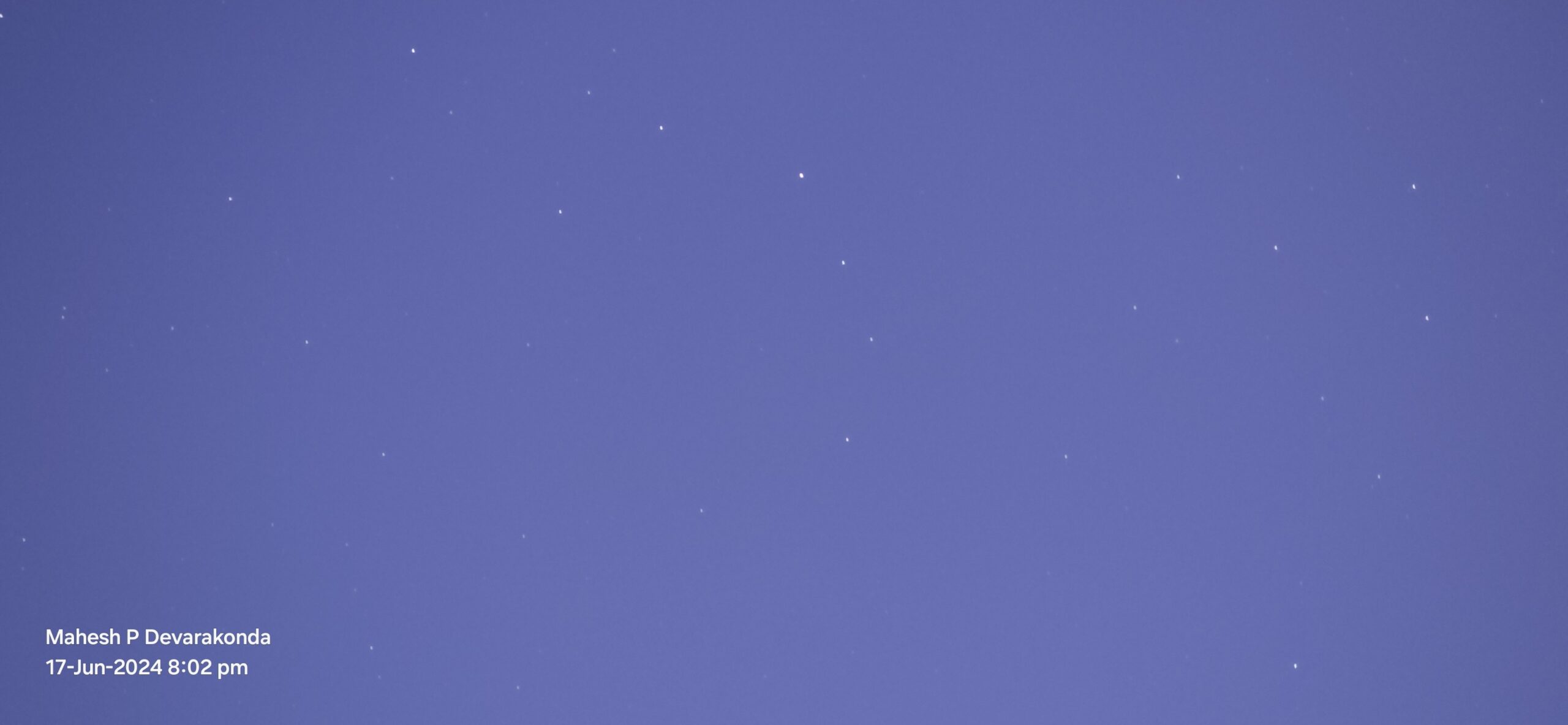
As we wait for the Blaze Star to light up the night sky, these images and this blog post will serve as a reminder of the tranquil beauty of the night sky before the event. Once the star goes nova, I plan to capture the ‘after’ images and share the dramatic transformation of the Blaze Star with you all.
One of the stars in the Corona Borealis constellation, Alphecca (see below), shines brightly at a magnitude of 2.0. This star, also known as Gemma, is the brightest star in the constellation and is easily visible to the naked eye.

The fascinating part is that once the Blaze Star goes nova, it’s expected to match the brightness of Alphecca. For a few days, the Blaze Star will be visible to the naked eye, shining as brightly as Alphecca. This will truly be a rare and spectacular event, as we witness a usually faint star transform into one of the brightest objects in the night sky.
Here’s to the anticipation of a rare celestial event, the joy of stargazing, and the marvels of modern technology that allow us to capture these moments. So, keep your eyes on the sky and don’t miss this celestial spectacle. I’ll be back with the ‘after’ images and the story of the Blaze Star’s transformation. Until then, clear skies and happy stargazing!
The above is a brief time-lapse video of the constellation moving before clouds started to appear.