There is a distinct, breathless magic that occurs when the celestial clockwork aligns perfectly to pierce through a stormy night.
Earlier this evening, right here in Bengaluru, the heavy pre-monsoon clouds parted just enough to reveal a breathtaking cosmic triad: a delicate, glowing crescent Moon suspended beautifully in the western sky, flanked by the two brightest planets in our solar system—Venus and Jupiter.
For those tracking the heavens this week, the Moon has been on an elegant pilgrimage, visiting the evening planets one by one. While the monsoon-laden skies blocked out yesterday’s view, tonight offered a blessed, short-lived window of absolute clarity. It was a visual reminder that no matter how dense the earthly clouds around us become, the grand alignment of the universe remains entirely uninterrupted.
The Evening in Frames: From Dusk to Deep Space Capturing this event over the span of an hour using a flagship mobile sensor yielded a progression of details that feel deeply intimate yet staggeringly vast.
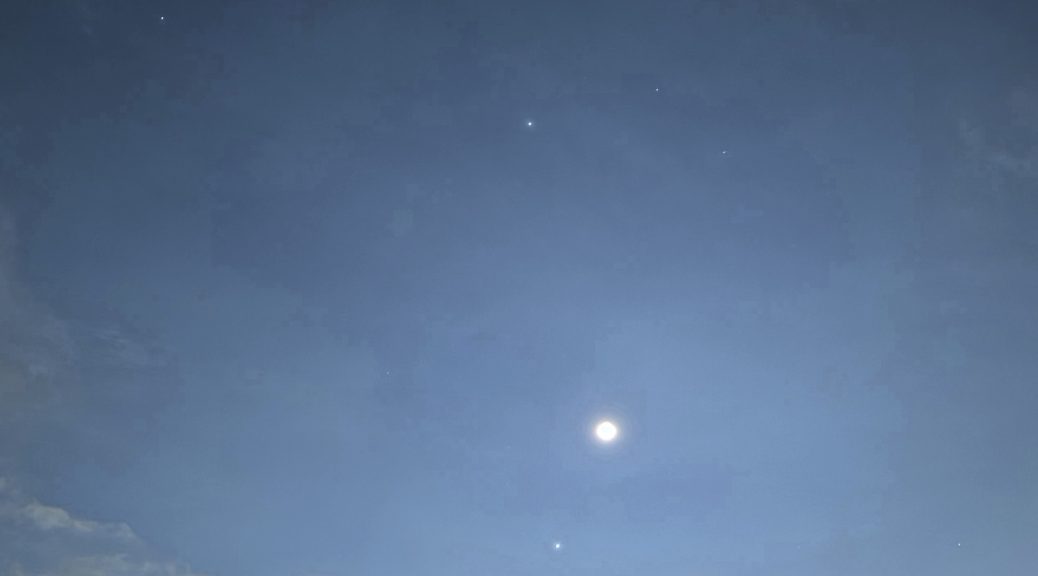
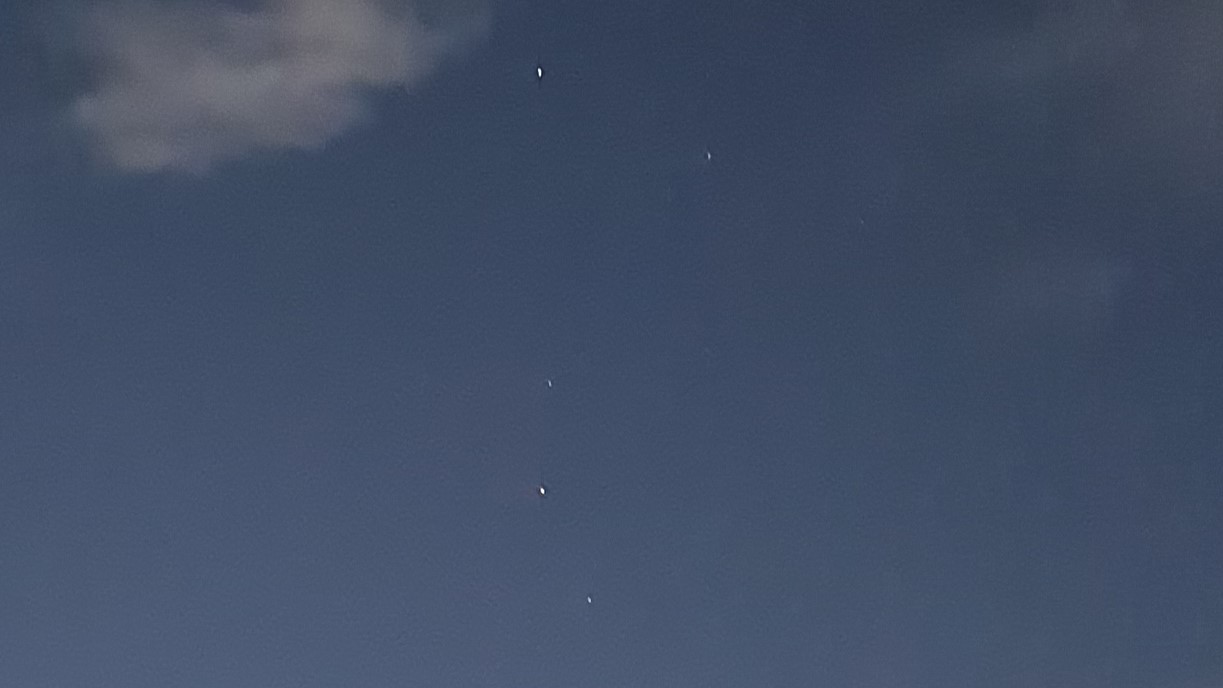
1. The Twilight Geometry (7:14 PM) As twilight began to deepen, the sheer scale of the alignment became visible over the urban skyline. Even with city lights and low-hanging moisture, Venus and the crescent Moon pierced the blue hour with remarkable brilliance, hanging like gems over the cityscape.
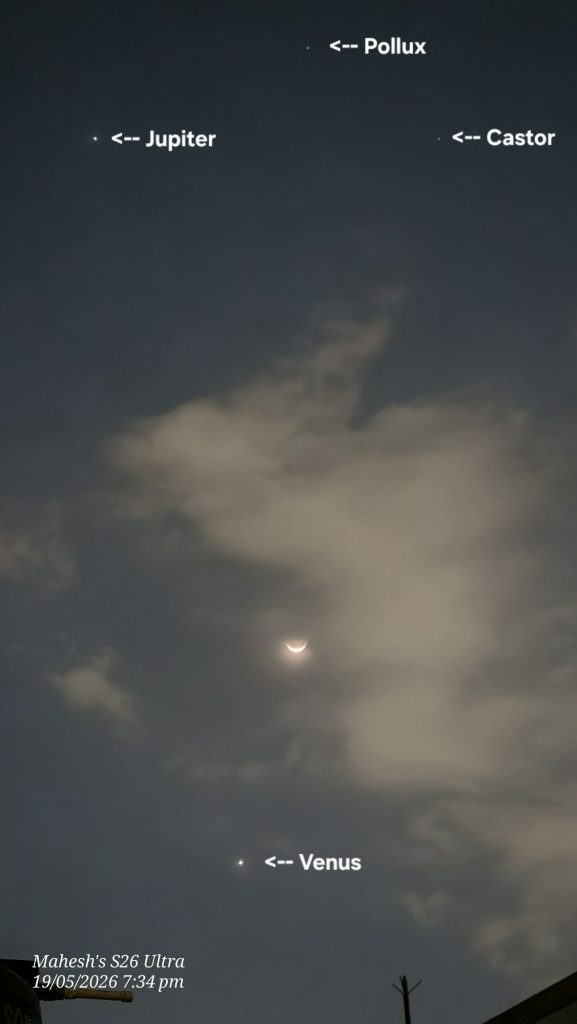
2. Enter the Twins: Castor and Pollux (7:34 PM) As the sky darkened further, the composition expanded dramatically. The Moon hung in perfect poise—positioned directly above brilliant Venus (blazing at an intense apparent magnitude of roughly -3.9) and just below the majestic authority of Jupiter (shining at magnitude -1.9).
But the real surprise was the appearance of the famous celestial twins of the Gemini constellation. Sitting high above the planetary dance, Pollux (the brighter, golden giant) and Castor (the bright binary system) framed the top of the view, creating a spectacular multi-body celestial matrix.
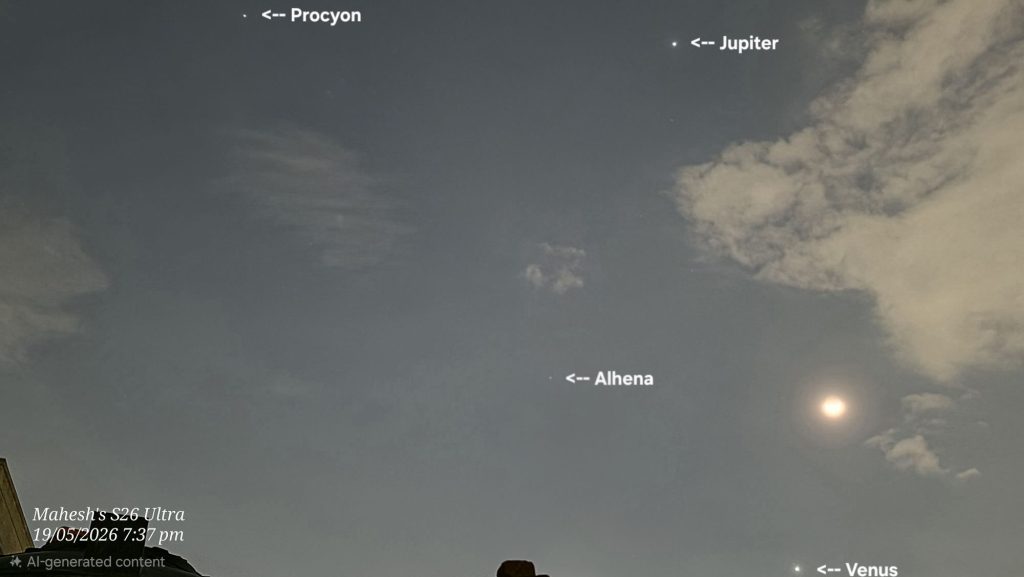
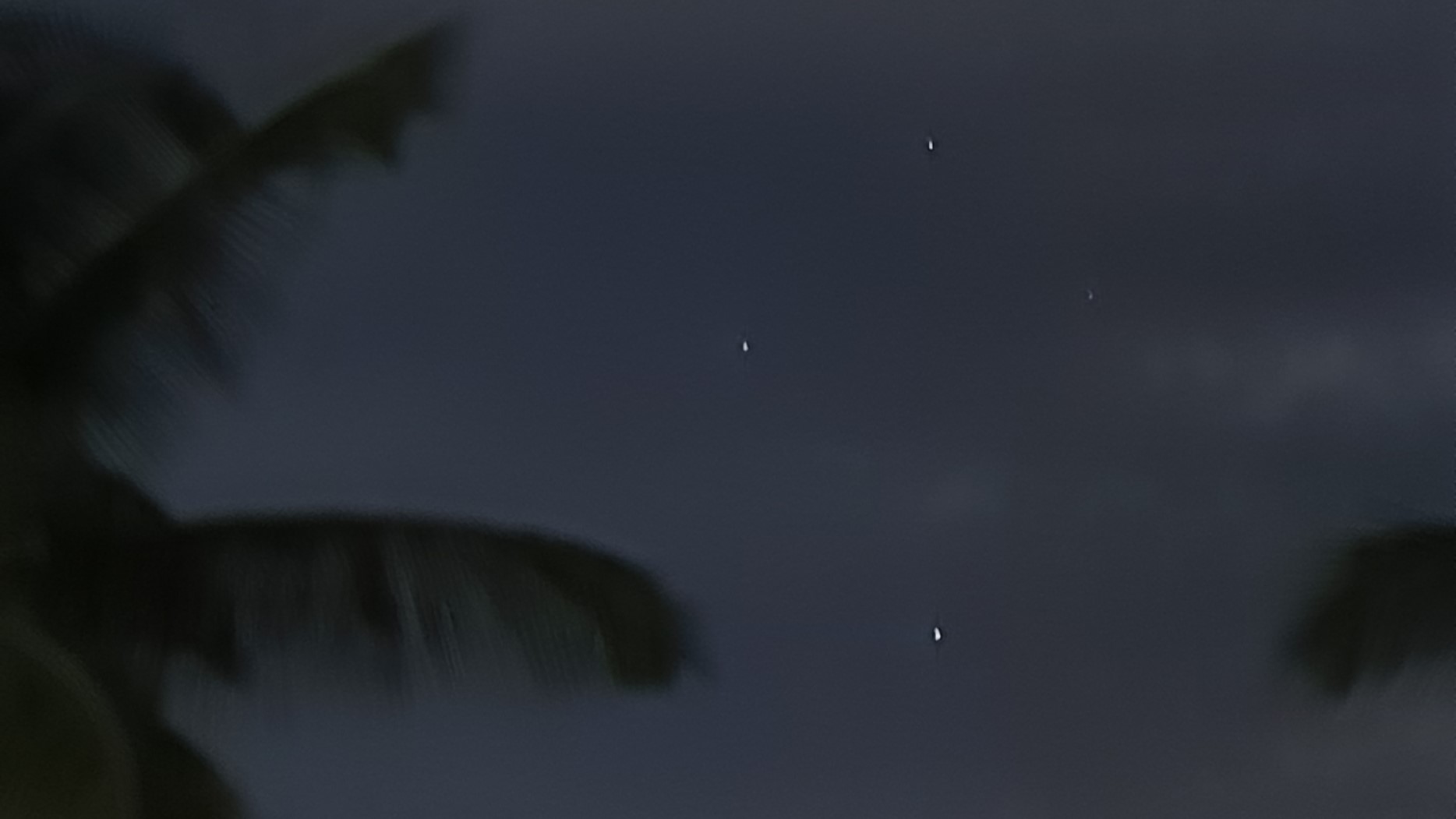
3. The Grand Panoramic Canvas (7:37 PM) Just a few minutes later, switching to a landscape orientation completely transformed the perspective, turning a tight planetary framing into a sweeping cosmic map. This wide-angle shot beautifully illustrates the massive scale of the celestial neighborhood.
To the far upper left, the brilliant star Procyon—the eighth-brightest star in the night sky and the anchor of Canis Minor—shines with its steady, distinct light. Right in the center of the frame, standing like a cosmic milestone directly above the rooftop line, sits Alhena (gamma Geminorum). Alhena marks the “left foot” of the twin Pollux in the constellation Gemini. Seeing Alhena, Jupiter, Venus, and the Moon all suspended in a vast, open horizontal plane reveals the beautiful, geometric web that connects our immediate solar system neighbors to stars burning light-years away in the deep background of space.
4. The Ghostly Radiance of Earthshine Zooming into the lunar disk revealed the spectacular phenomenon of Earthshine —often called the “Da Vinci Glow.” While the sunlit sliver of the crescent burned intensely, the dark, un-illuminated portion of the lunar disk was softly, visibly awake. This ghostly illumination isn’t caused by direct sunlight, but by sunlight reflecting off Earth’s own clouds and vast oceans, bouncing back into the dark spaces of the Moon. It is a profound reminder that even the dark side of our neighbor is gently lit by the home we stand on.
5. Resolving the Deep Space Beacon: Mebsuta Perhaps the most technically thrilling success of the evening was zooming past our planetary neighbors to capture a true deep-sky beacon sitting just to the upper left of the lunar glow: Mebsuta (epsilon Geminorum). Click on the photo below.
Tucked within the constellation Gemini, Mebsuta is a yellow supergiant stellar engine sitting nearly 900 light-years away from Earth. Remarkably, the phone’s sensor managed to distinctly resolve not just the primary star, but its faint, 9.6-magnitude optical companion star. Resolving a companion star of that magnitude through the atmospheric haze of a post-rain city sky is a true triumph of modern optical stacking and computational mobile photography.
Did you manage to catch a glimpse of the Moon sitting between the two evening giants tonight?
Video of this evening’s alignment
Celestial Whispers: A Night of Automated Discovery
Last night, May 12, 2026, was a testament to how modern technology can bridge the gap between our busy daily lives and the silent, ancient wonders of the cosmos.
Between 7:20 PM and 10:15 PM, while I was indoors attending to other tasks, my gear was outside under the Bengaluru sky, diligently working through a pre-planned cosmic itinerary.
The true hero of this session was the Dwarf Mini’s Scheduler feature. By setting up a sequence in advance, the telescope seamlessly transitioned from one Deep Sky Object (DSO) to the next without any manual intervention.
Connected via STA mode to my home Wi-Fi, I could monitor the live stacks on my S26 Ultra from the couch. It is a profound shift—observing the universe not through shivering hours in the dark, but through a harmonious blend of automation and intentionality.
Observations
1. Markarian’s Chain: A Cosmic Neighborhood
This capture reveals a stretch of galaxies in the heart of the Virgo Cluster. Seeing these massive structures grouped together reminds us that nothing in the universe exists in true isolation; everything is part of a grand, gravitational dance.
Type: A string of galaxies including M84, M86, and the “Eyes” galaxies.
Distance: Approximately 50 to 60 million light-years from Earth.
Significance: Most of these galaxies are moving in a coherent motion, hence the “chain” designation, though some are just line-of-sight coincidences.
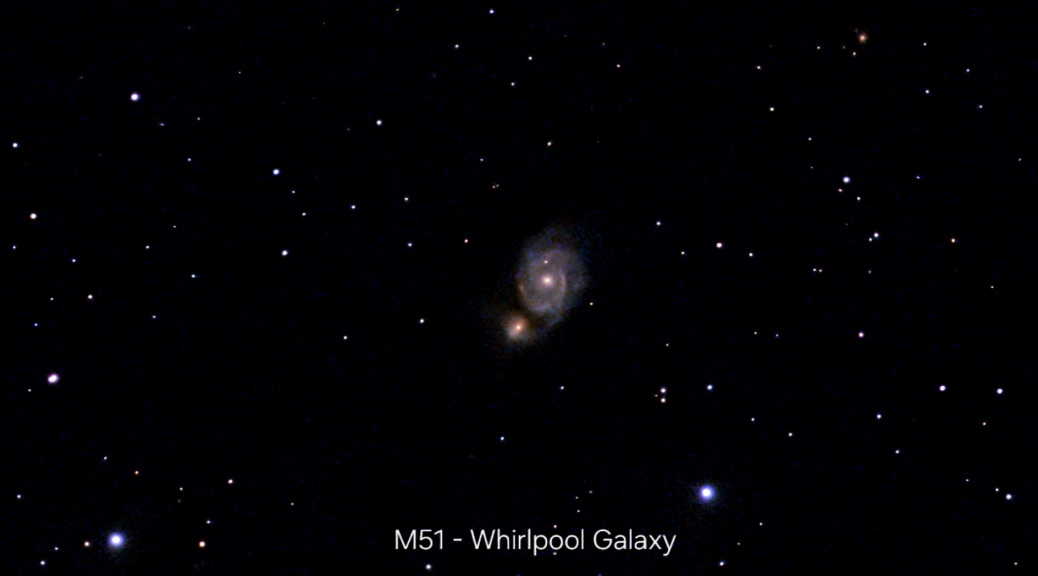
The spiral structure of M51 is perhaps the most iconic “transcendental” image in astronomy. It represents the perfect whirlpool of creation, where the smaller companion galaxy (NGC 5195) is literally tugging on the arms of the larger spiral.
Type: Grand-design spiral galaxy.
Distance: Roughly 31 million light-years away in the constellation Canes Venatici.
Interaction: The gravitational interaction with its companion triggers intense star formation, lighting up the spiral arms with brilliant pink nebulae.
Looking at the Sombrero, one can’t help but see a “crown” or a “brim” of starlight. It is a solitary, majestic object that sits on the edge of the Virgo Cluster, characterized by its unusually large central bulge and a prominent dark dust lane.
Type: Unbarred spiral galaxy (often appearing like an elliptical with a disk).
Distance: About 28 million light-years from Earth.
Feature: It contains a massive central black hole, estimated to be a billion times the mass of our Sun, and a rich system of nearly 2,000 globular clusters.
Reflecting on the Night As I reviewed the final edits on my S26 Ultra, I realized that it isn’t just about the images—it’s about the process. By using the scheduler, we remove the friction of the “how” and allow ourselves to focus on the “why.” We are capturing light that has traveled for millions of years to reach a terrace in Bengaluru.
How do these distant giants change your perspective on the “small” tasks we handle every day?
The Arrival of a Tiny Giant Yesterday, a small box arrived that promised to bridge the gap between my terrace and the deep reaches of space: the DWARF mini. In an age where we are often glued to small screens for trivialities, this device uses technology to turn our eyes upward, reminding us of the vastness that the ancient texts have long contemplated.
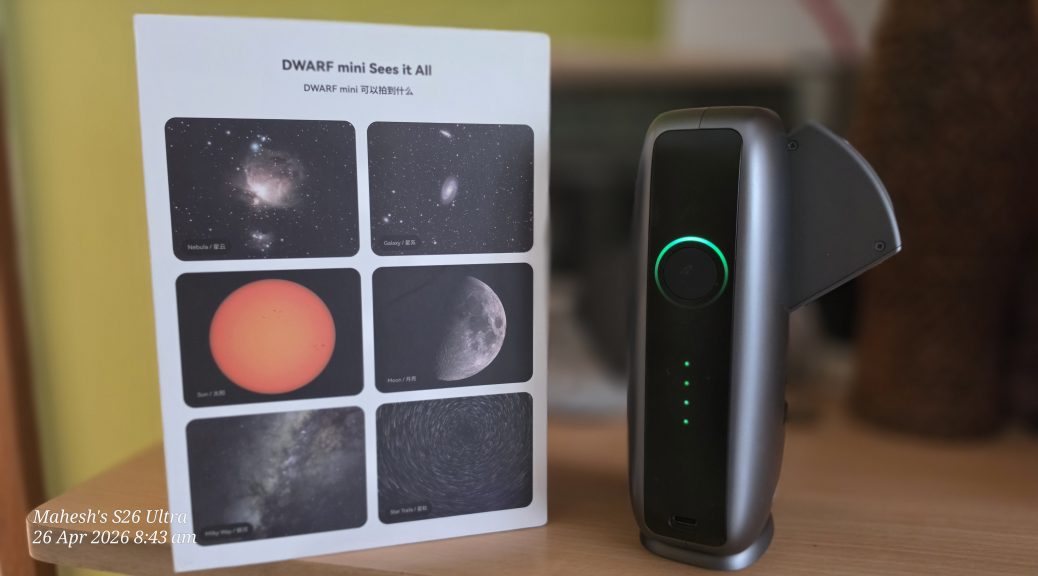
The DWARF Mini: A Loaf of Bread That Sees Stars To capture these images, I used the DWARF Mini. It’s an incredible piece of engineering—weighing only about 840 grams (roughly the same as a loaf of bread!), yet it houses a Sony IMX662 sensor and a 150mm telephoto lens. It’s a “smart” telescope, meaning it handles the complex star-tracking and autofocusing via an app, making astrophotography accessible even from a backyard in Bengaluru.
I’m still learning the nuances of this smart tech—figuring out the best stacking times and how to frame these distant wonders. But even in these first “wide” views, the connection to the universe feels more personal than ever.
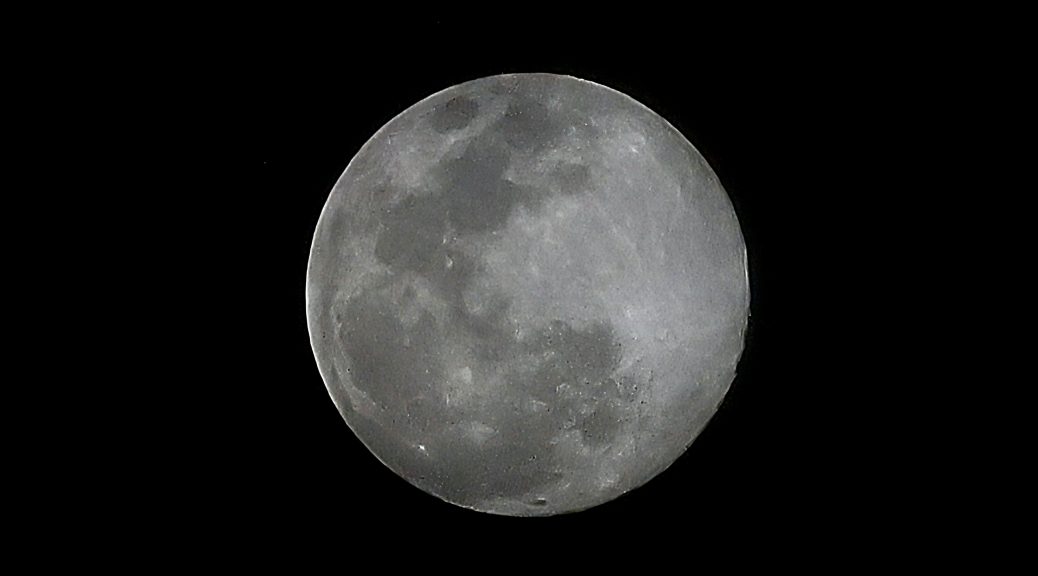
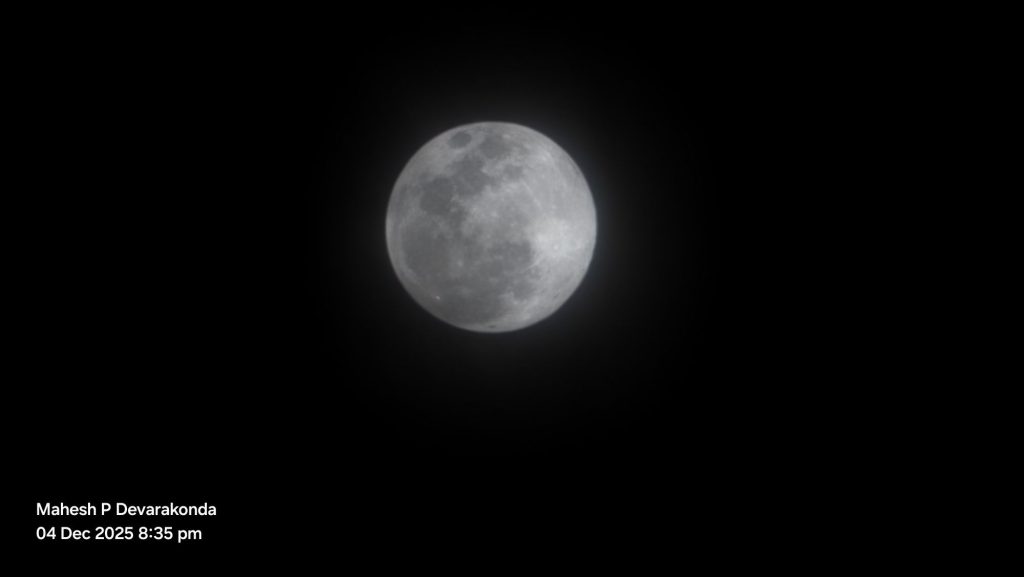
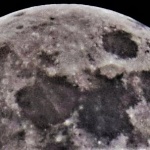
1. The Moon: A Silent Witness My first target was the Moon. Even at a 0.1s exposure, the detail is breathtaking. Looking at the craters, I’m reminded of how the Moon has been a steady companion in our history—constant yet ever-changing in its phases.
2. M41: A Celestial Gathering Next, I pointed the DWARF toward M41, an open cluster in Canis Major. To the naked eye, it’s a faint smudge; through the telescope, it’s a brilliant gathering of stars. It reminds me of the concept of Satsang—a community of light-bearers coming together to create something more luminous than they could alone.
3. M104: The Sombrero Galaxy – 30 Million Light Years Away Finally, I tracked M104, the Sombrero Galaxy. While it appears small in this wide-angle view, the thought that I am capturing light that traveled for 30 million years is humbling. In our fast-paced modern life, looking at a galaxy teaches us the ultimate lesson in patience and scale.
The Might of M104 To put that little “smudge” of light into perspective, here is what we are actually looking at:
The Weight of 800 Billion Suns: NASA estimates that M104 has a mass equivalent to 800 billion suns. It is one of the most massive objects in the Virgo galaxy cluster.
A Billion-Solar-Mass Black Hole: At its very center lies a supermassive black hole. For comparison, the black hole at the center of our Milky Way is about 4 million times the mass of our Sun; M104’s is estimated to be nearly one billion times as massive.
A “Hat” of Dust: The “brim” of the sombrero is actually a massive lane of dust and gas that is a primary site for star formation.
Ancient Neighbors: The galaxy is home to nearly 2,000 globular clusters—ten times more than our own Milky Way. Some of these star clusters are up to 13 billion years old, nearly as old as the universe itself.
A Journey Across Continents: Words of Thanks This cosmic journey wouldn’t have been possible without the incredible kindness of a few special people who helped bring the universe a little closer to me.
I want to extend my deepest gratitude to Suchitra and Sanjay Rao. They believed in this vision early on, securing the pre-order all the way back in January 2026. Your foresight and help in navigating the initial steps were the foundation of this project.
I also wish to offer my most sincere heartfelt thanks, gratitude and regards to Dr. Emmanuelle Voisin.
Despite her demanding schedule as a CEO, she very graciously and kindly agreed to carry this telescope all the way from France specifically for me🙏💐
To both of you: thank you for your generosity and for being the “stars” that helped make this possible.
Your kindness is a reminder that while telescopes help us see the light of distant suns, the brightest light often comes from the people around us.
Exploring the Moon — Observations from October 4, 2025
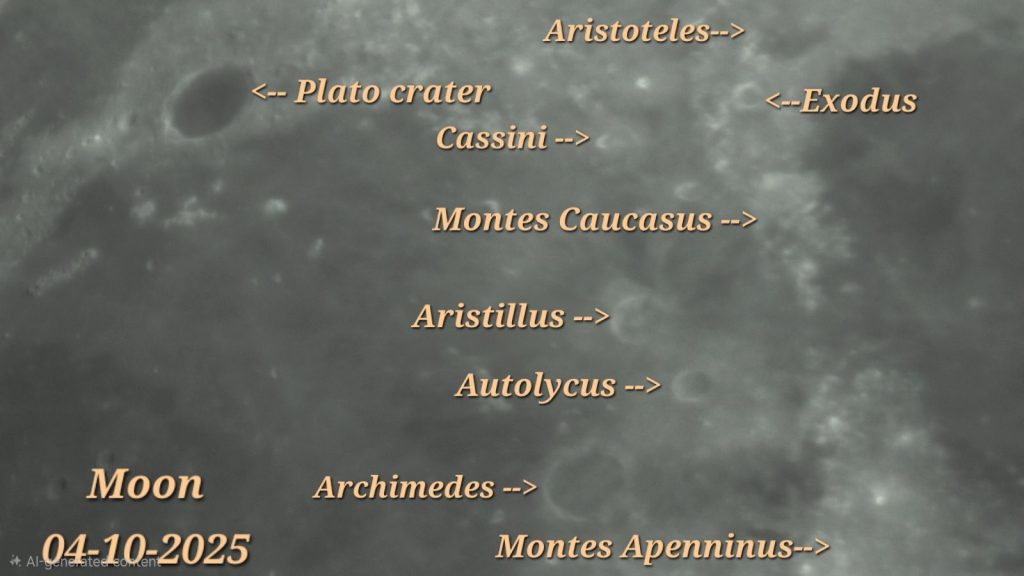
Location: Bengaluru, India Telescope: 127mm Maksutov-Cassegrain Camera: ZWO ASI 462MC Lunar Phase: Waxing Moon (~43% illuminated) Seeing Conditions: Good (7/10), thin passing clouds
A Night of Lunar Detail
The Moon was in a perfect position tonight for high-contrast views along the terminator, where sunlight rakes across crater rims and mountain slopes.
Using the 127mm MAK-CAS with the ZWO ASI 462MC camera, I was able to capture both wide-field and close-up views of several craters, mountain ranges, and maria.
Featured Craters
Composite image showing several of the observed craters.
1. Copernicus – ~93 km wide and 3.8 km deep. Bright ray systems and central peaks make it a favorite for lunar observers.
2. Tycho – ~85 km wide and 4.8 km deep. One of the youngest craters, famous for rays extending over 1,500 km.
3. Plato – ~101 km in diameter with a dark, basaltic floor near Mare Imbrium. Smooth and subtle, ideal for testing seeing stability.
4. Archimedes – 83 km wide, with a bright rim and lava-flooded interior.
5. Aristillus – 55 km across, showing sharp walls and a distinct central peak complex.
6. Cassini – 57 km in diameter, with two smaller inner craters (Cassini A and B).
7. Aristoteles – 87 km wide with 3.3 km high terraced walls, bordering Mare Frigoris.
8. Eudoxus – 67 km across, located just south of Aristoteles — together they form one of the Moon’s most picturesque crater pairs.
Mountain Ranges
The Apennine Mountains marking the Imbrium Basin’s rim.
Montes Apenninus – Stretching over 600 km, with peaks rising above 5 km, this range forms a dramatic arc along Mare Imbrium’s southeastern rim.
Montes Caucasus – Extending roughly 445 km, these rugged peaks bridge the Apenninus and Haemus ranges, outlining the Imbrium Basin’s northern boundary.
Lunar Sea
The Sea of Serenity — a vast, smooth lava plain with a soft bluish tint.
Mare Serenitatis (Sea of Serenity) – Roughly 700 km in diameter, this ancient basaltic plain shows a gentle bluish tone through color imaging — a striking contrast to the bright crater rims nearby.
Reflections Even after countless observing sessions, the Moon always feels new.
Tonight’s combination of clear air, steady seeing, and moderate illumination revealed an extraordinary sense of texture — from the razor-sharp crater rims of Copernicus and Tycho to the serene lava plains of Serenitatis.
Each feature is a frozen moment in the Moon’s history — a record of impacts, volcanic floods, and cosmic time, captured from a quiet night here on Earth.
Image Notes Most craters were captured together in a single wide-field image, while a few — including Tycho and Copernicus — have individual close-ups.
All frames were processed with gentle sharpening to retain a natural look.
The Fierce Dance of Divine Justice (Chapters 7 & 8)
Introduction: The Escalation of the Great War
Welcome back, spiritual seekers, to Day 5 of our sacred journey through Devi’s Grace: A Navaratri Journey! Yesterday, we witnessed the swift and absolute destruction of the arrogant demon Dhumralochana in Chapter 6, a powerful display of the Devi’s effortless might. Today, the divine drama escalates as we delve into Chapters 7 and 8, where the battle for the cosmos intensifies.
The demon king Shumbha, enraged by the annihilation of his general, continues to be blinded by his pride. But before the all-out war begins, the Devi makes one last effort for peace, sending a divine messenger to negotiate with the demons. When this final offer is rejected, the battlefield erupts, leading to the manifestation of powerful new forces—including the fierce Kali and the divine energies of the gods themselves. These chapters unveil the ultimate, protective ferocity of the Divine Mother, showing that justice, when needed, can be both swift and unyielding.
Chapter 7 & 8: The Slaying of Chanda-Munda and Raktabīja
Chapter 7: The Messenger and the Emergence of Kali
Enraged by the deaths of Dhumralochana and his army, Shumbha and Nishumbha, filled with a renewed rage and determination, sent forth their generals, Chanda and Munda. However, before the full battle could begin, the Devi, in an act of compassion, chose to send a final messenger to the demons. She sent Lord Shiva himself as her emissary, a symbolic gesture of the universal power of consciousness seeking to guide the demons away from a path of destruction. For this act of sending Shiva as a doota (messenger), the Devi is known by the name Shivaduti. Shumbha and Nishumbha, however, were too blinded by their pride and arrogance to heed her warning.
When the Devi saw the ferocious army of Chanda and Munda approaching, her face filled with anger. From the frown on her forehead emerged a dark, emaciated, and terrifying form of the Goddess: Kali. With a skeletal body, a sword, and a noose, and adorned with a garland of skulls, Kali charged into the battle. She quickly destroyed the entire army of Chanda and Munda, and finally, she beheaded the two demon generals and brought their heads to the Devi. Upon receiving the severed heads, the Devi gave Kali a new name: Chamunda, derived from Chanda and Munda’s names.
Chapter 8: The Matrikas and the Slaying of Raktabīja
Enraged by the loss of his most powerful generals, Shumbha finally sent the most formidable demon of all: Raktabīja. Raktabīja possessed a terrifying boon—for every drop of blood that fell from his body, a new demon, identical to him in power, would arise. The Devi and the gods’ army fought fiercely, but with every wound, more and more Raktabījas appeared, quickly overwhelming the battlefield.
To assist the Devi in this seemingly impossible battle, the divine energies of the gods themselves manifested as their female counterparts, the Matrikas. From the body of Lord Brahma emerged Brahmani, from Shiva came Maheshwari, from Skanda came Kaumari, from Vishnu came Vaishnavi, and so on. These fierce mother goddesses joined the battle, fighting with the same weapons and attributes as their male counterparts. However, even with their combined strength, the problem of Raktabīja’s multiplying blood proved insurmountable. Seeing this, the Devi commanded Kali to open her mouth and drink every drop of blood that poured from Raktabīja’s body before it could touch the ground. As the Goddess struck Raktabīja with her weapons, Kali, with her wide-open mouth, drank his blood, ensuring not a single drop could fall. Once his blood was completely drained, the final Raktabīja fell lifeless to the ground, and he was finally slain.
A Glimpse into the Original Text
These chapters are filled with vivid imagery and powerful verses. The moments when Devi calls upon Kali and the Matrikas to defeat the seemingly invincible demons are particularly significant. We see Kali’s awe-inspiring emergence from Devi’s brow, her earning of the name Chamunda after vanquishing formidable foes, and even Lord Shiva being dispatched as the Divine Mother’s messenger.
Translation: “From her (Devi Ambika’s) forehead, furrowed with a frown, swiftly emerged Kali, with a dreadful face, holding a sword and a noose.”
Commentary: This dramatic verse vividly describes the very moment of Kali’s emergence. Born from the furrowed brow of Devi Ambika, a sign of her immense anger and fierce resolve, Kali bursts forth with a terrifying appearance, armed with a sword and a noose. This imagery signifies the sudden and unstoppable manifestation of divine wrath against evil. Kali’s emergence from the forehead, often associated with the third eye and spiritual insight, suggests that this fierce power is born from a profound understanding of the cosmic order and the necessity of annihilating disruptive forces. She represents the ultimate destructive aspect of the Divine Mother, appearing precisely when other means have failed, ready to swiftly and decisively eliminate negativity.
Verse from Chapter 7:
“यस्माच्चण्डं च मुण्डं च गृहीत्वा त्वमुपागता। चामुण्डेति ततो लोके ख्याता देवी भविष्यसि॥”
Yasmāccaṇḍaṁ ca muṇḍaṁ ca gṛhītvā tvamupāgatā. Cāmuṇḍeti tato loke khyātā devī bhaviṣyasi. || 7.27 ||
Translation: “Because you have come bringing Chanda and Munda (to me), O Devi, you shall be known in this world as Chamunda.”
Commentary: This verse is one of the most significant in the entire Devi Mahatmyam, as it is the moment the fierce form of Kali earns her renowned name, Chamunda. It explains that her name is not a mere title but a direct recognition of her supreme power in destroying the demons Chanda and Munda. Chanda and Munda represent our most formidable inner demons, such as anger and fury. The act of bringing their severed heads to the Goddess and receiving the name Chamunda signifies that when we channel the divine energy within us to conquer our own inner rage and ignorance, we too can achieve a form of spiritual victory and transformation that is recognized by the world.
Verse from Chapter 8:
“यतो नियुक्तो दौत्येन तया देव्या शिवः स्वयम्। शिवदूतीति लोकेऽस्मिन् ख्यातिमागता॥”
Translation: “Because Shiva himself was sent as a messenger by that Devi, she became known in this world as Shivaduti.”
Commentary: In a unique and powerful display of divine authority, this verse reveals how the Goddess designates none other than Lord Shiva as her messenger (duta) to the demons. This act is so significant that it earns her the name Shivaduti, meaning “the one with Shiva as her messenger.” This is a powerful reversal of traditional roles, showing the Supreme Goddess as the ultimate force, commanding even the great Lord Shiva. This act can be interpreted as the feminine divine (Shakti) activating and directing the masculine principle (Shiva) for the purpose of creation, preservation, and destruction. It underscores that spiritual power and divine leadership transcend conventional expectations and hierarchies.
Devi of the Day – Day 5: Skandamata
The fifth day of Navaratri is dedicated to Devi Skandamata, the mother of Lord Skanda (Kartikeya). She represents the purest, most compassionate form of motherhood.
Symbolism: Devi Skandamata is depicted with four arms, holding her infant son Skanda in one of her right hands. Her other two hands hold a lotus, and she rides a lion. She symbolizes the protective, nourishing, and loving aspect of the Divine Mother. Her lion mount signifies her protective power, as a mother will go to any lengths to protect her child.
Connection to Chapters 7 & 8: The presence of Skandamata on Day 5 is a beautiful and poignant contrast to the ferocious battles of Chapters 7 and 8. The fierce, destructive energy of Kali and Chamunda is a mother’s fierce, protective love in action. Just as Skandamata sits peacefully holding her child while mounted on a powerful lion, the Devi’s violence in this chapter is not out of hatred but out of a fierce love and protection for her devotees (the gods) and the entire universe. She is willing to unleash the most terrible forces to protect her creation, mirroring a mother’s unconditional and protective instincts.
Modern Reflection
The battles in Chapters 7 and 8 offer profound insights into our own inner struggles. Chanda and Munda represent the raw, destructive emotions of our psyche—uncontrolled anger, fury, and passion. The Goddess manifests Kali to destroy them, showing that some of our most deeply rooted negative tendencies can only be overcome by a primal, fierce, and raw force that rises from within. It is a reminder that spiritual transformation is not always a gentle process; sometimes, it requires a ferocious inner reckoning.
Raktabīja is an even deeper symbol. He represents our self-perpetuating negative patterns and infinite desires. Just as new demons sprout from his every drop of blood, our bad habits often create new, related desires and problems. For example, stress might lead to unhealthy eating, which in turn leads to poor health and more stress. Fighting the symptoms (the new demons) is futile. The Devi’s solution—having Kali drink the blood—is the ultimate lesson. It teaches us that to solve our deeply ingrained problems, we must stop them at the source. We must deal with the root cause, the very energy that sustains them, before they can multiply and overwhelm us.
Closing Thoughts
On this fifth day of Navaratri, we are reminded that true love and protection can manifest in many forms, from the gentle embrace of a mother to the fierce power needed to destroy evil.
The battles against Chanda, Munda, and Raktabīja teach us that to achieve lasting transformation, we must not shy away from confronting our most deeply ingrained negativities.
Let us honor Devi Skandamata by reflecting on the unconditional love of the Divine Mother and finding the courage to face our inner demons with her fierce and protective grace.
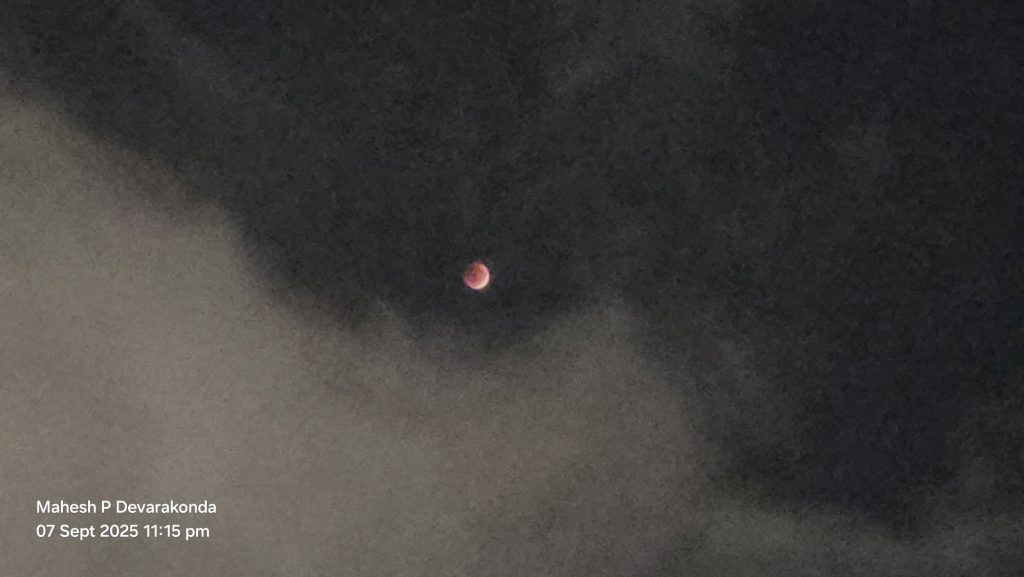
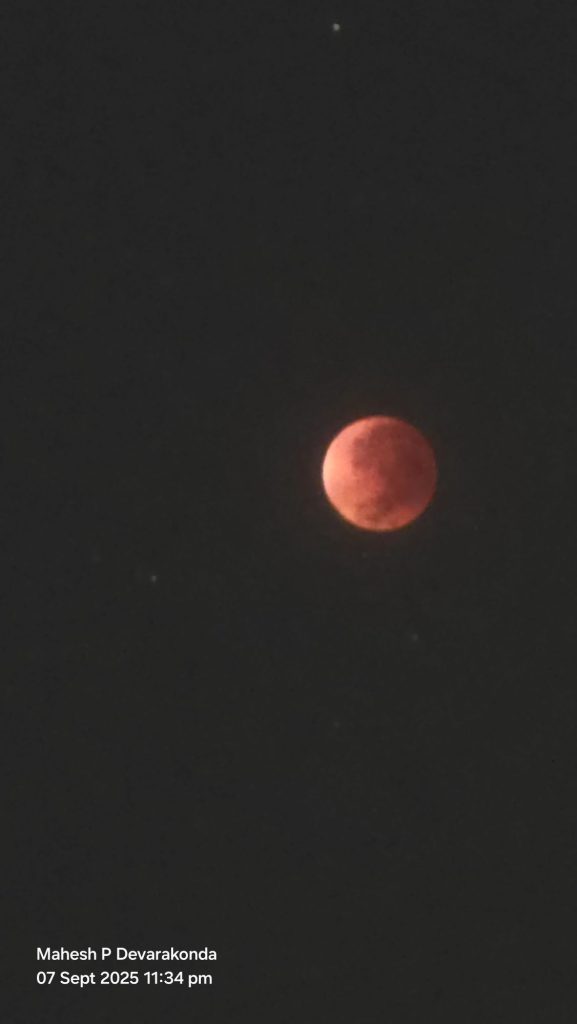
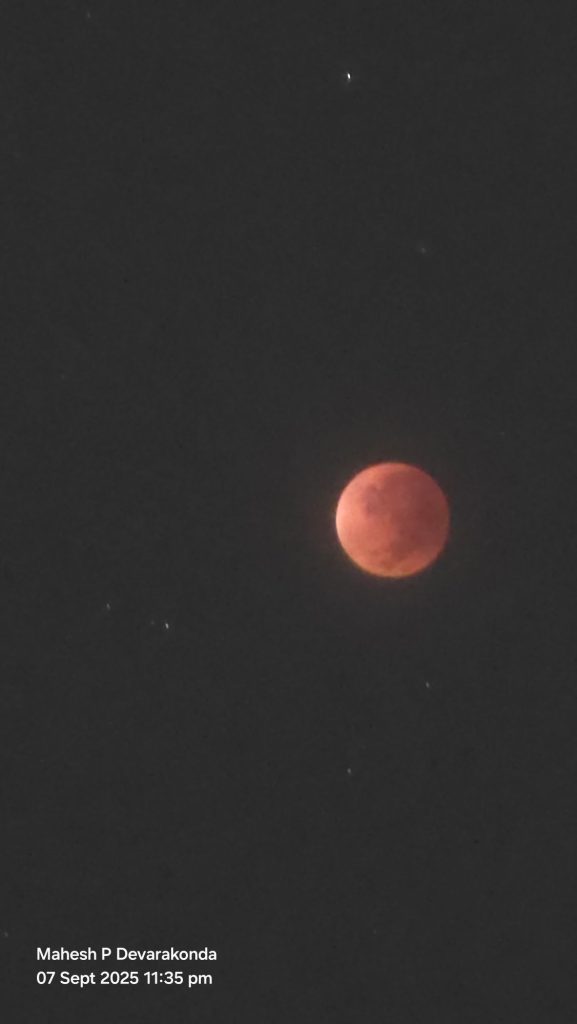
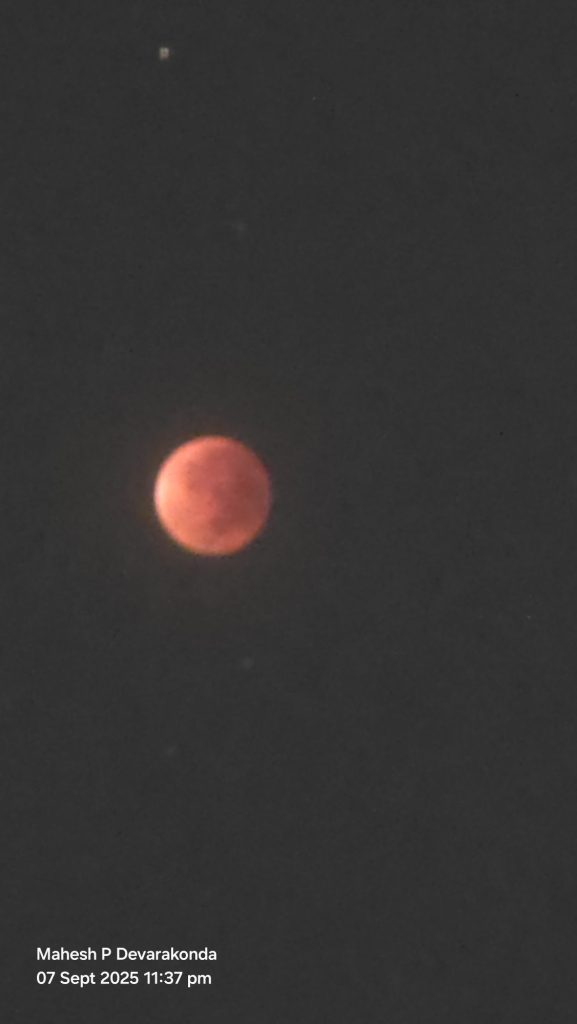
September 7th, 2025, the skies revealed a breathtaking sight: the full moon transforming into a deep, blood-red orb during the eclipse.
After a cloudy day, I was lucky to catch a few clear moments and capture this rare celestial spectacle with my mobile and mirrorless camera..
The eclipse began at 9:58 pm, and the moon reached its maximum phase at 11:41 pm, slowly shifting from bright silver to fiery red. The sky seemed to hold its breath as light gave way to shadow, leaving behind a glowing crimson reminder of the universe’s magic.
Even in these fleeting moments, the lunar eclipse left an unforgettable impression—a perfect blend of wonder, mystery, and the awe-inspiring cycles of nature.
“The moon turns red, and the world pauses”.
Below are a few photos taken a minute apart. The full moon is completely covered and is fully red in colour.
Star chart showing the red-moon and nearby star
The star Hydor can be seen clearly in the photo directly above the moon, as seen in the star chart.
After the earths shadow started receding, the white crescent started appearing..
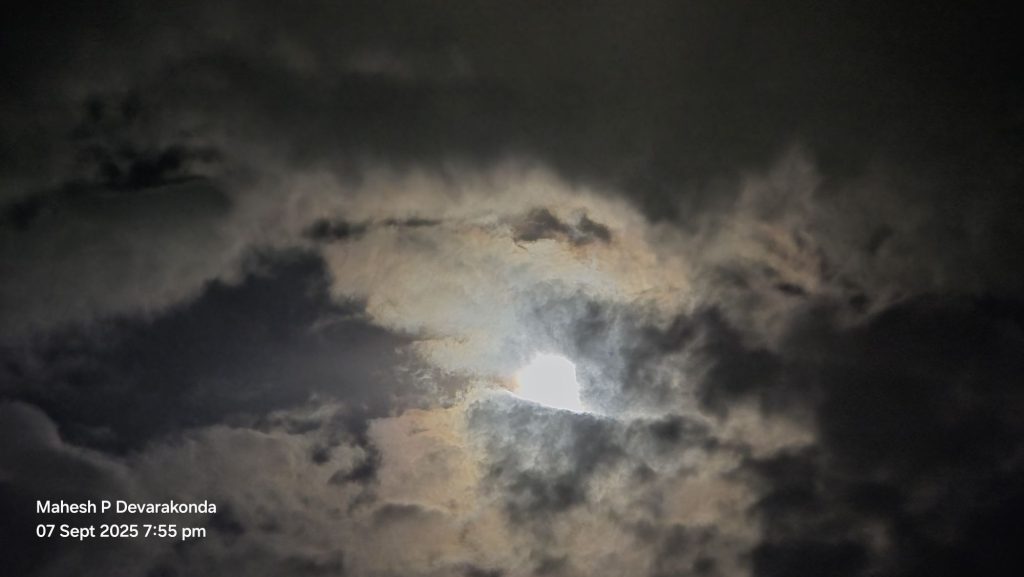
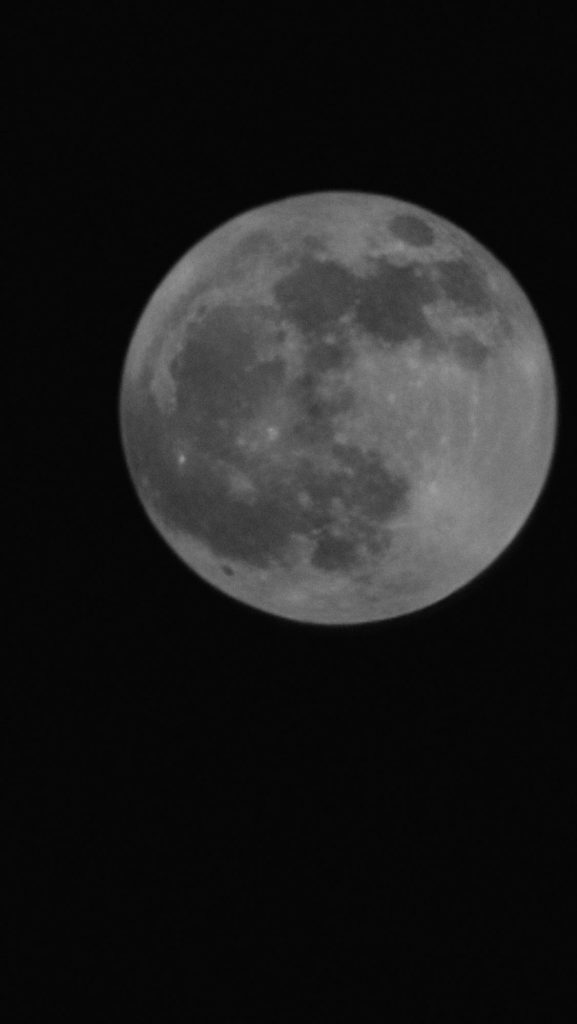
This evening, September 7th, 2025, the skies gifted us with a radiant full moon just before the eclipse.
Though the clouds kept playing hide and seek, there were a few magical moments when the sky cleared—just enough to catch a glimpse of the moon shining in all glory.
Captured around 8:08 pm, just under two hours before the eclipse begins its journey across the night sky at 9:58 pm, these moments felt special.
Even from behind the clouds, the moon’s presence was powerful and calming, a reminder of cycles, change, and light breaking through the veil.
Here are some photos captured using a mobile.
Extremely cloudy skiesImage cropped and repositioned to center in frame using Samsung AIImage enhanced to show surface details
Moonlight whispering through the clouds
A Night of Stargazing: What I Saw in the Sky on 10-06-2023
Hello, dear readers! I hope you are all doing well and enjoying the beauty of nature. Today, I want to share with you my experience of stargazing on the night of 10-06-2023, when I observed some amazing constellations and planets in the sky. The sky was partially cloudy however I was still able to see and capture some nice photos. I used my mobile phone as a camera and a star map to help me identify what I saw. Here are some of the highlights and photos of my night sky observations:
Ursa Major and Arundhati-Vasishta
The first constellation that caught my eye was Ursa Major, also known as the Big Dipper or the Plough. It is a large constellation in the northern sky that contains seven bright stars (Saptha rishi mandala) that form a distinctive shape. It is one of the oldest and most recognized constellations in many cultures, and has various myths and legends associated with it.
One of the most interesting features of Ursa Major is the pair of stars Mizar and Alcor, which are also known as Arundhati and Vasishta in traditional Indian astronomy. They are located at the bend of the Big Dipper’s handle and can be seen as a single star with the naked eye, or as two stars with a telescope or binoculars. They represent a legendary couple who were devoted to each other and exemplified marital fidelity. They are also considered as a symbol of good fortune and happiness for married couples.
I was able to see both Mizar and Alcor clearly with the photos taken (see below), and I felt a sense of awe and wonder at their beauty and significance.
Scorpio and Antares
The next constellation that I observed was Scorpio, also known as Scorpius, which is a zodiac constellation located in the southern sky, near the center of the Milky Way. It is one of the brightest and most easily visible constellations, especially in the summer months. It depicts a scorpion, a symbol of power and mystery in many ancient civilizations.
The most prominent star in Scorpio is Antares, which is also the 15th brightest star in the night sky. It is a red supergiant, one of the largest and most luminous stars known. Its name means “rival of Mars” in Greek, because of its reddish hue and similar brightness to the planet Mars. Antares is also known as the heart of the scorpion, as it marks the location of the scorpion’s chest in the constellation.
I was able to see Antares shining brightly in the sky, along with three other stars that form the head of Scorpio: Graffias, Dschubba, and Pi Scorpii. They looked like a curved line of four stars above Antares. See photo below.
Crux and the Southern Cross
The third constellation that I saw was Crux, also known as the Southern Cross. It is a small but conspicuous constellation in the southern sky that is also one of the best known constellations in the southern hemisphere. It has a high cultural significance in many countries, such as Australia and New Zealand, where it appears on their flags and coats of arms. It consists of four bright stars that form a cross-shaped pattern, with a fifth star near the junction of the cross.
I was able to see all four stars of Crux clearly with my mobile phone camera as shown below: Acrux, Mimosa, Gacrux, and Delta Crucis. They looked like a diamond-shaped cross in the sky. The fifth star, Epsilon Crucis, was fainter but still visible.
Venus and Mars
The last two objects that I observed were not stars but planets: Venus and Mars. They are two of the five planets that can be seen with the naked eye from Earth. They are both terrestrial planets, meaning they have a rocky surface, unlike the gas giants Jupiter and Saturn.
Venus is the second planet from the Sun and the brightest object in the night sky after the Moon. It is often called Earth’s twin because of its similar size and mass, but it has a very different environment, with a thick atmosphere, high temperatures, and no signs of life. Currently, Venus appears as a bright white star in the western sky after sunset.
Mars is the fourth planet from the Sun and the second smallest planet in the solar system. It is often called the red planet because of its reddish color, caused by iron oxide on its surface. It has a thin atmosphere, polar ice caps, volcanoes, canyons, and evidence of past water activity.
I was able to see both Venus and Mars in the sky on the night of 10-06-2023. Venus was brighter and closer to the horizon, while Mars was dimmer and higher in the sky. Venus looked like a jewel shining in the dark.
Conclusion
I hope you enjoyed reading about my night sky observations on 10-06-2023. It was a wonderful experience for me to see the beauty and diversity of the stars and planets. I learned a lot about the constellations and their stories, and I felt a connection with the ancient cultures that also admired the sky.
Thank you for reading my blog post and stay tuned for more updates! 😊