Devi’s Grace – Day1
Introduction: Unveiling the Divine Mother During Navaratri
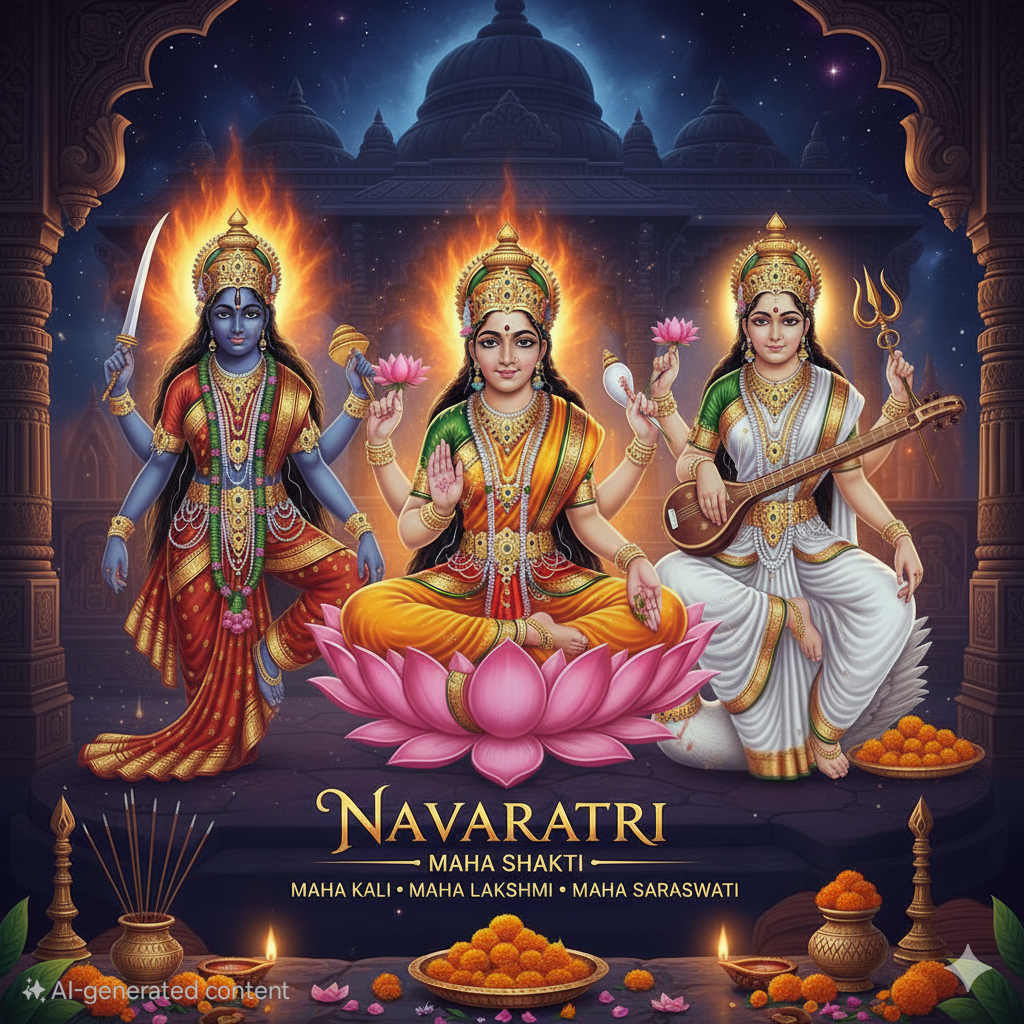
Welcome, seekers, to a sacred journey that takes us to the very heart of cosmic power and spiritual awakening! As the vibrant festival of Navaratri dawns, the air hums with the energy of the Divine Feminine. For nine auspicious nights and ten days, we honor Devi, the Universal Mother, in her myriad forms – a celebration that reminds us of the strength, wisdom, and compassion that resides within and all around us.
Central to this celebration is a profound scripture known as the Devi Mahatmyam, often referred to as Durga Saptashati or Chandi Path. This ancient text, composed of 700 verses, is not merely a collection of stories; it is a powerful spiritual manual that unveils the glory of the Goddess and her cosmic play in creating, preserving, and transforming the universe. It describes her fierce battles against the forces of negativity and ignorance, symbolizing our own inner struggles and the ultimate triumph of light over darkness.
Over the next nine days, we will embark on a chapter-by-chapter exploration of this magnificent text, delving into its timeless wisdom and discovering how its ancient narratives resonate with our modern lives. Each chapter presents a unique facet of the Divine Mother’s power, offering insights into overcoming challenges, understanding the nature of reality, and awakening our inherent divine potential.
Today, we begin with Chapter 1: The Slaying of Madhu and Kaitabha, a foundational narrative that introduces us to the cosmic illusion (Maya) and the primordial manifestation of the Goddess. Join us as we uncover the profound lessons hidden within these sacred verses, paving the way for a deeper connection with the Divine Mother during this Navaratri.
Setting Our Intention with Mantras
As we begin our journey into the sacred text of the Devi Mahatyam, we can set a powerful intention with three core mantras.
The first is a reverence to the supreme Goddess herself:
Om Namash Chandikayai (ॐ नमश्चण्डिकायै).
This mantra is a powerful salutation to Chandi, the fierce and powerful form of the Divine Mother, who fearlessly destroys all negativity and ignorance. Reciting this mantra helps us invoke her strength as we delve into her stories.
The second mantra honors the three great forms of the Goddess who are the central figures of this scripture:
The Sanskrit verse for this profound mantra is:
श्रीमहाकालीश्रीमहालक्ष्मीश्रीमहासरस्वत्यै एकैकरूपा श्री दुर्गायै नमः.
Translation:
Sri Mahakali Sri Mahalakshmi Sri Mahasaraswatyai Ekaikya Rupa Sri Durgayai Namah.
This mantra beautifully states that Mahakali, Mahalakshmi, and Mahasaraswati are the one single form of Sri Durga. These forms represent the three main parts of the Devi Mahatyam and the fundamental cosmic forces of destruction, preservation, and creation.
A third powerful mantra that can be chanted 108 times to deepen one’s practice is the Navarna Mantra, or the nine-syllable mantra:
Sanskrit:
ॐ ऐं ह्रीं क्लीं चामुण्डायै विच्चे
Translation:
Om Aim Hreem Kleem Chamundayai Vicche.
This powerful mantra is believed to contain the very essence of the three main forms of the Goddess. Each syllable represents a specific Devi: Aim (ऐं) for Mahasaraswati, Hreem (ह्रीं) for Mahalakshmi, and Kleem (क्लीं) for Mahakali. The final phrase, “Chamundayai Vicche,” is a salutation to the fierce Goddess Chamunda, and chanting it is considered highly beneficial for protection from negativity, granting courage, and helping to fulfill aspirations.
Chapter 1: The Slaying of Madhu and Kaitabha

This chapter introduces the core narrative structure of the Devi Mahatmyam: the sage Markandeya narrating the glorious deeds of the Goddess to the sage Jaimini. The story begins with a king named Suratha, who has lost his kingdom, and a merchant named Samadhi, who has been disowned by his family. Both meet in a hermitage and express their bewilderment and sorrow to the wise sage Medhas. The sage then begins to explain the cosmic power of the Great Goddess, Mahamaya, who is responsible for the illusion (maya) that binds all beings.
He narrates the first great act of the Goddess: her manifestation to save the world from the demons Madhu and Kaitabha. When the universe was a primordial ocean, Lord Vishnu was asleep on the cosmic serpent, Ananta. From his earwax, two demons, Madhu and Kaitabha, were born. They planned to kill Brahma, the creator, who sat on a lotus that sprouted from Vishnu’s navel. Brahma, in a state of distress, praised the Goddess of Cosmic Sleep (Yoga Nidra), who was residing within Lord Vishnu. Pleased by his prayers, the Goddess emerged from Vishnu’s body, waking him. A fierce battle ensued between Vishnu and the demons, lasting for five thousand years. With the help of the Goddess, who confused the demons, Vishnu finally killed them. The chapter concludes with the sage Medhas explaining to Suratha and Samadhi that it is this same Goddess, Mahamaya, who is responsible for their attachment and bewilderment.
Modern Reflection
The story of King Suratha and the merchant Samadhi serves as a timeless metaphor for the human condition. Both men, despite their worldly losses, are still attached to the very things that caused their suffering. This is the essence of Maya, the divine illusion that the Goddess Mahamaya represents.
In modern life, we often find ourselves in similar situations. We may lose a job, a relationship, or a sense of purpose, yet we remain fixated on the past, unable to let go of the very attachments that caused our pain. This chapter teaches us that true liberation begins with recognizing the source of our bondage. Like the two men, we must seek wisdom to understand that the external world is a fleeting illusion. The inner struggle against our own attachments—the “demons” of ego, desire, and ignorance—is the true battle. When we turn inwards and invoke the divine grace, we can awaken our own inner “Vishnu” and overcome these inner demons.
This chapter is a call to action: to move beyond bewilderment and confusion by seeking wisdom and acknowledging the divine force that governs all of creation.
A Glimpse into the Original Text
To truly grasp the essence of the Devi Mahatmyam, it is powerful to look at the original Sanskrit. The text itself reveals the profound truth of the Goddess’s power, as seen in this sequence of verses where Brahma’s praise of the Goddess begins.
ब्रह्मोवाच ॥ ७२ ॥ (Brahmovāca || 72 ||)
Translation: Brahma said:
त्वं स्वाहा त्वं स्वधा त्वं हि वषट्कारः स्वरात्मिका।
सुधा त्वमक्षरे नित्ये त्रिधा मात्रात्मिका स्थिता॥ ७३ ॥
Tvaṁ svāhā tvaṁ svadhā tvaṁ hi vaṣaṭkāraḥ svarātmikā.
Sudhā tvam akṣare nitye tridhā mātrātmikā sthitā. || 73 ||
Translation: “You are Svaha, you are Svadha, you are the cry of Vashat, you are of the nature of the sacred sound Om. You are nectar, O imperishable one. You are eternally established in the three-and-a-half measures of the sacred Om.”
अर्धमात्रा स्थिता नित्या यानुच्चार्या विशेषतः।
त्वमेव सन्ध्या सावित्री त्वं देवि जननी परा॥ ७४ ॥
Ardhamātrā sthitā nityā yān uccāryā viśeṣataḥ.
Tvam eva sandhyā sāvitrī tvaṁ devi jananī parā. || 74 ||
Translation: “You are the half-syllable, which is ever present and which is specially beyond utterance. You alone are the Sandhya, Gayatri, and Savitri; you are the supreme divine mother.”
Commentary: This series of verses is a beautiful and concise hymn to the Goddess, identifying her with the fundamental aspects of Vedic rituals, the cosmic sound of creation (Om), and the very forces of nature and existence. Brahma’s praise establishes the Goddess as the ultimate reality, the one power that is the source of all nourishment and all knowledge (Svaha, Svadha, Sandhya, Gayatri). By identifying her as the very foundation of the universe and the cause of both worldly pleasure (bhukti) and ultimate freedom (mukti), the hymn elevates her from a mere deity to the supreme, all-encompassing force that governs all of creation and spiritual endeavor.
Devi of the Day – Day 1: Shailaputri (The Daughter of the Mountains)

As we commence our Navaratri journey, the first day is dedicated to Devi Shailaputri, literally meaning the “Daughter of the Mountains.”
Her story is one of unwavering resolve and primordial energy. She is the first manifestation of Goddess Durga, born as the daughter of Himavat, the King of the Himalayas, after her previous incarnation as Sati immolated herself.
Symbolism: Shailaputri represents the root of all existence and the beginning of spiritual ascent. Sitting gracefully upon a bull, holding a trident in one hand and a lotus in the other, she embodies stability, strength, and purity. The mountains symbolize steadfastness and the unshakeable foundation of spiritual practice. Her presence reminds us to be firm in our convictions and to cultivate an unyielding faith in our spiritual path. The Navratri color for the first day, Pratipada, is also white, which symbolizes purity and peace. This aligns with her form as the daughter of the Himalayas and the pure beginning of the Navratri festival.
Connection to Chapter 1: Just as Chapter 1 introduces the fundamental concept of Maya and the primordial power of the Goddess emerging from Vishnu’s sleep, Shailaputri signifies the very beginning—the foundational energy that initiates the entire cycle of creation and spiritual endeavor. She is the grounding force, guiding us to establish a strong spiritual base before embarking on the deeper esoteric journeys that Navaratri and the Devi Mahatmyam unfold.
Meditation for the Day: As you reflect on Chapter 1 and honor Shailaputri today, focus on grounding yourself. Find your inner strength, much like the immovable mountains. Reflect on your spiritual intentions for Navaratri and resolve to remain steadfast in your pursuit of wisdom and inner peace.
Closing Thoughts
As we conclude our first day’s exploration of the Devi Mahatmyam, we are left with a powerful message: the world we perceive, with all its attachments and illusions, is governed by a divine, cosmic force. The story of King Suratha and the merchant Samadhi is our story—a reminder that despite our worldly losses or gains, the real journey is an inner one. By recognizing the divine power of the Goddess and her role in both creation and confusion, we can begin to untangle ourselves from the very things that bind us.
This Navaratri, let us honor Devi Shailaputri by grounding ourselves in unwavering faith and resolve. May our spiritual practice be as steadfast as the mountains, and may we be blessed with the wisdom to see beyond the veil of illusion.
Join us tomorrow as we continue our journey into the Devi Mahatmyam and celebrate the next magnificent form of the Divine Mother.
References
Here are some verified online sources for further reading on the Devi Mahatmyam and Navaratri:
- Devi Mahatmyam Text and Commentary:
- Navaratri and Shailaputri:
Samastah Lokah Sukhino Bhavanthu
May All Beings in All Worlds be Happy!

Jai Sai Ram!
Please note all content and images generated using AI Tools