Cosmic Temple

In the cosmic temple, a divine river flows,
Where earth and fire meet, and sacred lotus grows.
Guided by the breath of air, the universe expands,
A silent OM in the ether, held in a divine hand.
Seeing the Divine in Creation
In the sacred worldview of Bharatiya culture, the universe is not a random assembly of matter—it is a living temple, pulsating with the presence of the Divine. Every mountain is a murti, every river a goddess, every breeze a whisper of God. This vision invites us to move from observation to reverence, from consumption to communion.
At the heart of this temple are the five great elements—earth, water, fire, air, and ether—each a manifestation of the Supreme. To worship them is not to worship nature, but to honor God moving through nature.

Bhagawan’s Teaching: Angavathi Worship
Bhagawan Sri Sathya Sai Baba often spoke of the Angavathi form of worship, where the five elements are revered as aspects of Divinity. In one discourse, He explained:
“Angavathi refers to the worship of the five elements—earth, water, fire, air, and ether—considering them as manifestations of the Divine. The earth bears the burden of mighty mountains, vast oceans, dense forests, villages, towns, and cities. Likewise, the remaining four elements are also responsible for the sustenance of creation.” —Discourse link
He further elaborated in another talk:
“All the five elements are aspects of God, His Divinity, and His supreme power. It is for this reason that our ancients worshipped the five elements, revering them as aspects of God Almighty. They worshipped the earth as Mother Goddess, the rivers as various goddesses, and the elements as various deities.” —Discourse link
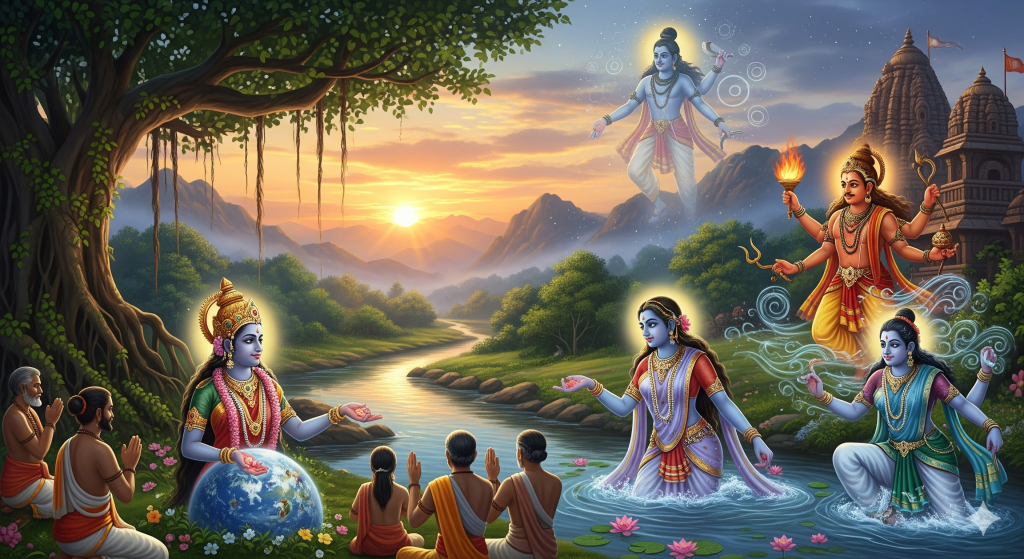
This reverence is not limited to the external world. Bhagawan reminds us that our own body is composed of these five elements, and that honoring them externally is a way of aligning with their presence within.
The Temple Within: Our Body and the Five Elements

In His discourse “The Sanctity of the Five Elements”, Bhagawan offers a profound teaching that bridges the cosmic and the personal:
“The five elements of which the entire cosmos is built up, are present also in the human being… The human body too is one particular combination of the five elements.”
This transforms Angavathi worship from an external ritual into an intimate act of self-reverence. To honor the elements is to honor the sacred architecture of our own being. The body becomes a temple—not metaphorically, but literally—constructed from divine substance.
Bhagawan further explains that each element is not just a physical force but a limb of the Divine:
“Since the earth is suffused with divine power, it is nothing but an anga or limb of God… All five elements and indeed the whole of Creation is sacred. You are a part of Creation, which is a limb of God.”
This is the heart of Angavathi: to see the five elements as God’s body, and ourselves as part of that cosmic embodiment.
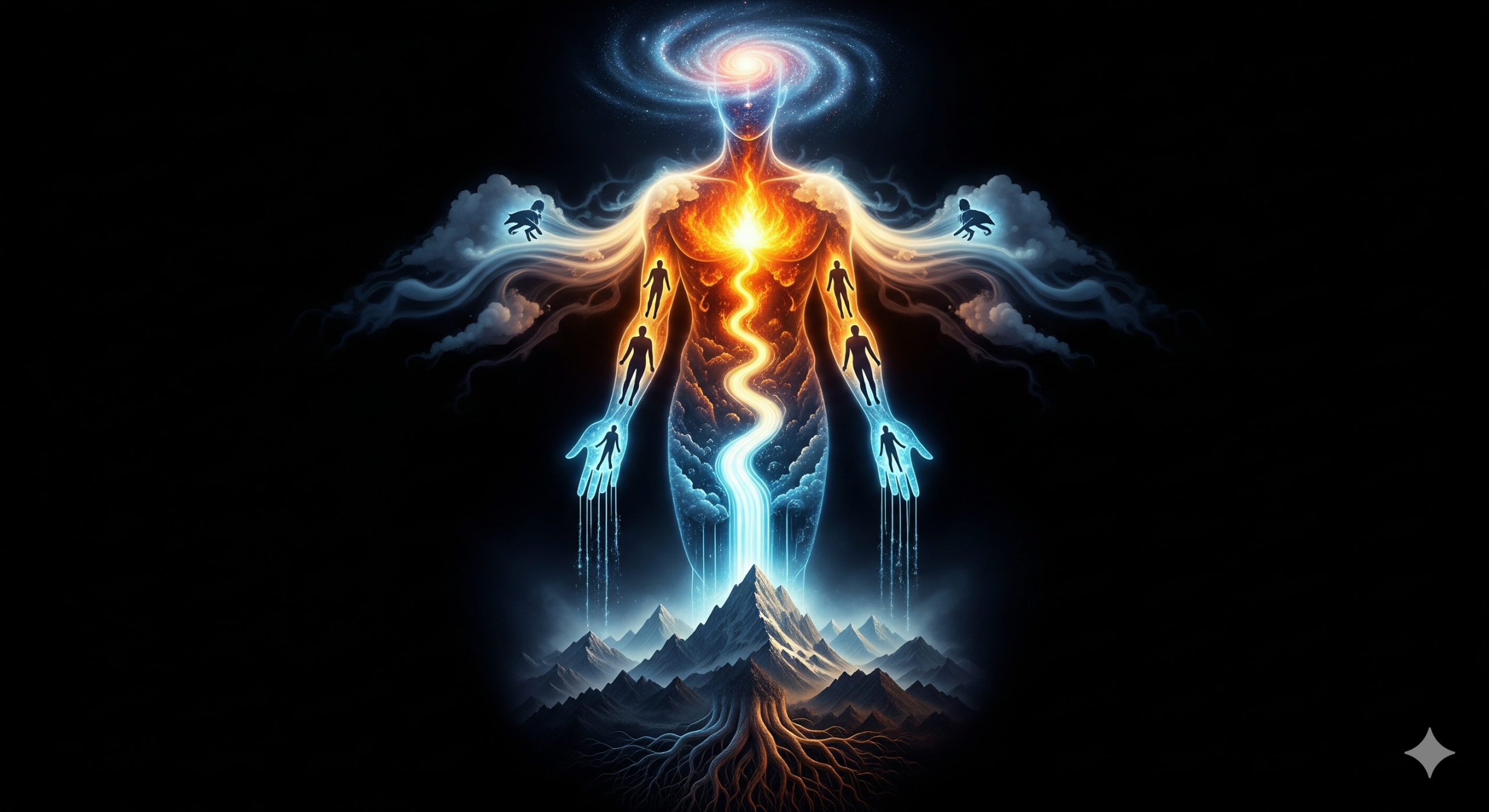
He also offers a subtle Vedantic insight into the attributes and hierarchy of the elements, showing how each one becomes subtler and more pervasive:
- Earth possesses all five attributes: sound, touch, form, taste, and smell
- Water lacks smell
- Fire lacks taste and smell
- Air retains only sound and touch
- Ether (Akasha) carries only sound
“As the attributes diminish one by one, the subtlety of the entity concerned and its vastness increase.”
This mirrors the Upanishadic sequence of creation, where the Divine unfolds from the formless to the formed. Ether is the subtlest and most expansive, while earth is the densest and most tangible. Yet all are sacred, all are limbs of the One.
Upanishadic Foundations: The Elements as Divine Emanations
The Upanishads affirm this sacred vision. The five elements are not inert—they are emanations of Brahman, the Supreme Reality.
Taittirīya Upaniṣad – Brahmānanda Valli – 1.1

Sanskrit: तस्माद्वा एतस्मादात्मन आकाशः सम्भूतः । आकाशाद्वायुः । वायोरग्निः । अग्नेरापः । अद्भ्यः पृथिवी ।
Transliteration: tasmād vā etasmād ātmana ākāśaḥ sambhūtaḥ | ākāśād vāyuḥ | vāyor agniḥ | agner āpaḥ | adbhyaḥ pṛthivī |
Translation: From that Self (Ātman) arose space; from space, air; from air, fire; from fire, water; and from water, earth.
Insight: Creation flows from subtle to gross, from the formless to form. Ether is the womb of vibration; earth is the cradle of manifestation.
Muṇḍaka Upaniṣad – 2.1.3

Sanskrit: एतस्माज्जायते प्राणो मनः सर्वेन्द्रियाणि च । खं वायुर्ज्योतिरापः पृथिवी विश्वस्य धारिणी ॥
Transliteration: etasmājjāyate prāṇo manaḥ sarvendriyāṇi ca | khaṃ vāyurjyotirāpaḥ pṛthivī viśvasya dhāriṇī ||
Translation: From Him are born prāṇa, mind, all the sense-organs, space, air, fire, water, and earth, which supports all.
Insight: The five elements are direct emanations of Brahman, forming the very fabric of creation and sustaining all life.
Living the Worship: From Cosmos to Body
Angavathi is not just ritual—it is relationship. Here’s how each element can be honored in daily life:
| Element | Deity | Practice | Symbolic Insight |
|---|---|---|---|
| Earth (Prithvi) | Bhudevi | Walking barefoot, gardening | Groundedness, support |
| Water (Apas) | Gangadevi | Offering water, mindful drinking | Purity, flow |
| Fire (Agni) | Agnideva | Lighting lamps, inner tapas | Illumination, transformation |
| Air (Vayu) | Vayudeva | Pranayama, chanting SOHAM | Movement, vitality |
| Ether (Akasha) | — | Silence, Omkara meditation | Space, subtlety |
To worship the elements is to honor the Divine within and without. Our body is made of earth, our blood of water, our digestion of fire, our breath of air, and our mind dances in ether.
Practical Application- Angavathi for a Greener India(Bharat)

We’re growing up in a time where our beautiful Bharat is facing some big challenges – from smog in our cities to plastics in our rivers, and the changing climate affecting our farmers. It’s easy to feel overwhelmed, or think these are just “government problems.” But what if our ancient wisdom, the kind our grandparents talked about, actually gives us the most powerful solutions?
The idea of Angavathi worship isn’t just about ancient rituals; it’s a call to action for us, right now. Imagine if we saw our surroundings – the very elements of India – as sacred, as parts of the Divine.
- When we see the Yamuna or Ganga (or any river, even the smaller ones in our own towns) not just as water, but as Gangadevi herself, would we let plastic choke her flow? When we choose reusable bottles instead of single-use plastic, that’s a small act of worship, a way of saying, “I respect you, Divine Water.”
- When we walk through a park or a forest, are we just seeing trees, or are we experiencing Bhudevi, Mother Earth, sustaining us? Every time we choose public transport or cycle instead of taking a car, we’re reducing the burden on the air (Vayudeva), keeping it cleaner for everyone in Bengaluru and beyond.
- Even the energy we use! From the flicker of a traditional lamp (Agnideva) to the electricity powering our phones – think about its source. Supporting solar energy or being mindful about switching off lights are modern ways to honor the divine fire, using its power wisely and respectfully.
- And us! We are made of these elements. When we choose to live consciously, separating our waste, conserving water at home, or joining a local cleanup drive in our neighborhood or near a lake, we aren’t just doing “good deeds.” We are performing Angavathi worship, honoring the very fabric of creation that sustains our lives and our incredible country.
This isn’t about rote spirituality; it’s about making our faith active. It’s about taking pride in our heritage and applying its deepest truths to build a better, cleaner, more respectful Bharat for ourselves and for future generations. Let’s not just observe; let’s participate in preserving the divine temple that is our home.
Closing Thoughts: Worship as Alignment

Angavathi worship is not a ritual—it is alignment. It is the recognition that the same elements that form the mountains and rivers also form our bones and breath. To bow to Bhudevi is to bow to the earth within. To light a lamp is to awaken the fire of awareness.
In this temple called cosmos, every gust of wind, every drop of water, every flicker of flame is a darshan. And every act of reverence is a step toward Atma-sākṣātkāra—Self-realization.
Citations
- Taittirīya Upaniṣad – Brahmānanda Valli – 1.1 Vedic Heritage Portal
- Muṇḍaka Upaniṣad – 2.1.3 VivekaVani Archive
- Bhagawan Sri Sathya Sai Baba Discourses:
Samastah Lokah Sukhino Bhavanthu
May all the beings of all the worlds be happy

Jai Sai Ram!
Please note all images and content created using AI Tools